Grades, Degrees and Principles

It surely is in some respect a no-go-area for reflection, relating the brutal banality of evil of a man facing

15 criminal charges, including war crimes, crimes against humanity, and crimes against the Jewish people.

… – and still it is a field of reflection that has to be entered, not aiming on mocking anybody or anything as it is suggested as part of the debate on “little Eichmanns”, supposedly denying the sincerity and the difference of war crimes, as argued by Henri Clemens (Clemens Heni, November 2, 2008: Secondary Anti-Semitism: From Hard-Core to Soft-Core Denial of the Shoah). Such position may easily be seen as denial of the banality of evil, waiting until it is too late  ….  

We have to remember Martin Niemoeller’s words:

  • First they came for the Jews
    and I did not speak out
    because I was not a Jew.
    Then they came for the Communists
    and I did not speak out
    because I was not a Communist.
    Then they came for the trade unionists
    and I did not speak out
    because I was not a trade unionist.
    Then they came for me
    and there was no one left
    to speak out for me.

****

It is the time of the year again, students worrying about their future, teachers eager to support them finding their way …, and going it. It is about writing academic references that are nowadays increasingly administratively defined ….. It is the time of the year again …  institutions – schools of different kind, employers, training centre, parties and NGOs …. well, and if needed hospitals for the burned-out, welfare offices for the drop-outs, prisons for the forced-outs and whoever else comes to mind being waiting …, opening their doors to help everybody finding a place in this democracy of which

it has been said that democracy is the worst form of Government except all those other forms that have been tried from time to time

T&C apply – and when it comes to terms & conditions, one of the decisive questions, easily forgotten, is: Who is, who is the actual actor? Or is it a What-Actor?

It had been frequently mentioned on these pages that in the academic world – as in so many other worlds – it is administrative systems, paralysing people who then paralyse people … – does the law of six degrees of separation also apply here? Will the fifth who has to be paralysed, end in a coma; the sixth immediately going down into the grave, even if physically still alive?

Preparing a presentation I gave some time ago in Ostrava, Neil Postman’s book on Amusing ourselves to Death came to my mind, shifting the at the time frequent attention from Orwell toward Huxley, his excelling grasp of the tantalising effect of totalising amusement, entertainment …

Part of this is the increasing fragmentation – each little act needing a rule, every two rules in need of another rule by which the two are linked, brought together, of course being in need of another rule that keeps them together …., an exponentially growing rule-you-machine, rolling out a net in which also responsibility gets lost, simply not felt …, but not felt because the brain is forced into the Procrustean bed of a surveillance state, lurking around every corner:

Torturing a prisoner on the rack, Middle Ages. A 19th-century representation of a medieval torture device in use, from World of Wonders, published by Cassell and Co, (London, 1894). (Photo by Ann Ronan Pictures/Print Collector/Getty Images)

(https:// cotyreh.com/2018/02/28/tyranny-reason-academias-procrustean-bed/)

  • Every wee commodity not only claiming to be an entire world but loudly demanding – Thou shalt have no other commodities before me.
  • Every little rule not only claiming to be an entire world but loudly stating – Thou shalt have no other rules before me.
  • Every little act not only claiming to be an entire world but loudly enforcing – Thou shalt think about no other act before me.  …

… NO EXCUSE – NO EXCUSE – NO EXCUSE – NO EXCUSE …

The consequences you have to bear, equally singular as every single commodity, rule and act. No, the consequences ARE NOT singular, they are paralysing, comatising, engraving as bringing-into-the-grave …

This points on the underlying problem – the methodological segmentation of actor, referential space, action seen as relevant and time:

If the public is only me – not in terms of individualisation but in terms of relevance: an earthquake, fire as also the beauty of a sunrise, and the relevance of my action are equally only me, my maintenance and security, safety, comfort …., enjoyment, career, arousal or anything relevant as matter of satisfaction when facing the need of emergency management, protecting against drowning in the tsunami of threats from nature, including emotions.

Hannah Arendt wrote about the banality of evil, following and analysing the process against Eichmann in Jerusalem. The massmurderer claimed that he did only what he had been asked, told to do … – rule is rule, act is act, outcome is outcome …. Eichmann’s argument: I had not been responsible, I knew, though only followed the rule … others …

Supposedly he accepted in hindsight 

I am guilty – that is the larger rule for those who accept responsibility beyond the tiny, singular rule 

another Big Bang, ending in another singularity.

It is worth to make a little side remark, looking at the work of Georg Jellinek, who studied form 1867 onwards jurisprudence, arts history, philosophy and history. He emphasised in his work not least that law – and one can thus say also administrative norms are only part of a wider setting. They cannot explain their acceptance and implementation which are a matter of society and people living in it. Or in the present context we may say: law and order is nothing that emerges simply from legally valid acts and individuals executing them orderly, i.e. within the order – the conflict Gustav Radbruch had been investigating in 1946, suggesting that in law it has to be considered that there are possible conflicts between the positive law and the requirement of material justice. Though Radbruch came to the conclusion of the superiority of positive law, he always faced the problematique of falling short where that law would stand in extreme conflict with being unbearable. It should be read as where the consequence in reality means they are not able to give an answer to the needs of reality. And as such they are not sufficient to deal with the contradictions of reality … – realities of bureaucratic and other machines:

On the other hand, when a person is called an “automaton” or a “robot” it is usually a derogatory comment denoting someone who is stiff and awkward in speech or movement; one who lacks imagination, emotion, spontaneity or a sense of humor; a fanatical follower of rules and regulations; a social or political conformist who is easily manipulated due to an inability to think critically and independently. In a recent issue of Perspectives, the news magazine of the American Historical Association, a history teacher objected to a Florida state education bill that asserted the view that Amer- ican history is “factual, not constructed,” by declaring that making students memorize information without teaching them analytic skills was tantamount to turning them into “little robots.”

(Kang, Minsoo, 2011: Sublime Dreams of Living Machines. The Automaton in the European Imagination; Cambridge, Massachusetts, and London, England: harvard university press 4)

****

It is the time of the year again, students worrying about their future, teachers eager to support them finding their way …, and going it. It is about writing academic references that are nowadays increasingly administratively defined ….

…. paradoxically so many complaining, criticising …., and clicking the link, ticking the box ….. it is the rule – a rule I cannot change …., and isn’t clicking, ticking …. an act of banality …. a wee act, not doing any harm, and if it does do any harm it is actually done by others … Providing the garrote is not using it, is not even telling others to do so …., we may even warn them while handing it over to the tyrant:

Not cruelty is the attribute of tyranny, but the destruction of the public political realm, monopolised by the despot by claiming ‘wisdom’ … or based on thirst for power, i.e. insisting on citizens looking after their private concerns, leaving it to him, the ‘ruler, to take of the public matters’.

(Arendt, Hannah, 1958: Vita Activa oder Vom Tätigen Leben; München/Zuerich: Piper, 1981, new edition: 215; translated from the German edition; with reference to Aristotle: Athenische Verfassung; XV, 5)

****

on administrative issues, simple money issues …  Well the many other things: professional ones or …, well, what is called “private/personal” – and being in the middle of it .., and trying to resist: cosy links, giving in when certain requirements are put forward …, and permanently asking if there is a definitive frontier line where TREASON begins, if and where. Knowing well, that there had been and still is very interesting stuff going on. But the latter makes it somewhat more difficult. Recently I had been reading some “old stuff”, 60s, more 70s and even 80s. So many wise things said – then it had been dealing with other “items” as Postman’s look at TV which could be written today, with wee alterations, now on computers and the WWW.

Who listened and listens?

There are so many things going on about critique of using SSCI- or SCOPUS as standard …, and when it comes to the point … , bubbles not only in the economy. Or, of course I have to say this: it is part of the economy: the material basis, the way in which people price and reproduce their daily life, and that is a matter of the economy …

Of course, it my sound like being over the top, but how often do we have to ask questions that are at least in structural terms, in principle, like those we see dealt with in the theatre play Terror, in legal cases as the one Fuller had been writing about under the title Case of the Speluncean Explorers … where is the tipping point that marks the step into the middle of the banality of evil …, and the step where resistance turns into “integration on a higher level” – I could have used this expression as one line of the Ostrava-talk mentioned earlier: there it had been Bansky, apparently protesting, revolting … attempted subversion coming out at the other end as submerging: the stream of the banality: in that case “arts as object of speculation”, in other cases – and they bother me again: letting one student down, because I cannot accept what I think is “terror of administration” against studentship: Warwick (again) writing something as ‘We cannot accept reference letters sent as mail attachment, you have to create an account, log in, …. Well, I wrote, answering:

I am terribly sorry that you submitted yourself under the rule of technological dictatorship – and I am upset that you force other people to do the same – which is …

Read Hannah Arendt  on The Banality of Evil – that is where you will find yourself.

You may accept the letter attached or otherwise I feel sorry for the student for the fact that I cannot do the secretarial service for a university that did not learn from its own history, and is dealing with colleagues in a highly disrespectful and offending way, using outdated procedures.

Upset, sincerely upset

Peter Herrmann

And what happens: an automated reply

Sometimes it may be even better getting this kind of reply than getting another lie, directly and personally stated, with a smile. I wanted to write “credenced with a smile” – thinking there would be something in English like the German Kredenzen: “present, in a more or less celebratory way … “ – there is no such term, but in English we have the term “credence”, of which the dictionary says:

Well, at least for me it is difficult to live with such tension – being aware of it, assuming that people are actually not “bad”, not all people .. , and still: there is the ultimate need to overcome such banality …, before we really end up sliding into it again … – well, you see, I still try to make sense, even trying to gain energy from all this, against the odds, and against the temptation to give in into the ultimate urge of the ultimate paralysis.

It is in this way that the Christmas-hustle and bustle put me off, as every year, like so many celebrations. Bubble-happiness then, perhaps it is the complement of bubble economies that are living in the stream of … bubbles, a huge stream, being fed by a spring of foam.

****

As stated in the beginning

It surely is in some respect a no-go-area for reflection. Eichman and the little bailiffs … – and still it is a field of reflection that has to be entered, unmasking the authoritarian personality ….

And then we arrive at the strangulation of young people, eager to study, though pushed towards pressing a button …. call it gamification of applications, then of studying, then of work – you may get the gamification also without the detour …. – no studies needed, many of the new gods with their temples in Silicon Valley, are drop outs, many even (quasi-) criminals ….

strangulating everybody who … resists the need to go beyond the excitement of 

click 

for like

click 

for excitement – and do not allow any negative feeling, critique, discourse ….

****

Indeed,

Principiis obsta. Sero medicina parata, cum mala per longas convaluere moras.

Wehre den Anfängen! Zu spät wird die Medizin bereitet, wenn die Übel durch langes Zögern erstarkt sind

And indeed, Ovid’s words are relevant … – can’t we see some amorousness when looking at the pedantic errand boys and errand girls , proud and nescient …?

Finally again Martin Niemoeller’s words:

  • First they came for the Jews
    and I did not speak out
    because I was not a Jew.
    Then they came for the Communists
    and I did not speak out
    because I was not a Communist.
    Then they came for the trade unionists
    and I did not speak out
    because I was not a trade unionist.
    Then they came for me
    and there was no one left
    to speak out for me.

Or in the words of C. Wright Mills, written in 1956 in his book on The Power Elite

It is much safer to celebrate civil liberties than to defend them; it is much safer to defend them as a formal right than to use them in a politically effective way. Even those who would most willingly subvert these liberties usually do so in their very name. It is easier still to defend someone else’s right to have used them years ago than to have something yourself to say now and to say it now forcibly. The defense of civil liberties—even of their practice a decade ago—has become the major concern of many liberal and once leftward scholars. All of which is a safe way of diverting intel- lectual effort from the sphere of political reflection and demand.

success of German lesson …

A year coming to its end – most part of it I spent in Germany – after having left the country over twenty years ago for the ongoing ‘Odyssee’, only occasionally returning, for short visits …

[…] iam pridem, ex quo suffragia nulli
uendimus, effudit curas; nam qui dabat olim
imperium, fasces, legiones, omnia, nunc se
continet atque duas tantum res anxius optat,
panem et circenses. […]
Juvenal, Satire 10.77–81

… many things are still in the olden places or are put back into place, re-establishing hope; others are obviously changed; and some of these are creeping changes, barely mentioned, while very obvious for the attentive … stranger, eternal tourist as I had been occasionally classified. One of the latter is here suggested as the

“All-Good-Model”

When it comes to politics and economic policies it is for instance veiled in proposals to regulate a little bit better, to include some special clauses and quotas, the premise however being “all is good” After having lived in Munich after my return end of 2017 for some weeks, I was getting used to the expression “all is good” – a standard phrase that didn’t to exist when I left in the 1990s – the time when the “new, large, Germany” was surely still in its infancy, the new empire already very self-conscious, though still learning to walk on its clumsy feet.

Sure, I know the All-Good from earlier, noticing something similar during my “Italian journey” – in the country where the lemons bloom, it always occured to me to be the central good (good as in what is produced and also as in what is judged as valuable) of the language: nessun problema! and so was the lifestyle – wonderful, if you had completely immersed in it, knowing that an idiot crossing the street and forcing you to emergency break is ‘una bella’ and a turbulent stock-market is un incredibile sviluppo in questi giorni and non c’è dubbio, la vita è bella – e non si dovrebbe guardare a ciò che è brutto – there is no doubt, life is beautiful – and you should not look at what is ugly; if you were there as a visitor, knowing that it is only some limited time; often difficult to handle, if you live there as a stranger in Georg Simmel’s sense – in a way where abstract time and concrete time, as Henri Bergson defined it, can never unite; and in the long run the nessun probelma is extremely dangerous as we can see in the “soft-fascist” Mussolini, in Berlusconi and M5S.

Now it arrived in Germany as All-Good – I think it is something with which we all have to engage much more strongly. In short, part of the generation change, which also paves the way to a very special field on which a new generation seems to meet with a weird mix of individualism and pragmatism about which I talked a bit more on other occasions:

As important as it is to set the “old class analysis” against it, I think it often lacks a rather critical reference to the way of life, making it difficult to detect the move of a new generation of an all good mood … – panem et circenses, the games go on – and for some these neo-feudal structures are most enjoyable – the Plutocrats, being even aware of what they are … – it is a matter of obtaining a space that allows the own ambitions to unfold – ‘clarity’ in their terms is what the Plutocrats stand for, and where real people do not accept this, they are victim of new strategies of cleansing, whipping Valley’s reality of extreme income polarisation out.

Many tech companies solved this problem by having the lowest-paid workers not actually be employees. They’re contracted out’, Schmidt explained. ‘We can treat them differently, because we don’t really hire them. The person who’s cleaning the bathroom is not exactly the same sort of person.

(Freeland, Chrystia, 2012: Plutocrats: The Rise of the New Global Super Rich and the Fall of Everyone Else; New York: The Penguin Press)

At least that changed – the previous all-good-lords did not even problenatise it, despite few:

If anything is wrong this is wrong. If we will not endure a king as a political power we should not endure a king over the production, transportation, and sale of any of the necessaries of life. If we would not submit to an emperor we should not submit to an autocrat of trade, with power to prevent competition and to fix the price of any commodity.

(Congressional Record. Senate, 1890, March 21; 2455-2473; here: 2457; http://www.appliedantitrust.com/02_early_foundations/3_sherman_act/cong_rec/21_cong_rec_2455_2474.pdf; 26/04/18)

AI for Social Good

There is always something new, or at least one can find always something new – and recently I stumbled upon more good-doers news, this time from google, saying

But we’re far from having all the answers—or even knowing all the questions. We want people from as many backgrounds as possible to surface problems that AI can help solve, and to be empowered to create solutions themselves. So as a part of AI for Social Good, we’re also launching the Google AI Impact Challenge, a global call for nonprofits, academics, and social enterprises from around the world to submit proposals on how they could use AI to help address some of the world’s greatest social, humanitarian and environmental problems.

I would not suggest that there are people at work who are absolutely evil, or even more: I firmly believe that many of them are good-willing people, eager to make their knowledge available for a better world.

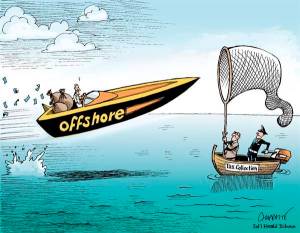
https: //d31029zd06w0t6.cloudfront.net/wp-content/uploads/sites/48/2017/12/web1_offshore-tax-haven.jpg


But Santa, just around the corner … knowing very well, that is need of a radical change in our thinking, leaving individualism and nationalism as methodological guides behind, search gin for long-term programmes that guarantee sustainability, I may still come up with too small suggestions, that can be taken up without much ado:

  • payment of taxes, possibly to a global fund that is based in and linked to rights that deserve to be seen as Global Human Rights and as such guaranteeing peoples’ and people’s freedom from exploitation, which, of course, entails that value chains are not established as poverty-chains.
  • and a really tiny thing: can’t providers of services like wordpress, computers like apple (it would take any single coin from the ca 14 billion they owe the people of Ireland) etc. stop setting the spell-check on US-English as default, often impossible to change … – yes, it is a wee thing – though I am sometimes wondering ion there is a connection between them, called the mental and intellectual trap(ing) coming from US-imperialism.

It is just a matter off the small differences

****

********


Honesty Lost?

Tyranny of Lost Honesty

Truth Or: About Clouds and Roads

⇓⇓

Only Problems of Academics?
⇓⇓⇓

The Moral of the Story is …
⇓⇓⇓⇓

*****************

https://qph.fs.quoracdn.net/main-qimg-cc3030c0d2a807f4a1a0989dbe6ab119-c

Tyranny of Lost Honesty

Not cruelty is the attribute of tyranny, but the destruction of the public political realm, monopolised by the despot by claiming ‘wisdom’ … or based on thirst for power, i.e. insisting on citizens looking after their private concerns, leaving it to him, the ‘ruler, to take of the public matters’.[1]

Of course, there are good reasons for proper referencing, based on sound and serious work with books, how, otherwise, should we climb up on the shoulders of giants ….., to borrow from Isaac Newton.

But if serious work is ridiculed by paranoia-infected, formalist series-killers of intellectual freedom one may have to think if one should change discipline, from giant-climbing to em–powerwalking, enabling the intellect to breath again … Or as Frédéric Gros writes:

Many others have written their books solely from their reading of other books, so that many books exude the stuffy odour of libraries. By what does one judge a book? By its smell (and even more, as we shall see, by its cadence). Its smell: far too many books have the fusty odour of reading rooms or desks. Lightless rooms, poorly ventilated. The air circulates badly between the shelves and becomes saturated with the scent of mildew, the slow decomposition of paper, ink undergoing chemical change. The air is loaded with miasmas there. Other books breathe a livelier air; the bracing air of outdoors, the wind of high mountains, even the icy gust of the high crags buffeting the body; or in the morning, the cool scented air of southern paths through the pines. These books breathe. They are not overloaded, saturated, with dead, vain erudition.[2]

At least such setting comes to mind if a publisher, and not only one, is now asking to mention, when inserting tables, matrices etc. something like “own calculation”…. – next step up the ladder of mental tyranny: every sentence requires a footnote: this sentence had been written by myself …. .

The policing ideas are surely not coming from mentally healthy people, who’re are able to make use of the qualification the surely have. It may be that they are actually not coming from people at all – instead emerging from weird apparatuses, independent as a quasi-demon, reminding of The Sorcerer’s Apprentice:

Sir, my need is sore.

Spirits that I’ve cited

My commands ignore.

To the lonely

Corner, broom!

Hear your doom.

As a spirit

When he wills, your master only

Calls you, then ‘tis time to hear it.[3]

More boxing …, the concept against which I argue since some time ….

What is astonishing is that we factually – we = at least too many in academia, factually = in too many cases of writing, administratively and political-economically defining performance – simply accept the bending of law, perhaps with a grumble and an acquaintance, more or less certain within, but factually without counter-censorship and without demanding two, nevertheless, generally valid legal principles:

  • the acceptance of innocence until proven otherwise
  • the obligation of the plaintiff to prove the accusation

It is much safer to celebrate civil liberties than to defend them; it is much safer to defend them as a formal right than to use them in a politically effective way. Even those who would most willingly subvert these liberties usually do so in their very name. It is easier still to defend someone else’s right to have used them years ago than to have something yourself to say now and to say it now forcibly. The defense of civil liberties – even of their practice a decade ago – has become the major concern of many liberal and once leftward scholars. All of which is a safe way of diverting intellectual effort from the sphere of political reflection and demand.[4]

https://qph.fs.quoracdn.net/main-qimg-80a3424c87e948efcc454bb224a81f3d-c

Truth Or: About Clouds and Roads

In the piece The Roads Around Pisa, Karen Blixen wrote

How difficult it is to know the truth. I wonder if it is really possible to be absolutely truthful when you are alone. Truth, like time, is an idea arising from, and dependent upon, human intercourse. What is the truth about a mountain in Africa that has no name and not even a footpath across it? The truth about this road is that it leads to Pisa, and the truth about Pisa can be found within books written and read by human beings. What is the truth about a man on a desert island? And I, I am like a man on a desert island.[5]

Why? Why can truth be characterised this way, as part of walking together one road? And why can one feel this way, deserted, (a)lone(ly) on an island? One reason behind it will be that we are not really acknowledging the fact that we are ourselves only by others – call it ubuntu if you need a name, though remain aware of the fact that it is probably a term that can only be understood by people who ubuntued instead of growing up Western-ly enlightened (or should we say something like who Montesquieu-ed?).[6]To ubuntu then is about knowing the wings of freedom it gives, also feeling the marks of strangulation that come with it, and knowing that no arithmetic sum can be gained to measure its value.

Truth, as much as it is about ‘objective facts’ which includes social facts as approached by Durkheim in sociology, existing independent of any consciousness, is importantly also itself a social fact, on the one hand by being result of our common action, on the other hand by being important element of and for our common action: experiences we have – together with others, or at least together in one space – are the foundation of further experience, further action, further contest, be it contest between people or between people and the objective environment which itself is changed depending on how we approach it, what we do with our experience of it. Though this may sound difficult, it actually is trivial. Go out one of these winter days, just wearing a t-shirt, at the side of your friend who is properly wrapped up … . You will start to feel cold (most likely at least); s/he will say that you are silly, you will physically eventually suffer, may have to stay in bed, put up the heating etc. … it will not necessarily be warmer when you go for a walk next time but, as small as it may be, there is some contribution also from here with regards to global warming. So, yes, there is some reason for saying

If a butterfly flip its wings in one part of the world it is able to cause storm in another part!

Now, there is also some link from here to the referencing. Without denying in any way the need for proper referencing, it is easy to see that it is simply breeding lies when it is getting over the top. The following illustration tries to show this:


Of course, any knowledge comes from somewhere, and thus anything we state comes from somewhere. This ‘somewhere’ develops by way of differentiation, roles historically and individually into some form of formal education [which is also the education in form(alitie)s], cascades up the stream of higher education in humanities and finally evaporating into general knowledge, be it general academic knowledge or ‘general literacy’. Thinking, writing, discoursing surely needs referencing. However, it only makes sense if it is about a definite reference as quote or paraphrasing or reflection of … in the sense of ‘see’ and ‘conferatur’. It does not make sense as matter of claiming ‘property’ where t property does already exist = it does to make sense to say: this is said by me (there are exceptions: to reclaim property: “This is what I said, the other took it from me.” or: “This is what I say, even if all others do not accept it.”)  Strangely enough, publishers and academics are easily accepting extremely sloppy references taking the form of name and date stated, without letting the reader know why they forget mentioning the ‘cf.’ It equally accepted to refer to …, let’s say

Kant, Immanuel. Observations on the Feeling of the Beautiful and Sublime. Trans. John T. Goldthwait. University of California Press, 1961, 2003

This had been taken on the 12/15/18 8:25:45 AM from https://en.wikipedia.org/wiki/Immanuel_Kant

@ from Wikipedia and similar things can be found in books, journals … – oh folks, the Kant who wrote the ‘observations’ in 1764, published 1799 in English language was in 1861 simply dead as a doornail.

– Over-Referencing is surly not much more than an intellectual masturbation of pity bourgeois, not knowing much, having read a lot and completely lacking the courage to say the little they may think quasi-independently, or lacking the courage to think independently …. Or is it about pushing academics – and all of us – finally to take Whithead’s words in Process and Reality

The safest general characterization of the European philosophical tradi- tion is that it consists of a series of footnotes to Plato.

literally. That is surely equally misleading …

Only Problems of Academics?

As such, these are indeed problems of academics – and let’s face it: many widely abused their power by reputation, the lack of control of performance and ethical standards, one of the “highlights” the former minister for education resigning over PhD-plagiarism.

This is of course already something that goes beyond the academic world and effects everybody – as matter of such people being in positions where they decide for instance over the future of our children. Coincidentally, while writing, I receive a mail from the Council of Europe, talking about

Students as suspects? – The challenges of counter-radicalisation policies in education in the Council of Europe member states

But there is even more to it: it is the spirit that pervades in such attitudes: such request for permanent proof, such spirit of distrust is lurking behind so many forms we have to complete, so many authorisations we need – it is the spirit of tyranny Hannah Arendt was talking about starting from the assumption that we are all criminals while giving us an opportunity to show that we are not – it is the opportunity within a strangulated public of a surveillance state.

Far reaching, indeed, and a matter of The Struggle for Law, about which Rudolph Jhering writes[7]and which is really relevant even when it comes to The Tip and how to deal with it – as the same author writes[8]

Ob die hier gemachten Vorschläge Aussicht auf Verwirklichung haben? Man giebt uns Deutschen Schuld, dass wir einen Stein im Wege, an dem wir uns stossen, ruhig liegen lassen — Jeder verwünsche ihn, aber Niemand nähme sich die Mühe, ihn aus dem Wege zu räumen oder, wenn er für ihn allein zu schwer sei, Andere zur Hülfe herbeizuziehen. Das Trinkgelderunwesen ist ein solcher Stein, Jeder klagt über ihn, aber Jeder lässt ihn liegen. Der Vorwurf, den wir gegen den Stein erheben, richtet sich gegen uns selber; wer eine Unsitte bloss verwünscht, anstatt für seinen Theil mitzuwirken, sie zu beseitigen, klagt sich selber an — für das Bestehen einer Unsitte ist Jeder, der nicht den Muth hat, ihr entgegenzutreten, selber mit verantwortlich, Niemand hat das Recht, sich über sie zu beklagen, als derjenige, der sich das Zeugniss ausstellen kann, seinerseits Alles gethan zu haben, was in seinen Kräften stand, um ihr ein Ende zu machen. Jeder meiner Leser kann sich damit in Bezug auf das Trinkgelderunwesen sein eigenes Urtheil sprechen.

Thanks to Deepl.com

Do the proposals made here have any prospect of being implemented? We Germans are blamed for leaving a stone in our way lying quietly – everyone desires it, but no one takes the trouble to remove it or, if it is too heavy for him alone, to bring others to help. The unbeing of tips is such a stone, everyone complains about it, but everyone leaves it lying. The reproach which we make against the stone is directed against ourselves; he who merely curses a bad habit, instead of cooperating for his part in eliminating it, accuses himself – everyone who does not have the courage to oppose it is himself responsible for the existence of a bad habit; no one has the right to complain about it, as he who can give the testimony has done everything in his power to put an end to it. Each of my readers can thus speak his own judgment with regard to the tipping misdemeanour.

(Translated with http://www.DeepL.com/Translator)

The Moral of the Story is …

Kant, in his Metaphysics of Ethics summarised it in a short sentence – the simple thing, of which it is so difficult to get it right:

… he who first makes himself a worm, does not complain when he trampled under foot.

***********

[1]    Arendt, Hannah, 1958: Vita Activa oder Vom Tätigen Leben; München/Zurich: Piper, 1981, new edition: 215; translated from the German edition; the 2nd English edition: Arendt, Hannah, 1958: The Human Condition; Introduction by Margaret Canovan; Chicago: University of Chicago Press; second edition 1998 does not contain the passage in this way

[2]    Passi di: Frederic Gros. “A Philosophy of Walking”. Apple Books.

[3]    Goethe, Johann Wolfgang von, 1797: Zauberlehrling [The Sorcerer’s Apprentice]; translation by Edwin Zeydel

[4]    Mills, C. Wright, 1956: The Power Elite; Oxford University Press, 2000: 334

[5]     Passi di: Isak Dinesen. “Seven Gothic Tales. Isak Dinesen (Karen Blixen)”. Apple Books

[6]     Of course, making such statement evokes the need to qualify it, stating at least: such characterisations have to be taken with care, they are based on out limited knowledge, they are ideal-types/idealisations and as such they are also based on the current view, neglecting for instance several ‘ubuntu qualities’ and also individualist aspects in both our histories.

[7]    Jhering, Rudolph von, 1879: The Struggle for Law

[8]    Jhering, Rudolph von, 1882: Das Trinkgeld

roi – ROI

le roi a changé de nom – maintenant il a un nom anglais

(the king [roi] changed his name – has an english name now)

ROI – Return on Investment 


https://extranewsfeed.com/the-emperors-new-clothes-trump-the-media-and-the-problems-of-pluralistic-ignorance-afb276f0bc1e

The value of it, the distribution of what is produced, actually leaves more the people naked, while the new rulers are really something like members of a new feudal class.

********

Becoming Socially Acceptable ?

Public lectures are scheduled for the 5th and the 12th December.

After last week’s special lecture to a group of PhD-students, looking at
the upcoming lectures are linking to the recent book “Bullshit Jobs – A Theory”. [1] So is it finally socially acceptable to use such term as Bullshit in academic parlance?
It surely is a catchy phrase, and it also is surely a topic that allows to think abut all the Kafkaesk patterns and requirements …But as glad as I am to take up on the catchiness and as much as I appreciate that Graeber is interested in a very specific point, namely
to understand the psychological, social, and political effects of the fact that so many of us labor under the secret belief that our jobs lack social utility or social value
I am wondering if it is not also a danger of distracting from rather complex issues, linked to more or less fundamental shifts in economic structures.
The honour to give the reputable Deans Lecture at the Faculty of Economics and Sociology in Łódź on the 12th of December provides the opportunity to look at

Bullshit Jobs? suggesting that the Problem is the Stable

The aim is to show that – leaving some general aspects of squander, disrespect and ignorance aside – the underlying problem is an ongoing shift of capitalist accumulation that requires the increasing segregation and fragmentation: The fact that use value and exchange value are juxtaposed results necessarily in the fact that human relationships are systematically torn apart: to relate humans to each other they first have to – speaking systematically – separated by the process of commodification. On the market of commodities they are becoming equal and can – then, ex post – relate to each other. Not least it means that the increasing mediatisation – indeed Graeber points out that most of the relevant jobs occur in IT-related sectors – is necessary condition for making society economically possible. However, it also means that content doesn’t count – as much as capital SEEMINGLY generates capital as much is the sole presence of people considered to be a job, even if it is

a form of paid employment that is so completely pointless, unnecessary, or pernicious that even the employee cannot justify its existence even though, as part of the conditions of employment, the employee feels obliged to pretend that this is not the case.

– this is Graeber’s definition.

For the week before, on the 5th of December, the sociology department of the Ostravská univerzita in the Czech Republic organised a special lecture, the title of which is
In addition to the Graeber-book another reference is the more or less recent auto-shredding of Bansky’s Painting “Girl With Balloon” – the latter again giving the opportunity discuss the problems of hegemony and counter-hegemony – the link is given by reflecting on a statement by Hannah Arendt. She contends that
(n)ot cruelty is the attribute of tyranny, but the destruction of the public political realm, monopolised by the despot by claiming ‘wisdom’ … or based on thirst for power, i.e. insisting on citizens looking after their private concerns, leaving it to him, the ‘ruler, to take of the public matters’.[2]
Surely something marking a demarcation we face – be it in the shopping centres or academic institutions or political space.
*****
[1] David Graeber, 2018: Bullshit Jobs – A Theory; New York et altera Simon&Schuster
[2] Arendt, Hannah, 1958: Vita Activa oder Vom Tätigen Leben; München/Zuerich: Piper, 1981, new edition: 215; translated from the German edition; with reference to Aristotle: Athenische Verfassung; XV, 5 – the available English edition did not contain the statement in this clarity.
******

Net-Work-Effect-S

I still try to figure out how it works – network effects …the Net-Work …

Isn’t it remarkable that we find more and more the term ‘extraction of value/extraction of profit’ where we talked previously about the production of surplus value? This is getting vaguely perceptible looking at the development of paypal. According to Elon Musk, initially incentives of $20, then $10, later $5 had been spent to attract new customers, until a critical mass had been reached. According to Musk it had been “a fair amount. I think it was probably $60 or $70 million” this is what we learn from Elon Musk – CEO of Tesla Motors and SpaceX | Entrepreneurship | Khan Academy – quoted from the auto-transcript. It is about attracting people to extract value from the fact that they are linked together – a rather simple mechanism.

Well, extraction – who likes digging in the ground, getting dirty – that is what usually happens when extracting things.

Anyway, this example clearly shows that network effects do exist: after reaching a critical mass things are becoming shiny self-movers, after enough people caught in the net, the effect is that it works: shines like a bright star over the present, seemingly reaching beyond the horizon …

Shiny …? – hang on: The College Edition of  WEBSTER’S NEW WORLD DICTIONARY OF THE AMERICAN LANGUAGE (THE WORLD PUBLISHING COMPANY Cleveland and New York (Copyright 1960 and 1953, 1954, 1955, 1956, 1957, 1958, 1959) says on page 985, under the lemma net

trap, snare, caught – clean, pure – gain are some outstanding terms

*****

The other day  I received a mail by a trade company, asking me to join a draw, liking the company on Facebook (tempting to join FB?). And inviting to tell a story (probably nobody would read anyway, and definitely not relevant for the “competition”). Anyway, the moral of the (more or less immoral) story: join us by joining facebook to be joined by facebook that joins us in order to find more to join facebook that join more to joining us … — there is at some stage no choice, no end, just for the sake of being part of it: the plastic card society, virtualised as social-network society where shops – for grocery’s to high-end whatsoeveryounameit-products and services are themselves networks, presenting themselves as such … where shopping in the stores, according to Apple’s Angela Ahrendts, is about 20 % buying, 80 percent about being part of it …., an expensive part if we think about it – but neat, shiny, — nets, the

‘fabric made from string … used to trap or snare’

these nets do indeed work:

the stores become a place to experience physically live everything you’ve been doing on your device

… and vice versa: what you are made to see and hear: the reality transformed into the store …,  becomes the reality.

Of course, there is a dangerous side to it, often called conspiracy, but actually a matter of using two very simple rules

first, six degrees of separation, namely the apparent fact that things and people are six or even less steps away from each other

second, the fact of 

taking the immediate encounter as the limit of knowable reality. In both, external knowledge on the part of the audience is not involved—in the city by necessity, in the theater by fiat (using the words of Richard Sennett in The Fall of the Public Man)

Taken together, the effect of the working net is the establishment of permanent trust: trusting the other on sounds of a vague feeling of knowing each other while we try everything to hide from each other and sadly from ourselves – the remaining trust – and of course there is some – goes with the commodities obtained and the self, saved somewhere as Narcissus.

At the end, in entrepreneurial terms it is net profit, extracted …, coming from nowhere else than from shine , pictures, at times amazing in their beauty, definitely in their deception  …. .

*****

Another “the other day” … wondering around, watching one of these street artists, fascinating today like those impostors in the medievals (I can only guess, never met one – just to young): a little puddle, and huge, huge bubbles after a short while, jiggling and joggling and juggling with the long special rope at the end of the two sticks, transposing matter into air, caught in a sometimes colourful, always shiny ball of air …. remaining nothingness of singularity located between zero and one.

*****

the red of the black

Black Friday, another bad import from ‘big brother’

– the following doesn’t even look at the small print let alone at what seems to be so small that it is not even printed: such day we are bombarded with goods — all those ‘special offers’ the sale of which, I am sure, still allowed to make a profit good profit: whatever the historical background is, that special day was not made a tradition of making loss. Besides this probably everybody reading these lines had been bombarded with e-mails, many unwanted SPAM-mails

By Source (WP:NFCC#4), Fair use, https://en.wikipedia.org/w/index.php?curid=44458281

, aiming on convincing us to buy buy buy …

Leaving aside the wasted time – deleting all the unwanted mails and getting upset …- there is another, actually real cost: According to the Guardian

The sending, sorting and filtering of spam email alone accounts for 33bn units of electricity each year

According to another source – PhysOrg

Sending even a short email is estimated to add about four grammes (0.14 ounces) of CO2 equivalent (gCO2e) to the atmosphere.

To put this into perspective, the carbon output of hitting “send” on 65 mails is on par with driving an average-sized car a kilometre (0.6 of a mile).

And furthermore they calculated

The global carbon footprint from spam annually is equivalent to the greenhouse gases pumped out by 3.1 million passenger cars using 7.6 billion litres (two billion gallons) of gasoline in a year.

Of course, it is difficult to draw a line and perhaps such blogs as this should not exist. But leaving this aside, Black Friday was surely a red day, a warning lamp switching on such day when looking at the environmental question: a huge cost for the environment …, rarely considered or calculated; a huge “contribution to the GDB”, proving that in capitalism production of waste is considered to be valuable.

Cornered?

Of course it feels often like tyranny – in the understanding of Hannah Arendt:

Not cruelty is the attribute of tyranny, but the destruction of the public political realm, monopolised by the despot by claiming ‘wisdom’ … or based on thirst for power, i.e. insisting on citizens looking after their private concerns, leaving it to him, the ‘ruler, to take of the public matters’.*

But then it may be necessary to blame a bit ourselves, us, the members of the scientific community, but more in general: we as member of any republic. Isn’t there a tendency towards accepting that we as members are made to res, to things instead of making things public?

Much had been said about open access, and the spirit of the words quoted above may be taken as a guidance for further thinking about the direction and necessity. It is of utmost importance to acknowledge developments that move into the direction of open access – surely in very different directions as The Berlin Declaration on Open Access to Knowledge in the Sciences and Humanities of 22 October 2003, but also the increasingly mushrooming sites as libgen.io, sci-hub.tw or achieve.org and even google, researchgate, academia and the like…, or the non-commercials as RePEc, Mupra and in addition one I only spotted now: http://www.knowledgeunlatched.org
The really interesting point is that apparently all in the field are under various pressures: publishers, libraries, academics, students, readers – and of course, in many cases we are concerned, occupying different of these roles at the same time. Doesn’t this suggest to switch to organising, controlling, coordinating an counter-hegemony? – Sure, without forgetting complaining? May be the long march through the institutions should be seen in a more political light, seeing OA not simply as something one may beneficially use but as a weapon.

____________________

* Arendt, Hannah, 1958: Vita Activa oder Vom Tätigen Leben; München/Zuerich: Piper, 1981, new edition: 215; translated from the German edition; the 2nd English edition: Arendt, Hannah, 1958: The Human Condition; Introduction by Margaret Canovan; Chicago: University of Chicago Press; second edition 1998 does not contain the passage in this way

Ten years on … – no wisdom gained?

Of course, there are many contestable issues concerned with the “ten years on” – leaving the question of timing aside, one point may well be concerned with the word “on”, considering that it should be replaced by “into” or even “digging the grave deeper”. The success-stories so far are, if they exist, stories about de-synchronisation: the fact that some countries succeeded again in a more pronounced way to live on the back of others, temporary victories, and often victories for the countries, not for the people (for instance good overall “economic performance” often means increasing inequality)  …
Preparing the class for coming Monday, but also working on finalising the book
Changing the Socio-Economic Formation – Revisiting Value and Valuation in a Globalising Digital World
I looked up a Briefing Note, presented in 2008, in preparation of the OECD Global Forum on International Investment, titled
It is not looking at the crisis – if the collapse of Lehmann Brothers is taken as reference, it would be even a pre-crisis work, presented on a pre-crisis conference. What makes it interesting (surely – not only – for my classes “Development versus Growth”) is the fact of presenting in a masterful way the shortcoming of an understanding of economics and political economy that can well be seen as structural weakness leading to a crisis like the one we are still suffering from (sure, not everybody).
A quote right from the beginning of the briefing note:
The service sector makes an important contribution to GDP in most countries, providing jobs, inputs and public services for the economy. Trade in services can improve economic performance and provide a range of traditional and new export opportunities. However, services liberalisation also carries risks, and appropriate regulation and other complementary policies help to ensure that liberalisation delivers the expected benefits. We have reviewed the literature on these issues for 6 service sectors (tourism, financial services, energy services, information and communications technology, and Mode IV), … .
And it goes on and goes on and goes on in this spirit, not talking about the essentials of what should be at stake of any analysis. Engels, in 1884, wrote:
According to the materialistic conception, the determining factor in history is, in the last resort, the production and reproduction of the immediate life. But this itself is again of a twofold character. On the one side, the production of the means of subsistence, of food and clothing and shelter and the implements required for this; on the other, the production of human beings themselves, the propagation of the species. The social institutions under which men of a definite historical epoch and of a particular country live are determined by both kinds of production: by the stage of development of labour, on the one hand, and of the family, on the other.
(Engels, Frederick, 1884: Origins of the Family, Private Property, and the State. Preface [to the First Edition]; in: Karl Marx Frederick Engels. Collected Works. Volume 26. Frederick Engels. 1882-89; London: Lawrence&Wishart, 1990: 131-133)
The OECD-experts go exactly the other way round, starting from the end – and actually defining the end as ultimate point of departure and ultimate goal: growth, though remaining undefined, only specified by the reference to the GDP.
Indeed, there is something interesting about GDP and Development.
In fact, the up for some may mean the move back for others
Commonly the “concept” of GDP is attributed to Simon Kuznet – detailed in 1934 in
, it is time to acknowledge that already then the author spelled out – more or less at the outset:
The welfare of a nation can, therefore, scarcely be inferred from a measurement of national income as defined above. (page 7)
And he continues:
The abuses of national income estimates arise largely from a failure to take into account the precise definition of income and the methods of its evaluation which the estimator assumes in arriving at his final figures. Notions of productivity or welfare as understood by the user of the estimates are often read by him into the income measurement, regardless of the assumptions made by the income estimator in arriving at the figures. As a result we find all too commonly such inferences that a decline of 30 percent in the national income (in terms of “constant” dollars) means a 30 percent decline in the total productivity of the nation, and a corresponding decline in its welfare. Or that a nation whose total income is twice the size of the national income of another country is twice “as well off”, can sustain payments abroad twice as large or can carry a debt burden double in size. Such statements can obviously be true only when gualified by a host of “ifs.”
A detail, mentioned at the end of the report, is surely of special interest:
The individual industries included here are photography, undertaking, mausoleum and cemetery operation, social service agencies, athletic, yacht, and country clubs, Y.M.C.A.’s, Y.W.C.A/s, and other services not accounted for elsewhere. Most of these services are of a type not easily curtailed or dispensed with, while social and welfare agencies have had a special reason for increasing since 1929. The number of employees was about a quarter of a million in 1929 and probably increased, or at least did not decline greatly, during the 3 following years (see table 200). The estimated average compensation of employees is probably fairly near the actual situation for 1929 but the trend shown since that year, except that there was probably very little per capita decline, is open to question as far as the country as a whole is concerned. (page 140)
Well, perhaps this is what the briefing says???: “Think of your people and your countries economy and accept: poverty is good for you.” In plain language – and this is very much the underlying gist of IMF and World Bank politics – be nationalist and socially unjust.
I am sure, those who write those reports, will not face what poverty or lack of wellbeing etc. mean.
Of course, this is only the visible, more or less tangible part of the underlying misinterpretation of economics: While calculations may well be correct, fact is – as John Maynard Keynes convincingly wrote in 1936:

Too large a proportion of recent ‘mathematical’ economics are mere concoctions, as imprecise as the initial assumptions they rest on, which allow the author to lose sight of the complexities and interdependencies of the real world in a maze of pretentious and unhelpful symbols.

(Keynes 1936)

Still, if we look at the title of the quoted opus magnum presented by Keynes reads

The General Theory of Employment, Interest and Money

and we still may remain without considering the entire depth of reference. Of course, not every book can start with all the life stories …- but at least it should commence by focusing on the real life situation and the supply conditions and the relationality that is part of it. – Think about employment conditions that allow flexibility and reduction of working time without lowering wage and without stress caused by any fear, thus possibly causing the GDP to drop, but enabling employees to care for relatives, to be politically active, to follow their “intellectual needs” … As much as items expressed by GDP are mere means to an end, the same is true for employment, the ends not being products and services, the end not being income but “production and reproduction of the immediate life”.

Even Alfred Marshall, rightly criticised for his contribution to the mathematisation of economics, knew better than many who still highlight the centrality of employment today, (and here; and many could be added) knew better. As we can read in the Memorials of Alfred Marshall (edited 1925 by Arthur Cecil Pigou), Pigou states in his own contribution to the book (page 84):

Though a skilled mathematician, he used mathematics sparingly. He saw that excessive reliance on this instrument might lead us astray in pursuit of intellectual toys, imaginary problems not conforming to the conditions of real life: and further, might distort our sense of proportion by causing us to neglect factors that could not easily be worked up in the mathematical machine.

Acknowledging this, there would not have been any need to write to the Queen …