Ranking, awarding …

…reviewed from a very different corner

A spectre is haunting academia: the specter of competition – having politicians, who want to instrumentalise science, as their mouthpiece – for instance recently the Hungarian government came up with a strangulating funding scheme

and surely many other countries may be added.

Another instrument of the specter is the use of various schemes of ranking, awarding and the like …There are different dimensions of policies that are tightly strangulating what may be called “freedom of academia”

(may be called so, as this terminology had been abused by conservative and reactionary politicians in Germany against the student movement end of the 1960s (see Hans-Abrecht Koch: Professorale Selbstbehauptung in turbulenter Zeit; see also 
Review of Nikolai Wehrs, Protest der Professoren. Der «Bund Freiheit der Wissenschaft» in den 1970er Jahren
Alessandro Stoppoloni (in Italian); also: 
Martina Steber: Die Hüter der Begriffe. Politische Sprachen des Konservativen in Großbritannien und der Bundesrepublik Deutschland, 1945-1980 – available via liegen.io)

One aspect came to my mind when reading an article titled
CAN AN ALGORITHM WRITE A BETTER NEWS STORY THAN A HUMAN REPORTER?, written by Steven Levy. Two passages caught my special attention: 

Hammond was recently asked for his reaction to a prediction that a computer would win a Pulitzer Prize within 20 years. He disagreed. It would happen, he said, in five.


The other passage:

Last year at a small conference of journalists and technologists, I asked Hammond [Narrative Science’s CTO and cofounder, Kristian Hammond] to predict what percentage of news would be written by computers in 15 years. At first he tried to duck the question, but with some prodding he sighed and gave in: “More than 90 percent.

What actually is frightening of the following little story? Sure, for many the outlook of loosing their employment but we may consider that today’s standards – such as the Pulitzer Prize and many others – aren’t as noble as so many ranking-fed moneybags propose. Again, many things to be said and discussed, though for the moment only one, quoting Felix Stalder:

“iUsers are only able to evaluate search results pragmatically; that is, in light of whether or not they are helpful in solving a concrete problem. In this regard, it is not paramount that they find the best solution or the correct answer but rather one that is available and sufficient.”

Estratto di: Stalder, Felix. “The Digital Condition.” Polity Press, 2018

Indeed, everybody gets the Prize he or she deserves – it also means that at some stage the winning material will be self-assessed by an algorithm (a step further than the currently already ‘automated review’) by – finally that would be the ‘peer’ for the review. Anything new? May be, but may be not so much. Rancière, writing about post-democracy, states that it

is the government practice and conceptual legitimization of a democracy after the demos, a democracy that has eliminated the appearance, miscount and dispute of the people.


Just in time – and one could say: time does actually not matter. One of “my” universities sent a newsletter today – via e-mail, may be that this is the reason for calling it ‘connection’. It is arriving from one of the Chinese universities I worked at, ne of the headlines reading (in the section Education)

Nobel Prize Inspiration Initiative kicks off at … with Michael Young

right away followed by an article titled

… establishes International Business School

Now I dare to wonder to which extent revolutions, also and perhaps especially in science are initiated by a spark, a genius – often not (easily) understood, daring to make a step further – nit fearing being possibly wrong … – of course, this is a slippery field. We in China and we protestants in Europe know, for different reasons:
it is all about working hard
– in the east to serve society, in the west to build a house, plant a tree and have a sun (so the sayings go, standards set for male). And it is – nolens volens – working in society, being, existing , living in society and (as Marx stated) even individualising in society. And still there is this moment of genius – not only needed to be awarded any of these high ranking symbols but being awarded by some form and degree of independence. One does not have to agree with Kant in all the facets, one can laugh about his habits – but one has to accept the challenge he out in front of each of us: consciously living, accepting responsibility, only with this being able to go beyond the Kantian individualism, and doing what we do: making our own history, even if we have to accept that we do not do it entirely according to our own ‘simple individual will’.

Such awards make only sense if this is acknowledged and academic work does not degenerate to mere International Business …

The latter is exactly what we see with the entire reviewing, and new attitudes to awarding – at least as danger of the massification of ranked publishing: mass, numbers, formal perfection counts – quality control as engaged dispute amongst peers is replaced by checking the reflection of formal coherence – relativity in terms of E = M2cannot be seen, and Schroedinger’s cat will be known as dead or alive, no option for the beast to be … really Schroedinger’s cat.

Another issue with reviews – algorithmised or not, or another expression: Finally any reviewer – human or not – can only review what is familiar.
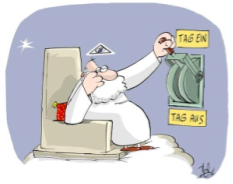
The divine day in-day out

Or it is about resistance

and getting engaged in debates …we, each of us, has to decide

experience

wishes at the end and beginning of the semester II

http://www.mrichatham.com/wp-content/uploads/2014/01/knowledge-vs-experience. jpg

May we learn how to deconstruct the industrial norms, so that experience, appropriation and appropriateness guide us through the days and life.

strength

wishes at the end of the one and beginning of another semester I

May we gain the strength, to acknowledge the limits of our wisdom and judgement without accepting the consequences arising from there – this, instead of being tempted to think we know everything, and even worse, knowing everything better than those who are directly concerned. 

senza via d’uscita

la speranza è l’ultima a morire

hope is the last to die 

l’espoir est le dernier à mourir. 

die Hoffnung stirbt zuletzt


a rather simple formula, logics for beginners

∀x(Sx⇒Mx)

∀x(M⇒Px)

∀x(Sx⇒Px)

But seen in this light …, does it mean those who lost hope are already dead? Guess it really does make life much easier then …

The Price to be paid

Much has been said about the price to be paid for success … and often the German’s are praised: zeal, diligence …, though Protestantism was and is not necessarily dominant amongst the Germans, this tribe is often presented as incarnation of the protestant work ethics (as Max Weber analysed it). Topics for many discussions; many topics for discussion.

One aspect, often forgotten, had been mentioned by Immanuel Kant, though emerging from a possibly unexpected, even unrecognised context (English below):   

Die vorzügliche Achtungsbezeigung in Worten und Manieren selbst gegen einen nicht Gebietenden in der bürgerlichen Verfassung – die Reverenzen, Verbeugungen (Complimente), höfische – den Unterschied der Stände mit sorgfältiger Pünktlichkeit bezeichnende Phrasen, – welche von der Höflichkeit (die auch sich gleich Achtenden nothwendig ist) ganz unterschieden sind – das Du, Er, Ihr und Sie, oder Ew. Wohledlen, Hochedeln, Hochedelgebornen, Wohlgebornen ( ohe, iam satis est !) in der Anrede als in der Pedanterei die Deutschen unter allen Völkern der Erde (die indische Kasten vielleicht ausgenommen) es am weitesten gebracht haben, sind das nicht Beweise eines ausgebreiteten Hanges zur Kriecherei unter Menschen? ( Hae nugae in seria ducunt. ) Wer sich aber zum Wurm macht, kann nachher nicht klagen, daß er mit Füßen getreten wird.[1]

Preferential tributes of respect in words and manners even to those who have no civil authority – reverences, obeisance’s (compliments) and courtly phrases marking with the utmost precision every distinction in rank, is something altogether different from courtesy (which is necessary even for those who respect each other equally) – the Du, Er, Ihr and Sie, or Ew. Wohledeln, Hochedeln, Hochedelgeborenen, Wohlgeborenen (ohe, iam satis est!) as forms of address, a pedantry in which the Germans seem to outdo any other people in the world (except possibly the Indian castes): Does not all this prove that there is a widespread propensity to servility in men? (Hae nugae in seria ducunt) But one who makes himself a worm cannot complain afterwards if people step on him.[2]

Worthwhile to think about it, not least as it reminds a bit of Mills, thinking about the dissatisfied human and the satisfied pig.

It may be worth to mention that, looking for the text on the internet, usually quotations omit the last sentence, thus, I would say, omitting the price to be paid for such success.


[1]    (Kant, Immanuel, 1793: Die Religion innerhalb der Grenzen der bloßen Vernunft. Die Metaphysik der Sitten; 437)

[2]    (Kant, Immanuel, 1793: The Metaphysics of Morals; Introduction, translation, and notes by Mary Gregor; New York et altera: Cambridge Univesity Press, 1991: 232)

never … – theless …

(English below – a message I sent to my bank, my health insurance, my … – wherever I have an “account”)

Danke fuer die Nachricht, eine Frage an die administration der Kommunikation: Ist es wirklich erforderlich, dass ich eine mail bekomme, die mir mitteilt, dass ich eine Nachricht im Portal habe, fuer deren Zugang ich mich einloggen muss, die ich dann öffnen muss, um zu erfahren, was letztlich ausreichend im Betreff der e-mail Nachricht haette mitgeteilt werden können. Abgesehen von meiner Zeit, die da verschwendet wird (ihre auch, aber Sie werden fuer solchen Unfug bezahlt, leiten Sie dies ich bitte einmal an die unverantwortlichen Verantwortlichen weiter:

https://pixabay.com/it/bolle-grazie-messaggio-cliente-1968298/

Thank you for the message, a question to the communication administration: Is it really necessary that I receive an e-mail telling me that I have a message in the portal, for whose access I have to log in, which I then have to open to find out what could have been sufficiently communicated in the subject of the e-mail message? Apart from my time, which is wasted (yours too, but you are paid for such nonsense, please pass this on to the irresponsible responsible person:

https://www.theguardian.com/environment/green-living-blog/2010/oct/21/carbon-footprint-email

Nevertheless, best regards, Peter

Well there is surely some reason to speak of bullshit jobs and question an economic system that is made up of bullshit tasks … – and to doubt that it is the way forward …

alternative reading

Recently I had been proofreading an article I wrote, looking at

The Particular and the Universal – Indigenous Sports for the Integrity of the Global Village

Though too often this work is the annoying part – but in this case I actually enjoyed it, thinking that there could be other criteria for peer reviewing etc.

  • How often does one interrupt reading to thing, reflect deeply on what had been written
  • How often does one detect connections that are unusual, though showing uo as being interesting
  • How often does one find new knowledge instead of new information confirming what one knows
  • How often is something written with which one does not agree, while one feels nevertheless stimulated by it and is provoked to think about the own ideas and the own standard arguments
  • Is there anything in the text that really provokes looking something up in order to gain some deeper insight, especially is there any “strange cat” – equally alive and dead – mentioned: something that one may have vaguely come across but one is now keen to recap, or study more in detail though it has nothing to do with one’s usual focus (e.g. Schroedinger’s cat – if it is alive of dead is not centrally a matter of [animal] welfare but still may of interest for everybody)

Recently, after having given a presentation, I received a mail by the Dean who was actually hosting the event, He said

…. I thought about a few explanations you shared with us. Nice job. Inspiring …

Leaving aside that there had been some interesting discussion at the end, a line as the one quoted may be the “highest praise” one can get after giving a presentation or writing something. A kind of “slow listening”.

For journal reviews (and reading, of course), it may be good to revisit the usual “comments to the editor”/”comments to the author”.

I remember once about an author, let’s call her A. A’s submission to a journal had been rejected by the review (anonymised process on all sides). The reason, brought forward:

The author did not make any reference to the work that had been undertaken by A.

Again, mind, the reviewer did not know that A had been actually the author of the reviewed article.

And the moral of an amoral academia: Never say anything new, always repeat what you said … – with a wee bit of change, possible just put in the new data: instead of 2xyz, the new article has the data of 2xyz+5. Interesting …

pay for part-time jobs

What is the pay for a part-time job on call?

The other day, booking a flight, I was browsing a bit, also looking at the options of seat-reservation. Another time that I was thinking about this strange construct of today’s economy, reading

The passenger named above has chosen a seat in an emergency exit row. In the unlikely event of an evacuation they will be expected to assist in the opening of the emergency door.

One interpretation is that one pays for some extra space – for more comfort, for medical reasons – or perhaps even to force oneself to store the hand-luggage properly in the overhead bin.

http://politicsslashletters.org/wp-content/uploads/2018/02/11-Robbins.jpg

Another interpretation: I see myself as part-time casual worker, serving the airline on demand (sure, in the unlikely event they stress), actually even giving up the extra comfort) … – and I pay for it.

Now, a silly remark you may say – but is it really silly? As far as it is known some airlines “offer the opportunity to fly as co-pilot”, the payment being the hours needed to secure the validity of the license.

This “pay-to-fly” principle is sometimes applied at the Irish low-cost airline Ryanair too, according to insiders. Young pilots are not paid for flying, but have to pay for the pleasure of sitting in the cockpit, making flying one of the only jobs you actually have to buy.


To which extent is all this part of a wider move towards something new, i.e. a new capitalism? Surely this will also come up as part of the presentations I had been asked to give in the near future, the first of them next Wednesday.

Trinity – a search image

Enlightenment — there is no “one international day of enlightenment”, if there would be, it would be a European one as Eurocentrism prevails; and if there would be it would also be difficult to decide on a date – too many could be reasonably suggested (see also here). One that may be of outstanding meaning, simply due to the fact that is always used as reference, could be linked to the publication of Immanuel Kant’s piece “Beantwortung der Frage: Was ist Aufklärung?” (In: Berlinische Monatsschrift, 1784 – 2019 it would be 235 years ago) – At the end there are three aspects that really matter, shown in the photo below:

(photo taken in Berlin, October 2019)

See here for the “solution”. And see here for …, well, is this documentation on Light in the Cities the metaphorical presentation of the socio-economico-philosophical meaning of light or is the socio-economico-philosophical real advancement a result of power-technical developments?
(There may be a version with translations, or the original French …?)

Here another docu on light – more the “science” one, on emission.