speed …

… the way we seem to live today.

From Alice, Through the looking glass: page 32 f:

Alice looked round her in great surprise. ‘Why, I do believe we’ve been under this tree the whole time! Everything’s just as it was!’

‘Of course it is,’ said the Queen, ‘what would you have it?’

‘Well, in our country,’ said Alice, still panting a little, ‘you’d generally get to somewhere else—if  you ran very fast for a long time, as we’ve been doing.’

‘A slow sort of country!’ said the Queen. ‘Now, here, you see, it takes all the running you can do, to keep in the same place. If you want to get some- where else, you must run at least twice as fast as that!’

To where do we go from here?

From teaching economics at Bangor College China, in Changsha, China – some reflections had been published here earlier, and also here – I arrived now – after some interim work in France and The Netherlands – in Munich, Bavaria, a generous grant from the Max-Planck-Institute for Social Law and Social Policy allows me occupying from today a research position for the next twelve month, looking at issues around digitisation – some books I asked for are already at my disposal on my new desk. And right at the beginning, after having been giving out against orthodox economics [not so much from a heterodox, but from an unorthodox position (or was it more from an alternative orthodoxy?)], I am now wondering if – cum grano salis – heterodox thinking is needed also when it comes to law?

[scan from: Johann Wolfgang Goethe, Faust – Der Tragödie Erster Teil, mit Illustrationen aus drei Jahrhunderten, ed. by Hans Hanning, Berlin: Rütting & Loening, 1982, 2nd ed., p. 123
Teufelspakt_Faust-Mephisto, by Julius Nisle]

And much as Marx did not ‘invent communism out of the blue’, but based it in historical analysis [see in particular Engels’ Work on ‘The Origin of the Family, Private Property, and the State’] , such historical review is also most valuable in jurisprudence. A nice passage I found – in a book by St Germain, writing  on the Dialogues between a doctor of divinity and a student in the laws of England –  and surely not suggesting that we find the alternatives in divinity …

And so it appeareth, that equity taketh not away the very right, but only that that seemeth to be right by the general words of the law. Nor it is not ordained against the cruelness of the law, for the law in such case generally taken is good in himself; but equity followeth the law in all particular cases where right and justice requireth, notwithstanding the general rule of the law be to the contrary. Wherefore it appeareth., that if any law were made by man without any such exception expressed or implied, it were manifestly unreasonable, and were not to be suffered …

Reading this on page 45, we read already a page earlier as definition:

Equity is a right wiseness that considereth all the particular circumstances of the deed, the which also is tempered with the sweetness of mercy. And such an equity must always be observed in every law of man, and in every general rule thereof: and that knew he well that said thus, Laws covet to be ruled by equity. And the wise man saith, Be not overmuch right wise; for the extreme right wiseness is extreme wrong: as who saith, If thou take all that the words of the law giveth thee thou shalt sometime do against the law.

Reminder for the Future

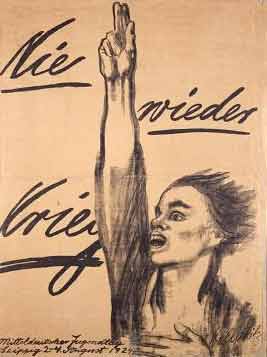
It may be questionable to state one day, one event as beginning of a war, though it had been the first of September nineteen-hundred-thirty-nine that the German troops invaded Poland, under false accusations. The date is taken as occasion to post a reminder, unfortunately seeing today again so many reasons in so many countries to be mobilised against moves towards violence and war. Many ways can be imagined, many wise things said – in length and in short slogans and paintings and demands – as already Kaethe Kollwitz’ lithography from 1924,

[1]

demanding ‘Never again War’.

There is one short passage in Zuckmeyer’s The Devils General, which brings it in an impressive way the point – not translating well from the German. It is part of the dispute between SS-group-leader Schmidt-Lausitz and general Harras, the latter shouting against the group-leader:

What did you just say? Fatherland [Vaterland]? You? What do you understand as fatherland? Hä? Just spell it!

V as Volksgerichtshof (People’s Court of Justice)! A as hanging! T as death! E as shooting! R as racial persecution! L as camp! Ausschwitz, Neuengamme, Dachau

You see, this is how fatherland is spelled today in Germany!

the original German version:

“Watt haben Sie da gesagt?” Vaterland?! Sie? Was versteh Sie den darunter?

“Hä? Buchstabieren Sie doch mal”

“V wie Volksgerichtshof! A wie Aufhängen! T wie Tod! E wie Erschießen! R wie Rassenverfolgung! L wie Lager! Ausschwitz, Neuengamme, Dachau

Sehen Sie, so buchstabiert man heute in Deutschland Vaterland!”

[For the short scene from the film see here].

Terms and letters, occasions …, all this may be different – but the underlying patterns never changed!


[1]            Antikriegsplakat von Käthe Kollwitz für den Mitteldeutschen Jugendtag 1924 (Lithographie, 95,2 cm x 72,3 cm; Quelle: DHM) – http://www.zeithistorische-forschungen.de/1-2-2007/id%3D4397; 22/08/17

Sorrows of Young Werther – not only

It had not been just the young Werther plagued by sorrows, and among the many concerned are academics – some old, some young; some knowing, some innocent; some forced and some voluntarily … .

[scan from: Johann Wolfgang Goethe, Faust – Der Tragödie Erster Teil, mit Illustrationen aus drei Jahrhunderten, ed. by Hans Hanning, Berlin: Rütting & Loening, 1982, 2nd ed., p. 123
Teufelspakt_Faust-Mephisto, by Julius Nisle]

All this is by no means new, the fine-tuning changed while the symphony itself is still the old lyre …

Career settings – career is a nice word actually: ‘a person really made a career’, we say it is somebody reached ‘high ranks’, and to get to the heights one has to make a career, i.e. move along a given path. Going back to Latin and Italian it is about the via cararia – the carriage road, the path on and along which the car – carrus – chariot moves. And it is about carrying, of course.

A brief outline then, if one gets an important part of the picture – surely not the complete one:

First step, getting the weight that needs to be carried – well prepared, and well wrapped:

Influence and manipulation in Teaching Economics – Backgrounds and Examples[1]

– There is at least an abstract in English language – and there is also an article on the topic[2]

Next step, prostitution[3] – it is not about what one says but how and where one says something.

And mind, see the progress: from the wrapped being presented, it is now about oneself, the young academic, wrapping.

Well, the end of the career? For some … the eternal wrappers, stepping higher and higher, the chariot being increasingly beautiful, the golden grids appearing as louvre – is it by accident that this is also the name of the great galleries in Paris?

For others the story ends …, well one may say Wertherian, i.e. by suicide – the way that social science goes too often[4] – actually the other side of prostitution – or its other side.

And indeed, there is some cunning of reason in the fact that this obituary on the academic freedom is published in a journal with access-by-payment-only … – Well, the Goethe, in his Faust, was clearer than Hegel with his hope for the cunning of reason, writing

To nonsense reason turns,

and benefit to worry.

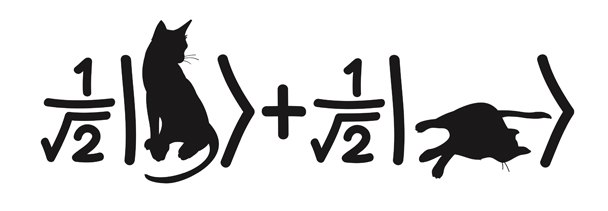
And we basically have to fail if we maintain reasoning by simple reason, accepting that we are not quantum mechanic beings but real ones.

And still, exactly therefore we have to look where and how exactly the cat moves – accepting also that it cannot be understood if we use those concepts that are hidden behind the eclipsed reason.

Sure, some leave the wrapping post and move on as rapper – against the rapists.

The answer history will give ????   – well, it may be that you have to go for it

******

******

[1]            Silja Graupe: Beeinflussung und Manipulation in der ökonomischen Bildung Hintergründe und Beispiele; Duesseldorf: FGW – Forschungsinstitut für gesellschaftliche Weiterentwicklung e.V.

[2]            Silja Graupe. The Power of Ideas. The Teaching of Economics and its Image of Man; in: Volume 11, Number 2, © JSSE 2012 ISSN 1618-5293

[3]            Frey: PUBLISHING AS PROSTITUTION? Choosing Between One’s Own Ideas and Academic Failure; http://www.econ.uzh.ch/static/wp_iew/iewwp117.pdf

[4]            Holmquist, Carin and Sundin, Elisabeth(2010) ‘The suicide of the social sciences: causes and effects’, Innovation: The European Journal of Social Science Research, 23: 1, 13 — 23

Simplifications

Keynes himself suggests in his supposed main work

The General Theory of Employment, Interest, and Money

that

the essence of the General Theory of Employment

can actually be reduced on three points

Hence the volume of employment in equilibrium depends on (i) the aggregate supply function, (ii) the propensity to consume, and (iii) the volume of investment, D2.

And the entire theory can be reduced in other ways as the following quotes from the same work show:

Consumption—to repeat the obvious—is the sole end and object of all economic activity. Opportunities for employment are necessarily limited by the extent of aggregate demand. Aggregate demand can be derived only from present consumption or from present provision for future consumption. The consumption for which we can profitably provide in advance cannot be pushed indefinitely into the future.

And another contention:

When involuntary unemployment exists, the marginal disutility of labour is necessarily less than the utility of the marginal product. Indeed it may be much less. For a man who has been long unemployed some measure of labour, instead of involving disutility, may have a positive utility. If this is accepted, the above reasoning shows how ‘wasteful’ loan expenditure may nevertheless enrich the community on balance. Pyramid-building, earthquakes, even wars may serve to increase wealth, if the education of our statesmen on the principles of the classical economics stands in the way of anything better.


If the Treasury were to fill old bottles with banknotes, bury them at suitable depths in disused coalmines which are then filled up to the surface with town rubbish, and leave it to private enterprise on well-tried principles of laissez-faire to dig the notes up again (the right to do so being obtained, of course, by tendering for leases of the note-bearing territory), there need be no more unemployment and, with the help of the repercussions, the real income of the community, and its capital wealth also, would probably become a good deal greater than it actually is.

If we reflect a little bit further on these few passages, and not withstanding the fact that Keynes is surely a great economist, at least in the sense of circumspection there remains a main obstacle that may suggest that there is not only a problem with

the education of our statesmen on the principles of the classical economics

but obviously also the assumption that the bottles, suggested to be filled with banknotes and hidden in disused coalmines had been full of high-percentage alcoholic drinks, consumed before suggesting such as mentioned above – in fact Keynes, in this ‘General Theory’ and especially, of course, in his outline of the

Economic Possibilities for our Grandchildren

seems to be aware of this. The reader of the quoted lines – and of the entire ‘General Theory’ – may take a few minutes and concentrate on the quoted passages, asking:

What society is suggested here and what role has economic activity in it?

It is a society that is distant from any meaningful social existence, founded in a circular understanding of consumption. Although production is not abandoned as relevant point of reference, in other words: although such economics does not necessarily reduce the process of generating value entirely in the sphere of consumption, it still does refer to the principle of marginality as ultimate motif de décision if not raison d’être.

In consequence it is a society and economy that is established by an inherent supposition that growth is the ultimate mechanism of reproduction, disjoined from any needs that are based in use value.

This also means that such economics fails to recognise that one cannot stop anybody striving to be a bubble in an economy that is conceptualised as bathtub. This refers to Keynes, stating

Speculators may do no harm as bubbles on a steady stream of enterprise. But the position is serious when enterprise becomes the bubble on a whirlpool of speculation. When the capital development of a country becomes a by-product of the activities of a casino, the job is likely to be ill-done. The measure of success attained by Wall Street, regarded as an institution of which the proper social purpose is to direct new investment into the most profitable channels in terms of future yield, cannot be claimed as one of the outstanding triumphs of laissez- faire capitalism—which is not surprising, if I am right in thinking that the best brains of Wall Street have been in fact directed towards a different object.

As briefly said, Keynes himself was to some extent critical about this, stating in his work on the

Economic Possibilities for our Grandchildren

For many ages to come the old Adam will be so strong in us that everybody will need to do some work if he is to be contented. We shall do more things for ourselves than is usual with the rich to-day, only too glad to have small duties and tasks and routines. But beyond this, we shall endeavour to spread the bread thin on the butter – to make what work there is still to be done to be as widely shared as possible. Three-hour shifts or a fifteen-hour week may put off the problem for a great while. For three hours a day is quite enough to satisfy the old Adam in most of us!

Even long time before him, the surely conservative economist John Stuart Mill was pursuing in his

Principles of Political Economy with some of their Applications to Social Philosophy

the idea of stationary state.

Leaving aside that nothing of this is reality, we should not forget to ask for the real reasons standing behind such unfulfilled unmatched state, not least

  • the permanent furthering of breeding ‘the old Adam’
  • and …, well, the unquestioned power of those who drowned the bit of education in the distilled and fermented content of the bottles that Keynes suggest to hide in the coalmines.

Indeed, as we know from Schumpeter

The conquest of the air may well be more important than the conquest of India was—we must not confuse geographical frontiers with economic ones.

And this conquest is going on: the conquest of air and everything, going hand in hand with the “re-conquest” of Venezuela etc, and the new conquest, now directed towards the outer space.

Digitalwirtschaft … Flexi oder was?

unter dem Titel
ist nun ein kurzer Artikel in der Freiheitsliebe  erschienen.

ABSTRACT

Plattformökonomie ist einer der Begriffe, unter denen neue Wirtschaftsentwicklungen gefasst werden. Schon in diesem kurzen Satz, der vagen Formulierung, wird deutlich, dass es bei diesem und ähnlichen Begriffen wie Digitalisierung, gig-Ökonomie, Robotisierung um ein Feld handelt, dass einerseits durch viele Facetten mit ganz spezifischen Detailaspekten gekennzeichnet ist, aber andererseits Teil eines komplexen Feldes von Änderungen ist, die das Wirtschaften und die Vergesellschaftung betreffen.
Das wird dann auch Thema des nächsten Projektes sein, welches mich dann ein Jahr lang am Max-Planck-Institut für Sozialrecht und Sozialpolitik
beschäftigen wird.
Siehe auch hier.

¿PRIMAVERA VATICANA?

Uploaded also this text now, dealing with the Vatican Spring on ‘my’ researchgate-site – kind of old stuff, though still of interest I suppose, reflecting on the limits of a ‘new catholicism’. As such it is also relevant as reflection of the limited meaning of religious ‘revolutionary claims’.

Resumen:

ENTELEQUIA
revista interdisciplinar revistaentelequia.wordpress.com

Peter Herrmann *

¿PRIMAVERA VATICANA?

VATICAN SPRING?

Tanto en los discursos de —o acerca de— la economía como en los discursos de —y acerca de— la ética se puede observar una evidente abstinencia mutual, y esto independientemente de la orientación política. Y si un lado reconoce la existencia del otro, suele ser más para identificarlo como su antagonista. Este prefacio, que se centra en la pregunta de si un ‘nuevo fantasma recorre el mundo’ desde la elección de Jorge Mario Bergoglio como máximo Pontífice —el espectro de una orientación católica fundamentalmente renovada— se propone discutir ese ‘despertar’ sugerido por muchos comentaristas desde una perspectiva más amplia. Al adoptar un punto de vista más amplio, llegamos a la conclusión de que existe una cierta necesidad de increpar al individualismo y al economismo desde una perspectiva ética, pero que esos reproches quedan muy cuestionables mientras no analicen y critiquen los fundamentos estructurales de tales ‘aberraciones’. Y concluye que seguramente existe la necesidad y el espacio para un ‘renacimiento de la ética’, pero que esto sólo se puede alcanzar por medio de la intervención colectiva y de procedimientos legislativos, no por la dicha de la oración. Si el cambio pretende ser sostenible, deberá de ser drástico, mucho más que ligeros rasguños en la superficie; y si el cambio pretende ser justo, deberá de ser estructural en lugar de moral.

Palabras clave: Iglesia Católica, ética, economía, reforma, sociedad.

free candies for all

Some stimulation can emerge from this article indeed. It wants to convince us that

European regulators are about to kill the digital media industry

While working on digitisation, and becoming increasingly aware of the fact that much it means that social property, namely data, are used for private gain, I am wondering if it is not time to think about free candies for all.

[from https://i.kinja-img.com/gawker-media/image/upload/s–_qErm2R8–/c_scale,fl_progressive,q_80,w_800/1514533461230255138.jpg]

Much of the debate is apparently misled, suggesting that we are mainly concerned with the protection of private data – leaving aside that there are some issues around this, I suggest that the main issue is the use of social data, i.e. public property. To me it seems to be a much more important point in question.

At least it is time to think seriously about the dangers of privatisation of everything, not being funny at all – this German language docu on privatisation of airlines and training of pilots

under the title

Die Schattenseite des “Traumberufs”


is definitely frightening.

Her

At least new for me, and even if it may not be necessarily a good idea to reform the language and write always

his and herstory

it is something that surely deserves attention and consideration. Sure, even Karl Marx wrote that

men make their own history

we surely have to recognise that men and women make our own history. And as much as it is about ‘great men and women’ that are usually considered, as much it is about recognising that we all do and that we should have the firm and permanently affirmed right of doing so: women and men, independent of their beliefs and the coiler of their skin etc, – and not least it is about

Latinos and Chicanos Reject Columbus, Embrace Indigenous Roots

the article in which I saw for the first time the formulation his and herstory. And it is also concerning other groups we to often don’t even know about.

And the formulation his and her story also points on another issue: it is about stories of everyday’s life, it just about the outstanding events and issues that are at most focal points in which all those stories are condensed.


… Some Answers Obtained from Reading a Menu …

The other day I saw a menu, highlighting that the restaurant in question offers dishes from the Rhine area and in general from Germany.

Though the questions asked at a restaurant are not the same as those questions of a customer, there are some answers on what had not been asked that can be inspiring.

As in particular my French and Italian habitat taught me to be a bit of a gourmet, a foodie, and being researcher by nature, I thought it would be worthwhile to have a quick look, and …, well, yes, sorry: wiki is quick. At least it gives some ideas, and in some cases I left the shortcut and dipped a it deeper into then matter, though not covering all.

  • Flammkuchen – Origin: France and German [specialità dell’Alsazia-Mosella, della Renania-Palatinato e del Baden-Württemberg che viene preparata e servita anche presso molte altre popolazioni di lingua tedesca.]
  • Mozzarella – Origin: Italy [originario della Campania e che da secoli è prodotta anche nel resto del Sud e nel Centro Italia; oggi la sua produzione è diffusa in vari paesi del mondo.]
  • Rucola – in particular linked to the mediterranean area [La rucola è originaria dell’area del bacino del Mediterraneo e dell’Asia centro-occidentale. Oggi è coltivata anche in altre parti del mondo.]
  • Salmon – presenti in tutto l’emisfero boreale, nelle zone temperate e fredde e fino alle zone polari, sia nei mari che nei fiumi e laghi. Sono stati largamente introdotti in tutte le parti del mondo con caratteristiche climatiche idonee; native to tributaries of the North Atlantic (genus Salmo) and Pacific Ocean (genus Oncorhynchus)
  • Ziegenkaese [Goat cheese] – not entirely clear; to be said for goats: diffuse nelle regioni montuose di Europa, Asia, Africa e Nordamerica – and have a look:

Im Jahre 1895 wird die Molkerei Soignon in der Region Poitou-Charentes gegründet. Die Region wird zu einer Wiege für den Ziegenkäse in Frankreich, zusammen mit den Regionen Centre und Rhône-Alpes.

Any comment needed on US-Burger?

A small comment on Blutwurst – Blood sausage makes me thinking about the world, then and now. Already mentioned in Homer’s Odyssey, where we read

There are goats’ paunches filled with blood and fat, there by the fire ready for roasting, waiting for our dinner.

it seems to be very common globally – at least in Europe and The Americas.