AI for Social Good

There is always something new, or at least one can find always something new – and recently I stumbled upon more good-doers news, this time from google, saying

But we’re far from having all the answers—or even knowing all the questions. We want people from as many backgrounds as possible to surface problems that AI can help solve, and to be empowered to create solutions themselves. So as a part of AI for Social Good, we’re also launching the Google AI Impact Challenge, a global call for nonprofits, academics, and social enterprises from around the world to submit proposals on how they could use AI to help address some of the world’s greatest social, humanitarian and environmental problems.

I would not suggest that there are people at work who are absolutely evil, or even more: I firmly believe that many of them are good-willing people, eager to make their knowledge available for a better world.

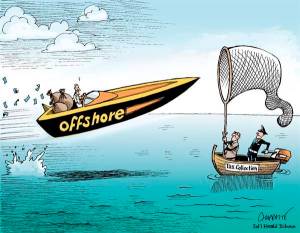
https: //d31029zd06w0t6.cloudfront.net/wp-content/uploads/sites/48/2017/12/web1_offshore-tax-haven.jpg


But Santa, just around the corner … knowing very well, that is need of a radical change in our thinking, leaving individualism and nationalism as methodological guides behind, search gin for long-term programmes that guarantee sustainability, I may still come up with too small suggestions, that can be taken up without much ado:

  • payment of taxes, possibly to a global fund that is based in and linked to rights that deserve to be seen as Global Human Rights and as such guaranteeing peoples’ and people’s freedom from exploitation, which, of course, entails that value chains are not established as poverty-chains.
  • and a really tiny thing: can’t providers of services like wordpress, computers like apple (it would take any single coin from the ca 14 billion they owe the people of Ireland) etc. stop setting the spell-check on US-English as default, often impossible to change … – yes, it is a wee thing – though I am sometimes wondering ion there is a connection between them, called the mental and intellectual trap(ing) coming from US-imperialism.

It is just a matter off the small differences

****

********


bit of work done

and finally even available – the recent “products” now out:

Recording of the Presentation in Łódź (29/11/2018)

Digitisation, AI and the need of another economy

***

Recording of the presentation in Ostrava (5/12/2018)

Bubble Economies Bullshit Jobs Shredding Paintings

***

Recording of the Deans Lecture in Łódź (5/12/2018)

Bullshit jobs – but the problem is the stable

***

Publication in the Journal “Economy of the Region”

an article titled

Two-Criterion Model of the Russian Society Stratification by Income and Housing Security, 

Authored by V. N. Bobkov, P. Herrmann, I. B. Kolmakov, E. V. Odintsova,

Another article with the mystery-title 😉

About You – Nur frage nicht, ob du überhaupt bist

in: Tarantel, 12/2018.

Zeitschrift der Ökologische Plattform bei DER LINKEN

Published with some delay, though not out of date the Social Law Report 6/2017 of the MAX PLANCK INSTITUTE FOR SOCIAL LAW AND SOCIAL POLICY

Entwicklungen der sozialen Sicherheit und des Sozialschutzes in Irland. Juli 2016 – Juli 2017

(These are regular reports and the 17/18 report is already waiting for being uploaded)

Now as recording – im German language:

Honesty Lost?

Tyranny of Lost Honesty

Truth Or: About Clouds and Roads

⇓⇓

Only Problems of Academics?
⇓⇓⇓

The Moral of the Story is …
⇓⇓⇓⇓

*****************

https://qph.fs.quoracdn.net/main-qimg-cc3030c0d2a807f4a1a0989dbe6ab119-c

Tyranny of Lost Honesty

Not cruelty is the attribute of tyranny, but the destruction of the public political realm, monopolised by the despot by claiming ‘wisdom’ … or based on thirst for power, i.e. insisting on citizens looking after their private concerns, leaving it to him, the ‘ruler, to take of the public matters’.[1]

Of course, there are good reasons for proper referencing, based on sound and serious work with books, how, otherwise, should we climb up on the shoulders of giants ….., to borrow from Isaac Newton.

But if serious work is ridiculed by paranoia-infected, formalist series-killers of intellectual freedom one may have to think if one should change discipline, from giant-climbing to em–powerwalking, enabling the intellect to breath again … Or as Frédéric Gros writes:

Many others have written their books solely from their reading of other books, so that many books exude the stuffy odour of libraries. By what does one judge a book? By its smell (and even more, as we shall see, by its cadence). Its smell: far too many books have the fusty odour of reading rooms or desks. Lightless rooms, poorly ventilated. The air circulates badly between the shelves and becomes saturated with the scent of mildew, the slow decomposition of paper, ink undergoing chemical change. The air is loaded with miasmas there. Other books breathe a livelier air; the bracing air of outdoors, the wind of high mountains, even the icy gust of the high crags buffeting the body; or in the morning, the cool scented air of southern paths through the pines. These books breathe. They are not overloaded, saturated, with dead, vain erudition.[2]

At least such setting comes to mind if a publisher, and not only one, is now asking to mention, when inserting tables, matrices etc. something like “own calculation”…. – next step up the ladder of mental tyranny: every sentence requires a footnote: this sentence had been written by myself …. .

The policing ideas are surely not coming from mentally healthy people, who’re are able to make use of the qualification the surely have. It may be that they are actually not coming from people at all – instead emerging from weird apparatuses, independent as a quasi-demon, reminding of The Sorcerer’s Apprentice:

Sir, my need is sore.

Spirits that I’ve cited

My commands ignore.

To the lonely

Corner, broom!

Hear your doom.

As a spirit

When he wills, your master only

Calls you, then ‘tis time to hear it.[3]

More boxing …, the concept against which I argue since some time ….

What is astonishing is that we factually – we = at least too many in academia, factually = in too many cases of writing, administratively and political-economically defining performance – simply accept the bending of law, perhaps with a grumble and an acquaintance, more or less certain within, but factually without counter-censorship and without demanding two, nevertheless, generally valid legal principles:

  • the acceptance of innocence until proven otherwise
  • the obligation of the plaintiff to prove the accusation

It is much safer to celebrate civil liberties than to defend them; it is much safer to defend them as a formal right than to use them in a politically effective way. Even those who would most willingly subvert these liberties usually do so in their very name. It is easier still to defend someone else’s right to have used them years ago than to have something yourself to say now and to say it now forcibly. The defense of civil liberties – even of their practice a decade ago – has become the major concern of many liberal and once leftward scholars. All of which is a safe way of diverting intellectual effort from the sphere of political reflection and demand.[4]

https://qph.fs.quoracdn.net/main-qimg-80a3424c87e948efcc454bb224a81f3d-c

Truth Or: About Clouds and Roads

In the piece The Roads Around Pisa, Karen Blixen wrote

How difficult it is to know the truth. I wonder if it is really possible to be absolutely truthful when you are alone. Truth, like time, is an idea arising from, and dependent upon, human intercourse. What is the truth about a mountain in Africa that has no name and not even a footpath across it? The truth about this road is that it leads to Pisa, and the truth about Pisa can be found within books written and read by human beings. What is the truth about a man on a desert island? And I, I am like a man on a desert island.[5]

Why? Why can truth be characterised this way, as part of walking together one road? And why can one feel this way, deserted, (a)lone(ly) on an island? One reason behind it will be that we are not really acknowledging the fact that we are ourselves only by others – call it ubuntu if you need a name, though remain aware of the fact that it is probably a term that can only be understood by people who ubuntued instead of growing up Western-ly enlightened (or should we say something like who Montesquieu-ed?).[6]To ubuntu then is about knowing the wings of freedom it gives, also feeling the marks of strangulation that come with it, and knowing that no arithmetic sum can be gained to measure its value.

Truth, as much as it is about ‘objective facts’ which includes social facts as approached by Durkheim in sociology, existing independent of any consciousness, is importantly also itself a social fact, on the one hand by being result of our common action, on the other hand by being important element of and for our common action: experiences we have – together with others, or at least together in one space – are the foundation of further experience, further action, further contest, be it contest between people or between people and the objective environment which itself is changed depending on how we approach it, what we do with our experience of it. Though this may sound difficult, it actually is trivial. Go out one of these winter days, just wearing a t-shirt, at the side of your friend who is properly wrapped up … . You will start to feel cold (most likely at least); s/he will say that you are silly, you will physically eventually suffer, may have to stay in bed, put up the heating etc. … it will not necessarily be warmer when you go for a walk next time but, as small as it may be, there is some contribution also from here with regards to global warming. So, yes, there is some reason for saying

If a butterfly flip its wings in one part of the world it is able to cause storm in another part!

Now, there is also some link from here to the referencing. Without denying in any way the need for proper referencing, it is easy to see that it is simply breeding lies when it is getting over the top. The following illustration tries to show this:


Of course, any knowledge comes from somewhere, and thus anything we state comes from somewhere. This ‘somewhere’ develops by way of differentiation, roles historically and individually into some form of formal education [which is also the education in form(alitie)s], cascades up the stream of higher education in humanities and finally evaporating into general knowledge, be it general academic knowledge or ‘general literacy’. Thinking, writing, discoursing surely needs referencing. However, it only makes sense if it is about a definite reference as quote or paraphrasing or reflection of … in the sense of ‘see’ and ‘conferatur’. It does not make sense as matter of claiming ‘property’ where t property does already exist = it does to make sense to say: this is said by me (there are exceptions: to reclaim property: “This is what I said, the other took it from me.” or: “This is what I say, even if all others do not accept it.”)  Strangely enough, publishers and academics are easily accepting extremely sloppy references taking the form of name and date stated, without letting the reader know why they forget mentioning the ‘cf.’ It equally accepted to refer to …, let’s say

Kant, Immanuel. Observations on the Feeling of the Beautiful and Sublime. Trans. John T. Goldthwait. University of California Press, 1961, 2003

This had been taken on the 12/15/18 8:25:45 AM from https://en.wikipedia.org/wiki/Immanuel_Kant

@ from Wikipedia and similar things can be found in books, journals … – oh folks, the Kant who wrote the ‘observations’ in 1764, published 1799 in English language was in 1861 simply dead as a doornail.

– Over-Referencing is surly not much more than an intellectual masturbation of pity bourgeois, not knowing much, having read a lot and completely lacking the courage to say the little they may think quasi-independently, or lacking the courage to think independently …. Or is it about pushing academics – and all of us – finally to take Whithead’s words in Process and Reality

The safest general characterization of the European philosophical tradi- tion is that it consists of a series of footnotes to Plato.

literally. That is surely equally misleading …

Only Problems of Academics?

As such, these are indeed problems of academics – and let’s face it: many widely abused their power by reputation, the lack of control of performance and ethical standards, one of the “highlights” the former minister for education resigning over PhD-plagiarism.

This is of course already something that goes beyond the academic world and effects everybody – as matter of such people being in positions where they decide for instance over the future of our children. Coincidentally, while writing, I receive a mail from the Council of Europe, talking about

Students as suspects? – The challenges of counter-radicalisation policies in education in the Council of Europe member states

But there is even more to it: it is the spirit that pervades in such attitudes: such request for permanent proof, such spirit of distrust is lurking behind so many forms we have to complete, so many authorisations we need – it is the spirit of tyranny Hannah Arendt was talking about starting from the assumption that we are all criminals while giving us an opportunity to show that we are not – it is the opportunity within a strangulated public of a surveillance state.

Far reaching, indeed, and a matter of The Struggle for Law, about which Rudolph Jhering writes[7]and which is really relevant even when it comes to The Tip and how to deal with it – as the same author writes[8]

Ob die hier gemachten Vorschläge Aussicht auf Verwirklichung haben? Man giebt uns Deutschen Schuld, dass wir einen Stein im Wege, an dem wir uns stossen, ruhig liegen lassen — Jeder verwünsche ihn, aber Niemand nähme sich die Mühe, ihn aus dem Wege zu räumen oder, wenn er für ihn allein zu schwer sei, Andere zur Hülfe herbeizuziehen. Das Trinkgelderunwesen ist ein solcher Stein, Jeder klagt über ihn, aber Jeder lässt ihn liegen. Der Vorwurf, den wir gegen den Stein erheben, richtet sich gegen uns selber; wer eine Unsitte bloss verwünscht, anstatt für seinen Theil mitzuwirken, sie zu beseitigen, klagt sich selber an — für das Bestehen einer Unsitte ist Jeder, der nicht den Muth hat, ihr entgegenzutreten, selber mit verantwortlich, Niemand hat das Recht, sich über sie zu beklagen, als derjenige, der sich das Zeugniss ausstellen kann, seinerseits Alles gethan zu haben, was in seinen Kräften stand, um ihr ein Ende zu machen. Jeder meiner Leser kann sich damit in Bezug auf das Trinkgelderunwesen sein eigenes Urtheil sprechen.

Thanks to Deepl.com

Do the proposals made here have any prospect of being implemented? We Germans are blamed for leaving a stone in our way lying quietly – everyone desires it, but no one takes the trouble to remove it or, if it is too heavy for him alone, to bring others to help. The unbeing of tips is such a stone, everyone complains about it, but everyone leaves it lying. The reproach which we make against the stone is directed against ourselves; he who merely curses a bad habit, instead of cooperating for his part in eliminating it, accuses himself – everyone who does not have the courage to oppose it is himself responsible for the existence of a bad habit; no one has the right to complain about it, as he who can give the testimony has done everything in his power to put an end to it. Each of my readers can thus speak his own judgment with regard to the tipping misdemeanour.

(Translated with http://www.DeepL.com/Translator)

The Moral of the Story is …

Kant, in his Metaphysics of Ethics summarised it in a short sentence – the simple thing, of which it is so difficult to get it right:

… he who first makes himself a worm, does not complain when he trampled under foot.

***********

[1]    Arendt, Hannah, 1958: Vita Activa oder Vom Tätigen Leben; München/Zurich: Piper, 1981, new edition: 215; translated from the German edition; the 2nd English edition: Arendt, Hannah, 1958: The Human Condition; Introduction by Margaret Canovan; Chicago: University of Chicago Press; second edition 1998 does not contain the passage in this way

[2]    Passi di: Frederic Gros. “A Philosophy of Walking”. Apple Books.

[3]    Goethe, Johann Wolfgang von, 1797: Zauberlehrling [The Sorcerer’s Apprentice]; translation by Edwin Zeydel

[4]    Mills, C. Wright, 1956: The Power Elite; Oxford University Press, 2000: 334

[5]     Passi di: Isak Dinesen. “Seven Gothic Tales. Isak Dinesen (Karen Blixen)”. Apple Books

[6]     Of course, making such statement evokes the need to qualify it, stating at least: such characterisations have to be taken with care, they are based on out limited knowledge, they are ideal-types/idealisations and as such they are also based on the current view, neglecting for instance several ‘ubuntu qualities’ and also individualist aspects in both our histories.

[7]    Jhering, Rudolph von, 1879: The Struggle for Law

[8]    Jhering, Rudolph von, 1882: Das Trinkgeld

ABC of BSJs

The shooting … Of course, critique is critical in such a moment, and criticising too, if not even reprehensible.

“We must move forward. This is why the European Parliament keeps working.”
It all comes down to a battle of ideas, in which society needs to demonstrate that there is value in freedom, democratic institutions, the free and peaceful expression of ideas, fundamental rights. We need a resilient democracy. And we need a strong Europe.
The show, as they say, must go on.

These are the words from
The Brief – The show must go on by  Alexandra Brzozowski, posted on the 12th of Dezember, at 17:02
The morning of the 12th I had been given a public lecture, titled
Towards the end of the presentation I suggested an ABC of such jobs – or to be more precise, of an economy that boosts such jobs or tasks
managing not by but as doing – the ABC of BSJs:

ppointments, a packed calendar, provide glory

oosting the number of completed forms increases security and replaces proper management


apital is reinterpreted: being the thing in itself, it’s increase is the main thing, even if such increase results from the factual deception of increased amount of input of labour as operand – simply as figure
All show, all glimmer, all appearance, spectacle …
Doesn’t it make more sense to emphasise the need of a move to serious work, beyond the show:
  • beyond and different to sham activities?
  • beyond a bureaucratisation that is searching for justification by remaining self-reflective, not oriented on dealing with people’s and peoples’ life?
  • beyond the glamour of GDP-growth, aiming on sustainable production but also inclusive ways of determining what to produce and how to organize it?
I guess we all need LESS show and more genuine engagement and solid spheres to engage. May be it would be a kind of revolution against le roi, the new king.

roi – ROI

le roi a changé de nom – maintenant il a un nom anglais

(the king [roi] changed his name – has an english name now)

ROI – Return on Investment 


https://extranewsfeed.com/the-emperors-new-clothes-trump-the-media-and-the-problems-of-pluralistic-ignorance-afb276f0bc1e

The value of it, the distribution of what is produced, actually leaves more the people naked, while the new rulers are really something like members of a new feudal class.

********

call for applications and nominations Jörg-Huffschmid-Award 2019

Scroll down for English

Jörg-Huffschmid-Preis 2019

In Gedenken an das wissenschaftliche Werk und das gesellschaftspolitische Engagement des kritischen Ökonomen Jörg Huffschmid wird 2019 zum fünften Mal der nach ihm benannte Preis für herausragende Arbeiten aus dem Feld der Politischen Ökonomie ausgeschrieben. Der Preis soll insbesondere junge Wissenschaftlerinnen und Wissenschaftler ermutigen, kritische Forschung im Sinne des Wirkens dieses herausragenden Wissenschaftlers betreiben.

Jörg Huffschmid, der im Dezember 2009 im Alter von 69 Jahren gestorben ist, verband in seinen Arbeiten scharfsinnige Analysen mit Kapitalismuskritik und politischer Vernunft. Als einer der Gründer der Arbeitsgruppe Alternative Wirtschaftspolitik und der EuroMemo Gruppe sowie in seinem Wirken im Wissenschaftlichen Beirat von Attac und der Rosa-Luxemburg-Stiftung war sein persönliches, politisches und wissenschaftliches Zieleine sozial gerechte Gesellschaft – gegen die vermeintliche Alternativlosigkeit des wirtschaftswissenschaftlichen Mainstreams. Diese vier Organisationen schreiben daher den Preis seit 2011 alle zwei Jahre gemeinsam aus.

Eingereicht werdenkönnenneben Dissertationen auch Magister-, Master- und Diplomarbeiten in der Kategorie Abschlussarbeiten. Für Dissertationen ist eine Auszeichnung über 1.500 Euro und für Studienabschlussarbeiten über 500 Euro vorgesehen. Die Arbeiten sollten dem Feld der Politischen Ökonomie entstammen, zum Beispiel:

  • Finanzmarkt-, Fiskal-, Handels- und Industriepolitik
  • Alternativen zu Austerität und Privatisierung
  • Militarisierung europäischer Außen-, Grenzsicherungs- und Rüstungspolitik
  • Herausforderungen im digitalen Zeitalter
  • Sozial-ökologischer Umbau
  • 10 Jahre nach dem Zusammenbruch von Lehman Brothers – Lehren aus der jüngsten globalen Finanz- und Wirtschaftskrise
  • 20 Jahre Euro – Kontroversen um die Europäische Währungsunion

Dabei ermutigen wir ausdrücklich zur Einreichung disziplinübergreifender Arbeiten, die ökonomische mit sozial- oder politikwissenschaftlichen Ansätzen kombinieren.

Berücksichtigung finden Arbeiten, die seit dem April 2017 an einer europäischen Hochschule in deutscher oder englischer Sprache eingereicht und bewertet wurden. Arbeiten von Mitgliedern der ausschreibenden Arbeitsgruppen, Beiräte und den Beschäftigten der RLS können nicht berücksichtigt werden. Ihre Bewerbung richten Sie bitte vollständig und ausschließlich in elektronischer Form bis zum 1. April 2019 anJoerghuffschmidpreis@esosc.eu. Ihrer Arbeit fügen Sie bitte bei:

  1. Anschreiben
  2. Zusammenfassung im Umfang von 800 Wörtern – in der der Bezug zum wissenschaftlichen Werk von Jörg Huffschmid dargestellt wird
  3. Lebenslauf
  4. die hochschulischen Gutachten zur Arbeit.

Die Jury des Jörg-Huffschmid-Preises besteht 2019 aus:

Gerstenberger,Heide,Wissenschaftlicher Beirat Attac, Universität Bremen;

Hafkemeyer,Jörg;Wissenschaftlicher Beirat der Rosa-Luxemburg-Stiftung, Universität der Künste Berlin;

Herrmann, Peter, EuroMemo Gruppe, Corvinus University Budapest;

Huffschmid, Anne,FU-Berlin

Mahnkopf,Birgit,Wissenschaftlicher Beirat Attac, Hochschule für Wirtschaft und Recht Berlin

Ötsch, Silke, Wissenschaftlicher Beirat Attac

Sablowski, Thomas, Rosa-Luxemburg-Stiftung

Sauer, Thomas, Arbeitsgruppe Alternative Wirtschaftspolitik, Ernst-Abbe-Hochschule Jena;

Schrooten, Mechthild,Arbeitsgruppe Alternative Wirtschaftspolitik, Hochschule Bremen,

Beratend arbeitenBärbel RompeltienundRainer Rilling(Mitglied des Vorstands der Rosa-Luxemburg-Stiftung) in der Jury mit.

Die Preisverleihungist für den 18. Oktober 2019 in Berlin geplant.

Kontakt und weitere Informationen:

Peter Herrmann,herrmann@esosc.eu

Dezember 2018


Jörg-Huffschmid-Award 2019

In memoriam of the scientific work and the political engagement of the critical economist Joerg Huffschmid the call for the award that is named after him is now announced for the 5thtime, awarding outstanding works in the field of Political Economy. The aim is to encourage in particular young scholars to take up on the tradition of critical thinking for which the outstanding name giver of the prize stands.

Joerg Huffschmid, who passed away in December 2009, at the age of 69 years, combined in his work astute analyses with a critique of capitalism and political reason. As one of the founders of the Arbeitsgruppe Alternative Wirtschaftspolitik, the EuroMemo group and member of the scientific council of attac and the Rosa Luxemburg Foundation he aimed in his personal, political and scientific life on a socially just society, engaged against the supposed lack of an alternative as suggested by mainstream economics. Therefore the four organisations publish since 2011 the call for this award.

We invite final degree-theseson level of PhD, Magister, Master and Diploma. The selected PhD-thesis will be awarded with 1500 Euro, the other collected degree thesis will be awarded with 500 Euro. The work should be related to the field of Political Economy, and look, for instance at the following:

  • finance, fiscal, trade and industrial policy
  • alternatives to austerity and privatisation
  • militarisation of European foreign-, border-security and armament policies
  • challenges arising from processes of digitalisation
  • socio-ecological remodelling
  • social and technological innovation and new economic systems
  • 10 years after the collapse of Lehman Brothers – consequences of the recent financial and economic crisis
  • 20 years Euro – controversies concerned with the European Monetary Union

Encouraged are especially theses that apply an approach that brings different disciplines together, integrating economics and approaches from social and political science.

We will consider submissions that had been accepted since April 2017at a European university/third-level institution, submitted in German or English language.Submissions by members of one of the four organisations and members of the respective scientific councils will not be considered. Applications are only accepted in electronic form, to be sent before or at the very latest on April 1st, 2019to the following address:

Joerghuffschmidpreis@esosc.eu

Please, attach the following:

  • Cover letter
  • Summary of 800 words, showing the link to the scientific work of Joerg Hufschmid
  • CV
  • Academic references that had been provided as part of the graduation process

Members of the Jury:

Heide Gerstenberger, Wissenschaftlicher Beirat Attac, Universität Bremen; Jörg Hafkemeyer, Wissenschaftlicher Beirat der Rosa-Luxemburg-Stiftung, Universität der Künste Berlin; Peter Herrmann, EuroMemo Gruppe, Corvinus University Budapest; Anne Hufschmid, FU Berlin; Birgit Mahnkopf, Wissenschaftlicher Beirat Attac, Hochschule für Wirtschaft und Recht Berlin; Silke Ötsch, Wissenschaftlicher Beirat Attac, Soziologin; Thomas Sablowski, Rosa-Luxemburg-Stiftung, Thomas Sauer, Wissenschaftlicher Beirat Attac, Ernst- Abbe-Hochschule Jena; Mechthild Schrooten, Hochschule Bremen;consultative Bärbel Rompeltien and Rainer Rilling (Rosa-Luxemburg-Stiftung)

The awarding ceremonyis planned for October 18th2019 in Berlin.

Contact and further information

Peter Herrmann, herrmann@esosc.eu

You will get a more or less immediate conformation of the submission, if you do not receive this after a week, please contact the coordinator.

Becoming Socially Acceptable ?

Public lectures are scheduled for the 5th and the 12th December.

After last week’s special lecture to a group of PhD-students, looking at
the upcoming lectures are linking to the recent book “Bullshit Jobs – A Theory”. [1] So is it finally socially acceptable to use such term as Bullshit in academic parlance?
It surely is a catchy phrase, and it also is surely a topic that allows to think abut all the Kafkaesk patterns and requirements …But as glad as I am to take up on the catchiness and as much as I appreciate that Graeber is interested in a very specific point, namely
to understand the psychological, social, and political effects of the fact that so many of us labor under the secret belief that our jobs lack social utility or social value
I am wondering if it is not also a danger of distracting from rather complex issues, linked to more or less fundamental shifts in economic structures.
The honour to give the reputable Deans Lecture at the Faculty of Economics and Sociology in Łódź on the 12th of December provides the opportunity to look at

Bullshit Jobs? suggesting that the Problem is the Stable

The aim is to show that – leaving some general aspects of squander, disrespect and ignorance aside – the underlying problem is an ongoing shift of capitalist accumulation that requires the increasing segregation and fragmentation: The fact that use value and exchange value are juxtaposed results necessarily in the fact that human relationships are systematically torn apart: to relate humans to each other they first have to – speaking systematically – separated by the process of commodification. On the market of commodities they are becoming equal and can – then, ex post – relate to each other. Not least it means that the increasing mediatisation – indeed Graeber points out that most of the relevant jobs occur in IT-related sectors – is necessary condition for making society economically possible. However, it also means that content doesn’t count – as much as capital SEEMINGLY generates capital as much is the sole presence of people considered to be a job, even if it is

a form of paid employment that is so completely pointless, unnecessary, or pernicious that even the employee cannot justify its existence even though, as part of the conditions of employment, the employee feels obliged to pretend that this is not the case.

– this is Graeber’s definition.

For the week before, on the 5th of December, the sociology department of the Ostravská univerzita in the Czech Republic organised a special lecture, the title of which is
In addition to the Graeber-book another reference is the more or less recent auto-shredding of Bansky’s Painting “Girl With Balloon” – the latter again giving the opportunity discuss the problems of hegemony and counter-hegemony – the link is given by reflecting on a statement by Hannah Arendt. She contends that
(n)ot cruelty is the attribute of tyranny, but the destruction of the public political realm, monopolised by the despot by claiming ‘wisdom’ … or based on thirst for power, i.e. insisting on citizens looking after their private concerns, leaving it to him, the ‘ruler, to take of the public matters’.[2]
Surely something marking a demarcation we face – be it in the shopping centres or academic institutions or political space.
*****
[1] David Graeber, 2018: Bullshit Jobs – A Theory; New York et altera Simon&Schuster
[2] Arendt, Hannah, 1958: Vita Activa oder Vom Tätigen Leben; München/Zuerich: Piper, 1981, new edition: 215; translated from the German edition; with reference to Aristotle: Athenische Verfassung; XV, 5 – the available English edition did not contain the statement in this clarity.
******

Net-Work-Effect-S

I still try to figure out how it works – network effects …the Net-Work …

Isn’t it remarkable that we find more and more the term ‘extraction of value/extraction of profit’ where we talked previously about the production of surplus value? This is getting vaguely perceptible looking at the development of paypal. According to Elon Musk, initially incentives of $20, then $10, later $5 had been spent to attract new customers, until a critical mass had been reached. According to Musk it had been “a fair amount. I think it was probably $60 or $70 million” this is what we learn from Elon Musk – CEO of Tesla Motors and SpaceX | Entrepreneurship | Khan Academy – quoted from the auto-transcript. It is about attracting people to extract value from the fact that they are linked together – a rather simple mechanism.

Well, extraction – who likes digging in the ground, getting dirty – that is what usually happens when extracting things.

Anyway, this example clearly shows that network effects do exist: after reaching a critical mass things are becoming shiny self-movers, after enough people caught in the net, the effect is that it works: shines like a bright star over the present, seemingly reaching beyond the horizon …

Shiny …? – hang on: The College Edition of  WEBSTER’S NEW WORLD DICTIONARY OF THE AMERICAN LANGUAGE (THE WORLD PUBLISHING COMPANY Cleveland and New York (Copyright 1960 and 1953, 1954, 1955, 1956, 1957, 1958, 1959) says on page 985, under the lemma net

trap, snare, caught – clean, pure – gain are some outstanding terms

*****

The other day  I received a mail by a trade company, asking me to join a draw, liking the company on Facebook (tempting to join FB?). And inviting to tell a story (probably nobody would read anyway, and definitely not relevant for the “competition”). Anyway, the moral of the (more or less immoral) story: join us by joining facebook to be joined by facebook that joins us in order to find more to join facebook that join more to joining us … — there is at some stage no choice, no end, just for the sake of being part of it: the plastic card society, virtualised as social-network society where shops – for grocery’s to high-end whatsoeveryounameit-products and services are themselves networks, presenting themselves as such … where shopping in the stores, according to Apple’s Angela Ahrendts, is about 20 % buying, 80 percent about being part of it …., an expensive part if we think about it – but neat, shiny, — nets, the

‘fabric made from string … used to trap or snare’

these nets do indeed work:

the stores become a place to experience physically live everything you’ve been doing on your device

… and vice versa: what you are made to see and hear: the reality transformed into the store …,  becomes the reality.

Of course, there is a dangerous side to it, often called conspiracy, but actually a matter of using two very simple rules

first, six degrees of separation, namely the apparent fact that things and people are six or even less steps away from each other

second, the fact of 

taking the immediate encounter as the limit of knowable reality. In both, external knowledge on the part of the audience is not involved—in the city by necessity, in the theater by fiat (using the words of Richard Sennett in The Fall of the Public Man)

Taken together, the effect of the working net is the establishment of permanent trust: trusting the other on sounds of a vague feeling of knowing each other while we try everything to hide from each other and sadly from ourselves – the remaining trust – and of course there is some – goes with the commodities obtained and the self, saved somewhere as Narcissus.

At the end, in entrepreneurial terms it is net profit, extracted …, coming from nowhere else than from shine , pictures, at times amazing in their beauty, definitely in their deception  …. .

*****

Another “the other day” … wondering around, watching one of these street artists, fascinating today like those impostors in the medievals (I can only guess, never met one – just to young): a little puddle, and huge, huge bubbles after a short while, jiggling and joggling and juggling with the long special rope at the end of the two sticks, transposing matter into air, caught in a sometimes colourful, always shiny ball of air …. remaining nothingness of singularity located between zero and one.

*****

the red of the black

Black Friday, another bad import from ‘big brother’

– the following doesn’t even look at the small print let alone at what seems to be so small that it is not even printed: such day we are bombarded with goods — all those ‘special offers’ the sale of which, I am sure, still allowed to make a profit good profit: whatever the historical background is, that special day was not made a tradition of making loss. Besides this probably everybody reading these lines had been bombarded with e-mails, many unwanted SPAM-mails

By Source (WP:NFCC#4), Fair use, https://en.wikipedia.org/w/index.php?curid=44458281

, aiming on convincing us to buy buy buy …

Leaving aside the wasted time – deleting all the unwanted mails and getting upset …- there is another, actually real cost: According to the Guardian

The sending, sorting and filtering of spam email alone accounts for 33bn units of electricity each year

According to another source – PhysOrg

Sending even a short email is estimated to add about four grammes (0.14 ounces) of CO2 equivalent (gCO2e) to the atmosphere.

To put this into perspective, the carbon output of hitting “send” on 65 mails is on par with driving an average-sized car a kilometre (0.6 of a mile).

And furthermore they calculated

The global carbon footprint from spam annually is equivalent to the greenhouse gases pumped out by 3.1 million passenger cars using 7.6 billion litres (two billion gallons) of gasoline in a year.

Of course, it is difficult to draw a line and perhaps such blogs as this should not exist. But leaving this aside, Black Friday was surely a red day, a warning lamp switching on such day when looking at the environmental question: a huge cost for the environment …, rarely considered or calculated; a huge “contribution to the GDB”, proving that in capitalism production of waste is considered to be valuable.

Digitisation and Precarisation – Redefining Work and Redefining Society

Off it went – the script, as “final draft” – had been sent to Springer who agreed already to publish the work as part of the S.U.P.I.series – SUPI being the network researching issues of social uncertainty, precarity and Inequality.

The following presents the outline of the book. Below then part of the first contribitution as kind of teaser, followed at the end by the list of contributors.

Vyacheslav Bobkov/Peter Herrmann (Eds.)

Digitisation and Precarisation – Redefining Work and Redefining Society

Acknowledgements5

Peter Herrmann/Vyacheslav Bobkov       6

Foreword: Digitisation and Precarisation – Redefining Work and Redefining Society     6

Abstract    6

General Remarks        6

Searching for a Framework         9

Bibliography      33

Peter Herrmann       38

Economy of Difference and Social Differentiation    38

Precarity – searching for a new interpretative paradigm          38

Introduction      38

Varieties of Capitalism or Variety Within the One Capitalism?        42

Capitalism in One Country?         46

Societal Development – Between Inclusion and Exclusion     51

Dis-Embeddedness – Searching the Reference     53

Evaluating Costs         59

Empirical Dimensions         63

References         65

Vyacheslav Bobkov  73

Society under Threat of Precarity of Employment   73

Theory and Methodology   73

Outline of ontological characteristics of societies with unstable (Precarious) employment       79

About the axiological characteristics of social structures of precarious employment        85

Social housing standards: minimum, medium and high housing standards.   89

Conclusion         93

References         95

Nataliya Loktyukhina        98

Precarious Employment: Definition of the Concept Given by Russian Researchers98

The Relevance of the Research   98

Variations in Defining the Concept of “Precarious Employment”   99

Russian Experts’ Appreciation of PE Definitions.  101

Compulsory character of relations in flexible (non-standard) employment as a criterion of precarity      103

Types of Employment with High Precarity Potential     105

Features of Precarity Recognized and Unrecognized by the Employee.  109

Complex of Probabilistic Criteria of Precarity.       110

Conclusion.         113

References.        114

I.V. Novikova    117

Digitalization: a New Form of Precarity or New Opportunities?       117

  1. Digitizing of Jobs 117
  2. Elimination of Territorial Boundaries of Jobs’ dislocation 120

III.  Generation Z Enters the Labour Market          122

  1. Development of Specialisation, Multitasking and Vertical Disintegration of Production. 124
  2. Differentiation of Income 125
  3. Non-conventional Workplaces 126

VII. Online-platforms127

Conclusions: Factors of Digitalization, Facilitating and Restraining Precarity of Employment    129

References         130

Olesya Veredyuk       136

Labour market performance and digitisation of work: brief overview    136

Abstract    136

Introductory Overview       136

Precarious employment: quantitative and qualitative measurements    138

Precarisation aspects of digitisation     141

Institutional nature of employment precarity       142

Conclusion         144

Reference144

Veronica Sheen         146

Australia’s precarious workforce and the role of digitalisation      146

Introduction      146

Overview of Australian employment   147

Integration into employment      150

Fragmentation of employment    153

21stcentury hyper-flexibility and job insecurity  154

Precarious employment and social control   155

Conclusion         156

References         159

Nicole Horáková       163

The Czech Republic – a Case Study   163

Introduction      163

Economic Development and Labour Market: From Basement-Dweller to Top Performer?        165

Development of Employment and Unemployment in the Czech Republic      165

Changing Working Contracts?       166

Rising Debts of Czech Households  168

Challenges Presented for the Czech Republic by Industry 4.0 and Digitization       168

Challenges for the Industry         170

How Digitalized is the Czech Population?         172

Industry 4.0 and Digitization: New Forms of Employment on the Czech Labour Market?       173

Education as a key activity175

Conclusion: Is the Czech Society Prepared?176

Bibliography      177

Judit Csoba       181

„Predictable uncertainty” – Social Land Programme in Hungary      181

Abstract    181

Introduction      181

The Social Land Program between 1993 and 2004      182

“Village enterprise” – The new character of the Social Land Program: cooperatives instead of households       186

Social Land Program without land       188

Main dilemmas of the Social Land Programme     191

Summary  193

Bibliography      195

Mehmet Okyayuz      199

Affirmative and Alternative Discourses and Practices of Knowledge Production and Distribution in Turkey199

  1. The Metapolitics of Digitization: The Political-Ideological Discourse of Producing and Distributing Knowledge200
  2. Digitization as an Affirmative Practice in the Global System208

Ray Griffin/Tom Boland/Aisling Tuite / Aoife Hennessy         218

Electric dreams of welfare in the 4thindustrial revolution: An actor-network investigation and genealogy of an Algorithm.218

Abstract    218

Introduction: The Algorithm of life in the 4thIndustrial revolution         220

Socio-Technical Control of Welfare      222

Digital dole – PEX       224

PEX and the Irish Welfare System       227

The implications of the use of an algorithm in context  231

The social life of the PEX algorithm     232

Technotopia, Theology and Redemption      235

Enter faith, then God237

In sum       239

Bibliography      241

Vadim Kvachev         247

Bringing Precarity to the Political Agenda        247

Contributors    260


Acknowledgements

The editors want to thank all contributors for the work and the patience which allowed taking the time for the work on the book. We also are grateful for the editors of the series, namely David Kregel, Rolf Hepp and Robert Riesinger – equally patient and supportive. Not least special thanks go to Veronica Sheen who helped with some language editing.

The work on the individual contributions benefited from different sources which are – where applicable – mentioned by the authors.

Peter Herrmann wants to extend his expression of gratitude to the Max-Planck- Institute for Social Law and Social Policy, Munich and the Faculty of Economics and Sociology, University of  Łódź – without their generous support the editorial work would not have been possible.

(just some teaser .. – though many contributions are highly empirical …)

Peter Herrmann/Vyacheslav Bobkov

Foreword: Digitisation and Precarisation – Redefining Work and Redefining Society

Abstract

Currently it is fashionable to talk about digitisation, robotisation, industry 4.0, but also about the gig economy, the Millenials, precarisation and the like. However, too often the relevant issues are taken in isolation, very much caught in traditional terms. The present collection aims on providing some thoughts that allow going further, on the one hand by qualifying some of the aspects, and on the other hand by taking a view that approaches the topic from distinct perspectives in order to arrive at an assessment of emerging societal changes.

General Remarks

The present collection is an attempt to define the field of precarity more systematically than it is usually undertaken. Doing so, there had been at least theoretically different options. The two most obvious approaches are the following: leaving it to the contributors to find their own definition and applying it to national frameworks, later gathering the different approaches in an attempt to find a minimum common denominator. The other, not fundamentally different, endeavour would be to start from a “standard definition”, e.g. one used by major statistical proponents as EUROSTAT, the ILO or OECD, asking the contributors to evaluate and assess the situation in specific fields and countries, then leaving it to the editors again to come up with a minimum common denominator. The problem in both of the cases is that the object of investigation is both, complex and multifaceted as well as relational. Another, pragmatic, challenge is in both cases the need to gather a research team that is able to work along such a given line, in turn committing themselves to such task, which simply requires available resources that allow retreating from other ongoing work.

In any case, in particular the relational character of the subject issue advises to avoid from the outset an approach that requires a firm foundation which is then used to assess the problem by scaling, i.e. suggesting different degrees to which we may speak of precarity. Such approach would suggest at least the following

  • a once and forever given normality, thus neglecting the fact that full and permanent employment – usually counterposed to precarity – is a socio-economic construct that is hugely presupposition-rich. In actual fact it can be said that it is based on a systematic reversal of reality – as concluded in the contribution by Herrmann the means of (re-)production – and with this employment as specific form of work – are fictitious part of human existence, not more and not anything else than means to maintain physical existence. In other words, what is supposedly normal appears now as socio-historical exception
  • furthermore, it is easily overlooked that such “supposed norm” usually depends on derivations: the two most obvious instances are (i) the need for non- or not completely commodified spheres that secure employment as dominant (e.g. housework, social benefits in cases of unemployment, sickness …) and (ii) the local and regional segregation and “division of work” that secures the execution of societally necessary tasks despite extremely dispersed conditions of profitability (e.g. the rural-urban-divide)
  • relevant is also that we are witnessing the multifaceted character by way such normality being itself in some way a patchwork: if we take as more or less arbitrary example, permanent 40 years full-time (forty-hours/week) employment as norm, it will most likely take for every individual a different shape: times of education may under certain conditions be acknowledged as acceptable derivations; DIY or temporary private saving from some kind of “windfall income” may work out as individual solution as some form of “unviable saving” (e.g. substandard accommodation …) may offer temporary substitution for failing to reach the norm
  • moreover – without claiming that this is an exhaustive compilation – in particular socio-economic changes that are part of socio-technical and socio-spatial shifts may well change the overall setting of soci(et)al embedding, disembedding and communication – bonds and margins, solidarities and hostilities are redefined, opening new forms of material support but also new mechanisms of exclusion.

One of the core problems is that there is no – even roughly defined – clear line allowing a demarcation between different facets – insecurity of employment, but only if it is lasting, and only if it is connected with serious material cutbacks, and/or only if it seriously influences social embeddedness and causes psychological distress? Another approach could look for more societal dimensions, asking if we should speak of precarity only if “classical patterns of unemployment” do not apply, as we see it today, where some definitions refer simply to insecure employment moving into the centre of society – a title like InfoproletárIos. Degradação real do trabalho virtual, speaking of degradation in connection with virtual work (Antunes/Braga, 2009) is surely telling as it implies a downward-turn from a given status. On the other hand we witness empirically different patterns: the down-grading of existing jobs, the emergence of new jobs that are from the outset defined by precarious conditions, and a variety of “entries” into a segment which Ricardo Antunes classifies in a broader sense, starting by looking at the character of work; for him “(t)he future of work for the world’s laboring masses appears to be one of flexible employment, with no pre-established working days, no clearly defined working spaces, no fixed wages, no pre-determined activities, no rights, and no protection or representation by trade unions. The system of “goals” itself is flexible: tomorrow’s goals are always changing, and must always be superior to those of the previous day.” (Antunes, 2018). Different approaches can be taken and looking at the literature shows that the most common reference is that we are dealing with some kind of “patchwork”. Different criteria, different combinations, usually centring on employment patterns, reaching from there out to all spheres of life.

In concrete terms this means that this volumes compiles contributions that aim on making a distinct input to the debate by looking at different aspects instead of presenting a strictly comparative perspective. The contributors followed some generally accepted “fundamentals”, highlighting in an interpretative way their meaning regarding the chosen functions and dysfunctions of socio-economic integration. In addition, and this is actually part of the comparative perspective, it is also about the interpretation in the specific national perspectives.

…..

Contributors

Bobkov, YyacheslavDoctor of Economics, Professor, Head of the Laboratory of Problems of Life Quality and Living Standards of the Institute of Socio – Economic Problems of Population of the Russian Academy of Sciences, Moscow, Russia

Boland, Tomis a lecturer in sociology in the school of humanities and co-founder of WUERC (Waterford Unemployment Experiences Research Collaborative)

Csoba, JuditProf. Dr. habil. Department of Sociology and Social Policy, University of Debrecen. Research focus: Sociology of Work, Social Policy, Employment Policy, Social Economy

Griffin, Raylecturer in strategy in the school of business, he is co-PI of the PEX project and co-founder of WUERC (Waterford Unemployment Experiences Research Collaborative)

Hennessy, Aoifelecturer in mathematics in the school of science and computing and is co-PI of the PEX Project.

Herrmann, Petersocial philosopher, having worked globally in research and teaching positions in particular on social policy and economics.

Horáková, NicoleDepartment of Sociology, Faculty of Arts, University of Ostrava

Kvachev, Vadim PhD in Sociology, Assistant Professor, Plekhanov Russian University of Economics, Moscow

Loktyukhina, NataliaDoctor of Economics, Professor, Academy of Labour and Social Relations

Novikova, IrinaPh.D. in Economics, Associate Professor, the Laboratory of Problems of Living Standards and Quality of Life of the Institute of Socio-Economic Problems of Population; Russian Academy of Sciences, Moscow

Mehmet OkyayuzDepartment of Political Science and Public Administration at Middle East Technical University in Ankara/Turkey. Some of his areas of research and education are labor migration along with Political Theory/Thought, Social Policy and Ideology Research

Sheen, VeronicaAustralian social researcher, specializing in the growth and effects of precarious employment which was the subject of her doctoral research at Monash University. She is a widely published commentator on the future of work

Tuite, Aislingis a post-doctoral researcher on the PEX Project

Veredyuk, OlesjaPhD, Associate Professor, Saint Petersburg University, Russia