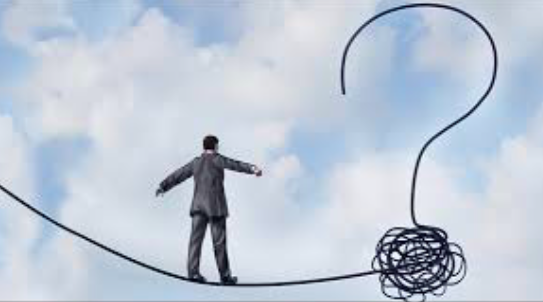
strength

wishes at the end of the one and beginning of another semester I

May we gain the strength, to acknowledge the limits of our wisdom and judgement without accepting the consequences arising from there – this, instead of being tempted to think we know everything, and even worse, knowing everything better than those who are directly concerned. 

senza via d’uscita

la speranza è l’ultima a morire

hope is the last to die 

l’espoir est le dernier à mourir. 

die Hoffnung stirbt zuletzt


a rather simple formula, logics for beginners

∀x(Sx⇒Mx)

∀x(M⇒Px)

∀x(Sx⇒Px)

But seen in this light …, does it mean those who lost hope are already dead? Guess it really does make life much easier then …

Uncertainty as the highest state of insecurity

The following gives an outlook on a new publication, contributing to the work at the HIGHER SOCIAL AND ECONOMIC SCHOOL IN GDAŃSK (WSSE) on Security issues in education and management, selected aspects of social security

Discussing increasing populism and right-wing political movements and social law together is commonly – and without any doubt importantly – dealing with issues of social legislation, employability and emphasising the importance of ‘honesty and reliability’ from the political side. And while globalisation is not condemned, it is at least in tendency suggested to be a centre piece of the present quarrels; migration, low-wage policies, capital-flight and tax competition are then highlighted as major issues. The present contribution aims on taking a wider approach, arguing that one of the major problems is the aggravation of a secular process that may be called – alluding to Karl Polanyi’s work – disembedding of law.

The Price to be paid

Much has been said about the price to be paid for success … and often the German’s are praised: zeal, diligence …, though Protestantism was and is not necessarily dominant amongst the Germans, this tribe is often presented as incarnation of the protestant work ethics (as Max Weber analysed it). Topics for many discussions; many topics for discussion.

One aspect, often forgotten, had been mentioned by Immanuel Kant, though emerging from a possibly unexpected, even unrecognised context (English below):   

Die vorzügliche Achtungsbezeigung in Worten und Manieren selbst gegen einen nicht Gebietenden in der bürgerlichen Verfassung – die Reverenzen, Verbeugungen (Complimente), höfische – den Unterschied der Stände mit sorgfältiger Pünktlichkeit bezeichnende Phrasen, – welche von der Höflichkeit (die auch sich gleich Achtenden nothwendig ist) ganz unterschieden sind – das Du, Er, Ihr und Sie, oder Ew. Wohledlen, Hochedeln, Hochedelgebornen, Wohlgebornen ( ohe, iam satis est !) in der Anrede als in der Pedanterei die Deutschen unter allen Völkern der Erde (die indische Kasten vielleicht ausgenommen) es am weitesten gebracht haben, sind das nicht Beweise eines ausgebreiteten Hanges zur Kriecherei unter Menschen? ( Hae nugae in seria ducunt. ) Wer sich aber zum Wurm macht, kann nachher nicht klagen, daß er mit Füßen getreten wird.[1]

Preferential tributes of respect in words and manners even to those who have no civil authority – reverences, obeisance’s (compliments) and courtly phrases marking with the utmost precision every distinction in rank, is something altogether different from courtesy (which is necessary even for those who respect each other equally) – the Du, Er, Ihr and Sie, or Ew. Wohledeln, Hochedeln, Hochedelgeborenen, Wohlgeborenen (ohe, iam satis est!) as forms of address, a pedantry in which the Germans seem to outdo any other people in the world (except possibly the Indian castes): Does not all this prove that there is a widespread propensity to servility in men? (Hae nugae in seria ducunt) But one who makes himself a worm cannot complain afterwards if people step on him.[2]

Worthwhile to think about it, not least as it reminds a bit of Mills, thinking about the dissatisfied human and the satisfied pig.

It may be worth to mention that, looking for the text on the internet, usually quotations omit the last sentence, thus, I would say, omitting the price to be paid for such success.


[1]    (Kant, Immanuel, 1793: Die Religion innerhalb der Grenzen der bloßen Vernunft. Die Metaphysik der Sitten; 437)

[2]    (Kant, Immanuel, 1793: The Metaphysics of Morals; Introduction, translation, and notes by Mary Gregor; New York et altera: Cambridge Univesity Press, 1991: 232)


had I been wrong ?

or is it just the world that took a wrong turn?

https://www.ft.com/__origami/service/image/v2/
images/raw/http%3A%2F%2Fcom.ft.imagepublish.
prod.s3.amazonaws.com%2Fc707b964-0471-11e7-
ace0-1ce02ef0def9?source=next&fit=scale-down&width=600

… I share the general and underlying gist of your concern: there had been a historically specific background against which the work emerged and consolidated. And it consolidated by elaborating, by deeper collective reflection on the conditions that provided the womb from which it is the off-spring, and with the firm conviction to cut off the umbilical cord, the provider altering, being carrier of the venom, ready to kill his child which he would have preferred to be still-born anyway. What is the answer? Is there only one answer?
One reply is very common, and a kind of standard object of sociological investigation: aim on growth in order to be sufficiently strong in order to stand up and resist – again and again the danger of being poisoned had been revealed – now walking, after the umbilical cord cut-off the problem comes while walking: It is not possible without rest, and even rooting is necessary – the striking leg depends on the supporting leg, and as harder as you one wants to strike, as stronger the supporting leg has to be. Not biologist nor professional player are needed to know: sooner or later the one leg gets in the way of the other, and by the very nature of this process, it is the supporting leg that will gain dominance. – The problem with [the project] is that we forgot that cutting off the cord, still left us on the same poisoned soil on which we now try to walk.

The alternative: aiming on inner strength, remaining a small group, or at least prioritising a healthy strong diet and movement, not per se growing in seize. Call it developing instead of growing, sturdily walking, instead of running with the support of narcotics (of course, these narcotics are called antibiotics, and the like), faster though not sustainable, and less and less able even to survive without the drugs.
Dilemmas, dichotomies, contradictions, hopelessness, challenges, choices, facing bills that need to be paid … understand it as you like, coming statistically to the end of my life, I am wondering, if I have to question my first real child, baptised “Die Organisation”, though brought on the way with the second name “Eine Analyse der modernen Gesellschaft”. Inscribed had been the thesis:
Kurzum: gefordert ist die Erfassung genau diese komplexe Widersprüchlichkeit, in der Organisationen (ent-) stehen und die sie selbst bilden – sowohl in sich als auch in ‘Beeinflussung ihrer Umwelt’. Es geht mit anderen Worten um die Erfassung von Organisationen als vergesellschaftete und zugleich vergesellschaftende Gebilde, die sich durch Strukturiertheit und Prozessualität auszeichnen.**
As so often, we can learn from one of the disciplines dealing with nature. In her book “Chaos Bound. Orderly Disorder in Contemporary Literature and Science”, Katherine Hayles states on page 221
Consider, for example, how conceptions of gravity have changed over the last three hundred years. Gravity is conceived in the Newto­ nian paradigm very differently from in the general theory of relativity. For Newton, gravity was the result of mutual attraction between masses; for Einstein, it was the result of the curvature of space. One might imagine still other kinds of explanation, such as a Native American belief that objects fall to the earth because the spirit of Mother Earth calls out to kindred spirits in other bodies. But no matter how gravity is conceived, no viable paradigm could predict that when someone steps off a cliff, she will remain spontaneously suspended in mid-air. This possibility is ruled out by the nature of physical reality.

And now it nevertheless seems that another hybrid is trying to emerge. While we do not know about Schroedinger’s cat before the box is opened, while it is thus important to make use of the openness and indeterminacy as we do know that hybrids are so far only found on burial sites …

The [project’s] growth-path reminds me a bit of what is frequently said about the cobbler: that he wears the worst of all shoes. Being scientists we may have to think about it when it comes to the knowledge and ability to deeply reflect as the braingear we use when thinking as the rambler disposes of when walking.
May be this metaphorical way of writing inspires to some thinking, and may be it encourages to return to another crucial element of what [the project] had been about: a really collective exercise of a day growing and going together, instead of bringing individuals together for a common walk for a while ….
So long, courage …
Peter
**
In short: the challenge is to capture precisely this complex contradictoriness in which organisations (en-) stand and which they themselves form – both in themselves and in ‘influencing their environment’. In other words, it is a matter of recording organisations as socialised and at the same time socialising entities which are characterised by structure and process.
(Herrmann, Peter, Die Organisation …: page 6 (machine translation)

never … – theless …

(English below – a message I sent to my bank, my health insurance, my … – wherever I have an “account”)

Danke fuer die Nachricht, eine Frage an die administration der Kommunikation: Ist es wirklich erforderlich, dass ich eine mail bekomme, die mir mitteilt, dass ich eine Nachricht im Portal habe, fuer deren Zugang ich mich einloggen muss, die ich dann öffnen muss, um zu erfahren, was letztlich ausreichend im Betreff der e-mail Nachricht haette mitgeteilt werden können. Abgesehen von meiner Zeit, die da verschwendet wird (ihre auch, aber Sie werden fuer solchen Unfug bezahlt, leiten Sie dies ich bitte einmal an die unverantwortlichen Verantwortlichen weiter:

https://pixabay.com/it/bolle-grazie-messaggio-cliente-1968298/

Thank you for the message, a question to the communication administration: Is it really necessary that I receive an e-mail telling me that I have a message in the portal, for whose access I have to log in, which I then have to open to find out what could have been sufficiently communicated in the subject of the e-mail message? Apart from my time, which is wasted (yours too, but you are paid for such nonsense, please pass this on to the irresponsible responsible person:

https://www.theguardian.com/environment/green-living-blog/2010/oct/21/carbon-footprint-email

Nevertheless, best regards, Peter

Well there is surely some reason to speak of bullshit jobs and question an economic system that is made up of bullshit tasks … – and to doubt that it is the way forward …

alternative reading

Recently I had been proofreading an article I wrote, looking at

The Particular and the Universal – Indigenous Sports for the Integrity of the Global Village

Though too often this work is the annoying part – but in this case I actually enjoyed it, thinking that there could be other criteria for peer reviewing etc.

  • How often does one interrupt reading to thing, reflect deeply on what had been written
  • How often does one detect connections that are unusual, though showing uo as being interesting
  • How often does one find new knowledge instead of new information confirming what one knows
  • How often is something written with which one does not agree, while one feels nevertheless stimulated by it and is provoked to think about the own ideas and the own standard arguments
  • Is there anything in the text that really provokes looking something up in order to gain some deeper insight, especially is there any “strange cat” – equally alive and dead – mentioned: something that one may have vaguely come across but one is now keen to recap, or study more in detail though it has nothing to do with one’s usual focus (e.g. Schroedinger’s cat – if it is alive of dead is not centrally a matter of [animal] welfare but still may of interest for everybody)

Recently, after having given a presentation, I received a mail by the Dean who was actually hosting the event, He said

…. I thought about a few explanations you shared with us. Nice job. Inspiring …

Leaving aside that there had been some interesting discussion at the end, a line as the one quoted may be the “highest praise” one can get after giving a presentation or writing something. A kind of “slow listening”.

For journal reviews (and reading, of course), it may be good to revisit the usual “comments to the editor”/”comments to the author”.

I remember once about an author, let’s call her A. A’s submission to a journal had been rejected by the review (anonymised process on all sides). The reason, brought forward:

The author did not make any reference to the work that had been undertaken by A.

Again, mind, the reviewer did not know that A had been actually the author of the reviewed article.

And the moral of an amoral academia: Never say anything new, always repeat what you said … – with a wee bit of change, possible just put in the new data: instead of 2xyz, the new article has the data of 2xyz+5. Interesting …

pay for part-time jobs

What is the pay for a part-time job on call?

The other day, booking a flight, I was browsing a bit, also looking at the options of seat-reservation. Another time that I was thinking about this strange construct of today’s economy, reading

The passenger named above has chosen a seat in an emergency exit row. In the unlikely event of an evacuation they will be expected to assist in the opening of the emergency door.

One interpretation is that one pays for some extra space – for more comfort, for medical reasons – or perhaps even to force oneself to store the hand-luggage properly in the overhead bin.

http://politicsslashletters.org/wp-content/uploads/2018/02/11-Robbins.jpg

Another interpretation: I see myself as part-time casual worker, serving the airline on demand (sure, in the unlikely event they stress), actually even giving up the extra comfort) … – and I pay for it.

Now, a silly remark you may say – but is it really silly? As far as it is known some airlines “offer the opportunity to fly as co-pilot”, the payment being the hours needed to secure the validity of the license.

This “pay-to-fly” principle is sometimes applied at the Irish low-cost airline Ryanair too, according to insiders. Young pilots are not paid for flying, but have to pay for the pleasure of sitting in the cockpit, making flying one of the only jobs you actually have to buy.


To which extent is all this part of a wider move towards something new, i.e. a new capitalism? Surely this will also come up as part of the presentations I had been asked to give in the near future, the first of them next Wednesday.

so what is the point?

Alluding to the 11th thesis on Feuerbach

Philosophers have hitherto only interpreted the world in various ways; the point is to change it

I was thinking the other day there may be – today – some good reason to add a 12th thesis:

There are many studies we are doing today; the point is to conflate information obtained and make real knowledge out of them.

Something delightful – though it is not the first and only institution apparently deciding to work for knowledge, not for ranks – so on the news-site of theUniversity Ghent we read


We are transforming our university into a place where talent once again feels valued and nurtured

The beginning of a new year! And also a new direction when thinking about reforms of education and training?