Ho Paura

Or:

Weird-alternative analysis of the results of the German elections

Yes, it is five minutes before midnight …

… here in Germany had been elections [without me, I temporarily lost voting rights as I lived too long outside of the country – actually I think it is justified]. Anyway ‘I took part’, not least seeing the various posters – it least those by Aldi, highlighting that there is no Aldi-native

Consumo ergo sum – I wrote this slogan many, many years ago –a ctually in the last century. With such posters it reaches a new stage: the political citizen now even closer to the consumer … . Wolfgang Streeck also speaking since some time of the market citizen.

Well, I am admittedly more or less good in losing ground – leaving my thoughts to seemingly abstract levels …, but perhaps it is not so abstract at all: all the independence and populism …, isn’t that very much about this: having lost ground – transparency being closed behind the door, the only ground on which we can stand and move is consuming and individually struggling to survive = to manage life as the space for real living is limited.

There is a paradox I cannot solve for myself – it is in some way linked to the experience I made while being in China: the experience of living there, and also the experience of looking from there back: to Italy, Ireland etc. We struggle for life, to survive and apparently the only way and place of and for living is very much the wee space we have with other individuals. Initially nothing wrong with it, of course: we are individuals and being together with other individuals – camminare insieme, perhaps also in honest disputes with those near to us, is indeed also some kind of satisfaction of the social instincts – or less profane: the social being that is reflected upon by Aristotle and the many who followed him. But coming back to the sentence ‘Initially nothing wrong with it …’ suggests that there may be something wrong with it: isn’t it also potentially the futile ground for small seedbeds of hedonism and communitarian ideologies of seclusion, NIBY-ideas? Isn’t it in this way the ground on which populism finds its roots? If so, it is not so much abbot charismatics leaders but about the search for the private being political and the political being a matter in which every individual needs to have a say. The alienation of Aldi-nativlos, the alienation of a society that offers identity only by consumption shouting for a solution – offered by communitarian self-love and the loving those who are next to you. It is about the age-old recommendation as we know it from Mark, 12:30-31

30 And thou shalt love the Lord thy God with all thy heart, and with all thy soul, and with all thy mind, and with all thy strength;’ this is the first commandment.
31 And the second is like, namely this: ‘Thou shalt love thy neighbor as thyself.’ There is no other commandment greater than these.”

Admittedly there may be other interpretations of this, but at least it allows a populist version’: it is only the one who is above you and those who are immediately around you. This is of further relevance, of course, at times where identity-building via consumption faces the limits – increasing inequality and increasing poverty are much more than they seem to be at first glance: it is not ‘only’ about loosing control over life [basic socio-economic security], but even more the loss of control over living beyond the    immediate  neighbours: the [fear of the] loss of social inclusion, social cohesion and social empowerment, the loss of personal (human) security; social recognition; social responsiveness; personal (human) capacity as elaborated in Social Quality Thinking. It is the economy, but on the surface it appears to be the community.

…, and in this weird constellation of competitive, hedonist consumers we loose the control not just over our individual behaviour [well fortunately not everybody turns to Buddhism, Catholicism, Islam and its political-populist variations … though too many do]. But we have these difficulties of ‘emphatically socialising’: call it controlled, rational empathy if something like it can exist. Many [not all for sure] my of the students throughout the years – really young people or youngish as myself – wanted to escape this individualism. And seemingly they could not – that was my impression: they did not want this consumerism, this ‘success’, this ‘ranked education’ – they were modest, curious, open but always faced those walls of our times. One of the walls: not being taken serious, pushed into the world of ranked competition …, and even young lecturers, just having entered that world, still verbally remembering their lovings from ten years or so ago, pushing and pulling those who are young now, into that direction. I tried to get closer to some, tried to organise a jour fixe to get known to each other, went for class trips to other countries, yes admittedly to incite them a bit: YOU HAVE RIGHTS – YOU AS STUDENTS [mind the plural], MAKE THEM KNOWN, CHALLENGE US … very limited success. There are many small and large case-studies to it, I should have written the third volume of my bio … , following up on the Briefe zwischen Welten and the Diary from a Journey into another World

Anyway, there is a wider perspective on it I will later engage with this and you can read it in a bloge-entry under the title

where legal scholars and economist (should) sit at the same table

[Pianificato il: 25 Ott, 2017 @ 17:40] It is about the changes I see – and that brings me closer to my take on the results of the elections but also on the independence question in Catalonia and the like: really looking from outside, though knowing a bit from inside: having been active in political struggles and canvassing in Germany, being member of a party in one of the neighbouring countries [where we have had elections to the senate], also looking back at ‘my Irish years’, but also looking at the time I spent in Australia [there the question of aborigines and PNG played a major role], there is something that goes for me MUCH beyond the current issues: populism, independence, the helplessness of being ‘voll muttiviert’[1] as one of the celebratory banners of the CDU suggests…; the … can one even say dictatorial behaviour of Madrid, the mal-functionings in Catalonia … the aggressiveness and ignorance of Trumpism, shown another time and also shown as part-defeat  … all these are serious issues but when we look at this as an attack against democratic institutions, I am wondering: did they ever really exist? Do we really have anywhere REALLY democratic institutions? The problem I see more and more is: how can we bring together the Rechtstaat, equality and direct peoples’ saying and rule. This trinagle may be a bit of an extension of Rodrik’s ‘inescapable trilemma of the world economy’ …

And it is a triangular tension that we easily put aside, simplifying things, finding answers before we really think about what the questions are.

Yes, a better government for Germany – one that is not a minority government with a highly problematic turnout, independence for Catalonia and others. But how can we guarantee that such democracies – small and large – are respecting the rights of others AND how can we ensure that such democratic entities respect ‘equality within it’s the borders’. Looking at independent and democratic Germany speaks volumes, if not libraries.

– Well, but for me: more philosopher than politician, more economist than lawyer: the crucial questions are the following two: how to overcome inequality on the different levels, i.e. from the local to the global, and how can we guarantee that by tackling the core = production, not the distribution — that the latter does not work had been shown often enough: e.g. by the Bill and Melinda Gates Foundation and the Pope’s appeals of the camminare insieme. Walking together is fine – if it is on the same layer; if it is about sitting in one and the same boat, the one giving the orders and the others still pulling the oared, there is something wrong.

Well, whatever happens in the near future – in Catalonia, Bavaria, Germany, Europe – I am afraid here remains much to be done to reach at real change.

And this is also something I brought with me from China: name it deep respect for the students and distaste of this system that keeps us in its fetters …; it makes me a bit sad, jaundiced, hurt …. somewhat feeling ashamed and afraid: with so many moves, the tiny moves against accepting these fetters and the fear of just forcing fetters on others, not being able to fully respect and support the students’ modesty, curiosity, openness … All the walls that surround them, while being forced to walk like cattle to the trough of competitive success may be for a tiny number pointers on the way success, for many it may well be the harness of the live that makes real living difficult and for another and increasingly large number it may well be wall they duplicate as wall against a fortress Europe, closure towards Mexico and the like …

Well, much could be added – also about ‘The enjoyable lightness of being’ that we can still find – a phrase linking to the title of a book, a Chinese friend made me aware of: Kundera’s ‘Unbearable Lightness of Being’ – an amazing book we still did not digest. A book that still employs our mind. Actually reading it, and talking about it brought many things back to me: all the stuff that moved me and my generation so many years ago: existentialism, Marxism, communism, anarchism – there was for me much of that ‘in the air’ during the more than two years; and the air here, being back in Europe now, is soaked by it too.

****************

[1]            A pun: merging Mutti Merkel and motivation.

small print

Sure,elections – and results matter. Still, one may dare to ask how much. Merkel in a speech, opening the recent G20-meeting came back to my mind – you can watch it here. The really interesting part can be found at the and of the video:

I ask the members of the press to leave so that we can start to do our serious work.

Well, that is transparency -masterpiece behind the closed rhombus.

What we See – What we sometimes think – and What we have to learn

A Dedication to my Students, Around the World

The first impression on one of the the websites of my previous position was yesterday that of the

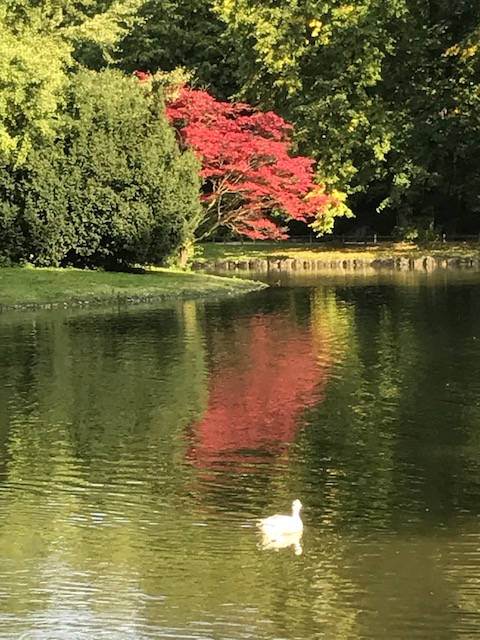
in its own way a very pleasing tune, matching the mood of the nicety of the previous Friday – for me much more than a beautiful autumn day

A day proving  the enjoyable lightness of being …

I scrolled down the site, saw the old photo showing me during the Shanghai Forum and was getting a bit curious, started the decipher …, wearisome …, to find out that all this is about the media centre and the ‘hyper-modern way of the networked world’ – where the global and the village come together …, perhaps not bad at all, if handled with care. Perhaps this is more important: the way to control the handling, not the instruments …

It surely means not least to be there for students – real, not virtual, and respecting …, no, accepting that we as teachers and as students have more in common than there are differences – where differences and arrogance, where delay and ‘servant-attitudes’ prevail, we have lost already our ingenuity.

visibility – tangibility

Of course it can be seen in different lights – another time division and separation and inequality, as many of the comments suggest

– but can that be sufficient reason for renouncing the right to make so obvious what is obvious. – It is interesting that it requires this kind of real-life-‘Verfremdung’: Everyday we ‘accept’ the pay gap, even if only by ignoring it; and it needs such reversal that makes us fully aware of the actual existence and its meaning.

not the US alone

While the devastation in the US makes the world-news, it is easily overlooked that Imra meant as ravage also for others. But before, another note is worth to be made: While Trump prefers continuing bis aggressive course, others are there to help and

Texas Governor Accepts Aid from Mexico for Hurricane Victims

Now to Cuba – it is interesting also as it shows that the embargo does not even respect humanitarian needs.

Mensaje de Raúl Castro al combativo pueblo de Cuba

Mensaje íntegro del General de Ejército Raúl Castro Ruz, Presidente de los Consejos de Estado y de Ministros de Cuba, sobre la etapa recuperativa en el país tras el paso del huracán Irma.

Llamamiento a nuestro combativo pueblo

El huracán Irma, con su fuerza destructora, arremetió contra nuestra Isla por más de 72 horas, desde la mañana del 8 de septiembre hasta la tarde de este domingo. Con vientos que sobrepasaron en ocasiones los 250 kilómetros por hora, recorrió el norte del país desde Baracoa, castigada también por otro fenómeno de este tipo hace casi un año, hasta las inmediaciones de Cárdenas.

Sin embargo, por la inmensidad de su tamaño prácticamente ningún territorio se libró de sus efectos.

Calificado por los expertos como el mayor huracán formado en el Atlántico, este fenómeno meteorológico causó severos daños al país, los cuales, justamente por su envergadura, aún no se han podido cuantificar. Una mirada preliminar evidencia afectaciones en la vivienda, el sistema electroenergético y la agricultura.

Además golpeó algunos de nuestros principales destinos turísticos, sin embargo las afectaciones serán recupe­radas antes del inicio de la temporada alta. Contamos para ello con los recursos humanos y materiales requeridos, por constituir una de las principales fuentes de ingreso de la economía nacional.

Han sido días duros para nuestro pueblo, que en solo pocas horas ha visto como lo construido con esfuerzo es golpeado por un devastador huracán. Las imágenes de las últimas horas son elocuentes, como también lo es el espíritu de resistencia y victoria de nuestro pueblo que renace con cada adversidad.

En estas difíciles circunstancias ha primado la unidad de los cubanos, la solidaridad entre los vecinos, la disciplina ante las orientaciones emitidas por el Estado Mayor Nacional de la Defensa Civil y los Consejos de Defensa a todos los niveles, la profesionalidad de los especialistas del Instituto de Meteorología, la inmediatez de nuestros medios de comunicación y sus periodistas, el apoyo de las organizaciones de masas, así como la cohesión de los órganos de dirección del Consejo de Defensa Nacional. Mención especial para todas nuestras mujeres, incluyendo las dirigentes del Partido y el Gobierno, que con aplomo y madurez dirigieron y enfrentaron la dura situación.

Las jornadas que se avecinan serán de mucho trabajo, donde volverá a quedar demostrada la fortaleza de los cubanos y la confianza indestructible en su Revolución. No es tiempo para lamentarnos, sino para volver a construir lo que los vientos del huracán Irma intentaron desaparecer.

Con organización, disciplina y la integración de todas nuestras estructuras, saldremos adelante como lo hemos hecho en ocasiones anteriores. Nadie se llame a engaño, la tarea que tenemos por delante es inmensa, pero con un pueblo como el nuestro ganaremos la batalla más importante: la recuperación.

En este momento crucial, la Central de Trabajadores de Cuba y la Asociación Nacional de Agricultores Pequeños, junto a las demás organizaciones de masas, deberán redoblar sus esfuerzos para borrar lo más pronto posible las secuelas de este destructivo evento.

Un principio se mantiene inamovible: la Revolución no dejará a nadie desamparado y desde ya se toman medidas para que ninguna familia cubana quede abandonada a su suerte.

Como ha sido costumbre cada vez que un fenómeno meteorológico nos golpea, son muchas las muestras de solidaridad recibidas desde todas partes del mundo. Jefes de Estado y de Gobierno, organizaciones políticas y amigos de los movimientos de solidaridad han expresado la voluntad de ayudarnos, lo que agradecemos en nombre de los más de once millones de cubanas y cubanos.

Enfrentemos la recuperación con el ejemplo del Comandante en Jefe de la Revolución Cubana, Fidel Castro Ruz, quien con su permanente fe en la victoria y férrea voluntad nos enseñó que no existen imposibles. En estas difíciles horas, su legado nos hace fuerte y nos une.

Raúl Castro Ruz

La Habana, 10 de septiembre de 2017

speed …

… the way we seem to live today.

From Alice, Through the looking glass: page 32 f:

Alice looked round her in great surprise. ‘Why, I do believe we’ve been under this tree the whole time! Everything’s just as it was!’

‘Of course it is,’ said the Queen, ‘what would you have it?’

‘Well, in our country,’ said Alice, still panting a little, ‘you’d generally get to somewhere else—if  you ran very fast for a long time, as we’ve been doing.’

‘A slow sort of country!’ said the Queen. ‘Now, here, you see, it takes all the running you can do, to keep in the same place. If you want to get some- where else, you must run at least twice as fast as that!’

To where do we go from here?

From teaching economics at Bangor College China, in Changsha, China – some reflections had been published here earlier, and also here – I arrived now – after some interim work in France and The Netherlands – in Munich, Bavaria, a generous grant from the Max-Planck-Institute for Social Law and Social Policy allows me occupying from today a research position for the next twelve month, looking at issues around digitisation – some books I asked for are already at my disposal on my new desk. And right at the beginning, after having been giving out against orthodox economics [not so much from a heterodox, but from an unorthodox position (or was it more from an alternative orthodoxy?)], I am now wondering if – cum grano salis – heterodox thinking is needed also when it comes to law?

[scan from: Johann Wolfgang Goethe, Faust – Der Tragödie Erster Teil, mit Illustrationen aus drei Jahrhunderten, ed. by Hans Hanning, Berlin: Rütting & Loening, 1982, 2nd ed., p. 123
Teufelspakt_Faust-Mephisto, by Julius Nisle]

And much as Marx did not ‘invent communism out of the blue’, but based it in historical analysis [see in particular Engels’ Work on ‘The Origin of the Family, Private Property, and the State’] , such historical review is also most valuable in jurisprudence. A nice passage I found – in a book by St Germain, writing  on the Dialogues between a doctor of divinity and a student in the laws of England –  and surely not suggesting that we find the alternatives in divinity …

And so it appeareth, that equity taketh not away the very right, but only that that seemeth to be right by the general words of the law. Nor it is not ordained against the cruelness of the law, for the law in such case generally taken is good in himself; but equity followeth the law in all particular cases where right and justice requireth, notwithstanding the general rule of the law be to the contrary. Wherefore it appeareth., that if any law were made by man without any such exception expressed or implied, it were manifestly unreasonable, and were not to be suffered …

Reading this on page 45, we read already a page earlier as definition:

Equity is a right wiseness that considereth all the particular circumstances of the deed, the which also is tempered with the sweetness of mercy. And such an equity must always be observed in every law of man, and in every general rule thereof: and that knew he well that said thus, Laws covet to be ruled by equity. And the wise man saith, Be not overmuch right wise; for the extreme right wiseness is extreme wrong: as who saith, If thou take all that the words of the law giveth thee thou shalt sometime do against the law.

Reminder for the Future

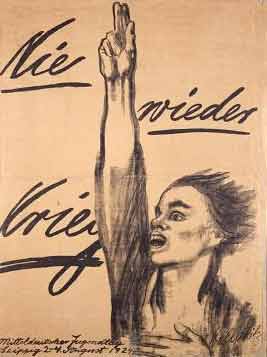
It may be questionable to state one day, one event as beginning of a war, though it had been the first of September nineteen-hundred-thirty-nine that the German troops invaded Poland, under false accusations. The date is taken as occasion to post a reminder, unfortunately seeing today again so many reasons in so many countries to be mobilised against moves towards violence and war. Many ways can be imagined, many wise things said – in length and in short slogans and paintings and demands – as already Kaethe Kollwitz’ lithography from 1924,

[1]

demanding ‘Never again War’.

There is one short passage in Zuckmeyer’s The Devils General, which brings it in an impressive way the point – not translating well from the German. It is part of the dispute between SS-group-leader Schmidt-Lausitz and general Harras, the latter shouting against the group-leader:

What did you just say? Fatherland [Vaterland]? You? What do you understand as fatherland? Hä? Just spell it!

V as Volksgerichtshof (People’s Court of Justice)! A as hanging! T as death! E as shooting! R as racial persecution! L as camp! Ausschwitz, Neuengamme, Dachau

You see, this is how fatherland is spelled today in Germany!

the original German version:

“Watt haben Sie da gesagt?” Vaterland?! Sie? Was versteh Sie den darunter?

“Hä? Buchstabieren Sie doch mal”

“V wie Volksgerichtshof! A wie Aufhängen! T wie Tod! E wie Erschießen! R wie Rassenverfolgung! L wie Lager! Ausschwitz, Neuengamme, Dachau

Sehen Sie, so buchstabiert man heute in Deutschland Vaterland!”

[For the short scene from the film see here].

Terms and letters, occasions …, all this may be different – but the underlying patterns never changed!


[1]            Antikriegsplakat von Käthe Kollwitz für den Mitteldeutschen Jugendtag 1924 (Lithographie, 95,2 cm x 72,3 cm; Quelle: DHM) – http://www.zeithistorische-forschungen.de/1-2-2007/id%3D4397; 22/08/17

Sorrows of Young Werther – not only

It had not been just the young Werther plagued by sorrows, and among the many concerned are academics – some old, some young; some knowing, some innocent; some forced and some voluntarily … .

[scan from: Johann Wolfgang Goethe, Faust – Der Tragödie Erster Teil, mit Illustrationen aus drei Jahrhunderten, ed. by Hans Hanning, Berlin: Rütting & Loening, 1982, 2nd ed., p. 123
Teufelspakt_Faust-Mephisto, by Julius Nisle]

All this is by no means new, the fine-tuning changed while the symphony itself is still the old lyre …

Career settings – career is a nice word actually: ‘a person really made a career’, we say it is somebody reached ‘high ranks’, and to get to the heights one has to make a career, i.e. move along a given path. Going back to Latin and Italian it is about the via cararia – the carriage road, the path on and along which the car – carrus – chariot moves. And it is about carrying, of course.

A brief outline then, if one gets an important part of the picture – surely not the complete one:

First step, getting the weight that needs to be carried – well prepared, and well wrapped:

Influence and manipulation in Teaching Economics – Backgrounds and Examples[1]

– There is at least an abstract in English language – and there is also an article on the topic[2]

Next step, prostitution[3] – it is not about what one says but how and where one says something.

And mind, see the progress: from the wrapped being presented, it is now about oneself, the young academic, wrapping.

Well, the end of the career? For some … the eternal wrappers, stepping higher and higher, the chariot being increasingly beautiful, the golden grids appearing as louvre – is it by accident that this is also the name of the great galleries in Paris?

For others the story ends …, well one may say Wertherian, i.e. by suicide – the way that social science goes too often[4] – actually the other side of prostitution – or its other side.

And indeed, there is some cunning of reason in the fact that this obituary on the academic freedom is published in a journal with access-by-payment-only … – Well, the Goethe, in his Faust, was clearer than Hegel with his hope for the cunning of reason, writing

To nonsense reason turns,

and benefit to worry.

And we basically have to fail if we maintain reasoning by simple reason, accepting that we are not quantum mechanic beings but real ones.

And still, exactly therefore we have to look where and how exactly the cat moves – accepting also that it cannot be understood if we use those concepts that are hidden behind the eclipsed reason.

Sure, some leave the wrapping post and move on as rapper – against the rapists.

The answer history will give ????   – well, it may be that you have to go for it

******

******

[1]            Silja Graupe: Beeinflussung und Manipulation in der ökonomischen Bildung Hintergründe und Beispiele; Duesseldorf: FGW – Forschungsinstitut für gesellschaftliche Weiterentwicklung e.V.

[2]            Silja Graupe. The Power of Ideas. The Teaching of Economics and its Image of Man; in: Volume 11, Number 2, © JSSE 2012 ISSN 1618-5293

[3]            Frey: PUBLISHING AS PROSTITUTION? Choosing Between One’s Own Ideas and Academic Failure; http://www.econ.uzh.ch/static/wp_iew/iewwp117.pdf

[4]            Holmquist, Carin and Sundin, Elisabeth(2010) ‘The suicide of the social sciences: causes and effects’, Innovation: The European Journal of Social Science Research, 23: 1, 13 — 23

Questions of a customer who reads …

There is a poem, written by Brecht:
I recently wrote about academics who may also have some special questions.
Perhaps it could also be ‘re-writtten’, like this … as
Questions of a customer who reads …
What is it one can find in a shop, for instance in a small town like Confolens, FR:
The shop: it is Lidle, German company
a chain soaring across more and more countries
distributing Asian food
produced in Germany
sold in France
with English-language label
– where did they produce the package,
from where did they get the oil for the plastic
from where the truck to transport the stuff to the train
which railway company brought the stuff to …
and from where are the workers who uploaded and unloaded the trains and trucks ..?
Who looks after the kids of the workers – are there creches maintained by the enterprise, public facilities or what solution is there for them?
Where do the owners of the enterprises pay taxes
– if they pay taxes at all
And what do they do with the profits …?
Who prepares the meal for the workers if they have to work all day long?
And what do the boss and the worker talk about
if they meet on the soccer pitch …?
There would be so many more questions to be asked – though Lidle has a shop, not a school, and a school has not time to go to shops, there are too many models to be learned about, not leaving space for reality, the pace not allowing to think too much …