While it is important to investigate the role of socio-economic shocks and simplifying ‘analyses’ of populist demagogues, standing behind the immediate dangers of populist threats, the present contribution outlines the need for and contours of a thorough analysis of the current formation. Reference to a broadly understood and somewhat refined regulationist theory makes it possible to understand more clearly the explosive constellation of a bisected modernity and capitalist mode of production. However, in order to understand this ongoing and structural problem of populism as normal occurrence, rather than a bewildering exception, we have to go beyond Ulrich Beck’s understanding, suggesting that ‘[i]ndustrial society never was or can be possible solely as industrial society, but is always only half industrial and half feudal.’[Beck, Ulrich: 1986/1992: Risk Society. Towards a New Modernity, London et altera: Sage [German edition @ Suhrkamp 1986; first English publication 1992]: 107] There are two lines of bisection, namely that between social and private production and social production and private appropriation as contradiction that – as long as we remain within the system – can be answered in three different ways, namely fundamental progressive change, reaching stability through alteration or reactionary re-transformation. Thus, there is permanently in danger to manifest itself to One-sided and often violent constellations.
Peter Herrmann[i]
Populism in the Light of Political Economy – Tentative Reflections
In Preparation of the Workshop
Political Economy of ‘Authoritarianism’ and ‘Right Wing Populism’
Organised by the Rosa-Luxemburg-Foundation
Berlin, November 8th and 9th 2017
Abstract 3
Introduction 3
Theory of Regulation – Defining Reoccurring Structural Mismatches 6
Current Surges 9
Production 12
Consumption 13
Distribution 15
Exchange 17
Trilemmas, Paradoxes and Contradictions 18
Economics behind Populism – A simple Question of Demand and Supply? 21
Conclusions 29
Abstract
While it is important to investigate the role of socio-economic shocks and simplifying ‘analyses’ of populist demagogues, standing behind the immediate dangers of populist threats, the present contribution outlines the need for and contours of a thorough analysis of the current formation. Reference to a broadly understood and somewhat refined regulationist theory makes it possible to understand more clearly the explosive constellation of a bisected modernity and capitalist mode of production. However, in order to understand this ongoing and structural problem of populism as normal occurrence, rather than a bewildering exception, we have to go beyond Ulrich Beck’s understanding, suggesting that ‘[i]ndustrial society never was or can be possible solely as industrial society, but is always only half industrial and half feudal.’[1] There are two lines of bisection, namely that between social and private production and social production and private appropriation as contradiction that – as long as we remain within the system – can be answered in three different ways, namely fundamental progressive change, reaching stability through alteration or reactionary re-transformation. Thus, there is permanently in danger to manifest itself to One-sided and often violent constellations.
Introduction
Limiting ourselves to the economic dimension of populism, we have to avoid the trap of a narrow understanding of mainstream macroeconomics, aiming on alternative calculations of the standard performance models – what we need is an alternative to these models, not their alteration. It is about elaborating seriously political character of political economy and analyses of patterns of accumulation. Reference is made to the extended interpretation overview 1.
| Accumulation Regime
‘stabilization over a long period of the allocation of the net product between consumption and accumulation’ which ‘implies some correspondence between the transformation of both the conditions of production and the conditions of the reproduction of wage earners’[2] |
Living Regime
conditions of the reproduction of wage earners as over time stabilised relationship between subordination under systemic requirements and the wish for self-realisation |
| Mode of Life
personal ‘life style’ as adaptation to, combination of and interpretation of different requirements and options which includes the established and establishing of explicit relationships |
Mode of Regulation
‘a materilization of the regime of accumulation taking the form of norms, habits, laws, regulating networks and so on that ensure the unity of the process, i.e. the approximate consistency of individual behaviors with the schema of reproduction’[3] |
overview 1: extended regulationist approach
In a nutshell, the accumulation regime reflects the way in which ‘money is made and spent’ while the mode of regulation defines what is allowed, what is tolerated and what is forbidden and it also defines the social classes and groups to which those rules are applied in which way and strictness.
They have to be understood as entity, together with the living regime as conditions of life and the mode of life as ‘what each of us makes out of them’. All four dimensions, taken as entity, make up for the concrete hegemonic constellation.
It is such system that allows us to understand the complexity better as matter of defining and redefining frames of action – be it about fundamental change, reaching stability through alteration or reactionary re-transformation. Furthermore it allows us a clearer assessment along the lines of process, structure, essence and elementary character.
| Processualism |
Essentialism |
| Structuralism |
| Elementarism |
overview 2: frames of action
All this may well employ a phenomenological perspective – understood as being concerned with the perception and perceived perspective of ordinary people in their daily life, emerging from the concrete living regime, translating into a melding pot of various nodes of life. Stated less ambitious it is simply about different people with different backgrounds meeting each other, ‘defining the situation’. However, we are equally easy distracted by looking at phenomena, may be some of them can be taken as cynically entertaining – and they may well reflect, affirmatively or even critically – part of the mental confrontation of and divide between politicians’ and peoples’ life as the following little episode suggests: The heaviest storm since decades threatens people in Ireland, likely swapping over to the UK – The Guardian is headlining:[4]
Three people die as Storm Ophelia batters Ireland and Britain
Three victims named as Irish PM describes ‘national emergency’ as storm brings 100mph winds, with schools and colleges to remain closed on Tuesday
continuing
Ahead of her trip to Brussels for dinner with EU leaders on Monday night, Theresa May telephoned the taoiseach to offer her sympathy for the deaths caused by the storm.
One may translate it in the following way: people are dying, and leading politicians are meeting for the funeral meal, in this case ‘working out’ the plan of dividing cost and benefit of the larger funeral to come under the name Brexit. – Sure, curtailments like this are deceiving, though they may well serve as inspiration for further reflection. At least, when it comes to a warning in connection with possibly deceiving curtailments, we have to underline that a too dominant reference to socio-economic shocks, demagogic propaganda and the like can also be easily misguiding.
Theory of Regulation – Defining Reoccurring Structural Mismatches
A fundamental issue addressed by the regulationist approach is that of socialisation – a secular process that is by definition inherently linked to forms of individuation.[5] As such, there is a forceful link between the given conditions and what is made out of them, i.e. their acceptance, rejection and/or interpretative application. There are some major patterns I want to highlight – they reflect a societal shift as part of a general pattern of socio-cultural mis-development of curtailed and blurred enlightenment, establishing the commodity-defined market individual (hollowing out the citizen) while undermining affordable commodities being available on an accessible market. As such it goes obviously far beyond the current manifestation and is a fundamental pattern of a reductionist ‘conservative’ approach to enlightenment – which finally always had been seen as bourgeois concept. It is also in economic terms part of wider reflections as they are recurring at times of societal-economic crisis and changes within existing modes of production though presenting cases of possible system surges of immanent change. The thesis of the present reflection is that we find three principle ways, as they had been already mentioned earlier, namely fundamental progressive change, reaching stability through alteration or reactionary re-transformation. At stake is not so much the immediate ‘socio-economic threat’ but the interaction of socio-economic and socio-stratifying factors on three levels, namely the individual coping strategies with secular-global changes and their reflection on the micro-level (formation of social groups, classes and cleavages). Decisively, any stability can only be temporary.
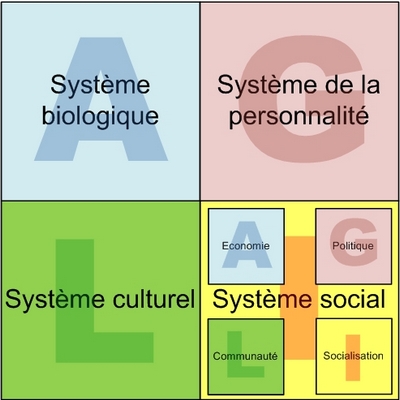
With all qualification towards Parsons’ modernist approach, reference to the AGIL-dimensions is useful, the following version can serve as stimulation for further thoughts when read in conjunction with overview 1 presenting the extended regulationist approach.

overview 3: AGIL scheme[6]
Utilised in this way, not least as ‘open tool box’, we can move on and develop a multidimensional approach that brings together (and allows to integrate):
I.
- the more process-oriented structuralist approach of regulationist thinking and
- the more functionalist approach as presented with reference to Parsons, and geared towards adaptation, goal attainment, integration and latent pattern maintenance
II:
- the societal
- the social and
- the personal level[7]
III:[8]
- Socio-Economic Security, Personal [Human] Security, Social Justice
- Social Cohesion, Social Recognition, Solidarity
- Social Cohesion, Social Recognition, Solidarity
- Social Inclusion, Social Responsiveness, Equal Value
Some explanatory note is required – not least as the factors are taken to some extent out of the framework in which they usually stand in the overall conceptualisation of social quality.[9] While they are usually used by suggesting an explanatory power in their own right, they are in the present context integrated into a wider context, not least to some extent modified by the fact of their integration into a functional context. We may also say that they are linked to an overarching pattern of the constitution of societies as hegemonic relationality. As such they provide a standard and they provide as well a friction surface on which the different forces strive for hegemony.
IV.
- specific factors that can be distilled as decisively shaping contemporary development
- acute socio-economic and socio-cultural shocks and ‘distortions’.
So far this provides only an analytical scheme. It is reasonably systematic, allows making out systemic features (going beyond contemporary seemingly obvious factors as they are manifesting themselves for descriptive analyses).[10]
Of central importance is the fact that we are dealing on the one hand with problems of societal integration that are at least in class societies normal, i.e. the problems of hegemony building and maintenance – we may even say that some forms of ‘populism’ are typical for what is commonly seen as ‘Western democracy’. On the other hand, however, we are dealing at certain stages or ‘turning points’ with aggravations or intensifications: in principle they are emerging from breaking points of and the growing discrepancy between the different layers outlined before.
In any case we can say that in a radical perspective populism is not the exception but the normal. In actual fact only exceptional conditions allow for some kind of temporary complete congruence between accumulation regime, living regime, mode of regulation and mode of life. The fundamental challenge is indeed the need to overcome a secular tension and alienation of the different aggregate levels of human existence. Speaking of a secular tension and alienation means that we urgently have to address also the question what this means for socialist strategies (and socialist societies).
Current Surges
At the moment the following core issues are seen as fundamental specific factors that are decisively shaping contemporary development and feeding into point IV of the before presented scheme:[11]
- de-firmisation – the tendency of the classical enterprise to loose its complex socio-economic meaning
- de-spacialisation – the blurring and changed intermingling of the different dimensions of ‘meaning’ of space
- de-classification as matter of shifting and questioning of social classes and strata
- de-formation – the tendency of known patterns of ‘educational formation’ loosing foundation and meaning
- de-legislation – the decreasing meaning of clear and durable legal frameworks and conditions, including the ‘charitiblisation of social rights’
- de-identification – occurring also as ‘big-brotherisation’
- de-personalisation – paradoxically occurring as overemphasis of individualism, taking forms as they are in sociology discussed as Infantilisation, Burn-Out Society, experience society, leisure time society, and the like[12]
- de-politisation – as part of a wider process that deals with life-style choices as the real choice, suggesting in the extreme case that the real choice is about withdrawing from politics, suggesting that it is ALDI-nativ- los: Bürger entlasten. Wir senken die Preise.’ – A pun: broadly translated as ‘there is no alternative to ALDI as it is ALDI that relieves pressure from citizens by lowering the prices’.[13] Continuing the pun in English language, we see that the synonym for terms like ‘relieve pressure form’, ‘unburden’, ‘relieving’ is ‘disengaging’. So – even if not necessarily intended, it is factually the orientation on individuals, not bothering about politics and policies as this is declared to be task of the ‘entrepreneur’, also highly individualist and stylised as charismatic personality. Should we say that it suggests the entrepreneur as new ‘father figure of the country’?[14]
- Characteristically all of them are fundamentally concerning the re-shaping of the economic formation and they are fundamentally re-shaping the four dimensions presented in overview 1. – Still, attention is at present especially directed towards changes of the accumulation regime that can be seen as central factors behind the emergence of populism. Again, we are mainly looking at the ‘allocation of the net product between consumption and accumulation’ and even narrower at the process of accumulation itself.
– The underlying definition of populism suggests this to be a set of politics offering pragmatic answers to questions emerging from disruption of a functioning accumulation regime, the ‘accepted’ balance of inclusion/exclusion, favourable for establishing a group as ruling class while maintaining the overall functioning of the system. – Some special attention should be paid to the formulation ‘favourable for establishing a group as ruling class’: what may broadly be seen as populist leaders and populist groups striving for power[15] is by and large a fraction of a more or less broad pool of potential power-holders (a) whose central goal is maintenance of the basic structure of the mode of production, (b) while often referring to an idealised ‘earlier’ version of it or even to a pre-stage,[16] (c) not least making within this context reference to communitarian patterns of ‘[self] governance’, often elevating this onto the level of the societal level and (d) that is inclined to accept explicit and massive exclusion for this purpose. As such, the populist potential and in particular its ideological seedbed and feeding trough are going much further than the known suspects as the Alternative für Deutschland, Fidesz – Magyar Polgári Szövetség (Hungarian Civic Alliance), Fronte Nazionale, Movimento Cinque Stelle, Prawo i Sprawiedliwość (Law and Justice Party) etc. . In the wider perspective it is surely also about the various ‘exiters’ and separatist movements (Brexit, Catalonia, Lombardia, Veneto …), and furthermore ‘valley economies’, explicitly based in some form of social separatism.[17] Importantly, we are dealing with a fraction of the ruling class, not the ruling class as such as that is in any case a diverse group. In many cases somewhat outsider positions – previously strong groups hat are pushed back, or ‘new rich’, money-capital-strong while lacking ‘social capital’ and rarely also aspiring groups of new sectors – serve as pool for the charismatic leaders and their immediate followers.
The in many debates dominant orientation on accumulation by dispossession (Harvey) – suggested as path for investing excess capital – allows limited understanding of the long-term structural changes. Without denying the meaning of his work, Harvey does not provide a reference for the far-reaching changes. Instead, it is limited to providing a kind of repair-kit for investment- and rent-seeking capital to survive until the next burst of the bubble, and actually heavily contributing to its emergence.
Looking at the economic development we have to analyse concisely the different dimensions of the economic process, highlighting two basic facts, namely [i] that the capitalist system depends on accumulation, accumulation itself however is differentiated and takes distinct forms; [ii] that accumulation of capital is not the same as moneymaking – this includes the need of a differentiated assessment of surplus, added value, profit, rent … ; [iii] the clear definition of the actors accordingly and [IV] the translation of the ‘money making dimension’ into patterns of consumption and living regimes. – Taking these dimensions together, we can understand the real varieties of capitalism, going much further than the managerial notion that is commonly given to this debate.[18]
Production
An important point of the new capitalist developments is in terms of the structure of capital a new stage of diversification. Even Hon Hai/Foxconn Technology Group presents itself as being in favour of strict corporate social and environmental responsibility. In this case a comparison between the English and the Chinese version of the website is telling: whereas the English version is outspoken modest and presenting the enterprise as modest though ambitious player for innovation, the ambition expressed in the Chinese version is – still a bit subliminal – more aggressive, the ‘contribution’ having more the character of claiming a leading role. The slogan on the English SER-website is simple and general: ‘We are committed to fulfilling our SER and to realizing our goal of protecting the environment and creating a sustainable ecosystem and society.[19]
All this can be seen as part of a new surge of hegemonic identity politics, bringing together (i) new socio-global patterns of definition and distribution of resources, (ii) new conditions of capital accumulation, (iii) a cultural-generational shift and (iv) a new understanding of entrepreneurship. As such it is about the ‘what is produced’, namely not only the material good but also some kind of ‘meaning’ and ‘social reflection’ – all this in an international and global setting; and it is about the how of production, namely the redefinition of workers, entrepreneurs and rights. Taken together, we can speak of production of he scaffold for hegemony emerging within the productive sphere.[20]
Consumption
At least in some sectors or linked to some products we find a remarkable shift of the use value, asking for its redefinition. The immediate character of the product, by the tangible, reified use is loosing part of its central character as defining force. As much as consumption is emerging as value in its own right (consumerism), we see the shift from ‘simple traditional mass consumption’ to products and shopping presenting a new sphere: a sphere that, in tendency, elevates the shopping experience itself to an unprecedented degree as ‘use value’, goods and the ‘shopping experience’ presented as something with which ‘people buy better versions of themselves, buying the brand but not the product’.[21] Such imagery market strategies are not limited to actual segments for luxury goods. Looking at shops as Primark and TK Maxx, we find a comparable feature: though the typical customer in those shops does most likely not dispose of a high income, still and perhaps even more so the focus is on underlining a supposed ‘freedom of choice beyond what is necessary’. – Having stated that this is a remarkable shift should not make us overlook that we are actually witnessing a feature of which some elements had been already looked at towards the end of the 19th century.[22]
There is some ambiguity coming with it. On the one hand we find a somewhat increasing complexity of consumption. Besides the emergence of the ‘prosumer’ in the conventional understanding, some fake prosumption can be also found in simple purchases – a catchy example is the market for mobile phones and computers: choice of technical specifications and an ever extending market for accessories. Also worth to be mentioned is the increasing outsourcing of services adjunct to certain purchases: check-outs and check-ins; extended feedback and rating opportunities help lines with the kindness of a computer voice[23] etc. – the customer as master is succeeded by the consumer as servant, though the golden chains are presented as sovereignty. On the other hand, the brand is at hand, offering simple mechanisms of reducing complexity and self-branding as opportunity for the formation of identity. What is systematically proposed as means of ‘anchor for the community of values’ in the world of consumption[24] can be seen as complement of populism in the definition of Nate Schenkkan et altera who suggest that
[a]t its core, it pits a mystically unified “nation” against corrupt “elites” and external enemies, and claims for a charismatic leader the power to voice the will of the nation. It is therefore fundamentally illiberal, rejecting diversity of identity and of opinion within society and discarding basic principles of modern constitutional thinking[25]
This matches perfectly the shifts that had been highlighted as central in respect of production and that we have to keep in mind for later, when we come to looking at exchange. And of course, the – real or feared – exclusion from consumerism can be easily integrated into frames of nationalist and/or scapegoat-politics, falling back on national identity as ultimate point of reference for individuals and societies.[26] Here and now, under the heading of consumption it has to be highlighted that we are also and not least dealing with consumption as factor of production, i.e. the ‘factors of production’ that are consumed during the process of production. What is often presented as change of the marginal rate of profit and its tendency to move towards zero,[27] is in actual fact to a large extent a matter of externalisation and accumulation by dispossession and decommodification, in particular ‘decommodification of labour power’.[28] In other words and leaving aside that much of the zero marginal cost society in the centre is only possible by the ongoing high marginal cost societies of the periphery, we find that the state and workers, often in precarious circumstances, are covering the difference between ‘in tendency zero’ and ‘in reality one’. May we say that part of the periphery in the centres is a pool from which populism may recruit followers? May we even say that for some the alternative appears to be about being prosumer of populism versus being consumed by the elite?
Distribution
Part of it is the charitibilisation, including social projects also supported by small and local businesses.[29] One can possibly see ‘simplification’ and supposed ‘concentration on essentials’ as complementing strategy, going sometimes hand in hand with playing the card of superiority: ‘helper and supporter of the poor’: The visitor of the local pub[30] or the ALDI-customer joining the good-doers Bill and Melinda Gates – condition: those to be supported have to stay outside, continue being objects of exploitation.
Reference may be made another time to ALDI, however in this case a new strive, still only a pilot: the opening of a bistro. It is remarkable in some respect: the offered menus, changing on a daily basis, are not particularly cheap though the ongoing image of ALDI is that of a low price discounter. Of course, we can take as centrepiece of this development the opening of a new field of investment. Also part of the package is the advertisement effect (real or imagined: customers will see the food as product of ALDI-groceries); the offer of recipes, and with this as additional advertisement for ALDI-products and not least the offer of belonging – the previous image of being low-cost discounter is not contested but on the contrary ‘normalised’, moved to the centre of society (which is the actual place as buying at ALDI is not in any way indicating a low social status), the new image supporting that this simplicity is carried on with some pride. – In actual fact all this is an example par excellence for how hegemony works: it is about conflating the different and often opposing requests and options, seemingly transcending the contradiction between classes and strata. In this light, one has to be careful when it comes to pointing on the role of demagogues: Though, alas Trump surely managed with boldness what Berlusconi mastered with strategic aptitude as demagogues, their success rested on the ability of each of them to conflate the different sides of a contradictory system into a supposed integer workability of economic consolidation: it is the move from the ‘Yes we can’ to the ‘Yes we do’. – Leaving aside that Obama’s campaign did have some populist-like features and leaving also aside that drawing simple comparisons is never without problems, a difference in the appearance is interesting: In the ‘Remarks of Senator Barack Obama on New Hampshire Primary Night’ we find the sentence ‘We know the battle ahead will be long, but always remember that no matter what obstacles stand in our way, nothing can stand in the way of the power of millions of voices calling for change.’[31] When it comes to slogans, Obama will be known for re-establishing the ‘yes we can’ as valid guideline, linked to the ‘call for support’. When it comes to Donald Trump, his campaigning will be remembered for twittering rants, and announcing practice, explicitly based on the notion of a Darwinian power of strength. – This is also the ultimate question of distribution: the power-based distribution following the slogan of the presidential campaign ‘Make America Great Again’, the right of the strongest blatantly proclaimed.
Exchange
Some of the questions that would actually belong under the heading of exchange had been already mentioned earlier, under the heading consumption, and also under the heading distribution. A detailed attribution will not be elaborated here. Still, it is necessary to look briefly at issues of exchange in connection with populism: On the one hand it is about orienting on a supposedly undistorted market. Exchange can be used as focus for support of nationalist orientations in a multiple way, in particular
- seeing it in a romanticised way as place of free exchange amongst equals, undisturbed by monopolist elites
- locating free exchange of goods with use-value – valuable for the household economy of the proverbial Swabian housewife – within the framework of undistorted markets, standing against the danger of being taken over by exchange-value-snatching intruders
- leading to the suggestion of a communitarian closed market, where ‘insiders and outsiders’ meet on equal foot – the idealised frame for the new ‘tribesman’ (‘Volksgenosse’): honest national producers and honest national consumers meet for free and equal exchange, anything contradicting this image is pure distortion by external forces
- finally within this framework also open for international free trade, depending however on a harsh understanding of freedom, without any interference by regulation.
– It is of no interest at all that this imagery contradicts completely the reality especially of those locations where exchange takes place for the majority. Still, it is worth to mention that at least some grain of reality is contained. We can see at least glimpses of levelling: people from different strata buying in the same shops and various shops offering goods that identical in construction or even offering the brand-products in the increasingly prevalent outlet-stores. A thorough exploration of exchange processes has to determine the tensions between the different forms of accumulation and appropriation taking place. Populism finds especially in this field a wide range of open doors, allowing romanticising traditional communitarianism and allowing at the same time blaming victims. Of course, scrutinising this area can also open a field for anti-populist strategies, though it is decisive that this has to table not least the ‘costly side’ of ‘economic justice’.
Trilemmas, Paradoxes and Contradictions
Though it may be questioned if gobalisation plays a fundamentally decisive role, it can be said that it is definitely an influential factor. – This more or less hesitant formulation is required as one should not overlook that many major changes in the economic constellation are not mainly due or linked to processes of globalisation but follow a pattern of secular developments of capitalism.
Be it as it is, the contradictions of the present constellation are reasonably well captured by Deni Rodrik, pointing out some fundamental tensions under two headlines:[32] the one is that of the trilemma of the world economy: pursuing three goals, namely democracy, national sovereignty and global economic integration, ends according to Rodrik in one goal being out of reach, notwithstanding the fact that all three are considered as desirable. In other words, only two of the three goals can be accomplished.
[33]
graph 1: Trilemma of the World Economyeee
The other is presented as paradox of globalisation, suggesting that globalisation undermines at some stage of development its institutional foundations. At stake are in particular the nation state and the non-institutional and non-market mechanisms of social and societal integration. With this, Rodrik emphasises the erosion of previously functioning mechanism of regulation and solidarity. This is in a way a new version of Karl Polanyi’s thoughts on the relation between market economy and market society.[34]
This translates into the reality of an irritating concurrence of extreme squeezing of any sources that allow generating an increasing amount of profit. On the other hand we find generous non-profitable investment in areas that are in many cases at most in a nonessential relation to the normal business-goal of increasing profit and that are also only vaguely occurring as advertising, reputation-gathering or the like. – Can they be interpreted as very vague and adventurous entrepreneurship, speculating on possible profit in the future? Or are they possibly expression of a generational change: completely lacking risk aversion and carrying on an infantilised attitude of ‘the winner catches all’ plus ‘immediate satisfaction’, the mind-set attributed to the ‘experience society’? Part of the explanation lies in the fact that we are witnessing a historical constellation that is from time to time recurring, seemingly unique though a pattern that reflects the need to reshuffle and readapt the elements of societal constitution. They had been outlined earlier as (i) new socio-global patterns of definition and distribution of resources, (ii) new conditions of capital accumulation, (iii) a cultural-generational shift and (iv) a new understanding of entrepreneurship. And of course, we have to ventilate the question of ‘philantropic entrepreneurs’ – the possible ‘Owens of the 19th century’, economically bound to the capitalist profit-making and ideologically oriented towards the good-doing in the framework of CSER.
One overarching aspect is seen in a shift of wealth that still needs to be clarified. Without suggesting that capital looses it’s meaning, we have to acknowledge another factor. Accumulation of capital did never occur simply as end in itself in strictu sensu. Even in its alienated and fetishised variety, the underlying goal was always control in its different forms (economic, political, cultural). And speaking of capital always meant and still means to refer to capital in the monetary and monetarisable form. Taking this into account, we face throughout history different patterns of the concrete meaning. The traditional range is particularly around productive capital, trade capital and finance capital. At the moment it needs to be clarified if and if so, in which way we can speak of data as capital, possibly a new asset. At stake is a new development that is not least of importance when it comes to the discussion of populism. The entire sphere is on the one hand a matter of accumulation processes and investment strategies. On the other hand another factor is closely linked: while the common notion is focussing on protection of personal data and securing privacy, it lacks attention that the question is much more complex: necessary is to distinguish clearly between
- private versus public generation of data
- ‘productive data’ versus ‘data consumables’
- ‘productive data’ versus ‘data that are solely of private relevance’
- private versus public use of data.[35]
In addition, it is always necessary to ask in a second step what ‘private’ and ‘public’ exactly means: issues of regulation play as much a role as the immediacy of control.[36] In any case we face a highly explosive and ambiguous constellation of control and exclusion that is also concerned with new forms of socialisation in terms of establishing possibly new ‘cleavages’ – including new forms of ‘privacy’.
Economics behind Populism – A simple Question of Demand and Supply?
– These aspects are easily overlooked, as it is actually difficult to integrate factors of living regimes and modes of life directly into the analysis of political economy – in part surely a problem of political economy as an increasing dismal science that often emulates the ‘academy’ or gets lost in crude politics. And it is equally difficult to overestimate relevant factors, drawing too much attention on new modes of life as central power for societal change. Though they can admittedly serve as driving force, this potentiality depends on given objective conditions. A detached analytical orientation on an ‘imperial mode of life’ and the reliance on an anti-imperial mode of life as counter force can easily feed into the pattern described earlier. Many of the alternative life projects are proposed by more or less well-off, often intellectual people. Without developing a differentiated analytical approach – here proposed by reference to accumulation regime, living regime, mode of regulation and mode of life – the presentation of an imperial mode of life[37] remains in danger to be voluntarist, orienting towards a socially unbiased strive for change.
Working within such a limited framework can be found as one main stream of arguments around populism. The formula is simple, and refers to demand and supply of populism, in the extreme case indeed calculated in a highly formalised way of a demand and supply funciton.[38]
We face the thorough need of going far beyond a multidimensional approach that remains on an eclectic level, considering economic, social and cultural factors as important, while seeing them as aggregation instead of relationing, i.e. taking a thoroughly relational perspective.[39] The former approach is likely not going beyond the analysis of socio-economic and socio-cultural shock-analysis.
Still, there is some reason to remain with one leg in the framework of the market model, however altering it in two respects. First, instead of referring to an imagined political market – as meeting point of political actors and political followers – as core of the considerations, a functionalist perspective is taken, looking at the demand of the socio-economic system. The question is now: What are the shortcomings, i.e. frictions that cannot be easily resolved within the temporarily stabilised system of the allocation of the net product between consumption and accumulation.[40] These frictions have to be severe enough to potentially undermine both the economic functioning and the political legitimation. Only from here we can move to the ‘political market’, exploring the political demand, i.e. the systemic small print that is showing up in the headlines. Concrete, commonly we may speak openly and critically about the problems on the market for accommodation and the fear or experience that apparently some refugees obtain of accommodation while nationals do not or have extreme difficulties. Face value, this may actually be a relevant point although the factual competition for accommodation social benefits is at most an exception in terms of non-nationals outrivaling nationals.
While remaining within the capitalist framework, we have to confront ourselves with the underlying economic question is concerned with the location and shift of competition. As such it is in actual fact about one fundamental issue of classifying capitalism as such, namely the fact exploitation is happening within the framework of ‘exchange between equals’ who meet freely and under the ‘same conditions of freedom’ on the market. Under conditions of globalisation this ‘free exchange’ gains a new twist. Let us take an often used framework: two companies competing with each other on one more or less narrowly defined market, i.e. also depending on the same factor input. Following scenarios may be looked at.[41]
Both companies are based in country A
- in the first case, they compete on the national market, both employing workers from country A
- in the second case, they compete by one employing workers from country A, the other employing workers from country B, characterised by comparable working and social standards
- in the third case, they compete by the one employing workers from country A, the other employing workers from country C who are working in country C, characterised by harsh working conditions and extremely low social standards
- in the fourth case, they compete by the one employing workers from country A, the other employing from country C, characterised by harsh working conditions and extremely low social standards – but these workers are now employed in country A, while the standards of country C are applied.
An additional difficulty emerges when we refer to a situation where the one company is legally based in country A, the other legally based in country B (more or less identical working conditions and social standards as in A) or in country C (much worse working conditions and lower social standards as in country A) respectively – where ‘legally based in’ means that they are in all these cases physically located in country A – not considered are other constellations, namely those where we are dealing with international competition between entities, producing in different countries but serving the same ‘domestic’ markets.
| Employer |
Employees |
Employer |
Employees |
Socio-Political Status |
| A |
A |
A |
A |
consolidated |
| A |
A |
A |
B |
by and large consolidated |
| A |
A |
A |
C |
precarious |
| A |
A |
A |
D |
fragile |
|
| A |
A |
B |
A |
by and large consolidated |
| A |
A |
B |
B |
precarious |
| A |
A |
B |
C |
precarious |
| A |
A |
B |
D |
precarious |
|
| A |
A |
C |
A |
by and large consolidated |
| A |
A |
C |
B |
by and large consolidated |
| A |
A |
C |
C |
fragile |
| A |
A |
C |
D |
fragile |
matrix 1: Constellations of Competition
Economic ruptures occur when the capitalist principle of equivalence is traversed. In such cases we find the decisive moment: we may say the law of value is verified and made obvious whereas the supposed determination of value as result of market exchange is falsified. Talking about inequality is not primarily about issuing the injustice of distribution and re-distribution though the issue of equivalence is raised as matter of ‘fairness’.[42]
Interpreting this as matter of demand-side factor of populism, the political challenge is about the way in which the ‘factor input’ is rebalanced in two dimensions: the one is the technological factor, usually captured as matter of rationalisation, and of outstanding meaning at times of major technological change; the other is the international and global aspect, concerned with working conditions and social standards but as well with the use of profits.[43]
Continuing from here, and suggesting supply side effects, we can say that the offer populism makes is the ruthless orientation on protecting vested rights – though the definition of vested rights remains unclear – at least it changes in accordance with different national settings. This is one of the reasons behind the differing national patterns in regard of the favoured groups and also in terms of those defined as ‘aliens’, ‘intruders’ or the like. An interesting peculiarity is mentioned by Timothy Garton Ash: Complains about and fears against intruding migrants come not least from the settled Indian communities.[44] In which way economic and political vested rights are linked and the weighing between them is relevant on the level of the analysis of concrete national and historical patterns. I am extremely hesitant to draw a distinguishing line and suggesting right-wing and left-wing variants of populism as for instance proposed by Dani Rodrik. He suggests that
[i]t is easier for populist politicians to mobilize along ethno-national/cultural cleavages when the globalization shock becomes salient in the form of immigration and refugees. That is largely the story of advanced countries in Europe. On the other hand, it is easier to mobilize along income/social class lines when the globalization shock takes the form mainly of trade, finance, and foreign investment.[45]
Critical points against such notion are about the fact that a distinction of this kind neglects at least four aspects:
- whereas there are surely differences between the main patterns in which ‘globalisation shocks’ appear, the underlying pattern is about globalisation as economic adjustments and rifts that are often closely linked to socio-cultural challenges and shifts but they cannot be juxtaposed – this had been also mentioned earlier, pointing on the need of a relational approach
- the differentiation between left- and right-wing populism focuses on the superstructure of the ‘challenges’, however it ignores (i) the fact that an defining and elementary characteristic of populism is its explicit and outspoken exclusionary character and (ii) the actual character and direction of the mobilisation – we may distinguish between ‘politics and promises for’ and ‘strategies for politics by and with’ the people
- the mobilisation aspect is very much a matter of the strategy used on the supply side, utilising certain forms of manifestation that do not [necessarily] have a strong link to the underlying objective factors
- finally, though there cannot be any ‘general interest’ within any society that is characterised by a fundamental and antagonist division, we can say that populism is primarily about class struggle between fractions of the ruling class, mobilising groups and people who can be in one or another way (e.g. ideologically and/or economically) affiliated whereas non-populist and in particular left movements understand reference to ‘the people’ in an inclusive way.
Having stated this, there are some issues that deserve some more consideration:
- Can we clearly draw a line between social movements that engage the populace and entities that ‘instrumentalise people’?
- It seems to be obvious that a shift of also of left groups towards populism may occur: original strategies may face hurdles and cause a change by which it is hoped to find a way to overcome especially externally caused difficulties.
- Also some attention is needed in respect of the different facets of individuals that are actively engaging as populists and in respect of the character of their engagement. One might wonder if seeing them as strategic thinkers, with a conscious approach, isn’t overestimating these movements and people. Isn’t it more or at least equally likely that we are dealing with people who are (i) looking for their own personal advantage not by elaborated strategies but by a programme based on helpless fear and (ii) simply reacting, emotionally and helplessly being victim and looking for an escape out of the trap, without being able to wait that the hunter has to open the deck of cards? – This does by no means suggest that the situation is less harmless nor does it see populists as psychopaths. Instead, it actually suggests that we are facing individuals and groups that are completely erratic, and actually dominated by violent delineation against as ultimate means.
- The latter point can also be seen in around the issue of spacialisation and despacialisation. One major issue is the one feature that is common to different groups:
What all these groups do have in common with the Catalan nationalists is their dislike, if not rejection, of the centralised authority of the state. Previous polls suggest most Catalans do not support independence from Madrid. But not unlike Scotland, a majority does appear to question the legitimacy of a distant central government that speaks a different language, hands down political diktats, levies unfair taxes and allegedly gives back less than it takes.[46]
As much as we are dealing physical space, the really decisive aspect is social control. And indeed this is a major challenge for any political strategy and action, formulated as question: how can we have a global orientation while only relatively small realms can sufficiently well observed and served? And how can we avoid the split between governed and governors that seems to be unavoidable with increasing scope. This brings us back to the first point if this section, the question if ‘[we] can we clearly draw a line between social movements that engage the populace and entities that ‘instrumentalise people’’. This question is a variation of the question if we can avoid a demarcation between governors and governed.
One point that causes necessarily problems when it comes to the development of strategies consists in the tension between the ‘need to deliver here and now’, the internationalist claim and the need to develop a clear and operationally relevant understanding of inequality within countries – and in particular within the so-called developed countries – and inequality between countries – not least recent developments of the emerging market economies lead to new patterns of global investment and also of distribution. But the real question is still the difference in the positioning of the different fractions of the classes.
Economically challenging is the ongoing debate about the division between – or should we say relationship of Oikonomia versus Chrematistike – again we face a complex issue as any kind of Oikonomia, the production of goods on the level fo subsistence is limited, any kind of good that is produced in a setting of division of labour is shifting in terms of value towards exchange value and with this in danger of emphasising chrematistike.
Finally and on the political level it has to be asked if the ‘Westphalian model’[47] has today any legitimate raison d’être or if there is the need and possibility to shift towards a new ‘global peace order’ that actually would decisively change the point of reference – finally one of the problems behind populism is the divergence between level of praxis and behaviour and the level of control of existence: while any kind of relevant action and praxis is in fact rather limited in time and space (leaving the joys of low fare fairy tales aside), we witness a permanent and immeasurable extension of the framing, reaching from strawberries 365 days per year to the quest for availability 24 hour per day. The problem with the strawberries may be for some that they actually cannot avail of them, but also for the others as much as alienation and the permanent tension that comes with it is gaining the dominance, leading to attempts living a wrong life rightly, paraphrasing in some way Adorno – we may recall the paragraph from the Minima Moralia here for fully understanding the relevance:
The trick is to keep in view, and to express, the fact that private property no longer belongs to one, in the sense that consumer goods have become potentially so abundant that no individual has the right to cling to the principle of their limitation; but that one must nevertheless have possessions, if one is not to sink into that dependence and need which serves the blind perpetuation of property relations. But the thesis of this paradox leads to destruction a loveless disregard for things which necessarily turns against people too; and the antithesis, no sooner uttered, is an ideology for those wishing with a bad conscience to keep what they have. Wrong life cannot be lived rightly.[48]/[49]
Conclusions
Cas Mudde and Cristóbal Rovira Kaltwasser take it as
given that populism often asks the right questions but provides the wrong answers[50]
thus suggesting that
the ultimate goal should be not just the destruction of populist supply, but also the weakening of populist demand.[51]
In general terms one may easily accept such statement. However, a serious limitation is given by the fact that what is suggested to be the right question is too often about matters showing up on the surface. And of course stating this we face also a very important issue for the development of political strategies. Though the degree of complexity and difficulty of economics is by and large overestimated and overstated, we cannot downplay the fact that it is much easier and plausible to figure out some evident threats and obvious discriminations – or issues that can be interpreted this way. Other issues – of structural kind and part of long-term patterns – are often not catchy. Furthermore policy-making – or the expectations toward policy-makers and activists are in some way and to some extent short-termist in character, making the development of long-term and inclusive policies difficult.
[1] Beck, Ulrich: 1986/1992: Risk Society. Towards a New Modernity, London et altera: Sage [German edition @ Suhrkamp 1986; first English publication 1992]: 107
[2] Lipietz, Alain, 1986: New Tendencies in International Division of Labour: Regimes of Accumulation and Nodes of Regulation, in: Production, Work, Territory; Scott, A.J./Storper, M. (eds.); London: Allen Unwin: 16-40, here: 19
[3] ibid.
[4] https://www.theguardian.com/world/2017/oct/16/storm-ophelia-irish-leader-urges-citizens-to-stay-indoors-during-national-emergency; 18/10/17
[5] Distinct from individualisation which is only one possible and as such distinctive form.
[6] Université de Lausanne: Projet BaSES. Apprentissage des notions de base en sciences économiques et sociales; Accueil→Sciences sociales→Théories (sciences sociales)→Le fonctionnalisme; https://wp.unil.ch/bases/2013/07/le-fonctionnalisme/; http://wp.unil.ch/bases/files/2013/07/agile.jpg; 01/11/17
[7] in the understanding of macro-, meso- and micro level.
[8] Factors of Social quality, here grouped according accumulation regime, mode of regulation, living regime and mode of life and linked to Parsons’ conception of AGIL:
| · Accumulation Regime
· Socio-Economic Security
· Personal [Human] Security
· Social Justice
· Goal Attainment |
· Living Regime
· Social Empowerment
· Personal [Human] Capacity
· Human Dignity
· Integration |
| · Mode of Life
· Social Inclusion
· Social Responsiveness
· Equal Value
· Latent Pattern Maintenance |
· Mode of Regulation
· Social Cohesion
· Social Recognition
· Solidarity
· Adaptation |
[9] For this see van der Maesen, Laurent/Walker, Alan (eds.), 2012: Social Quality. From Theory to Indicators; Houndsmills/New York: Palgrave MacMillan
[10] It deserves attention that empirical studies on socio-economic and socio-cultural background of ‘populist followers’ are often contradicting each other, being as contradictory as the populist elite and populist ‘programmes’ – see in this context the chapter on the reasons behind failing coalitions of populist movements in Janssen, Thilo, 2016: A Love-Hate Relationship. Far-Right Parties and the European Union; Brussels: Rosa-Luxemburg Foundation
[11] Referring to earlier point IV.
[12] See e.g. Stiegler, Bernhard, 2011: Infantilisation; Paris : JBZ & Cie, ; Schulze, Gerhard, 2005: the Experience Society; London: Sage; Han, Byung-Chul, 2015: The Burn-Out Society; Stanford: Stanford University Press
[13] others are e.g. ; http://www.horizont.net/marketing/nachrichten/Aldi-Sued-So-will-der-Discounter-mit-seinem-Frische-Programm-den-Wahlkampf-aufmischen-160663; 30/10/17; also https://www.aldinativlos.de/#/; 30/10/17
[14] A detail, as tiny as it is, is equally telling when it comes to the hegemonic system and looking for anchoring points for populists. It underlines the meaning of ‘entrepreneurial attitude’ and concerns the stylisation of individualist entrepreneurial spirit: presumably the representation of honesty and control. So even enterprises with a long tradition as medium- to large-seized performance advertise themselves as ‘private/family enterprise’
[15] to be distinguished from the followers
[16] as already the Narodniks in Russia, the Farmers’ Alliances in the US of the 1880s, followed in the 1890s by the Populist, the German fascists etc., in some way many of them carrying the notion of renaissance and return to simplicity of the life of the people with them.
[17] Remarkable is the following statement:
This egalitarian style can clash with the Valley’s reality of extreme income polarization. ‘Many tech companies solved this problem by having the lowest-paid workers not actually be employees. They’re contracted out’, Schmidt explained. ‘We can treat them differently, because we don’t really hire them. The person who’s cleaning the bathroom is not exactly the same sort of person.’
(Freeland, Chrystia, 2012: Plutocrats: The Rise of the New Global Super Rich and the Fall of Everyone Else; New York: The Penguin Press)
[18] see with further references: Herrmann, Peter, forthcoming: Social Policy Development in the International Context – Social Investment or a New Social Treatise?.
[19] http://ser.foxconn.com/home_index.action; 02/11/17
[20] A brief reminder may clarify this: this is on the general level exactly the same pattern that Antonio Gramsci was analysing in his studies on America and Fordism
[21] see https://blog.bufferapp.com/people-dont-buy-products-they-buy-better-versions-of-themselves; also: http://602communications.com/2011/12/selling-a-lifestyle/; http://tribedesign.com/services/tribe-branding-sell-brand-not-product/; 22/08/16; see also Klein, Naomi, 1999: No Logo. Taking Aim at the Brand Bullies; Toronto: Alfred A. Knopf
[22] see e.g. Veblen, Thorstein, 1899: The Theory of the Leisure Class: An Economic Study of Institutions; Mineola, N.Y.: Dover Publications; 1994
[23] even such details are remarkable as they may prove human superiority.
[24] Die Zukunft soll kommen. Wir besetzen die Zukunft wieder positiv. Wir machen aus der gegenwärtigen Unübersichtlichkeit eine neue Übersichtlichkeit. Und wir machen Marken zu einem Statement und zu einem Anker für Wertegemeinschaften. Let’s do it! (Albrecht, Roland, 2017, 8th of March: Wie Marken zum Anker für gemeinsame Werte werden; in: Die Welt; ; https://www.welt.de/wirtschaft/bilanz/article162665419/Wie-Marken-zum-Anker-fuer-gemeinsame-Werte-werden.html; 05/11/17)
[25] Schenkkan, Nate et altera, (without date, 2017): Nations in Transit. The False Promise of Populism; Washington. Freedom House: 2; https://freedomhouse.org/sites/default/files/NIT2017_booklet_FINAL_0.pdf; 05/11/17
[26] The question of identity politics is left out in the present contribution – not neglecting its importance, we can easily do so as its role is easily detectable in the framework suggested merger of the analytical dimensions of the regluationist, SQ and Parsonian approach, presented in footnote 8.
[27] E.g. Mason, Paul, 2015: Postcapitalism. A Guide to Our Future; London: Penguin; Rifkin, Jeremy, 2014: The Zero Marginal Cost Society. The Internet of Things, The Collaborative Commons & The Eclipse of Capitalism; London: Palgrave Macmillan
[28] Interesting is in this some of the work undertaken by Mariana Mazzucato on the Entrepreneurial State – in that context it had been shown from another side a tremendous amount of profit is facilitated by way of ex ante socialised cost.
[29] e.g. egger-Sozialprojekt Kinderzentrum Victoire Rasoamanarivo in Talata Volonondry in Madagaskar; http://madagaskar.eggerlokale.de; 31/10/17
[30] see previous footnote.
[31] Obama, Barack, 2008: New Hampshire Primary Speech; in: The New York Times. January 8th, 2008; http://www.nytimes.com/2008/01/08/us/politics/08text-obama.html?_r=1&pagewanted=print; 02/11/17
[32] Rodrik, Dani, 2011: The Globalisation Paradox. Why Global Markets, States, and Democracy Can’t Coexist; Oxford: Oxford University Press
[33] Rodrick, Dani, June, 27th, 2007: The inescapable trilemma of the world economy; http://rodrik.typepad.com/dani_rodriks_weblog/2007/06/the-inescapable.html; http://rodrik.typepad.com/dani_rodriks_weblog/WindowsLiveWriter/image.gif; 31/10/17
[34] see Polanyi, Karl, 1944: The Great Transformation: The Political and Economic Origins of Our Time; Boston: Beacon Press, 1957: e.g. 57
[35] see in this context the ‘Volkszählungsurteil’ – judgment concerning the population census. BVerfG · Urteil vom 15. Dezember 1983 · Az. 1 BvR 209/83, 1 BvR 484/83, 1 BvR 420/83, 1 BvR 362/83, 1 BvR 269/83, 1 BvR 440/83; https://openjur.de/u/268440.html; 05/11/17
[36] In respect of the latter we are dealing with different public, cooperative and communitarian forms.
[37] s. Brand, Ulrich/Wissen, Markus, 2017: Imperiale Lebensweise Zur Ausbeutung von Mensch und Natur in Zeiten des globalen Kapitalismus; München: oekom Verlag. Gesellschaft für ökologische Kommunikation; see also Brand, Ulrich/Wissen, Markus, 2012: Global Environmental Politics and the Imperial Mode of Living: Articulations of State–Capital Relations in the Multiple Crisis, Globalizations, 9:4, 547-560; http://dx.doi.org/10.1080/14747731.2012.699928
[38] e.g. Guiso, Luigi and Herrera, Helios and Morelli, Massimo, Demand and Supply of Populism (February 2017). CEPR Discussion Paper No. DP11871. Available at SSRN: https://ssrn.com/abstract=2924731; 02/11/17
[39] see Ash, Timothy Garton, September 18th, 2017: Does European Populism Exist? Presentation at the Minda de Gunzburg Centre for European Studies, Harvard; https://youtu.be/bJC7JAOccfw; 31/10/17; methodologically needed is a reference to Critical Realism, see e.g. Archer, Margaret et altera, 1998: Critical Realism: Essential Readings; London: Routledge; Bhaskar, Roy, 1975/1997: A Realist Theory of Science; London, Verso
[40] This formulation refers to the definition of the accumulation regime – for details s. footnote 2.
[41] In all cases we assume that legal obligations are acknowledged and followed up upon.
[42] See Clark, Andrew E./D’Ambrosio, Conchita, 2015: Attitudes to Income Inequality: Experimental and Survey Evidence; in: Atkinson, Anthony B./Bourguignon Francois [eds.]: Handbook of Income Distribution; Oxford/Amsterdam: Elsevier; 1147-1208; Starmans, Christina/Sheskin, Mark/Bloom, Paul, 2017: Why people prefer unequal societies; in: nature. Human Behaviour. 1, 0082 (2017) | DOI: 10.1038/s41562-017-0082
[43] Even if the latter is only a matter of perception, appreciating for instance reinvestment, responsibility of spending etc.
[44] see footnote 39
[45] Rodrik, Dani, August 2017: Populism and the Economics of Globalization; https://drodrik.scholar.harvard.edu/files/dani-rodrik/files/populism_and_the_economics_of_globalization.pdf; 03/11/17: 2
[46] Tisdall, Simon, 2017, 2 October: Ripples from Catalan referendum could extend beyond Spain; in: The Guardian; https://www.theguardian.com/world/2017/oct/02/ripples-from-catalan-referendum-could-extend-beyond-spain; 04/11/17
[47] for a critique see Teschke, Benno, 2003: The Myth of 1648. Class, Geopolitics, and the Making of Modern International Relations; London/New York: Verso
[48] Adorno, Theodor, 1951; translated from the German by E. F. N. Jephcott: Minima Moralia. Reflections on a Damaged Life; New York: Verso: 39
[49] Here, the question of left and right populism may indeed be raised as it had been very much this kind of alienation that stood behind the ‘cultural revolution’ that culminated in the movements in the late sixties of the last century.
[50] Mudde, Cas/Kaltwasser, Cristóbal Rovira, 2017; Populism. A Very Short Introduction; Oxford: Oxford University Press:118
[51] ibid.
[i] Dr. [philosophy] (Bremen, Germany) habil [sociology] (Debrecen, Hungary). Studies in Sociology (Bielefeld, Germany – FRG), Economics (Hamburg, Germany – FRG), Political Science (Leipzig, Germany – GDR) and Social Policy and Philosophy (Bremen, Germany – FRG).
Currently he works for the Max-Planck-Institute for Social Law and Social Policy [Law-Section]. He is also adjunct professor at the University of Eastern Finland (UEF), Department of Social Sciences (Kuopio, Finland), honorary associate professor at Corvinus University in Budapest, Faculty of Economics, Department of World Economy.
His areas of teaching comprise economics, political science, sociology and law in connection with globalisation







 COMMEDIA DELLA VITA OR PÁNTA RÊI'S FIRM GROUND