Today – an Era?

Contemporariness-Society, it seems that this may a useful term characterising part of today’s Zeitgeist: a society that is exists in the presence, fades out its emergence from history, and fades out its developing character into the future, with this strangely enough counteracting its real self: presence is only happening in the one location, and with this the factual globality is apparently getting lost: only the we/I and the now/here counts.

(https: //irp-cdn.multiscreensite.com/2f1f8bea/dms3rep/multi/tablet/ES-JCR1-1814×1208.jpg)

Not claiming to be based on a systematic study, it is interesting to see that soccer and the EUropean migration question had been heading the weekend journals while the elections in Turkey, a truly historical and existential issue, had been sidelined. As if the Turkish history – past, presence and future – is happening without us and we could happen …, sorry: act without Turkish history. Yesterday democracy faced a major challenge and failed to master it – a victory on paper, qualified by a high price. Today democracy faces new challenges which we have to master

and this challenge does not exist since yesterday – it is about Saviour and sultan, ally and foe – west in a bind over Erdoğan

input — throughput — output

Being aware of excellent ‘exceptions’ in the are of social work and public services, understanding this in the widest possible way, it is in my experience and view exactly that: exceptions. It is  bit worrying to look at today’s standards of

input — throughput — output

fees/private contributions — internal cost efficiency, which includes the use of any scope that allows externalisation of cost etc. — employability/measurability.
stands too often at the end of the ‘translation’.
I talk about general standards here, reflecting experience of childcare, the health system, education, public transport …
… it reminds me of a EU-project I had been involved in – many years ago. Topic: measurement of success of social services, norms, ISO-standards. A colleague, working with homeless people brought this up: the norms are set, measurable … Success is, of course, that people do not return to a status where they are in need of help, for instance of accommodation in any shelter for melees people. Do I have to tell you about  assessing a case where somebody leaves the shelter and passes away the next night, sleeping rough in the cold? – these days there is – in our regions – fortunately little danger of this kind, while the danger remains that we will not solve any problems by this kind of setting standards.
There is also some specific dimension of individualisation going hand in hand with (or underlying) this thinking: real quality, looking after people’s. not the systems’ needs is left to the individual carer, teacher, child-minder who does good, even excels … being too often her- or himself strangulated like the cared-for, pupil, child … the output pearls – pearls of beauty, the beads hidden by no-complains …,  even by stating that there are no problems … – nessun problema, troveremo una soluzione – anche se il tappeto di pagliacci populisti che li nasconde – we will find a solution – even if it the carpet of populist clowns that hides them – Reden ist Silber, Schweigen ist Gold – it is solver to talk, but gold to be silent – Rien ne va plus, les jeux sont faits – nothing possible anymore, the games are made
But listen
My life experience has taught me nothing happens by chance. Even the idea of the ball in a roulette game: it’s not chance it ends up in a certain place. It’s forces that are at play.
Andrea Bocelli

ordinary madness

http: //cf.mp-cdn.net/b9/42/12f04789eaa51ed84f12d30948cd-is-hypocrisy-the-greatest-threat-to-human-societies.jpg
I am working a bit on digitisation, and with this also looking at these Silicon Valley folks, these CEOs, their strategies and a bit of the ‘academic backing’ some of them get. The wisdom is mostly much inferior tho what my grandmother said, the difference: she did not have income comparable to that of Zuckerberg, McApple or Nadella. What is equally [or more?] worrying: we believe much of this rubbish [sorry] and even admire them. The other day I read about Mr Z., now being celebrated for his outstanding benevolence. And around the same time he had been accused of supporting Anti-Refugee-Campaigs …
In Washington, during the Senate hearing, Z. stated

Facebook is an idealistic and optimistic company. For most of our existence, we focused on all of the good that connecting people can do. And, as Facebook has grown, people everywhere have gotten a powerful new tool for staying connected to the people they love, for making their voices heard and for building communities and businesses.

BTW, a hearing that was a bit mute people asking a wall, their hearing not able to figure out that, naturally, the reply would be a kind of echo.

  • Is it worthwhile to add that nearly every senator explicitly and pronouncedly expressed gratefulness for Z’s appearance, much more than general curtesy, basic good manners would have suggested? And to ask why he meets the European Parliament’s leaders in private sessions ?
  • Is it worthwhile to ask if everybody who has to appear at Court – the small pickpocket, shoplifter or the murderer and rapist – meets the same curtesy?

It is necessary to ask for the real the reason for such ‘liberal’ case Z. – at least it is obvious that the view on liberalism and market equality deserves some qualified review, looking at the foundation and meaning of the ‘free market’.

science – new readings from the tea leaves

It is surely getting exciting now – on the back-cover of the book
Abundance – The Future Is Better Than You Think
authored by Peter H. Diamandis and Steven Kotler we read:
Breaking down human needs by category – water, food, energy, health care, education, freedom – Diamandis arm Kotler introduce us to dozens of innovators and industry captains making tremendous strides in each area: Dean Kamens’ Slingshot, a technology that can transform polluted water, salt water or even raw sewage into high-quality drinking water for less than one cent a liter; Qualcomm Tricorder X PRIZE which promises a low-cost, handheld medical device that allows anyone to diagnose themselves better than a board certified-doctor; Dickson Despommier’s ‘vertical farms,’ which replaces traditional agriculture with a system that uses 80 percent less land, 90 percent less water, 10 percent fewer pesticides, and zero transportation costs.
Now, I am not scientist but social scientist – and some scientists insist that there is a difference, science being the only ‘precise’ and ‘reliable’. Admitting that I am social scientist ‘only’, and thus speaking so to say as layperson, I still dare to conclude that something is odd:
zero transportation cost means the stuff grows from nowhere, just being there as the famous honey and milk rivers, the roasted pigeons just waiting to find a open throat and probably we all standing there, mutated to cows.
Oh, lads, mind: there is huge difference between scientific analysis and reading tea leaves as there is a difference between peoples’ visionary dreams and nightmares that are only profitable for minorities.
And that
[t]he authors also provide a detailed reference section filled with ninety graphs, charts and graphics offering much of the source data underpinning their conclusions
reminds a bit of the claim of most of religions: you have to believe, even if you cannot see it. And in case of doubt we make things visible.
What makes all this even more interesting is that New Princes, self-nominated, as for instance Ray Kurzweil and Sir Richard Branson are full of praise of the book – those are major players of RIP = RIp-off Profit businesses, exactly those who followed the Thatcherite programmatic of There is no such thing as society, which seems to translate well into – ‘We, the Soeders, Thatchers, Blairs, Zuckerbergs – sitting e.g. in Davos  on the Bilderberg, making sure that humankind’s future will end with stultified individuals, bleating like sheep.
Who ‘they’ are? – Here is what
Chrysta Freeland
writes in her book
PLUTOCRATS .THE RISE of the NEW GLOBAL SUPER-RICH and the FALL OF EVERYONE ELSE [39 f.]:

The best known of these events is the World Economic Forum’s annual meeting in Davos, Switzerland, invitation to which marks an aspiring plutocrat’s arrival on the international scene—and where, in lieu of noble titles, an elaborate hierarchy of conference badges has such significance that one first-time participant remarked that the staring at his chest made him realize for the first time what it must be like to have cleavage. The Bilderberg Group, which meets annually at locations in Europe and North America, is more exclusive still—and more secretive—though it is more focused on geopolitics and less on global business and philanthropy. The Boao Forum, convened on Hainan Island each spring, offers evidence both of China’s growing economic importance and of its understanding of the culture of the global plutocracy. Bill Clinton is pushing hard to win his Clinton Global Initiative a regular place on the circuit. The annual TED conference (the acronym stands for Technology, Entertainment, Design) is an important stop for the digerati, as is the DLD (Digital-Life- Design) gathering Israeli technology entrepreneur Yossi Vardi cohosts with publisher Hubert Burda in Munich each January (so convenient if you are en route to Davos). Herb Allen’s Sun Valley gathering is the place for media moguls, and the Aspen Institute’s Ideas Festival is for the more policy-minded, with a distinctly U.S. slant. There is nothing implicit, at these gatherings, about the sense of belonging to a global elite. As Chris Anderson, the curator of the TED talks, told one gathering: “Combined, our contacts reach pretty much everyone who’s interesting in the country, if not the planet.”
Recognizing the value of such global conclaves, some corporations have begun hosting their own. Among these is Google’s Zeitgeist conference, where I have moderated discussions for several years. One of its recent gatherings was held in May 2010 at the Grove, a former provincial estate in the English countryside whose three-hundred-acre grounds have been transformed into a golf course and whose high-ceilinged rooms are now decorated with a mixture of antique and contemporary furniture. (Mock Louis XIV chairs—made, with a wink, from high-end plastic—are much in evidence.) Cirque du Soleil offered the five hundred guests a private performance in an enormous tent erected on the grounds; the year before that, to celebrate its acquisition of YouTube, Google flew in overnight Internet sensations from around the world.

But mind …

Ambiguities – hardly coming to an end …

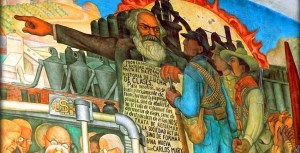
… be it as topic of love stories, of national identities, recognition of interpretation and believes or as matter of understanding of and acting within this world. It is the huge topic of Howard Zinn’s play
[Howard Zinn:
Three Plays: The Political Theater of Howard Zinn: Emma, Marx in Soho, Daughter of Venus]
It is truly coming across in this wonderful, poiggnant performance by Brian Jones
Well, I watched it, and read it before going to Maynooth early May – for some short lectures at my Department of Chiense at the University, one on
the other looking at
then attending the conference The (re)Birth of Marx(ism): haunting the future, there looking at the question
Value theory: is there any value in it? Is it still worthwhile to talk about it?
I remember one passage – showing the ambiguities, and also giving some tiny insight in the major role Jenny played.

I wish you could know Jenny. What she did for me cannot be calculated. And she accepted the fact that I could not simply get a job like other men. Yes, I did try once. I wrote a letter of inquiry to the railway for a position as clerk. They responded as follows: “Dr. Marx, we are honored with your request for a position here. We have never had a doctor of philosophy working for us as a clerk. But the position requires a legible handwriting, so we must regretfully decline your offer.” (He shrugs.)

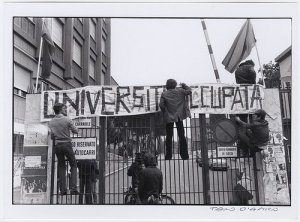
[https:// hauntingthefuture.files.wordpress.com
/2017/11/universita-occupata.jpg]
Jenny believed in my ideas. But she was impatient with what she considered the pretensions of high-level scholarship. “Come down to earth, Herr Doktor,” she would say.
She wanted me to describe the theory of surplus value so ordinary workers could understand it. I told her, “No one can understand it without first understanding the labor theory of value, and how labor power is a special commodity whose value is determined by the cost of the means of subsistence and yet gives value to all other commodities, a value which always exceeds the value of labor power.” She would shake her head: “No, that won’t do. All you have to say is this: your employer gives you the barest amount in wages, just enough for you to survive and work; but out of your labor he makes far more than what he pays you. And so he gets richer and richer, while you stay poor.” All right, let us say only a hundred people in world history have ever understood my theory of surplus value. (Gets heated) But it is still true! Just last week, I was reading the reports of the United States Department of Labor. There you have it. Your workers are producing more and more goods and getting less and less in wages. What is the result? Just as I predicted. Now the richest one percent of the American population owns forty percent of the nation’s wealth. And this in the great model of world capitalism, the nation that has not only robbed its own people, but sucked in the wealth of the rest of the world . . . Jenny was always trying to simplify ideas that were, by their nature, complex. She accused me of being a scholar first and a revolutionary second. She said: “Forget your intellectual readers. Address the workers.” She called me arrogant and intolerant. “Why do you attack other revolutionaries more vehemently than you attack the bourgeoisie?” she asked. Proudhon, for instance. The man did not understand that we must applaud capitalism for its development of giant industries, and then take them over. Proudhon thought we must retreat into a more simple society. When he wrote his book The Philosophy of Poverty, I replied with my own book, The Poverty of Philosophy. I thought this was clever. Jenny thought it was insulting. (Sighs) I suppose Jenny was a far better human being than I could ever be.

Tragicomedy of Capitalism Today

A new video is uploaded, referring to short clips from a BBC-biography cast presenting Bill Gates . The presentation here is titled

Tragicomedy of Capitalism Today – A bit of Gates-Peeling

and looks with the reference to short excerpts from the film at some of the socio-cultural dimension of the tragicomedy.

— Tiny aspects – still, if it is true that we are witnessing a fundamental and deep-far reaching change of the ways we produce ad live together, it may be worthwhile to reflect as well a bit on the generational shift and on who this self-appointed avant-garde is.

The five sections are musing around the following items:

  • Predatory and Tributary Aspects of Capitalism Today
  • Alligator Capitalism
  • Cultural/historical heritage without inheritance tax
  • Sense of public service or missionary capitalism?
  • On horses, cars and Microsoft computers

It is a bit of ‘slow reading’ of the sign of apparently turbulent times.

References:

photo in present text: https: //tr3.cbsistatic.com/hub/i/r/2017/12/13/7fa674ee-c595-4a22-867a-c5f27b5faaa6/resize/770x/dcc1b021beb10d381e6eed9ab560bd9f/istock-501221160.jpg

The Bill Gates Story: https://youtu.be/fu1fBJ9b0mQ

Garrett Hardin: The Tragedy of the Commons; i: Science, December 1968

Carol M. Rose, 1986: The Comedy of the Commons: Commerce, Custom, and Inherently Public Property; Faculty Scholarship Series. Paper 1828; http://digitalcommons.law.yale.edu/fss_papers/1828

Wassily Leontief, 1983: National Perspective: The Definition of Problems and Opportunities; in: National Academy of Engineering: The Long-Term Impact of Technology on Employment and Unemployment; Washington: National Academy Press

Peter D. Norton, 2008: Fighting Traffic. The Dawn of the Motor Age in the American City; Cambridge, Massachusetts London, England: The MIT Press

Not only paradise lost …

That paradise is lost is well known and widely accepted. And we probably have to accept that finally politics is lost too.
Some speak at least still changing the imperial mode of lifepleading for vegetarianism and opposing the use of SUVs – of course especially the latter easily accepted by the unemployed …. [see in this context Peter Herrmann / Mehmet Okyayuz: What to do with the revolution – and what does the revolution do to us?]
Others rejecting political responsibility completely … – well, passing it on to incompetent night watch [wo]men.
[Von Julian Herzog, CC-BY 4.0, https://commons.wikimedia.org/w/index.php?curid=43002116]
Some time ago, March 15th, 2018, the then designated Minister-president of Bavaria, stated in an interview
I will understand myself on the one hand as manager of Bavaria, but also as maker./Ich werde mich einerseits als Manager Bayerns verstehen, aber auch als Kümmerer.
His principle philosophy is Bavaria plus:
If the federal government decides something, ‘let’s put a scoop on it’./Wenn der Bund etwas beschließe, ‘legen wir noch eine Schippe drauf’. 

Schumpeter stated in his book on ‘Capitalism, Socialism and Democracy’

The conquest of the air may well be more important than the conquest of India was—we must not confuse geographical frontiers with economic ones.

At the moment it seems that exactly this applies to supposed
as for instance the GAFAs are selling us – HOT AIR, nothing more than extremely well paid gobbledygook, of course well displayed [BTW, habe a closer look at the logo on the mugs]
All this is even more remarkable when we consider that the top-CEOs are increasingly taking over politics as I elaborated in one of the recently submitted and accepted book-contributions, namely the one titled

The Comedy of Big Data – Or: Corporate Social Responsibility Today, while Corporations wither away?: in: Corporate Social Responsibility and Corporate Governance – a 21st Century Challenge; Mulej, Matjaž/O’Sullivan, Grażyna/Štrukelj, Tjaša (eds.): forthcoming

Some adjunct issues are also looked at in recent presentations of which the recordings can be found here.

What is the Value of things

Peter Herrmann, currently guest researcher at the Max Planck Institute for Social Law and Social Policy/Max-Planck-Institut für Sozialrecht und Sozialpolitik [section social law], Munich, Germany, will present later today his thoughts on
Value Theory –, asking if there is still any value in it?/Is it still worthwhile to talk about it?
to the conference

Abstract

The theory of value is probably the most contested feature of Marx’ political economy. The reasons for this are the following two

* It stands at the centre of making out the political of political economy
* It is cross cutting with respect to the micro- and macro-level and especially the ‘personal/individual’ and the ‘societal/institutional’ aspects of economic thinking.
Today the questionable character comes even more to the fore as we witness an apparently fundamental change of the mode of production.
Notwithstanding the critique then and now, there are good reasons to emphasise the usefulness of the theory of value. These will be taken up by exploring explicitly the tensions mentioned, and discussing them against the background of the contemporary shift within the capitalist mode of production.
Marxism, in this light, is especially instrumental for the analysis of globalisation as it allows a clearer understanding not least of the emergence of poverty chains and the role of the capitalist state as institution that maintains centre-periphery patterns of inequality within the productive sphere. Furthermore, we can find from here at least clues for answers Marxism has when it comes to fighting for societal change.

One Belt – One Road – One World – Digitisation of Life as Chinese Lifestyle?

It is never an easy thing: dedication of some work – doesn’t it propose also agreement?
I do not know if and in which way Elmar would have agreed with what I presented – yesterday he passed away and we, critical thinkers with a genuine interest in progressive scientific work – progressive by way of contributing to progress of societal development so we will never know exactly. One thing we do know – the obituary of the scientific committee of attac [German] clearly states it:

ELMAR ALTVATER DIED

It talks about him as an

Inspiring critique of the capitalist economy

This he truly was – as such he encourages me to dedicate the presentation to him: as quest to me and to the students to take up this challenge of critical thinking.

The abstract of the presentation which is recorded here
may give some insight into what you can expect from the lecture — and hopefully you still will be surprised and inspired.
Living in China means as well getting used to a highly advanced level of internet-penetration in large parts of daily life. Often this is perceived as contradicting prevailing traditional ‘life styles’ and attitudes. At first glance this has not much to do with the future of social policy, or does it? – Social policy faces the difficult task of bringing an institutional system and ‘life worlds’ together. With globalisation and digitisation there is an additional challenge: the reference to the nation state and standard forms of labour are increasingly loosing or changing their role, or at least changing it. Is there any common ground for small island nations like Ireland and unimaginable countries like China?

hope — even for those …?

Crosses ordered onto walls of all Bavarian government buildings

It requires a lot of …, well, hard to say: naivety (or is it Bavarian nativity?), stupidity, short-sightedness, self-overestimation … or lack of confidence that makes it necessary for politicians to hide behind ‘public acts’ that may have only one purpose: personal profiling in the sense of putting oneself on stage, perform as hero without becoming aware that they change the stage to a place for dangerous tragicomedies, to a place where clowns and comedians make policy in the name of five stars, one cross and an abyss that is guiding their thinking …

Their problem — but also that of each of us, requiring to condemn … also our own faults ….

The scribes and the Pharisees brought a woman who had been caught in adultery, and placing her in the midst they said to him, “Teacher, this woman has been caught in the act of adultery. Now in the Law, Moses commanded us to stone such women. So what do you say?” This they said to test him, that they might have some charge to bring against him. Jesus bent down and wrote with his finger on the ground. And as they continued to ask him, he stood up and said to them, “Let him who is without sin among you be the first to throw a stone at her.” And once more he bent down and wrote on the ground. But when they heard it, they went away one by one, beginning with the older ones, and Jesus was left alone with the woman standing before him. Jesus stood up and said to her, “Woman, where are they? Has no one condemned you?” She said, “No one, Lord.” And Jesus said, “Neither do I condemn you; go, and from now on sin no more.”

Of course, that, in the case in question, i.e. Mr. Soeder,  cannot mean to withdraw from critique – it is about dialectics I guess: accepting the message quoted from John 8.3-11, without following what is stated in Luca 23,34:

“Father, forgive them, for they know not what they do.” And they cast lots to divide his garments.

Where is the border between forgiving and civil courage? Surely not in retreating into the individuals’ realms …

Principiis obsta – Finem respice
‘Resist the beginnings’ – ‘consider the end