ordinary madness

http: //cf.mp-cdn.net/b9/42/12f04789eaa51ed84f12d30948cd-is-hypocrisy-the-greatest-threat-to-human-societies.jpg
I am working a bit on digitisation, and with this also looking at these Silicon Valley folks, these CEOs, their strategies and a bit of the ‘academic backing’ some of them get. The wisdom is mostly much inferior tho what my grandmother said, the difference: she did not have income comparable to that of Zuckerberg, McApple or Nadella. What is equally [or more?] worrying: we believe much of this rubbish [sorry] and even admire them. The other day I read about Mr Z., now being celebrated for his outstanding benevolence. And around the same time he had been accused of supporting Anti-Refugee-Campaigs …
In Washington, during the Senate hearing, Z. stated

Facebook is an idealistic and optimistic company. For most of our existence, we focused on all of the good that connecting people can do. And, as Facebook has grown, people everywhere have gotten a powerful new tool for staying connected to the people they love, for making their voices heard and for building communities and businesses.

BTW, a hearing that was a bit mute people asking a wall, their hearing not able to figure out that, naturally, the reply would be a kind of echo.

  • Is it worthwhile to add that nearly every senator explicitly and pronouncedly expressed gratefulness for Z’s appearance, much more than general curtesy, basic good manners would have suggested? And to ask why he meets the European Parliament’s leaders in private sessions ?
  • Is it worthwhile to ask if everybody who has to appear at Court – the small pickpocket, shoplifter or the murderer and rapist – meets the same curtesy?

It is necessary to ask for the real the reason for such ‘liberal’ case Z. – at least it is obvious that the view on liberalism and market equality deserves some qualified review, looking at the foundation and meaning of the ‘free market’.

Ambiguities – hardly coming to an end …

… be it as topic of love stories, of national identities, recognition of interpretation and believes or as matter of understanding of and acting within this world. It is the huge topic of Howard Zinn’s play
[Howard Zinn:
Three Plays: The Political Theater of Howard Zinn: Emma, Marx in Soho, Daughter of Venus]
It is truly coming across in this wonderful, poiggnant performance by Brian Jones
Well, I watched it, and read it before going to Maynooth early May – for some short lectures at my Department of Chiense at the University, one on
the other looking at
then attending the conference The (re)Birth of Marx(ism): haunting the future, there looking at the question
Value theory: is there any value in it? Is it still worthwhile to talk about it?
I remember one passage – showing the ambiguities, and also giving some tiny insight in the major role Jenny played.

I wish you could know Jenny. What she did for me cannot be calculated. And she accepted the fact that I could not simply get a job like other men. Yes, I did try once. I wrote a letter of inquiry to the railway for a position as clerk. They responded as follows: “Dr. Marx, we are honored with your request for a position here. We have never had a doctor of philosophy working for us as a clerk. But the position requires a legible handwriting, so we must regretfully decline your offer.” (He shrugs.)

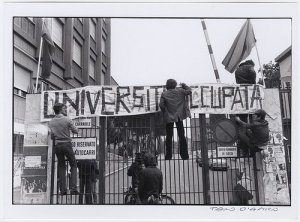
[https:// hauntingthefuture.files.wordpress.com
/2017/11/universita-occupata.jpg]
Jenny believed in my ideas. But she was impatient with what she considered the pretensions of high-level scholarship. “Come down to earth, Herr Doktor,” she would say.
She wanted me to describe the theory of surplus value so ordinary workers could understand it. I told her, “No one can understand it without first understanding the labor theory of value, and how labor power is a special commodity whose value is determined by the cost of the means of subsistence and yet gives value to all other commodities, a value which always exceeds the value of labor power.” She would shake her head: “No, that won’t do. All you have to say is this: your employer gives you the barest amount in wages, just enough for you to survive and work; but out of your labor he makes far more than what he pays you. And so he gets richer and richer, while you stay poor.” All right, let us say only a hundred people in world history have ever understood my theory of surplus value. (Gets heated) But it is still true! Just last week, I was reading the reports of the United States Department of Labor. There you have it. Your workers are producing more and more goods and getting less and less in wages. What is the result? Just as I predicted. Now the richest one percent of the American population owns forty percent of the nation’s wealth. And this in the great model of world capitalism, the nation that has not only robbed its own people, but sucked in the wealth of the rest of the world . . . Jenny was always trying to simplify ideas that were, by their nature, complex. She accused me of being a scholar first and a revolutionary second. She said: “Forget your intellectual readers. Address the workers.” She called me arrogant and intolerant. “Why do you attack other revolutionaries more vehemently than you attack the bourgeoisie?” she asked. Proudhon, for instance. The man did not understand that we must applaud capitalism for its development of giant industries, and then take them over. Proudhon thought we must retreat into a more simple society. When he wrote his book The Philosophy of Poverty, I replied with my own book, The Poverty of Philosophy. I thought this was clever. Jenny thought it was insulting. (Sighs) I suppose Jenny was a far better human being than I could ever be.

Fuer meine Tochter/For my daughter …

… and all her sisters, and all their Kids …. [english below]

Sah die eben – hab so oft an die lleine Geschichte gedacht, in Oberstaufen auf dem Weg nach Bad Rain, wenn ich den Namen richtig weiß, waren wir: Du warst noch viel in der pram, aber auch schon eifrig am Gehen. Und da hast Du mir etwas „beigebracht“, als Du die Schnecke sahst – ich dachte nur, was soll’s; Du hast Dich davor gehockt, wolltest beobachten, wie sie da kroch: langsam, schweigsam…vielsagend. Hab die Geschichte auch oft meinen Studis erzählt und so kennt man Dich in Ireland, China, Finland, Ungarn … nun auch als meine Lehrerin: Geduld, etwas selbst erforschen durch genaues Hinsehen, Hören, Details und das (im) Universum, in Zusammenhängen, und in der Ewigkeit — schließlich musste das kleine Wesen über diesen endlos breiten Weg …, und hatte dafür endlos Zeit …., bis an das Ende des Raums, und immer noch ein wenig weiter, bis an das Ende der Zeit, und immer noch ein wenig länger …

********

Just saw this fellow – I remembered so often the little story, in Oberstaufen on the way to Bad Rain, if I know the name correctly: You were still much in the pram, but already eager to walk. And then you “taught” me something, seeing the snail – I just thought, what the hell, it is nothing, but you sat in front of it, wanted to watch it crawl: slowly, silently… meaningful. And I joined …

I also told the story often to my students and so they know you in Ireland, China, Finland, Germany, Hungary… now also as my teacher, the lǎoshī of the lǎoshī: patience, exploring something by looking closely, hearing, details and the (in) the universe, in contexts, and in eternity – finally the little being had to follow this endlessly wide path…, and had endless time…., to the end of the space, and still a little further, to the end of time, and still a little longer…

There are these many things that can only be lived, no textbook can teach.

What is the Value of things

Peter Herrmann, currently guest researcher at the Max Planck Institute for Social Law and Social Policy/Max-Planck-Institut für Sozialrecht und Sozialpolitik [section social law], Munich, Germany, will present later today his thoughts on
Value Theory –, asking if there is still any value in it?/Is it still worthwhile to talk about it?
to the conference

Abstract

The theory of value is probably the most contested feature of Marx’ political economy. The reasons for this are the following two

* It stands at the centre of making out the political of political economy
* It is cross cutting with respect to the micro- and macro-level and especially the ‘personal/individual’ and the ‘societal/institutional’ aspects of economic thinking.
Today the questionable character comes even more to the fore as we witness an apparently fundamental change of the mode of production.
Notwithstanding the critique then and now, there are good reasons to emphasise the usefulness of the theory of value. These will be taken up by exploring explicitly the tensions mentioned, and discussing them against the background of the contemporary shift within the capitalist mode of production.
Marxism, in this light, is especially instrumental for the analysis of globalisation as it allows a clearer understanding not least of the emergence of poverty chains and the role of the capitalist state as institution that maintains centre-periphery patterns of inequality within the productive sphere. Furthermore, we can find from here at least clues for answers Marxism has when it comes to fighting for societal change.

Wisdom versus educating for “bubble-existence”

Again it is the one painting in the Lehnbachhaus that catches some special attention, fascination and wondering …

It simply says Children on the Balcony (by Albert Burkart) though our question is if these are children or – if it is about maturing, being able to look over the fence, preparing for the stage where the fence does not exist anymore … –

Man only plays when in the full meaning of the word he is a man, and he is only completely a man when he plays.

I nod

Yes, you are right

– and I ask

Do we need the birds-eye, the ease of the flight to reach such independence – an independence that only exists through the complete sintesi – a state of conflation and consolidation?

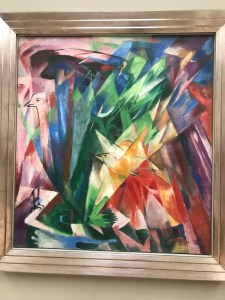
Marc was not able to see that this flight would bring him only to death – he may have thought of a peaceful merger, the merge towards peace, the two pieces fighting with each other for a while …

Colours as deceiving interims, though appropriating after some time the essence, ignorant when it comes to the need to communicate, to apply different, i.e. substantial criteria.

From where can we take them? Now I am the one to quote Schiller – again from the Letters On the Aesthetic Education of Man

The greater part of men are much too exhausted and enervated by their struggle with want to be able to engage in a new and severe contest with error. Satisfied if they themselves can escape from the hard labour of thought, they willingly abandon to others the guardianship of their thoughts.

And I add: the greater part is not able any more to dance, at least to dance the dance of the sintesi.


On the way back, passing the King’s Square, the former headquarter of the Fascist murderers that accommodates today a school for music and theatre (“Hochschule für Musik und Theater München”) we arrive at the back of the Old Pinakothek – today the place for free play, the place for free play today … – The freedom, registered as association according German law, once per year, between 14:00 and 18:00 hrs – the lawn is nicely cut, fresh .., one can still smell what The Grim, the man with the scythe revealed, a sweet odour of decay …

Additional opportunities can be booked as special service package – later such packages turn to boxes, but that is for students already …

… indeed, there’s nothing like starting young …

The way to reach free play, the state of free of play, constraint by bubbles

And true too:

… indeed, there’s nothing like starting young to reach wisdom ….

Age .. here it has to accept the responsibility – accepting what we may call Schiller’s paradox

It would be necessary that they should be already sages to love wisdom: a truth that was felt at once by him to whom philosophy owes its name.

Shall we … – the sun is too tempting … – we sit down … with the ease of true playfulness.

hope — even for those …?

Crosses ordered onto walls of all Bavarian government buildings

It requires a lot of …, well, hard to say: naivety (or is it Bavarian nativity?), stupidity, short-sightedness, self-overestimation … or lack of confidence that makes it necessary for politicians to hide behind ‘public acts’ that may have only one purpose: personal profiling in the sense of putting oneself on stage, perform as hero without becoming aware that they change the stage to a place for dangerous tragicomedies, to a place where clowns and comedians make policy in the name of five stars, one cross and an abyss that is guiding their thinking …

Their problem — but also that of each of us, requiring to condemn … also our own faults ….

The scribes and the Pharisees brought a woman who had been caught in adultery, and placing her in the midst they said to him, “Teacher, this woman has been caught in the act of adultery. Now in the Law, Moses commanded us to stone such women. So what do you say?” This they said to test him, that they might have some charge to bring against him. Jesus bent down and wrote with his finger on the ground. And as they continued to ask him, he stood up and said to them, “Let him who is without sin among you be the first to throw a stone at her.” And once more he bent down and wrote on the ground. But when they heard it, they went away one by one, beginning with the older ones, and Jesus was left alone with the woman standing before him. Jesus stood up and said to her, “Woman, where are they? Has no one condemned you?” She said, “No one, Lord.” And Jesus said, “Neither do I condemn you; go, and from now on sin no more.”

Of course, that, in the case in question, i.e. Mr. Soeder,  cannot mean to withdraw from critique – it is about dialectics I guess: accepting the message quoted from John 8.3-11, without following what is stated in Luca 23,34:

“Father, forgive them, for they know not what they do.” And they cast lots to divide his garments.

Where is the border between forgiving and civil courage? Surely not in retreating into the individuals’ realms …

Principiis obsta – Finem respice
‘Resist the beginnings’ – ‘consider the end

How many roads must a man have walked down

A visit of Peter Herrmann, currently guest researcher at the Max Planck Institute for Social Law and Social Policy/Max-Planck-Institut für Sozialrecht und Sozialpolitik [section social law], Munich, Germany, will be giving the coming first week of Mai two lectures in Maynooth, Ireland, at the Maynooth University’s Department of Chinese, directed by Dr. Lu Zhouxiang.
The first lecture deals with
One Belt – One Road [OBOR] – One World – From Economy of Comparative Advantage to Socio-Politics of Cooperative Progressing.
The second is looking at
One Belt – One Road – One World – Digitisation of Life as Chinese Lifestyle
[https://doc-research.org/en/new-match-dialogue-civilisations-one-belt-one-road/]
These lecturers, made possible in particular by the engagement of Dr. Lu Zhouxiang. Herrmann, who is himself visiting scholar at the Department in Maynooth, will contribute from his experience of having lectured and researched for some time  in China – Bangor College of Central South University of Forestry & Technology, ChangSha, and Zhejiang University, School of Public Affairs, Dept. of Social Security and Risk Management, HangZhou, PRC. This will establish links to theoretical debates and establish as well reflections from the global experience Herrmann gained over the years.

elementary knowledge for university admin staff

OPEN LETTER

I regret and feel very sorry: I would have expected that staff working in academic institutions – while we are writing the date of

Il giorno 20/mar/2018, alle ore 04:54,

apparently have to write

• Email submissions: We regret we are unable to accept references emailed to us

It is all about elementary knowledge, back to the real blackboard

Yes, I would have presumed the ability to deal with simple information technologies instead of uploading the burden on academics who surely have other and better things to do.

It is a commonly known problem though: specifically qualified staff not knowing about basics.
Feel free to contact one of my former students – they are surely most obliging and willing to help – and they do not even charge you such tremendous fees as universities like yours do. — I know, reading such things is frightening – as everything ugly is frightening if we see it in a mirror, feeling helpless especially if we are aware that we are acting as string puppets, being danced [yes, I hope for you that you don’t feel as dancer yourself] on others who are even weaker. – In any case, if YOU do not read it others will.
Positive thinking allows me to say that you fortunately are yourself worried about the low standards — otherwise you would not regret.
My recommendation: have a look if Warwick university offers offers some courses like
* basic IT-skills
* the problems of externalisation of cost: they multiplay and at some stage they return to the originator.
More positive thinking even: some universities came back to me, asked for apologies and promised changes. Unfortunately, after they asked for help and advice, they turned down my offer to support them further for a minor fee.
Sincerely worried – poor souls you are, a long way to academic standards [well, you remember E.P. Thompson? Top academics like him had been forced out …, history does to repeat, but lack of honesty and commitment apparently does …
Peter Herrmann
PS: Surprising for me is that a huge number of colleagues – students, administrators, academics – and surely most of the common people, using their common sense do agree .. and swallow.

Squalidness of a System – Gravediggers of Dreams – Murderers of Humanism

… which is all a continuation of the entries on boxing and the attempt to open the box and various other blogposts and you may have a look at
Sure, one may say it is not a great deal, all the advantages of the digital world will of course also be there to make universities a better world and even help to open the doors to these still somewhat sacred halls of humanism, Western education strongly claiming this tradition as still guiding principle, proudly showing the two Humboldt’s, sitting in front of the main building
[https://de.wikipedia.org/wiki/Datei:Wilhelm_von_Humboldt_Denkmal_-_Humboldt_Universität_zu_Berlin.jpg]
[https://de.wikipedia.org/wiki/Datei:Alexander_von_Humboldt_Denkmal_-_Humboldt_Universität_zu_Berlin.jpg]
Admittedly – oh vanity – it had been an delightfully exhilarating feeling when entering the building for [one of?] my first public presentations, passing the busts and insignia of the many ‘great forefather’ – and the few mothers mentioned. Being able to say ‘my forefathers’ allowed me to redefine my strange orphanage, knowing that it was indeed about moving on and moving up and stumbling through the academic world – witnessing and being part ….
Indeed, the baby can remain alive while occasionally the bathing water has to be changed. The problem, however, begins as soon as the new water proves to be poisoned.
*******
Warwick University is amongst quite a number that deserve being ‘reported’ as institutions boxing humans – and I will later return to this  case. Others are e.g. Brook [Canada], CUHK [HongKong], LSE [London], Oxford U and some UCL [somewhere on the island of independence-dreamers], being sufficiently arrogant to assume that everybody has to know who UCL is [actually it is possible to find out who is hiding behind the three letters: it is not Université catholique de Louvain, not the UEFA Champions League, Centre for Computational Psychiatry and Ageing Research … [interesting to see the differences in search engine results, depending on the location from which you search], but it is University College London – sure, symptomatically, being at such a UCL people begin to think like a puddle [see also here for the entire text about the Salmon of Doubt]: there is only one UCL – it is like the puddle being the entire world, only made for you], are part of the experience of disrespect and a ‘special kind of illiteracy’ which may well go as culprit to court at some stage – though for me the [il]legal side is only a wee part of a story that shows the squalidness which higher education reached.
*******
Now coming back to it: Talking about Warwick University means talking about one amongst many, denouncing one as example for a systematic defect. But it also means that it has some especially bitter taste as the history should have taught some wisdom.
Warwick is one of the universities founded during the times of a spirit of change: the forerunner, shock and also aftermath of the so-called 68-movement – forerunners, shock and aftermath also in a positive sense of taking up the need of investing in education, and understanding education as part of …, well not necessarily a revolutionary movement, but an emancipative strive in the spirit of the bourgeois enlightenment for which names like Kant and Humboldt and, yes also Mill and Smith stood. However
And at some this this culminated and
At stake was
And with this it was already at an early stage clear that the entire enterprise was concerned with a shift of understanding of subject matters, i.e. the self-uderstanding of disciplines. Here it changed for instance lets say from economics to ‘Management Science’.
Of course – and Andrew McGettigan makes us aware of it – this has to be seen against the background of the changing economic situation in Britain at the time – though it hadn’t been Britain alone.
It is an often forgotten factor, unfortunately – as seeing this context may help us to understand the moves today, for instance looking at the ‘Eon Energy Research Center’ in Aachen, Germany or the more or less recent ‘donation’ of twenty professorships: the technical university in Munich receives these from the discounter Lidl.
Much more could be said, also that Foundations [the professorships are provided by the Lidl-Foundation, not directly Lidl] are a kind of money-laundry-undertakings, other cases could be mentioned — mind snatchers are under way, even resulting in more or less funny …, perhaps Freudian slips? Briefly retuning to Warwick, we read that
Yes, God save the Queen and long live there multiple heirs. And though I recently looked into kind of shocked eyes when I mentioned the personal experience of the 1972 Anti-Radical Decree [oh, if official documents are looked at …and if some others are considered].
*******

Back to the presence and the bad habits and style when it comes to dealign with applicants and referees – again:

  • Students, naming referees, are asked to provide ‘institutional e-mail addresses’ – Shouldn’t a university that claims to be international and global accept that lecturers are international and global, sometimes not able to maintain mail addresses from previous positions, sometimes just making life a bit easier using onky one ‘private’ mail address instead of permanently changing and/or checking various addresses?
  • Mails sent out  to the institutional address are sent in completely automated fashion or at least the responses are not checked. Concrete: for my part I set up an auto-reply, informing the sender that the mail address they used is rarely checked and asking them to use another contact address. What happens? Nothing. The keen interest of students to get their application properly lodged and also the right of lecturers to be available in a self-defined way are not respected – even the self-respect of the universities diminished to the extent that they reduce themselves to illiterate, at most semi-literate machines.
  • This is completed then by the expected formats of references: a questionnaire any person who is at least a little bit qualified in data analysis [not to speak of common sense] would immediately see as inappropriate, lacking meaning and not allowing gaining any insight it the student’s ability. Personal questions about the referee that breach protection of privacy and are completely irrelevant …
    – Of course, the entire procedure may [and should] be questioned and there is the need to find better ways. But leaving this aside, it may deserve some further reflection: Should a questionable procedure, a matter that is extremely difficult to be answered, be followed up by further sub-standardising the way of dealing with it?
  • Useful, then, would be to to protect referees against being bombarded by advertisement from those universities, offering the referee to apply for a graduate course … — so, apparently undergrads can act as referee??
End Administrative infantilisation – Please stop it
Artificial intelligence … – I am more concerned about artificial stupidity – but then again, it is certainly true that computers, also intelligent systems, are just doing what they are told do by humans: in other words there is no artificial stupidity, even if messages are from academic systems, we should not blame those algorithms. And one may summarise, saying that algorithmisation, further administration and infantilisation are very much different forms of incapacitation.
Other things may be added, different combinations can be found – the bottom line: human issues are dehumanised and passed on to systems that are completely lacking empathy, and do not even show some basic mindfulness and respect of the values the system they supposedly represent, claims as guiding. Simple: If a university claims to reflect and pursue the values of humanism in the truest sense, the same university should make sure that the instruments and tools, used by its departments work by applying and supporting these values.
*******
Navigare necesse est, vivere non est necesse – Plutarco
The other day I talked with a colleague about all these developments in academia, she commented: ‘And we all accept it.’ I think it is really one of the problems, may be we get up, oppose on small items individually, may be even as small or large groups but at the end of the day  … – how can a system be changed, if changes are not approached on the system level, and systematically. Well, those who try have to pay. Those who have the say, always find a way. It is not least about  ‘squeezing more into less’.
To sum up, it is about universities and their development from academic educational settings to slaves of business further to administered systems, now to IT-led information providers.
Of course, the ‘old Bologna’ was also about business – and there Polanyi comes in: business was controlled by society – sure, we should not forget that it was a more or less rotten feudal society … And society itself is today actually often a stupid bubble economy, only leaving some small niches, suggesting real life is about withdrawing, looking for individual escapes … .
So, there you see me back, unsettled, opposing the temptation of a navigare necesse est, vivere non est necesse as already criticised by Plutarch. I just want to live, and I want for everybody the right to do exactly that. That is surely different  from permanently steering, moving from one emergency patch to another. And for the educational system it was already said by Alfred Marshall, thus even on the conservative side, stating

The schoolmaster must learn that his main duty is not to impart knowledge, for a few shillings will buy more printed knowledge than a man’s brain can hold. It is to educate character, faculties and activities; so that the children even of those parents who are not thoughtful themselves, may have a better chance of being trained up to become thoughtful parents of the next generation. To this end public money must flow freely. And it must flow freely to provide fresh air
and space for wholesome play for the children in all working class quarters. 

And we should never forget: at the end we are all complying! Nolens volens? Being algorithmicised, further administering life instead of living it or being infantilised – as long as we are not ready to stand up collectively and speak out loudly.