Increasingly we read articles – academic or not – and watch documentaries about the
healthcare crisis.

if you can’t pay, just stay away.
Increasingly we read articles – academic or not – and watch documentaries about the
healthcare crisis.

if you can’t pay, just stay away.
Well, I am not entirely sure if I got something wrong, if it is already a new business idea or if I bring it up as potential business strategy? Recently I saw in Austria a poster, advertising for flights. Part of it:

Flights, from 59.99 €. + registration of luggage — including miles.
Now I am wondering if there is another booking option: Booking a seat on the aircraft, and then paying per mile? This is the way car transport works – be it if you take a taxi or if you go for ‘car sharing’.
We may get there – or may even be on the way to ‘Ubering your flight‘ – without Uber.
– See also
Dopo il car sharing, arriva il “flight sharing”. I piloti condividono aereo… e spese
Fancy sharing the cost of a flight on a private aircraft?

There is a light
she said
and they are together. It is not a sad painting!
This is from a most enjoyable visit with a friend at the New Pinakothek. It had been much later that evening, after we had been chatting, nicely, seriously, laughingly over a drink when she gave me this think-piece, and with it came a ‘provocation to live’ …
Recently, my Italian translator, Giuseppe, wrote me an email. It was not a typical exchange, but quite an extraordinary personal query:
“Many see you as a very courageous person. They would like to imitate you at that, at least a little bit, but they feel they are not courageous, say, ‘by nature’ and they cannot learn courage. What do you think about that? Can people train themselves to be courageous?
I do not know how to answer this question in brief, and definitely not in the body of an email, not in just a few words. But the question is important, maybe essential, and so I decided to reply by writing this essay. ….
as rip-off capitalism ….
Sure, in capitalism, there may be many final rip offs … and yet, there is none that is really final. Always new niches, new paths and new fields are found by ingenious entrepreneurs, more or less ingenuously making a fortune out of nothing and of everything.
Schumpeter, at least in this respect wisely, said:
The conquest of the air may well be more important than the conquest of India was—we must not confuse geographical frontiers with economic ones.
From my side some idea, to be exploited by others, feeling myself to ingenuous in the meaning of lacking the disputes rip off attitude [oh, I hope, nobody really takes it up !!]: in Amsterdam I saw this photo in the window of an auctioneer …
Shouldn’t all birdhouses and bird feeders be exploited: the rip-off state could surely elaborate without problems a system of taxation, the birdwatchers, together with the developers of algorithms should look for ways to identify birds who use these, may be charged in a different way … hum … can’t one convert the wing beat to energy, then asking the birds to pay for the food ..
Sure, there may be another option: the price for accommodation in Amsterdam may suggest that such little places are also sold on the market …
The old question:
is always newly veiled, always requiring new answers … – and too often, as the little man told us, it finds, very sad answers.
Being now in the capital of Greece, a recent communication with a student comes to my mind again – it had been about her not having time to follow up on a mail I sent in connection with a reference letter I wrote for her because she was busy with urgent preparations of some exams. I frankly replied that I hate exams and reviews, receiving the reply
Nobody likes assessments …
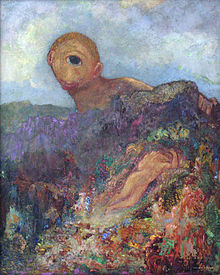
So he declared. I poured him another fiery bowl –
three bowls I brimmed and three he drank to the last drop,
the fool, and then, when tile wine was swirling round his brain, I approached my host with a cordial. winning word:
‘So, you ask me the name I’m known by, Cyclops? I will tell you. But you must give me a guest-giftas you’ve promised. Nobody-that’s my name. Nobody – so my mother and father call me, all my friends.’
But he boomed back at me from his ruthless heart, ‘Nobody? I’ll eat Nobody last of all his friends-
I’ll eat the others first! That’s my gift to you!’ …
‘If you’re alone: his friends boomed back at once,
‘and nobody’s trying to overpower you now-look,
it must be a plague sent here by mighty Zeus
and there’s no escape from that.
You’d better pray to your father. Lord Poseidon
Sure, any attempt of such calculation is limited by establishing a straightforwardness that does not exist. – Still, there is something in it I guess, trying to think about ‘models’
La Capitale, Le Gare de Paris-Est, four desks, one is open for selling ticket, including helping those who are lost. Three security police guards are roaming, being approached by a stranger, asking for directions, brusquely spurning him … – what would be the effect of “full service”, i.e. four open desks, friendly helping people … is anybody afraid of lowered aggressiveness, less pressure on travellers and possibly train stations as real meeting points, not thoroughfare with an increasing number of shops and security staff and decreasing service and communication hubs…?
The other day, Roma termini, I said
Se una persona mentalmente sana potesse vedere questo trambusto, avrebbe suggerito che questo mondo è …, si, mentalmente folle.
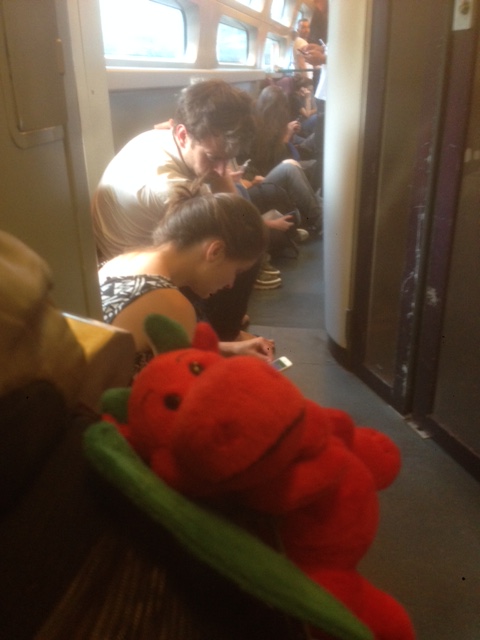
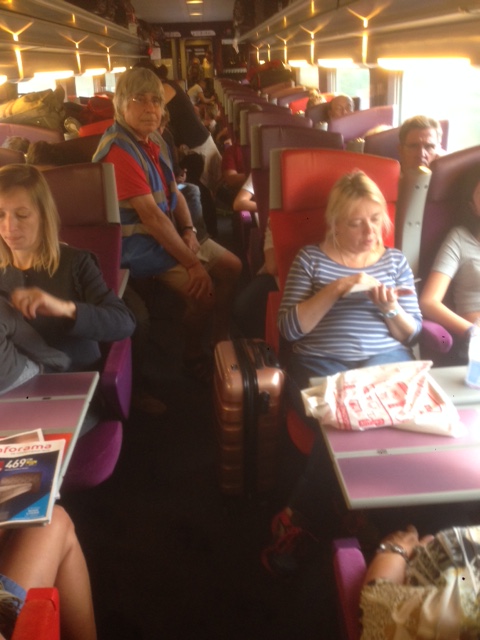
Well, finally one always gets there, can relax in the train …. 
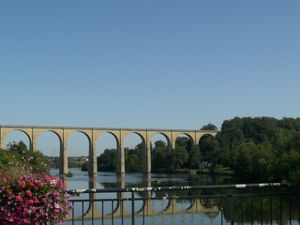
Passing the Viaduct near to L’Isle-Jourdain, I asked …
– indeed it is not a viaduct, as far as the term itself is not only about leading [ducere] a way across some kind of valley but it is also specifying the character of the lead: it refers to the via, i.e. road.
In this case, it is – I had been told – in actual fact not a viaduct but a pediaduct and a bit of a velo- or bikeduct.
Shouldn’t language try to advance things instead of maintaining old concepts, ant thus also ways of life. Shouldn’t it be – perhaps provocatively – in the present case be used as instrument that fosters walking and cycling?
Language-reformers of all countries unite, be brave … – use your power as means to change consciousness – towards a conscious way of living – towards innovation, instead of clinging to past and outdated models.
It may be worthwhile to consider:
You only get the ’trade marks’ of the car – be it star, rings, or … , well you name it – after a test period of driving in a responsible and circumspect way – not assessed by the police record [or the lack of it] but by showing respect for others, environmental responsibility in the way you drive and actually already the decision when you drive …
Oh ja, auch die deutsche Sprache kann Innovationen vertragen, es geht nicht nur um Braini-facturer und Gainification in der Englischen Sprache, sondern es bietet sich auch der Begriff der Ver-Indirektlichung als Wortschöpfung im Deutschen an. Der Grund ist eine zunehmende Diskussion von Prozessen der ‚Externalisierung’ vor allem auch in der deutschen Sozialwissenschaft: die Auslagerung von Kosten und Lasten und Belastungen, die erneute Umschichtung zwischen und Schaffung neuer Zentren und Peripherien etc. [siehe etwa Lessenich, Brand/Wissen und ebenso verschiedene meiner eigenen Arbeiten, allerdings letztere in Englischer Sprache] und zugleich eine meinerseits wachsende Unzufriedenheit mit einem solchen allgemeinen Begriff, dessen Verwendung hier nicht verworfen werden soll, wohl aber für eine Differenzierung Platz haben sollte. Kandidat ist eben die Ver-Indirektlichung. In mancher Hinsicht mag dies an Mechanismen erinnern, die von den Finanzmaerkten bekannt sind – vor allem die Derivate, aber selbst schon einfache Versicherungs- und Fonds-Verfahren sind ja im Grund nichts anderes als die Etablierung von funktionalen Ketten, die allerdings nicht ‚physisch’ oder in irgendeiner anderen Form real sind, sondern auf vagen, vermuteten, indirekten Zusammenhängen bestehen. Offensichtlich wächst einerseits mit der Anzahl der ‚Zwischenschritte’ das Risiko des Scheiterns; andererseits verringert sich die Wahrscheinlichkeit zugleich durch die mit einem solchen Prozess verbundene Streuung des Risikos. Mit Verindirektlichung ist folglich im Unterschied zu Externalisierung ein Prozess gemeint, bei dem die Abhängigkeitsverhältnisse weitgehend ungeklärt bleiben und die Verbindung auch nicht durch klar zu benennende ‚intermediäre Instanzen erfolgt. In diesem Sinne haben wir es auch mit einer Art von Intermediarität zu tun, die aber doch zugleich auch dadurch modifiziert ist, dass die Beziehung eben nicht als direkter und intendierter Kauslitätsmechanismus indiziert ist.