There is no such thing TINA said …

A short article, published in the magazine Sozialextra, is now i open access available, looking back at the history – the ideological change – behind what is again and again called neoliberalism and austerity policies:

TINA said, There is no such thing as society.

Eine kleine Gedenk-Schrift an die geistig moralische Wende der wilden 1980er

I suppose that it presents a view on the history of “social policy”, neoliberalism and austerity that is important to understand the deeper meaning of what is actually going on today – deeper meaning in terms of the underlying ideological shift, rooted in a development for which some (to least a matter of age, though not only) of us are responsible – nolens volens. And it deserves as such attention, not least when we discuss perspectives.. – I thought it is important enough to present at least a rough translation – deepl.com as aching transition tool, with some minor corrections; And als leaving the formatting, referencing a nit chaotic spread across the text. At least you will get the gist of it …

Peter Herrmanni

TINA said, There is no such thing as society[1]

A small commemorative writing on the spiritual-moral turn of wild-west in the 1980s

So there is no alternative, because there is no society – and anyone who knew Margaret Thatcher a little bit, also knows that what she said in 1987 in an interview with a women’s magazine was by no means an unfortunate statement.

Once upon a time …

Today we are complaining about exactly what she said already then. If today anything historical appears at all with the reference, it is a general regret: egoism (sic!) is getting worse and worse, ‘greed’ was even the cause of the crisis and then – yes, only then – neoliberalism has dismantled the remnants of society: The dismantling of the welfare state, austerity, capital-friendliness or even citizenship are then quickly at hand, and if a person has to travel a little, he or she quickly gets tired, because wherever one goes in Europe, for example, the situation is supposedly particularly bad: Oh, our state of careemergency – Il numero sempre crescente di disoccupupati – qu’est-ce que l’État fait pour s’occuper des enfants – Accommodation? Who can still go for that?…. – Buteveryone knows that it’s not so bad ‘everywhere there’, because it’s especiallydramatic only in one’s own country. Irony aside, the urge to bring things to the point of one place and one time, more precisely: the urge we feel to reduce issues on the here and now, is strong – and yet this is precisely also part of the policy that was already embarking on a social restructuring at the end of the 1970s: it was the point of methodological nationalism. And with the news of the ‘weare the poorest’ the foundation was laid for special diligence, but also for the special willingness to accept political changes. Basically, the policy of sticks and carrots advocated by ‘Chancellor Bismarck’ also works here. Itis, however, more than remarkable that the so-called Bismarckian social insurance was in the end decisively enforced by the efforts of the then Minister of Trade – it can even be sharpened: Bismarck held the whip in his hand and those interested in trade, distributed pieces of sugar.

… and now it’s coming true. 

It may bea coincidence that the re-release of the film Invasion of the Body Snatchersintroduced exactly this time – according to the imdb database it is about the fact that

In San Francisco, a group of people discover the human race is being replaced one by one, with clones devoid of emotion. (https://www.imdb.com/title/tt0077745/; 23.02.19)

So the screen was free for a spectacular game, which followed – but then it followed not only on the screen, but on the massive stage called society, even if this allegedly did not exist at all.

Just a little something
relative stabilization of the post-68 period of success, although as an
unstable tension field (seehttps://www.buko.info/http/kongress/buko31/deutsch/groups/68_zeitstrahl.pdf; 23.02.19)

Opening the exit door

1979: Takeover of the government by Margaret Thatcher; takeover of thegovernment by Labour (Leonard James Callaghan).
Since 1980 in various speeches Kohl's demand for a 'spiritual-moral turn',

‘spiritual renewal’ …

September 1982: Landtag election in Hesse with the first Landtag mandates
for the Greens
October 1982: Vote of no confidence against the Schmidt government and
government declaration
March 1983: Bundestag elections, with considerable profits for the CDU/CSU and the first entry of the Greens.
First evacuation
1982 a first rejection of the EU's 'poverty reduction programmes
1995 Judgment of the European Court of Justice confirming that the EU in fact has no social policy competence
1997: EU treaty definition: Poverty reduction is labour market policy and anchored in the Amsterdam treaty.
Blocking the return path
2006 Directive 2006/123/EC of the European Parliament and of the Council of 12 December 2006 on services in the internal market[2]2
epilog

2012 – according to Wikipedia: “Helmut Schmidt, who had been overthrown,  said in 2012 in retrospect in an interview that there had been no change at all, but that the social-liberal policy had been continued and “only thepersonnel had been replaced”. (https://de.wikipedia.org/wiki/Geistig-moralische_Wende; 23.02.19)

It can’t be

A look at the mixture of those years of change must come as a little surprise, for the first impression was quite positive: just as the students had turned against the muff of thousand years, the new regulators resisted the dust that had been stirred up in less than half of a century. However, this wording should be corrected immediately: (i) It is probably more correct to speak of new founders of the old order, because at least some of the old founders had died or were expelled, such as Alt-Nazi Kiesinger. (ii) It was also about the fact that the dust whirled up was just the dust left behind by the fathers of the new founders – from Vietnam to Pinochet-Hayek’s Chile.[3]

The success and lasting effect of the ’68ers are not at issue here – but with all the necessary caution, one can probably speak of a relatively successful implementation of the welfare state concept: here, too, the whip played a role – in the form of a civil war on several fronts;[4]but the carrots seemed large enough to ensure at least a temporary peace. For Germany at least it has to be said: what presented itself as a social sector was not without problems – at least three moments should not be forgotten:

  1. The 2ndGerman ‘socio-economic miracle’ was above all the result of a rather aggressive export orientation – and thus it basically dug its own grave.
  2. Last but not least it was possible to outsource or hide large part of the problems – only later this should become really virulent: Poverty did not exist – it was officially “clere by definition”, classifying welfare payments as poverty being overcome.
  3. Germany – above all, together with Denmark, the Netherlands and the UK – also made its mark in the 1972 hesitant European policy of social order, which shows its true essence cum grano salis only in retrospect, and one must admit (at least to some of the ‘doers’) that none of them opened the exit door, but suddenly all of them were in a kind of social cold.

What lasts long won’t be good for long.

The ‘free, not success-bound’ orientation as a regular task (see Scherr in this issue) found a symbolic supplement through the programme and project policy, which indeed offered partly exciting openings5– but the sadly exciting aspect was exactly the wrong reluctance6– subsidiarity was seen by professional representatives as a possibility of securing the existence of new areas of experience and also used to open up new ones, but at the same time there was no strength, who used this as a basis for a relevant policy at the EU level and finally demanded EU responsibility – for the projects there was no scope for influence, the profession was busy with day-to-day work, colleagues from the academic world usually lacked access, as there were hardly any relevant project calls and the exceptions demanded bureaucratic effort and the courage to speak a foreign language – the welfare associations were overburdened, because the EU’s day-to-day business demanded a lot and moreover, it had been caught in nitty-gritty such as the treatment of stamps with a welfare surcharge under European tax law. Government representatives interpreted these activities more as an excuse for abstinence, because after all there was no EU competence. Border-wise we can say that it was a hike in terra nullius: the land that does not belong to anyone, which thus became the land ofthe dispossessed as well. An internal land seizure then took place, bit by bit, linking further activities more and more to the ‘core tasks of the EU’. In plain language: where most of the social affairs was already outside, the border trees were lowered: Competition was now the magic word – by no means presented as an exclusion of the social. Everything should be even better, and now, at last, truly EU-Romanian, for example through the free movement of services. That cannot be7seen as denying the social sector, can it? Rather, ironically the full recognition of the social has been achieved: social service providers as equal economic partners, for example alongside Deutsche Bank and Hoch&Tief or Flixbus.

  • see for example Herrmann, Peter, 2000: Social work and European integration – dangers of confusing the left with the right shoe; in: New practice. Zeitschrift für Sozialarbeit, Sozialpädagogik und

Sozialpolitik; Neuwied: Luchterhand, Issue 6: 601 – 607; Herrmann, Peter, 2009: Die Europäischen

Union als Programmgesellschaft. The European Social Model, Social Policy and the Third Sector

  • Herrmann, Peter, 1995: Subsidiarity and the wrong restraint or: On the meaning of European poverty

programmes; in: Intelligence Service of the German Association for Public and Private Welfare, Frankfurt/M., Issue 2: 79 – 86

  • Herrmann, Peter, 2011: The End of Social Services? Economisation and Managerialism; Bremen:

European University Publishing House

Who once looks into the metal bowl …

So it was visionary exactly in the way it happened: Kohl and Thatcher spread with their slogans the main ingredients for an ‘alchemistic circle soup’, which systematically redefined the social space as we knew it and actually let parts of the profession run in circles. Basically, we have a constellation again where trade policy and general social order policy have to come together. The EU’s fortress policy of global trade follows the usual cross-paths of a fortress wall that is only closed from one side. Moreover, it is currently also a question of far-reaching structural shifts – keywords are digitization, service capitalism, trade capitalism and financial capitalism, at least in the Western centers, and at the same time so-called Brazilianization. The crucial thing is that in this way a ‘climate’ is created which is much more radical than what is repeatedly called neoliberalism. The abandonment of the social space was more skilfully promoted than any policy of cutbacks, savings and restructuring could have achieved: It is a kind of ‘inner emigration’ – almost exactly we are writing the fortieth year of this counterrevolution: it was against the demonized socialists, clarifying in advance

Our aim is not just to remove our uniquely incompetentGovernment from office—it is to destroy the socialist fallacies— indeed the whole fallacy of socialism—that the Labour Party exists to spread.8

That was easily visibly translated as the actual combat task, far beyond serving the short-term interests of the economic bosses. In fact, the view of the economy was seen much more fundamentally – Kohl, for example, turned out to be a kind of Gramscian and stated in the government statement

The ultimate fate of the market economy is decided – beyond supplyand demand.9

(Excerpt:

https://www.1000dokumente.de/pdf/dok_0144_koh_en.pdf)

Here, too, it wasn’t simply about the real problems,10but also about the problems that had been made or, more precisely, those that allegedly didn’t exist.

“The new poverty is an invention of the socialist jet-set.”

STERN, July 24, 1986

It is significant that they are often negative statements; critiques which, as it were, also describe negatively what the conservatives did not want to be, was the main programmatic point: socially and responsibly – as early as 194911– Thatcher pleaded for the Swabian housewife who later became known through Angela Merkel. According to this, national budgets also have the primary goal of not incurring debts.

Above all, however, they did not want to be socialists – remarkable when one considers that the predecessor of this a-social era, Schmidt, said that there had been no turning point anyway (see box); and equally remarkable that then the ‘third way’, which was later allegedly longed for with Tony Blair in the UK (1997) and Gerhard Schroeder in the Federal Republic (1998) – shortly before the election – in an article in the Financial Times (international edition; passim), with the tenor that a change was necessary to secure the continuation of the conservative way. Basically, the “masterpiece” was done: the social space was abandoned, a sign was hung on the door:

Careful, don’t look back! Poisonous deposits!

And new strangleholds were trained purposefully (see Bohnenberger in this issue) – they were supposed to prepare themselves for private services, competition, division, and stress for ‘social customers’ and ‘providers’, dressed up as zeal, among other things, and finally to accept the good wishes of TINA.

These ‘socialists’ have overlooked many things, including the fact that they have paved the way for an alternative of false demagogues (see Butterwegge in this issue).

  1. Admittedly, Kohl mentions some of the core problems in the government declaration with a certain systematic approach, including those of a kind that not only concern obvious facts but also those of amore techno-political nature (monetary and budgetary policy, etc.).

11Speech at her adoption meeting as Conservative candidate for Dartford (28 February 1949);https://www.margaretthatcher.org/document/100821; 24.02.19Prof. Dr. phil., Sozialphilosoph, News. Thoughts. Provocations www.esosc.euPart of the literature is freely accessible via https://www.researchgate.net/profile/Peter_Herrmann


[1]              Thatcher, Margaret, interviewed by Douglas Keay (1987, September 23). Interview for Woman’s Own; Thatcher Archive (THCR 5/2/262): COI transcript; https://www.margaretthatcher.org/document/106689; 17/06/18

[2]       OJ L 376, 27.12.2006, p. 36-68; http://data.europa.eu/eli/dir/2006/123/oj; 24.02.19

[3]           Zu dem letzten Punkt: Farrant, Andrew, et al. “Preventing the ‘Abuses’ of Democracy: Hayek, the ‘Military Usurper’ and Transitional Dictatorship in Chile?” American Journal of Economics and Sociology, vol. 71, no. 3, 2012, pp. 513–538., http://www.jstor.org/stable/23245188.)

[4]           Strike depositions, anti-trade union activities, legal violations, bans on employment, war with/against the RAF

Power … – also of words

One of the rare occasions that I use this space for simply reproducing from another site. Words have power … – if we use them to become ourselves powerful.

On 12 June 1942, Anne Frank received a notebook covered by a red-and-white plaid for her 13th birthday. She made it her diary, which went on to become one of the world’s most famous books. She would have turned 90 tomorrow.

From this day until 1 August 1944, she put down in words what it was like to live in a ‘Secret Annex’, the cluster of rooms with blacked out windows above Anne’s father’s office in Amsterdam where Anne, her sister Margot, her parents and four of their acquaintances hid from the Nazis.

She recorded her most intimate thoughts and feelings, describing the pressures of communal living mixed with spells of raw terror at moments of near discovery.

In addressing the journal directly as “Dear Kitty”, as though composing a letter, Anne takes the reader on a journey, a very personal one, yet paradoxically, one so many of us can somehow relate to. Because it speaks a language many of us can connect to. For instance:

“It’s difficult in times like these: ideals, dreams and cherished hopes rise within us, only to be crushed by grim reality. It’s a wonder I haven’t abandoned all my ideals, they seem so absurd and impractical. Yet I cling to them because I still believe, in spite of everything, that people are truly good at heart”. 

Can we not somehow relate these words to the current political turmoil Europe is going through? Her words are powerful. And that power remains independent from age, social status, nationality. It is universal and her book rightly became iconic.

Anne Frank aspired to become a journalist, writing the following on Wednesday, 5 April 1944:

“I finally realised that I must do my schoolwork to keep from being ignorant, to get on in life, to become a journalist, because that’s what I want! I know I can write …, but it remains to be seen whether I really have talent …

And if I don’t have the talent to write books or newspaper articles, I can always write for myself. But I want to achieve more than that. I can’t imagine living like Mother, Mrs. van Daan and all the women who go about their work and are then forgotten. I need to have something besides a husband and children to devote myself to! …

I want to be useful or bring enjoyment to all people, even those I’ve never met. I want to go on living even after my death! And that’s why I’m so grateful to God for having given me this gift, which I can use to develop myself and to express all that’s inside me!

When I write, I can shake off all my cares. My sorrow disappears, my spirits are revived! But, and that’s a big question, will I ever be able to write something great, will I ever become a journalist or a writer?”

As a journalist, I take pride in sharing these words with you. This way, you and I contribute to keeping the memory of Anne Frank alive. It is also a way to recognise what a great writer she already was.

throw-away-paradoxes

Environment, sustainability, protection of resources …, a short contribution may widen the view that is usually taken.

One of the paradoxes of the societies we live in, characterised by the present pope as throw-away-culture, is the waste of those resources that are actually valued and seen in one or the other way as productive, constituting the wealth of the times we live in. We speak, importantly, without doubt, about the environment. We sure should not forget taking other aspects into account under this heading.

The Economist published on the 8th of May an article titled


Riding alone in a car is an increasingly unaffordable luxury.

We read:

The right to use scarce road space is valuable. When it is given away, drivers overuse available roads, and clog them. The waste is colossal. An estimate by INRIX, a consulting firm, suggests that the value of time lost to traffic in 2018 in America alone reached $87bn.

In an article titled

The Cost of Reading Privacy Policies

and published it the Journal of Law and Policy for the Information Society, Aleecia M. McDonald and Lorrie Faith Cranor inform the reader:

We estimate that if all American Internet users were to annually read the online privacy policies word-for-word each time they visited a new site, the nation would spend about 54 billion hours reading privacy policies.

Sure, one of the challenges our economies face today, is the lack of employment, unemployment being another waste of …, well, actually of lives as those who are unemployed are far from enjoying leisure time as “main occupation” – the main occupation is worrying about how to get bread and butter on the table, maintaining social contacts, and remaining motivated to take up what is “on offer” (often visits to museums are free), but what does not make sense as “stand alone activity” in stand-alone existences …., meaningless as certain jobs of which the only meaning is that they do exist – as Bullshit Jobs, as David Graeber calls them.Indeed, all these examples underlining what I emphasized: “It is the stable”.


Moving or Staying – is that the question?


Peter Herrmann Right to Stay – Right to Move ISBN/EAN: 9783990610169, first 1; 2019; http://www.wienerverlag.at http://www.viennaacademicpress.com

This work contains Peter Herrmann’s reflections, an admirable result in terms of time and cultural productivity  of his research stay and material support at the University of Łódź, Poland (2018/2019) and the Max Planck Institute for Social Law and Social Policy, Germany (2017/2018) as he mentions in the following pages. Munich is perhaps the place, that might be considered as a possible common point where international and national experts in Social Law and Social Policy intertwine their destinies in this „labyrinth of lines“.

 Among the main contributions of this work is the sharpness in the use of the author’s knowledge in different disciplines particularly in Economics, Sociology, Social Policy and Law. As well as his academic audacity in resorting to a great ample baggage of sources both of current political conjuncture citing digital media as well as of return to the classics of Economy and Law, pleasant historical narratives and even of literary novels. As well as the use of recent publications identifying clear and provocative ideas of a path dependency and the “development of underdevelopment” for those who are willing to understand the connection between social space and social time of the global village. 

In the first part, with greater emphasis on economics but always keeping faithful to what is known in Germany as Grundlagenforschung. He follows in many respects the thought and academic legacy of Hans F. Zacher whom the author has personally known and who unites in his human warmth, sensitivity an attempt to understand that there is a “black hole” and to find interdisciplinary research questions regarding the relationship between inequality in the Global and the poverty chains. Peter Herrmann has the comparative advantage of being a global researcher – he does not seek to benefit from his competitive or cooperative advantage of coming from the scientific community of the North – trying to paraphrase his lucid explanations in these concepts, Peter Herrmann knows and is able to adapt to the viscitudes that many scientists of the global South must face day by day and in his words that are also taking place in Europe.

The work deals with one of the most relevant and current topics: Migration and Mobility.

In the second part dedicated to human rights, the reading demands a level of abstraction that can reveal that a naked reader in his capacity of magination of certain realities or on the contrary as Löwenstein would compare in his constitutions and forms of government policies that there are different „Kleidungsstücke“ or suits to understand certain realities and the scope of interpretation will depend on each reader.

The classification of human rights into three generations is a discussion that the author takes up again by proposing a fourth generation. A fourth generation of human rights has to acknowledge the responsibility for socio-economic development not in terms of distributive policies but as matter of (re-)productive responsibility. Interestingly, he also proposes to reflect on: “new dimensions of power but also the fundamental structural change which we may classify as ‘socialisation by privatisation of public power’. One of the greatest current challenges in public international law.

As a bridge between the two parts of this work, he uses the very illustrative scheme to understand the order in which States can be classified in the process of globalization: Accumulation Regime/Mode of Regulation/Life Regime/Mode of Living. With a very precise and brilliant explanation of the term “threshold countries” as an idea(l) of modernization, declaring mass consumption as highest stage of socio-human existence – with this he obviously criticises Rostow and the mainstream approach to “development”. In his view, obviously two major issues remain without being problematised: the crucial meaning of the differentiation between public and private is not considered; also, there is no thought directed towards sustainability. The threshold, thus, means capitalist industrialisation, in reality possibly directly moving to the ‘advanced’ stage of finance capitalism.”

The book ends with a very critical quote from internet access as a human right that reminds us of Cristobal Columbus’ initial quote when he used the knowledge of the eclipse to colonize what would be called the Indians in the author’s words “undermining sooner or later the productive foundation, the indigenous mode of production”.

Dr. Lorena Ossio, LLM

Koordinatorin der Forschungsgruppe “Das Soziale im globalen Süden”

Coordinator of the Research Group “Understanding Southern Welfare”

Zentrum für interdisziplinäre Forschung der Universität Bielefeld

Center for Interdisciplinary Research at Bielefeld University

Methoden 1, 33615 Bielefeld, Germany

Who gets the third phone, I ?

The Networking-effect, not anything else than spiraling what does already exist ….

… though here as with any kind of this effect the fundamental question is about hen, egg …, and the rooster, at some stage pretending that he (yes, he) is the real creator of everything. One may reword the question and ask:

Who gets the third phone?

In case this sounds strange, a brief explanation will do: the network effect is often explained by making reference to the phone:

  • Having one phone, just being the first and only one, is surely an exiting thing in terms of holding a device in your hand that is potentially a world changer, though it is equally frustrating as it value depends on somebody else also having a phone.
  • In actual fact, being the second having such device is …, well, it is probably the same person as the one who has the first because it is necessary to have two devices to test and proof that “it works” – From Ray Tomlinson, who had been working on this, we learn the following:

The first message was sent between two machines that were literally side by side. The only physical connection they had (aside from the floor they sat on) was through the ARPANET. I sent a number of test messages to myself from one machine to the other. The test messages were entirely forgettable and I have, therefore, forgotten them. Most likely the first message was QWERTYUIOP or something similar. When I was satisfied that the program seemed to work, I sent a message to the rest of my group explaining how to send messages over the network. The first use of network email announced its own existence.

These first messages were sent in late 1971. The next release of TENEX went out in early 1972 and included the version of SNDMSG with network mail capabilities. The CPYNET protocol was soon replaced with a real file transfer protocol having specific mail handling features. Later, a number of more general mail protocols were developed.

http://openmap.bbn.com/~tomlinso/ray/ka10.html, there with courtesy Dan Murphey.

  • Being the third who owns a phone, makes a decisive difference: it is the step “beyond the idea”, the moment of take off: if it is …, well, we may call it a “social decision first order”, it is the want to be in touch with somebody even if that person is not physically present; we may say there is another option, let us call it “social decision second order” – this is the want to change the world by initialising a new way of communication, namely communication across a long distance, limited to the participants of the communicative act (many people can hear fanfares or see smoke) – it is communication across the world, or at least within the village or the community – mind, this community is already a changed one if compared with “the original one”: it consists of more people than those being in the immediately (= without mediation) reachable present presence …. – but we may also find a different background, namely an economic one: again, one of first order: the need to maintain in touch to execute a specific business; the other of second order, which is about establishing a large network that can execute one task, composed of different sub-tasks that: if you want the institutionalisation of the six degrees of dependence, focused on  a special, though not entirely pre-defined “undertaking”.
  • Many of these in fact implying the need of going beyond the overall use of three phones. And this opens the way for a another reasoning, can we say it is a social-economic one? Or on of anticipated surplus-value? Or one based I a felt or assumed further process of socialisation? Surely different aspects play a role, and surely it is difficult to find the exact and reliable answer. And surely, in hindsight motives are coming to the fore that are in the meantime completely overgrown and changed by
    • mechanisms required by running the show – academic networks that change focus due to the requirement of financing the work
    • people who joined and take over with different interests
    • or we find a shift towards using nice wrapping paper with beautiful ribbons – perhaps the ribbons made of the ropes with which people could have hanged in other eras as their acts are just ordinary criminal offenses.

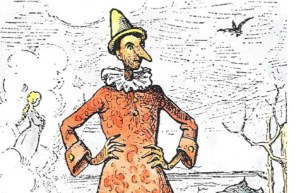
http://i2.wp.com/snaps.tic.bo/media/uploads/2016/08/Ilustración-de-Pinocho-e1470486261161.jpg

Utilitarianism – the core of it

Mark Pendergast, writing on August 15th, 1993 in the New York Times

A Brief History of Coca-Colonization

He really brought utilitarianism down to its very core: 

Devoted employees of the 101-year-old company that makes the world’s favorite soft drink have always believed that the human being was created primarily to serve as a conduit for the dark fizzy beverage. 

Indeed, it is not primarily the utilitarian customer – it is the producer that counts. And furthermore, as a job is a utility and even an essential one, it is better to be of the same opinion as s/he is and identify with “your” firm.

Now, is that a paradox? The real producer is surely not producing, at most sitting alone or amongst other CEOs, thinking about new strategies of extending business, without considering possible negative externalities, elaborating ways of producing externalities in order to enhance profit …

Now one may wonder and take up the question recently asked here;

What is if the satisfied human actually is becoming aware of the fact that s/he is a “pig”, in the metaphorical sense? A being that established this satisfaction on deception, wrong-doing, bribery or simply not sufficiently questioning the facts … just a moron …?

Swabian Housewife caught

Well, even the Swabian housewife  is on occasions unfolding her own way and casts light and shadow on her path.

One of these occasions had been recently uncovered.

Indeed, harping on about principles, resulted in a disastrous consequences.The teaser of the article reads in my translation as follows:

sueddeutsche.de Economy
27 February 2019, 05:18 Hartz IV
Job centres spend 60 million euros to collect 18 million
• Job centers must also reclaim small amounts from Hartz IV recipients. This causes an enormous administrative effort.
• In 2018, a total of 18 million euros in small amounts of up to 50 euros were reclaimed. However, this cost around 60 million euros. This is shown by new figures available to SZ.
• Reclaims are made when job centres discover that they have transferred too much to Hartz IV recipients. The Federal Agency has long demanded a de minimis limit for smaller amounts.

But isn’t this exactly against the principles? Yes and no – as there are two principles: the one is about what we learn from an article in the guardian?

They shop frugally, use credit cards rarely and save up to a third of a property’s value before applying for a mortgage.

There is another, though in some way linked, principle: discipline and discipline-enforcing zero-tolerance policies – honoring the cent is the ultimate rule, even if it costs a fortune … and even if it for the price of self-denial. Looking at conservatism, it sometime too simple to reduce things on black and white – they are simply deep, dark black.  

pay for part-time jobs

What is the pay for a part-time job on call?

The other day, booking a flight, I was browsing a bit, also looking at the options of seat-reservation. Another time that I was thinking about this strange construct of today’s economy, reading

The passenger named above has chosen a seat in an emergency exit row. In the unlikely event of an evacuation they will be expected to assist in the opening of the emergency door.

One interpretation is that one pays for some extra space – for more comfort, for medical reasons – or perhaps even to force oneself to store the hand-luggage properly in the overhead bin.

http://politicsslashletters.org/wp-content/uploads/2018/02/11-Robbins.jpg

Another interpretation: I see myself as part-time casual worker, serving the airline on demand (sure, in the unlikely event they stress), actually even giving up the extra comfort) … – and I pay for it.

Now, a silly remark you may say – but is it really silly? As far as it is known some airlines “offer the opportunity to fly as co-pilot”, the payment being the hours needed to secure the validity of the license.

This “pay-to-fly” principle is sometimes applied at the Irish low-cost airline Ryanair too, according to insiders. Young pilots are not paid for flying, but have to pay for the pleasure of sitting in the cockpit, making flying one of the only jobs you actually have to buy.


To which extent is all this part of a wider move towards something new, i.e. a new capitalism? Surely this will also come up as part of the presentations I had been asked to give in the near future, the first of them next Wednesday.

Grades, Degrees and Principles

It surely is in some respect a no-go-area for reflection, relating the brutal banality of evil of a man facing

15 criminal charges, including war crimes, crimes against humanity, and crimes against the Jewish people.

… – and still it is a field of reflection that has to be entered, not aiming on mocking anybody or anything as it is suggested as part of the debate on “little Eichmanns”, supposedly denying the sincerity and the difference of war crimes, as argued by Henri Clemens (Clemens Heni, November 2, 2008: Secondary Anti-Semitism: From Hard-Core to Soft-Core Denial of the Shoah). Such position may easily be seen as denial of the banality of evil, waiting until it is too late  ….  

We have to remember Martin Niemoeller’s words:

  • First they came for the Jews
    and I did not speak out
    because I was not a Jew.
    Then they came for the Communists
    and I did not speak out
    because I was not a Communist.
    Then they came for the trade unionists
    and I did not speak out
    because I was not a trade unionist.
    Then they came for me
    and there was no one left
    to speak out for me.

****

It is the time of the year again, students worrying about their future, teachers eager to support them finding their way …, and going it. It is about writing academic references that are nowadays increasingly administratively defined ….. It is the time of the year again …  institutions – schools of different kind, employers, training centre, parties and NGOs …. well, and if needed hospitals for the burned-out, welfare offices for the drop-outs, prisons for the forced-outs and whoever else comes to mind being waiting …, opening their doors to help everybody finding a place in this democracy of which

it has been said that democracy is the worst form of Government except all those other forms that have been tried from time to time

T&C apply – and when it comes to terms & conditions, one of the decisive questions, easily forgotten, is: Who is, who is the actual actor? Or is it a What-Actor?

It had been frequently mentioned on these pages that in the academic world – as in so many other worlds – it is administrative systems, paralysing people who then paralyse people … – does the law of six degrees of separation also apply here? Will the fifth who has to be paralysed, end in a coma; the sixth immediately going down into the grave, even if physically still alive?

Preparing a presentation I gave some time ago in Ostrava, Neil Postman’s book on Amusing ourselves to Death came to my mind, shifting the at the time frequent attention from Orwell toward Huxley, his excelling grasp of the tantalising effect of totalising amusement, entertainment …

Part of this is the increasing fragmentation – each little act needing a rule, every two rules in need of another rule by which the two are linked, brought together, of course being in need of another rule that keeps them together …., an exponentially growing rule-you-machine, rolling out a net in which also responsibility gets lost, simply not felt …, but not felt because the brain is forced into the Procrustean bed of a surveillance state, lurking around every corner:

Torturing a prisoner on the rack, Middle Ages. A 19th-century representation of a medieval torture device in use, from World of Wonders, published by Cassell and Co, (London, 1894). (Photo by Ann Ronan Pictures/Print Collector/Getty Images)

(https:// cotyreh.com/2018/02/28/tyranny-reason-academias-procrustean-bed/)

  • Every wee commodity not only claiming to be an entire world but loudly demanding – Thou shalt have no other commodities before me.
  • Every little rule not only claiming to be an entire world but loudly stating – Thou shalt have no other rules before me.
  • Every little act not only claiming to be an entire world but loudly enforcing – Thou shalt think about no other act before me.  …

… NO EXCUSE – NO EXCUSE – NO EXCUSE – NO EXCUSE …

The consequences you have to bear, equally singular as every single commodity, rule and act. No, the consequences ARE NOT singular, they are paralysing, comatising, engraving as bringing-into-the-grave …

This points on the underlying problem – the methodological segmentation of actor, referential space, action seen as relevant and time:

If the public is only me – not in terms of individualisation but in terms of relevance: an earthquake, fire as also the beauty of a sunrise, and the relevance of my action are equally only me, my maintenance and security, safety, comfort …., enjoyment, career, arousal or anything relevant as matter of satisfaction when facing the need of emergency management, protecting against drowning in the tsunami of threats from nature, including emotions.

Hannah Arendt wrote about the banality of evil, following and analysing the process against Eichmann in Jerusalem. The massmurderer claimed that he did only what he had been asked, told to do … – rule is rule, act is act, outcome is outcome …. Eichmann’s argument: I had not been responsible, I knew, though only followed the rule … others …

Supposedly he accepted in hindsight 

I am guilty – that is the larger rule for those who accept responsibility beyond the tiny, singular rule 

another Big Bang, ending in another singularity.

It is worth to make a little side remark, looking at the work of Georg Jellinek, who studied form 1867 onwards jurisprudence, arts history, philosophy and history. He emphasised in his work not least that law – and one can thus say also administrative norms are only part of a wider setting. They cannot explain their acceptance and implementation which are a matter of society and people living in it. Or in the present context we may say: law and order is nothing that emerges simply from legally valid acts and individuals executing them orderly, i.e. within the order – the conflict Gustav Radbruch had been investigating in 1946, suggesting that in law it has to be considered that there are possible conflicts between the positive law and the requirement of material justice. Though Radbruch came to the conclusion of the superiority of positive law, he always faced the problematique of falling short where that law would stand in extreme conflict with being unbearable. It should be read as where the consequence in reality means they are not able to give an answer to the needs of reality. And as such they are not sufficient to deal with the contradictions of reality … – realities of bureaucratic and other machines:

On the other hand, when a person is called an “automaton” or a “robot” it is usually a derogatory comment denoting someone who is stiff and awkward in speech or movement; one who lacks imagination, emotion, spontaneity or a sense of humor; a fanatical follower of rules and regulations; a social or political conformist who is easily manipulated due to an inability to think critically and independently. In a recent issue of Perspectives, the news magazine of the American Historical Association, a history teacher objected to a Florida state education bill that asserted the view that Amer- ican history is “factual, not constructed,” by declaring that making students memorize information without teaching them analytic skills was tantamount to turning them into “little robots.”

(Kang, Minsoo, 2011: Sublime Dreams of Living Machines. The Automaton in the European Imagination; Cambridge, Massachusetts, and London, England: harvard university press 4)

****

It is the time of the year again, students worrying about their future, teachers eager to support them finding their way …, and going it. It is about writing academic references that are nowadays increasingly administratively defined ….

…. paradoxically so many complaining, criticising …., and clicking the link, ticking the box ….. it is the rule – a rule I cannot change …., and isn’t clicking, ticking …. an act of banality …. a wee act, not doing any harm, and if it does do any harm it is actually done by others … Providing the garrote is not using it, is not even telling others to do so …., we may even warn them while handing it over to the tyrant:

Not cruelty is the attribute of tyranny, but the destruction of the public political realm, monopolised by the despot by claiming ‘wisdom’ … or based on thirst for power, i.e. insisting on citizens looking after their private concerns, leaving it to him, the ‘ruler, to take of the public matters’.

(Arendt, Hannah, 1958: Vita Activa oder Vom Tätigen Leben; München/Zuerich: Piper, 1981, new edition: 215; translated from the German edition; with reference to Aristotle: Athenische Verfassung; XV, 5)

****

on administrative issues, simple money issues …  Well the many other things: professional ones or …, well, what is called “private/personal” – and being in the middle of it .., and trying to resist: cosy links, giving in when certain requirements are put forward …, and permanently asking if there is a definitive frontier line where TREASON begins, if and where. Knowing well, that there had been and still is very interesting stuff going on. But the latter makes it somewhat more difficult. Recently I had been reading some “old stuff”, 60s, more 70s and even 80s. So many wise things said – then it had been dealing with other “items” as Postman’s look at TV which could be written today, with wee alterations, now on computers and the WWW.

Who listened and listens?

There are so many things going on about critique of using SSCI- or SCOPUS as standard …, and when it comes to the point … , bubbles not only in the economy. Or, of course I have to say this: it is part of the economy: the material basis, the way in which people price and reproduce their daily life, and that is a matter of the economy …

Of course, it my sound like being over the top, but how often do we have to ask questions that are at least in structural terms, in principle, like those we see dealt with in the theatre play Terror, in legal cases as the one Fuller had been writing about under the title Case of the Speluncean Explorers … where is the tipping point that marks the step into the middle of the banality of evil …, and the step where resistance turns into “integration on a higher level” – I could have used this expression as one line of the Ostrava-talk mentioned earlier: there it had been Bansky, apparently protesting, revolting … attempted subversion coming out at the other end as submerging: the stream of the banality: in that case “arts as object of speculation”, in other cases – and they bother me again: letting one student down, because I cannot accept what I think is “terror of administration” against studentship: Warwick (again) writing something as ‘We cannot accept reference letters sent as mail attachment, you have to create an account, log in, …. Well, I wrote, answering:

I am terribly sorry that you submitted yourself under the rule of technological dictatorship – and I am upset that you force other people to do the same – which is …

Read Hannah Arendt  on The Banality of Evil – that is where you will find yourself.

You may accept the letter attached or otherwise I feel sorry for the student for the fact that I cannot do the secretarial service for a university that did not learn from its own history, and is dealing with colleagues in a highly disrespectful and offending way, using outdated procedures.

Upset, sincerely upset

Peter Herrmann

And what happens: an automated reply

Sometimes it may be even better getting this kind of reply than getting another lie, directly and personally stated, with a smile. I wanted to write “credenced with a smile” – thinking there would be something in English like the German Kredenzen: “present, in a more or less celebratory way … “ – there is no such term, but in English we have the term “credence”, of which the dictionary says:

Well, at least for me it is difficult to live with such tension – being aware of it, assuming that people are actually not “bad”, not all people .. , and still: there is the ultimate need to overcome such banality …, before we really end up sliding into it again … – well, you see, I still try to make sense, even trying to gain energy from all this, against the odds, and against the temptation to give in into the ultimate urge of the ultimate paralysis.

It is in this way that the Christmas-hustle and bustle put me off, as every year, like so many celebrations. Bubble-happiness then, perhaps it is the complement of bubble economies that are living in the stream of … bubbles, a huge stream, being fed by a spring of foam.

****

As stated in the beginning

It surely is in some respect a no-go-area for reflection. Eichman and the little bailiffs … – and still it is a field of reflection that has to be entered, unmasking the authoritarian personality ….

And then we arrive at the strangulation of young people, eager to study, though pushed towards pressing a button …. call it gamification of applications, then of studying, then of work – you may get the gamification also without the detour …. – no studies needed, many of the new gods with their temples in Silicon Valley, are drop outs, many even (quasi-) criminals ….

strangulating everybody who … resists the need to go beyond the excitement of 

click 

for like

click 

for excitement – and do not allow any negative feeling, critique, discourse ….

****

Indeed,

Principiis obsta. Sero medicina parata, cum mala per longas convaluere moras.

Wehre den Anfängen! Zu spät wird die Medizin bereitet, wenn die Übel durch langes Zögern erstarkt sind

And indeed, Ovid’s words are relevant … – can’t we see some amorousness when looking at the pedantic errand boys and errand girls , proud and nescient …?

Finally again Martin Niemoeller’s words:

  • First they came for the Jews
    and I did not speak out
    because I was not a Jew.
    Then they came for the Communists
    and I did not speak out
    because I was not a Communist.
    Then they came for the trade unionists
    and I did not speak out
    because I was not a trade unionist.
    Then they came for me
    and there was no one left
    to speak out for me.

Or in the words of C. Wright Mills, written in 1956 in his book on The Power Elite

It is much safer to celebrate civil liberties than to defend them; it is much safer to defend them as a formal right than to use them in a politically effective way. Even those who would most willingly subvert these liberties usually do so in their very name. It is easier still to defend someone else’s right to have used them years ago than to have something yourself to say now and to say it now forcibly. The defense of civil liberties—even of their practice a decade ago—has become the major concern of many liberal and once leftward scholars. All of which is a safe way of diverting intel- lectual effort from the sphere of political reflection and demand.

success of German lesson …

A year coming to its end – most part of it I spent in Germany – after having left the country over twenty years ago for the ongoing ‘Odyssee’, only occasionally returning, for short visits …

[…] iam pridem, ex quo suffragia nulli
uendimus, effudit curas; nam qui dabat olim
imperium, fasces, legiones, omnia, nunc se
continet atque duas tantum res anxius optat,
panem et circenses. […]
Juvenal, Satire 10.77–81

… many things are still in the olden places or are put back into place, re-establishing hope; others are obviously changed; and some of these are creeping changes, barely mentioned, while very obvious for the attentive … stranger, eternal tourist as I had been occasionally classified. One of the latter is here suggested as the

“All-Good-Model”

When it comes to politics and economic policies it is for instance veiled in proposals to regulate a little bit better, to include some special clauses and quotas, the premise however being “all is good” After having lived in Munich after my return end of 2017 for some weeks, I was getting used to the expression “all is good” – a standard phrase that didn’t to exist when I left in the 1990s – the time when the “new, large, Germany” was surely still in its infancy, the new empire already very self-conscious, though still learning to walk on its clumsy feet.

Sure, I know the All-Good from earlier, noticing something similar during my “Italian journey” – in the country where the lemons bloom, it always occured to me to be the central good (good as in what is produced and also as in what is judged as valuable) of the language: nessun problema! and so was the lifestyle – wonderful, if you had completely immersed in it, knowing that an idiot crossing the street and forcing you to emergency break is ‘una bella’ and a turbulent stock-market is un incredibile sviluppo in questi giorni and non c’è dubbio, la vita è bella – e non si dovrebbe guardare a ciò che è brutto – there is no doubt, life is beautiful – and you should not look at what is ugly; if you were there as a visitor, knowing that it is only some limited time; often difficult to handle, if you live there as a stranger in Georg Simmel’s sense – in a way where abstract time and concrete time, as Henri Bergson defined it, can never unite; and in the long run the nessun probelma is extremely dangerous as we can see in the “soft-fascist” Mussolini, in Berlusconi and M5S.

Now it arrived in Germany as All-Good – I think it is something with which we all have to engage much more strongly. In short, part of the generation change, which also paves the way to a very special field on which a new generation seems to meet with a weird mix of individualism and pragmatism about which I talked a bit more on other occasions:

As important as it is to set the “old class analysis” against it, I think it often lacks a rather critical reference to the way of life, making it difficult to detect the move of a new generation of an all good mood … – panem et circenses, the games go on – and for some these neo-feudal structures are most enjoyable – the Plutocrats, being even aware of what they are … – it is a matter of obtaining a space that allows the own ambitions to unfold – ‘clarity’ in their terms is what the Plutocrats stand for, and where real people do not accept this, they are victim of new strategies of cleansing, whipping Valley’s reality of extreme income polarisation out.

Many tech companies solved this problem by having the lowest-paid workers not actually be employees. They’re contracted out’, Schmidt explained. ‘We can treat them differently, because we don’t really hire them. The person who’s cleaning the bathroom is not exactly the same sort of person.

(Freeland, Chrystia, 2012: Plutocrats: The Rise of the New Global Super Rich and the Fall of Everyone Else; New York: The Penguin Press)

At least that changed – the previous all-good-lords did not even problenatise it, despite few:

If anything is wrong this is wrong. If we will not endure a king as a political power we should not endure a king over the production, transportation, and sale of any of the necessaries of life. If we would not submit to an emperor we should not submit to an autocrat of trade, with power to prevent competition and to fix the price of any commodity.

(Congressional Record. Senate, 1890, March 21; 2455-2473; here: 2457; http://www.appliedantitrust.com/02_early_foundations/3_sherman_act/cong_rec/21_cong_rec_2455_2474.pdf; 26/04/18)