So bad !?

Reading last week the headlines in The Economist, and learning again that AI-tools are passing exams, celebrating the advancement I am hesitating, wondering if it is possibly not about the highly developed AI but an indicator on the downgrading of education: limited to reproducing knowledge, performing “excellence in simplicity”. Limiting thinking to binary scales and scopes.

(Higher) Education on a low level … and seen in the binary spirit, there are only two directions: horizontal and vertical so that the tower of PISA is in real danger of finally falling …

Cui Bono

Who benefits? Wem nützt das?

(scroll down for English …)

Vielleicht habe ich immer gewusst, dass ich hier gebraucht werde. Vielleicht ahnte ich, dass meine Aufgabe darin bestehen würde, diesen Hof in die Zukunft zu führen. Vielleicht war Münster nur eine nette Auszeit, ein kleiner Schlenker auf dem Weg zum eigentlichen Ziel, weil die Heldin fortgehen muss, um heimkehren zu können. Wir hatten eine tolle Zeit in Münster, aber mit der Germanistik konnte ich mich, ehrlich gesagt, nie richtig anfreunden. Natürlich ist lesen ein Glück. Für den Einzelnen und für die Menschheit. Aber muss man über das Gelesene etwas schreiben, über das dann etwas geschrieben wird, über das sich Heerscharen von gebildeten Menschen streiten, um den Streit anschließend zu dokumentieren und die Dokumentation in den Feuilletons zu besprechen? Wem nützt das, wem tut das etwas Gutes?

Juli Zeh/Simon Urban, 2023: Zwischen Welten; Muenchen: Luchterhand: 52 f.

*****

Maybe I always knew that I was needed here. Maybe I suspected that my task would be to lead this farm into the future. Maybe Münster was just a nice break, a little detour on the way to the real goal, because the heroine has to leave in order to return home. We had a great time in Münster, but to be honest, I could never really get to grips with German studies. Of course, reading is a good thing. For the individual and for humanity. But do you have to write something about what you read, which is then written about, about which legions of educated people argue, in order to subsequently document the argument and discuss the documentation in the feuilletons? Who benefits from it, for whom does it do any good?

White Christmas …

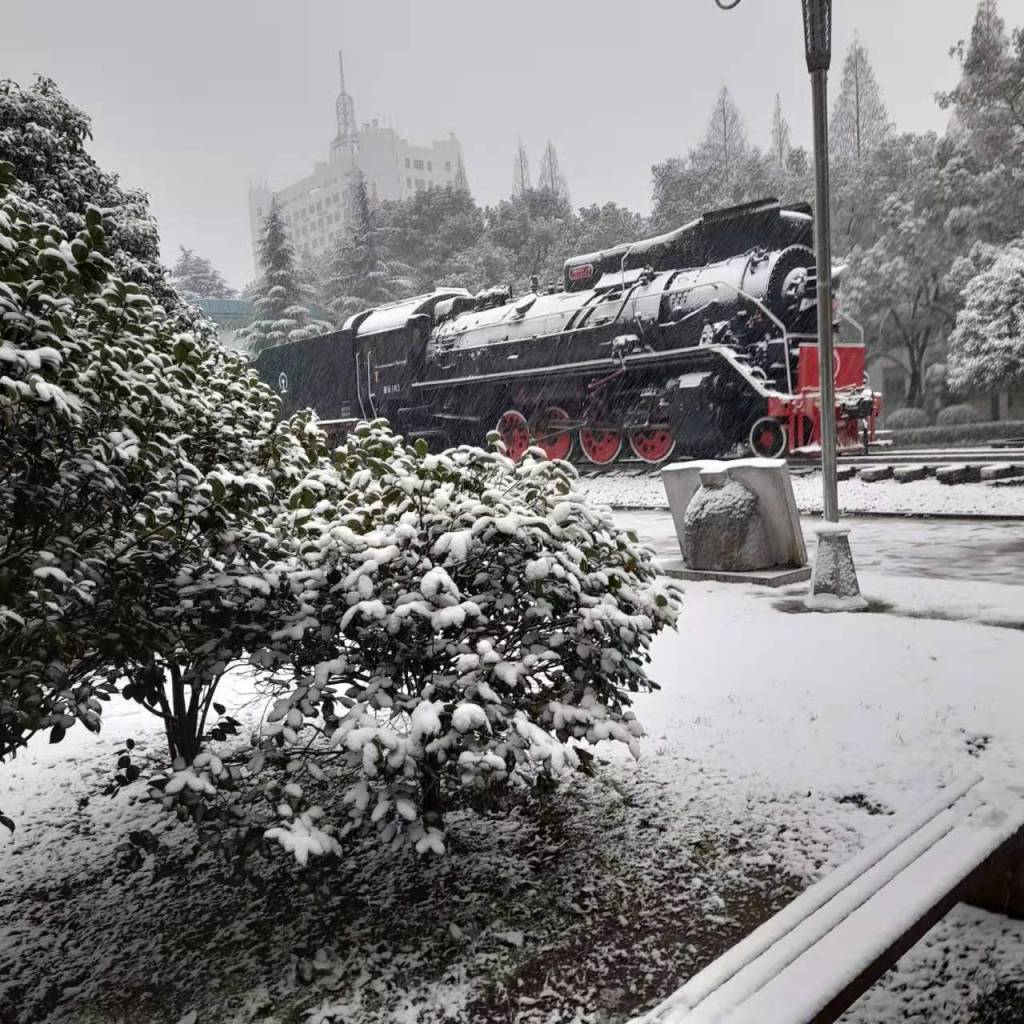
That had been last year, one of the rare occasions we have had snow in Changsha.

There is also a weird Christmas … for some. Branko Milanovic posted on the 26th of December 2021

I hardly knew about the existence of Christmas when I was a child. Both the 25th of December and the 7th of January were ordinary working days, with my parents, and everyone’s else parents going to work. When I would read in the newspapers an article, for example, on how Parisian streets were especially nicely lit for that year’s Christmas, I felt vaguely that the French must have been celebrating some weird quasi-medieval festival that no modern-minded person would pay slightest attention to. For me, Christmas celebrations in Western Europe were a bit like those weird customs that I would read still existed amongst the British Lords, Queens and Kings that seemed so outlandish that I was wondering how an advanced country could have such unenlightened practices. It was perhaps like a feeling that votaries of Scientology elicit among most people in the United States today.

Be it as it is, have some relaxing days – off work, time for reflection on past, present and future, near and far.

Not the Grand Finale … – … Yet

Not even in terms of work – remember Engels’ remark on labour and work, qualifying work as the activity that is paid for by wages, labour a (specific) physical activity.

Still, it is time to say another time good-bye as done earlier (and here)

 – this time from a sideline activity, I could without much exaggeration say: a kind of voluntary work, i.e. the casual teaching at a German third level institution.

It is difficult to present in a note of reasonable length – difficult as reality, this part of reality is full of contradictions. I try to be reasonably correct by putting some poles in the ground, some stumbling blocks – each of them on its own more or less ‘harmless’, ‘right’, ‘correct’, good by way of harmony of its tiny part of the world. Each of these poles is linked to another pole, or some other poles, striking a balance for some time, and collapsing like a house of cards when a butterfly passes, the palace crumbling as result of the stroke of the butterfly.

What are these activities about, how can they be characterised in general terms, leaving aside that each case is different: 

* they are securing income – as such privilege and often gratefully accepted; • one may be beneficiary of a colleague’s engagement by which one (= a person like me) gets the job, • just a matter of being at the right time in then right place, e.g. an institution is recruiting people with some specific expertise, • people who like teaching, supplementing their PhD-work … 

* it is about securing teaching – one may debate how many students are really “deserving students” = curious, mostly young people – sponging knowledge from A (as in ante portas, the state when the world as we know it only existed as Big Bang) to Z (as in zombie, ultimate part of the current culture which is itself somewhat zombie-like) it is the keen interest of those who are claiming on the many shoulders of great WoMen and the too often forgotten great work of their assistants). Sure, many of the students are more or even only interested in passing exams, answering the guiding question: “What do you want to do with your life” with the succinct wish: “making money, more than I actually need” … – but what can we expect if the main self-advertisement of such institutions is about careers and higher education for the sake of developing critical thinking emerges too often as unwanted side-effect

* — this (kind of) securing third level education by casual teaching (in several cases of third level institutions of the Western educational system a matter of app[roximately] 40 to 50 % – a matter of disencumber the public budget; a budget that for instance had been temporarily ramped by measures of privatisation: selling public goods means in the long run a deprivation of sources of public income

* furthermore, this kind of new division of labour has to be seen as twofold disqualification:

  • qualified admin work is disqualified – it is suggested that no qualification is needed and everybody, including academics can do it (yes, academics, this species that is for good reason often a welcome object for cartoons presenting the absent-minded, quixotic academic
  • qualified academic thinking is disqualified as it is overburdened by activities outside of their expertise – leaving aside that it is usually additional and non-remunerated activity, it is also depending on and supporting a specific understanding of the field and we can well speak of “taskification” of the work, defining the substance of teaching in tendency as solely task-oriented – evidenced by the knowledge society being shifted to a skills society [1]

* not least, being busy – with admin work; many colleagues also busy as they are in need of chasing for another job, or we may even say task

Yes, it is said that it is easy to find a job; but probably it is more correct to say: it is easy to find work, but still difficult to find work that allows to make a living. Little payment …, or actually highly qualified, if remunerated jobs that many citizens cannot afford. The societal consequences are often disastrous as the following quote from the Berlin Tagesspiegel (Tagesspiegel Checkpoint vom Dienstag, 11.10.2022; own translation P.H.) shows

Equally disturbing are the reports from the health offices, which, according to the president of the medical association, are short of 60 doctors. The erosion is extreme in Neukölln, where the quarrel between the city councillor and the current medical officer has escalated and the social psychiatric service has practically collapsed. In addition, the public health officers are outraged by the city councillor’s idea of having the health offices run by administrative professionals instead of doctors. In Treptow-Köpenick, a lawyer (specialised in medical law) has just started as head of the office. 

* Yes, then the polis is a romping place for ruled behaviour … – everything is given, no progress, not even movement its possible anymore: legitimation is a matter of entering rule-abiding processes, an ideal field for “how-to-research”, a cemetery for “why- and-what and what- and why-research” – the place where the past is only known as nightmare.

App – the abbreviation of approximately, used earlier – is today more known as abbreviation of application: application of rules, individual orders or complex systems of standards, regulations and their implementation in single acts or “behavioural standards” – be they meaningful or not, in any case a matter of boxing humans

****

von Jhering, in bis little book on the Trinkgeld, written end of the 19th century, states

It is blamed on us Germans that we leave a stone lying quietly in the path that we bump into – everyone curses it, but no one takes the trouble to move it out of the way or, if it is too heavy for him alone, to call in others to help. … ; everyone complains about it, but everyone leaves it there (to be added: continues doing so, P.H.). The reproach which we raise against the stone is directed against ourselves; he who merely curses a bad habit, instead of helping to eliminate it for his part, accuses himself – everyone who does not have the courage to oppose it is himself jointly responsible for the existence of a bad habit. No one has the right to complain about it but he who can give himself the testimony of having done everything in his power to put an end to it.

It is time then to say good-bye, not now and immediately; not without the famous “crying eye”, looking at those students who are really keen to study: for life and – where necessary – changing its conditions, not for a dull life of excessive self-presentation.[2]


[1] can teaching actually be booked via task rabbit – if so, the next step may be ordering it online, YouTube emerging as liferando of the educational system

[2] “… the twenty-first century is full of people who are full of themselves … a half-hour’s trawl through the online ocean of blogs, tweets … brings up thousands of individuals, fascinated by their own personalities and shouting for attention.” (Sarah Bakewell, 2010: How to live: A Life of Montaigne; London: Chatto and Windus: 1)

Why not?

Nowadays, it is so often that we receive emails or messages on the answer phone, informing that at the moment an increasing number of mails and phone calls has to be looked after – so they ask for understanding that things take a little bit longer. In particular since the outbreak of corona pandemic’s outbreak such announcements are common, though we should not overlook that this is the continuation of a trend that lasts already for decades, only accelerating now. But why is so little said about the true character of it: the fact that additional work is put on the shoulders of the employees, additional staff is often underpaid (and/or/due to lacking qualification) and employers aim on avoiding new permanent jobs … and due to this kind of “overheating exploitation” actually more things go wrong, giving cause for more complains.

Deutsche Bahn, progressing and progressive?

fake news or pipe dream?

Fake News or Pipe Dream – October 4th, 2022

Dear Professor …,

I am sure that you have also been aware of the current discussions about climate change, for example due to exorbitant ‘private transport’/’use of private cars’.

Deutsche Bahn is also not unaffected by this development – and we are well aware of the role we can play to counter this development by making public transport available, easy accessible for everybody.

That is why we are adjusting the prices of the BahnCards as of 11 December 2022 to needs of environmentally friendly policy needs: and introduce the BahnCard 100, free for everybody. There will be no difference between 1st and 2nd class as we upgrade all trains to 1st class standards. The network will also be extended, joining it closely with the needs of people travelling for leisure or business purposes …

from the mail, sent by info@mail.bahncard.bahn.de

Well, the original mail is a bit different …

Dear Professor …,

I am sure that you have also been aware of the current discussions about rising prices, for example in the energy sector. Deutsche Bahn is also not unaffected by this development.

That is why we are adjusting the prices of the BahnCards as of 11 December 2022.

Too small?

Lack of protection of the environment – and mind: we are “part of the environment”. There are the major incidences, misbehaviours …. And there is progress although one is wondering about the direction.

Indeed, information is crucial – and in particular when it comes to environmental issues. Consequently, we receive all the infos: printed on the packing and wrapping … and in some cases the wrapping is called apple skin. The one tiny label looks meaningless, but adding all these labels, putting them just on one heap … – and now the new generation is even bio-degradable – just as we humans are. Good that we always find new answers … though it remains worrying that we never look for another question …

One can say it this way …

But there may be a better way …

Now, after we move – slowly but surely – towards winter, we are worrying about the price for energy.

A friend recently said so. Sure, really worrisome – not least as there is only little progress in the area of regulating the price for accommodation, thus increasing the cost of basic needs further, making other things even less affordable. But there is another take on it, something else top worry about. And indeed, I am worrying more about society and the politicians: the over the years increasing – self-inflicted – inability to act, a democracy at the core of which we see a parliament that lives up to its name: parlare – to talk. And as important as it is to talk through things, to work towards answers that are standing on a sound basis, it should not result in things remaining there, on the pedestal of worries and laments: standing instead of moving, talking instead of acting. The incoherence of policy making today may be the core of the matter, sympathising with the difficulties to make a living and allowing TNCs to lower incomes, increase prices and throwing permanently new apples and other rotting fruits on the ground.

deals

I receive a mail, a friend sending me the latest news: a deal, hammered out to counter the energy problems, failed in the last minute. A problematic deal then?

The basic problem might be that it is not about deals, but about strategies, as global as possible. This also includes considering how to prevent a wildfire in Berlin’s Grunewald, which is caused by a local ammunition depot in addition to the long-lasting heat/drought. A ‘deal’ with regard to the ammunition depot may show what I mean: For years it has been controversial, the danger known and always ‘hushed up’ because a ‘good solution’ was sought. — No consolation: there are probably several such depots in Berlin’s forests, which were ‘set up’ there not so long ago (long after the end of WWII).

Did I use here at some time the term ‘Neroism’? I’ll have to work on that …. The perverted joy of watching the fall …

The origins and Impacts of Structural Racism in the Western Countries. China Side Event of the UN Human Rights Council’s 50th Session

会 议 概 要

2022年6月22日下午,联合国人权理事会第50届会议中方边会“美西方结构性种族主义的根源与影响”在长沙召开。本次边会由中国人权研究会主办,中南大学人权研究中心、中南大学法学院承办。来自美国、德国、南非、土耳其、阿根廷、爱尔兰、墨西哥、中国、也门等国家的近三十位专家学者通过线上线下方式参会。与会学者围绕美西方国家结构性种族主义的根源与影响这一主题开展讨论,从不同文化视角审视结构性种族主义的各种根源及其所带来的严峻挑战,探索消除一切形式种族主义的可行路径。

https://mp.weixin.qq.com/s/wauhn-su1U6mT_dvqb72JQ
