employment – precarity – or what

Precarity of Employment – Precarity of Capital Accumulation – Helplessness of Social Science

Thoughts from the Panel during the 28thEconomic Forum, Krynica-Zdroj, Polonia:
Flexible Employment: A way to a global chaos or to a new model of labour market stability?

a brief note, while already on the way back to Munich …

And the changed title is:

Panem et circenses – but who bakes the bread?

There is no reason to carry owls to Athens – they are there, and at least also one is in Krynica, in the park

– repeating what is well known, e.g. speaking about growth and employment and looking for ways for its enhancement. Opposing is often naively just about rejecting it without thinking about viable alternatives. The core of my contribution in Krynica can be summarised in the following table and a short para, trying to get a bit closer to the ground of things:

(Click to enlarge)

and in the one paragraph:

Precarity can only be meaningfully looked at, if understood as one of two sides of the accumulation regime: there we are dealing with employment issues, around generating value; and we are dealing with accumulation as realising value by combining factors of production and by recombining in different ways use value and exchange value. The one is a matter of production, the other of distribution and exchange. The problematique emanates from the fact of what we may call a “realisation paradox”: Though the market is needed to make surplus real, it is only the productive sphere that makes it possible. The outcome is the “destruction of time“ in the sphere of production, in order to be artificially extended in the sphere of consumption. It should not surprise if one feels reminded of the process of production which consumes raw material, i.e. destroys nature in order to establish artificial consumables.

– I would not suggest that capital/capital accumulation is in a more precarious situation than employment/the employment regime and social securitisation; however, there is good reason to look at (parts of) this under the heading “sex, drugs and crime”.

On the new title: such an event has something of exactly the Panem et Circenses, trying to make us forget that somebody has to bake the bread ….
Follow the link for the recording of some schort remarks.

How serious(ly stupid) they are

… or: the de-academisation of academia.
The other day I received a mail – one of many of this kind, though this time I have had a closer look as it had been addressed to
Dear Xiaoming,
with
Greetings from Journal of Accounting and Marketing!!
Bit strange – though I get admittedly occasionally mixed up with names of my Chinese colleagues, Xiaoming did not ring a bell at all. Also admittedly I (= Peter) published recently something on accounting, I was a bit surprised as my take on accounting is not necessarily that which suits the mainstream. Anyway, I was reading on. The usual rubbish and spam. Noting about three different URLs is surely not a matter suitable for establishing trust. The fact that the URL fur submissions is a hidden behind the term MARKETING is surely not suggesting that all this is about serious academic stuff. Also their reference to something that I supposedly wrote, read by them with great interest and appreciation …
Well, Mrs. Nancy Lisa, Managing Editor, Journal of Accounting & Marketing … E-mail: accounting@journalinsights.org – you surely deserve more and other than a personal reply, marking your stupidity. You would even deserve more than a blog-post …. (though you may read this also with great interest and appreciation … – One day you may even have to read your-journals …
******
… and still there is a big
As bad as such publishing spammers are, there is another dimension to all this: the de-academisation of academia. Another example, side by side with others mentioned  earlier, we may also look at
about whom The Economist reported a while back. There is an interesting detail that deserves attention:
… one study found that for every dollar spent to comply with government rules, voluntary spending on bureaucracy totalled $2 at public universities and $3 at private ones. Robert Martin of Centre College in Kentucky, a co-author of the study, says the real reason for the growth in spending is that administrators want to hire subordinates, thereby boosting their own authority and often pay, rather than faculty, over whom they have less power. Bureaucrats outnumber faculty 2:1 at public universities and 2.5:1 at private colleges, double the ratio in the 1970s.
Should we be surprised to see that
[o]ne result of all this is growing “resistance, anger, grumpiness, and eventually backlash” to the proliferation of diversity officials.
Well, in this light Nancy is probably just a poor person, not willing and not able to see that she is actually a cogwheel of a machinery that is not much else then a mafia of today’s time. – … scrupulous … stultification!

whereabout …?

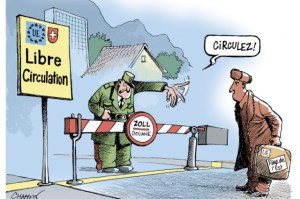
The other day I talked with Turkish colleagues – one mentioned the Ankara Agreement, making emigration easy and apparently gaining a new momentum: the opportunity to make use of a quasi-free movement being taken up by many young, qualified people (that is hat I had been told).

https: //www.swissinfo.ch/image/37930398/3×2/640/426/43d81eaeeb4ba567a36be455ccee7930/Ci/chappatte_immigration-37930404.jpg

It is funny then in the sense that young people from all countries emigrate: Turks to various EU-countries, Hungarians to the UK, Chinese to down under, Italians to Ireland, Irish to Poland, Yanks to China … though leaving it as open question to where they really move at the end … – a question if we do not accept that “somewhere” is the mental state of precarity of different forms is.

Migrants of all countries, you are united!

Though there remains the challenge of developing a truly “portable citizenship”, i.e. to become migrants not only by themselves but also for themselves.

windmills – small and large, without allowing to see an end

One of last week’s joy – one of the last weeks …

http://theaterspieleglyptothek.de

Is there a mission, a vision ….?

O Ja! Einfach wie Einstmals heiter aus dem Überflusse schöpfend!  O beglückende Zeit, O Zeitalter voll Glück, von unseren Altvorderen das goldene genannt, nicht, weil man damals Gold ohne Müh und Not gewann, nein, sondern weil all jene, die damals lebten, die Wörter Mein und Dein nicht kannten. In dieser segensreichen Zeit waren alle Dinge gemein. Alles damals war Friede, Liebe, Eintracht.

Oh yes! Simply like once cheerfully drawing from abundance!  O joyful time, O age of happiness, called the golden one by our ancestors – not because gold was at hand at easy, without hardship; no, it had been called thus because all those who lived at that time did not know the words Mine and Thine. In this blessed time, everything was common. Everything then was peace, love, harmony.

Ach, Nichtchen, weisst Du denn nicht, wie verhängnisvoll mein Zuhausebleiben fuer die Welt wäre, wenn man an all das Unrecht denkt, das ich zu richten habe, an all die Bosheit, die ich Gutmachen muss und an all die Sünden, die ich zu sühnen auserwählt bin.

Oh, little niece, don’t you know how disastrous it would be for the world if I stay at home – think of all the injustice I have to judge, think of all the evil for which I have to make good for and of all the sins, I have been chosen to atone for.

(From the leaflet Koenigsplatz – Theaterspiele Glyptothek im Innenhof: Miguel de Cervantes: Don Quijote – 17. July to 15th of September – own translation -P.H.)

Well, yes, soon moving on, indeed ….

differences

John, we met on occasion of a couple of conferences, frequently said:

I always see you sitting with you work in the hotel lounge or in the reception area.

And indeed, for many parts of my work I like an inspiring atmosphere as I can find it in hotel lounges or …

…, yes in some cases it is a privilege, being able to sit in a spot like this
It had been a year ago, near Amsterdam, children playing nearby did not really disturb me – more the other way round: I found it even motivating as it is a bit like having the “dedication of my work” directly as motivation and appeal around:
this work is dedicated to the future generations, aiming on contributing to a society that is worth living in
Such privilege can easily reverse – an adult abruptly dragging one of the kids at the arm, shouting at him
Just leave here, don’t play while we are sitting here.
 – I felt paralyzed, I had to leave soon after this “incidence”. Because of this old fellow’s misbehavior towards the children, but also as I felt disturbed by the permanently incoming beep-sound of incoming messages and swoosh-sound of outgoing messages on his phone.
Two days later, I went there again – I urgently needed a place that provides quietness and inspiration. I was a bit …, no, I was not really surprised that nobody calls the group of adults to order: about fifteen to twenty people, sitting in one of the corners, chatting and laughing loudly, cheering at each other with the beer and wine glasses, and walking around – each of them wanted to take a photo – about about fifteen to twenty people wanted to have more or less the same photo.
I left, feeling guilty that I did not make the point there, both days – the point of difference and sameness. And I left with the confirmation of the position of a lecturer and researcher: there is no such thing as value freedom, the place, any lecturer and researcher has to look for, is the place of the future, not a future ’that happens’ but a future that we have to develop. – Well, the value-judgement dispute should never be reduced on an abstract issue of academics disputing in an ivory tower.

Once upon a time …

… is today ….

Actually it is a more or less long time ago that this project commenced, making the first steps and growing, without a path that would be determined, trying to live in exactly that way that was also the birth name: Phanresia, bringing phantasy and reality together, trying to do it at least, playing the cross-cross conflation. And accepting that the reality could be something different than the original plan, imagined in the stories that had been made up, told to a little girl …

And then …?

… and then the little stories that had been told and imagined together, allowing the old to become young and the young to become …, well, wise and had been published as book …

…and then is now, commencing the youtube version of the book of Phanresia, telling stories from being different and stories about contradictions …. .

Yesterday, the 19th of August, the first part had been launched on youtube; and also the second part; the third part and the fourth. there will be more published subsequently while I enjoy writing the fourth volume, for a little boy… – step by step …, because once upon a time is now and will always be … if we allow reality of phantasy to be!

Samir Amin

Samir Amin (Arabic: سمير أمين‎) was an Egyptian-French Marxian economist – he passed away on the August 12th, 2018.

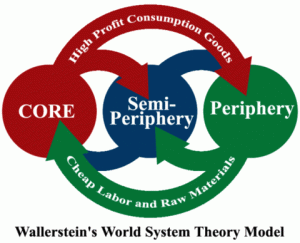
(from: https://medium.com/@kendallgrace15/periphery-role-in-the-world-systems-theory-fa5d291cac55)
I am surly not any kind of the 5th of what Immanuel Wallerstein sees in his comment 479 as a gang of four (Samir Amin, Andre Gunder Frank, Giovanni Arrighi, Immanuel Wallerstein, , himself . I have had some connection to one of the gang: Andre Gunder. Though it had been about the work of (one of his last?) publication(s), it emerged as the germ of a friendship. Reason enough, to feel close to the “family” – actually the wok of all of them very interesting and inspiring in my recent work.
Reason enough to link to the mourning … – in solidarity across borders.

What is it?

Was es ist — What it is

– a poem by Erich Fried (See below the poem in german language)

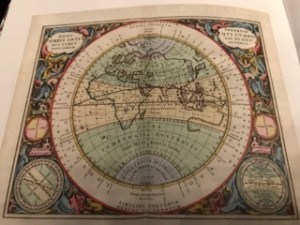
Andreas Cellarius: Harmonia Macrocosmica, Plate 13: The hemisphere of the old world circle, including its zones and circles as well as the areas of the various inhabitants, 1660 

Yesterday taking up on this: an attempt to formulate an Ode of Life, after a brief meeting at the academy in the morning, then while we had been waiting for Daniel and the West-Eastern Divan Orchestra, amidst the Salzburgian Schickeria.

Why this urge to write, rewrite Fried’s poem? Was it because I receive  right now a message from Tobias, stating

Listening to Parsifal in Bayreuth I was getting aware of so many things. It has such a beautiful message: every ritual, religion and ideology – every togetherness of people – can only exit on the foundation of pity and love … this is Parsifal’s experience … — and the music … …

Is it the the impression from the program brochure which I received in advance? – It says

In Coleman’s Looking for Palestine, Said’s words are sung by a solo soprano, but the large orchestral forces also give voices to thoughts and feelings possibly too deep for words. Along with the familiar woodwind, brass and strings is a large percussion section, including a lithophone (pieces of rock suspended and struck to produce half-defined notes). And, in addition to the harps and piano, Coleman makes prominent use of an old, the Arab ‘king of instruments’, lute-like in appearance, but usually played with wide vibrato and decorative slides in a quite distinct way. It is the old that opens and nearly closes Looking for Palestine, though the last sounds we actually hear are the dry, skeletal stabs of lithophone and high violins. Between these poignantly atmospheric frames, the soprano tells her story, at first in long, keening melodic phrases, nut approaching the more urgent patterns of speech as the story builds to its climax, culminating in anguished, repeated cries. It is anguish that knows no allegiance, takes no position, but one that any human being reduced to extremity by life’s senseless cruelty can share. (Stephen Johnson: Cries and Hymns)

Or is it yesterday’s work on Phanresia – the beginning of the recording of volume 1, the continuation of writing volume 4?

Or perhaps the mentioned snobbery – the need of living some reasonably real  life in the persisting wrong wrong one …?

Andreas Cellarius: Harmonia Macrocosmica, Plate 14: the established, ptolemaic hypothesis, as it presents the movement of the planet with its excentres and epicycles, 1660

An attempt …

What it is?

It’s nonsense

ratio says

But not only that

says life

It is lack of fortune

says the calculating mind

And nothing than pain

adds fear

Hopeless

supposes the insight

But worthwhile to be lived … the voice comes from no-everywhere

Ridiculous, isn’t it?

pride thinks so

Imprudent

knows care

Impossible after all

experience wants to have the last word

But that is what it is

says life – despite of it, and only if it is lived as such …


Was es ist

Es ist Unsinn

sagt die Vernunft

Es ist was es ist

sagt die Liebe

Es ist Unglück

sagt die Berechnung

Es ist nichts als Schmerz

sagt die Angst

Es ist aussichtslos

sagt die Einsicht

Es ist was es ist

sagt die Liebe

Es ist lächerlich

sagt der Stolz

Es ist leichtsinnig

sagt die Vorsicht

Es ist unmöglich

sagt die Erfahrung

Es ist was es ist

sagt die Liebe

Erich Fried

a(nother) sad day, a(nother) sad policy development, a(nother) sad country


I received a mail from, Zsuzsa, a good friend of mine – she sent it also to others; Adrian and John, also fiends of mine, circulated it via some mailing lists – and I want to do my part in distributing this news, hoping also to contribute to mobilisiation of as many as possible. Thank you for standing together, the only way to overcome. — While sitting here, writing …, no, I will not cry; and I will not answer in the biblical way of Exodus 22-25

22 “If people are fighting and hit a pregnant woman and she gives birth prematurely[e] but there is no serious injury, the offender must be fined whatever the woman’s husband demands and the court allows. 23 But if there is serious injury, you are to take life for life,24 eye for eye, tooth for tooth, hand for hand, foot for foot, 25 burn for burn, wound for wound, bruise for bruise.

But I will make use of the energy, that comes from the confrontation with evil …

Here now

Zsuzsa’s mail

Yesterday [=August 8th; p.h.) (full vacation time, nobody at the universities) the government sent a government decree to all universities. There  was no previous consultation or discussion. The decree forbids the teaching of GENDER STUDIES.  Almost all universities have some such subjects, CEU and ELTE Masters degree studies. The decree allows those already enrolled to finish their degree, but nothing else. Despite the exceptionally hot weather there are already many signs of indignation and outcry, and some started to organise conferences or petitions. Civil associations will send open letters, etc.

Do you see any way foreign organisations – including SPA, BSA –  could join us? Maybe open letters to  our government? And how should it run?

Dear Prime Minister , or

To Prime Minister of Hungary, Mr. Viktor Orbán!

We have been informed by…? that a government decree enacted  without previous consultation with the interested parties have been sent out ordering the closure of the teaching of gender studies. (We understand that those already enrolled at MS courses may finish their degree but no new courses are allowed.)

Our understanding of the legal and real autonomy of higher education excludes such measures. However, even if it may be legal according to Hungarian legislation, it seems to us a major attack on social science. Gender studies form since … an integral part of …etc.

(If somebody  has official contacts with Hungarian teachers of gender studies, this may be mentioned.,)

We ask (?) the Hungarian government to withdraw the decree in order to…

….

Please, help with the letter, with possible forms of support, with whatever you think.

I have to add that 2-3 years ago they already prohibited the courses of anthropology and andrapedagogy, but then noise was not loud enough. (The original Law of higher education made it the right and duty of Univ Senates to found  or close faculties, degrees etc., but this was altered too, in 2015. Hence the current step is “legal”.)

sad greetings from a self-revelating  dictatorship,

Zsuzsa

Adrian’s mail, sent via mailing lists, accompanying Zsuzsa’s lines

I have just received this email from Zsuzsa Ferge whom I have known and admired for nearly 50 years. The first professor of social policy in Hungary, she has made a major contribution to the social sciences, and especially social policy and sociology. Recently there have been increasing attacks on the universities, reducing their powers and that of the Hungarian Academy of Science ( Zsuzsa was made the first social policy member some 15 years ago). This is the latest development.

I have a very poor record in getting my own government to change decisions, let alone another one. But it does seem to me important to show that there is wide concern at developments such as this one. I do not know whether many individual letters or group ones will have more impact – both probably.

Best wishes, yours, Adrian

Finally John’s mail

Thanks, Caroline. The BSA and European sociological networks have it in hand already. But as it hasn’t reached me via ESPAnet or the European social policy jiscmail, I’ve added them here and would encourage maximum further dissemination to all the networks we are linked with in whatever subjects even at the risk of overlap and duplication.

John

*******

Still, I may add one point – I discussed it actually frequently with John, with Zsuzsa and so many others: It is not just about Orban and Hungary, as little as the discussion about Turkey is about Erdogan and Turkey, as little as Italy is a just one single case, as much as “we are all Greek” – we are all …, if we are ready to be!

Privatisation through the backdoor


on New Deal For Irish Families, states at the end of his article

Real choices for mothers and their partners requires a social investment state that supports families throughout their life course.

Of course, at first sight it is laudable but then …


Would it not be even more laudable and plausible to establish another reference as the words of Bertrand Russels who suggests in his In Praise of Idleness

that four hours’ work a day should entitle a man to the necessities and elementary comforts of life, and that the rest of his time should be his to use as he might see fit. It is an essential part of any such social system that education should be carried further than it usually is at present, and should aim, in part, at providing tastes which would enable a man to use leisure intelligently.

Indeed,

(l)eisure is essential to civilization, and in former times leisure for the few was only rendered possible by the labors of the many. But their labors were valuable, not because work is good, but because leisure is good. And with modern technique it would be possible to distribute leisure justly without injury to civilization.

https://www.datocms-assets.com/45/1522837592-soldi-alati-2.jpg?ixlib=rb-1.1.0&ch=Width%2CDPR&auto=compress&w=
500&h=500&fit=crop&dpr=1&fm=jpg

Isn’t the rhetoric of “social investment”, seen in connection with targeting choice between family and career, not only wrong by way of reducing social policy on a labour market instrument, but also by way of misguiding the understanding of work? Isn’t it with such social investment perspective also established as private matter through the backdoor? Instead of paying for childcare privately the state (or possibly private public partnerships) ar paid in kind, through the work they do instead. Redistribution of wealth has to go hand in hand with redistribution of  work. Indeed, Nicolas Bueno in his short Introduction to the Human Economy makes a point that is surely interesting enough to overcome the idea of social investment as a social policy. He writes

Once human beings are delivered from being thought of as mere producers of economic value, a part of the time and energy that was before only dedicated to producing goods and services can be used in order to create something else. But what can individuals create with their human potential? Human benefits.