Failing projects

This week, meeting the students here in Lodz for the second time, the work will get more serious. The topics

I.

European Integration – A Failed Political and Social Union?

(from: Zeit Campus: September 2018/2019)

Though proposal had been made a while back – not focussing on issues GREXIT, BREXIT and the very recent “EU-developments” in Switzerland – one is wondering if these developments are seriously distracting the debates: Although they are highlighting the vulnerability, they are easily moving debates on solutions strategies – saving a torso – while neglecting the more fundamental issues that can be seen as fundamentally structural flaws, undermining the supposed plans and claims. In other words, the project had been from the beginning as half-hearted as the project of enlightenment. – In principle, already the lectures in Vienna (2017) had been dealing with these questions. However, in Poland the more philosophical may hopefully be more focussed upon.

II.

The second course will look at

Development versus Growth. Perspectives for a Qualitative Dimension in Developmental Economics

Not an easy one, as there is the fundamental issue of determining value, or to be more precise : to determine what economics/the economy is about. Unfortunately, also in debates one alternative paradigms, easily accept the flawed definition of economy

The economy of humans emerges from two roots. They have to beeconomically active because the means are scarce in relation to the ends …; and they are in a position that allows them to be economically active as, though with some limitations, they can make decisions about the purchase and use of the goods regarding the kind, quality, quantity, use etc., thus influencing the use-impact that are achieved …

(Schoenfeld, Leo, 1924: Grenznutzen und Wirtschaftsrechnung [Marginal Rate and Business Mathematics]; Wien: Manz’sche Verlags- und Universitäts-Buchhandlung; unchanged reprint München/Wien: Philosophia Verlag: 1)

While in very general terms there is nothing wrong with what is said, there is everything wrong if we use this as real point of reference or economy and development. An alternative is Frederick Engels’ proposition:

According to the materialist conception, the determining factor in history is, in the last resort, the production and reproduction of immediate life. But this itself is again of a twofold character. On the one hand, the production of the means of subsistence, of food, clothing and shelter and the implements required for this; on the other, the production of human beings themselves, the propagation of the species. The social institutions under which men of a definite historical epoch and of a definite country live are determined by both kinds of production: by the stage of development of labour, on the one hand, and of the family, on the other. The less labour is developed and the more limited the volume of its products and, therefore, the wealth of society, the more predominantly the social order appears to be dominated by ties of kinship. However, within this structure of society based on ties of kinship, the productivity of labour develops more and more; with it, private property and exchange, differences in wealth, the possibility of utilising the labour power of others, and thereby the basis of class antagonisms: new social elements, which strive in the course of generations to adapt the old structure of society to the new conditions, until, finally, incompatibility of the two leads to a complete transformation. The old society, based on ties of kinship, bursts asunder with the collision of the newly developed social classes; in its place a new society appears, constituted in a state, the lower units of which are no longer groups based on ties of kinship but territorial groups, a society in which the family system is entirely dominated by the property system, and in which the class antagonisms and class struggle, which make up the content of all hitherto written history now freely unfold.

(Engels, Frederick, 1884: The Origin of the Family, Private Property and the State. In the Light of the Researches by Lewis H. Morgan; in: Marx&Engels Collected Works. Volume 26: Engels 1882-89; Lawrence & Wishart, 2010 [Electric Book]: 129-276, here: 131 f.)

A lengthy quote, a position that should also allow thinking what “the old society, based on ties of kinship, bursts asunder with the collision of the newly developed social classes” means today.
In a forthcoming publication – titled

About You – Nur frage nicht ob Du ueberhaupt bist

part of the topic, dealing with modes of life, will be looked at. After publication in the Tarantel, published by the Ökologische Platform bei Der Linken it will be announced here.


schwach angefangen, stark nachgelassen

A book review – in Gemany language – can be found here, trying to do justice to China by reviewing a publication

Schwach angefangen, stark nachgelassen

Buchautor_innen
Edition Le Monde diplomatique
Buchtitel
Chinas Aufstieg
Buchuntertitel
Mit Kapital, Kontrolle und Konfuzius
Kann man dem komplexen Phänomen „China“ auf wenigen Seiten gerecht werden? Zweifel daran sind mehr als angebracht. …

Precarity – It Isn’t about Employment, It Is the Economy, Stupid…

From the printer
Herrmann, Peter, 2018: Precarity – It Isn’t about Employment, It Is the Economy, Stupid…
in:
No3 (209)/2018: 73-73
Издается с 1992 года Выходит 4 раза в год
DOI: 10.24411/ISSN. 1999-9836
НАУЧНО-ПРАКТИЧЕСКИЙ ЖУРНАЛ
(scroll for English abstract)
Аннотация 

На прекаризацию обычно ссылаются как на проблему заня- тости и увеличения неуверенности и нестабильности су- ществования труда в качестве безопасной и предсказуемой основы социоэкономической безопасности – впоследствии мы обнаруживаем нестабильность включения, цельности и полномочий (и/или понимания). Намекая на лозунг «Это эко- номика, глупыш», который использовался в президентской компании Билла Клинтона в 1992 году, данный лозунг исполь- зован в заголовке публикуемой статьи: «Прекаризация – это не безработица, глупыш». Этот тезис звучит в таком объ- еме в обсуждении прекаризации как нестандартное понима- ние экономики, основанное на четырёх базовых принципах: денежная прибыль, экономический рост, конкуренция и заня- тость. Реальный вызов заключается в обращении к ограни- чениям данного базиса из четырёх частей, который преобла- дает в современной социологии, а именно методологический индивидуализм, методологический национализм, методоло- гический солюционизм и методологический презентизм. Объект исследования. Анализ неустойчивой занятости. Предмет исследования. Изменение методологических требований.

Цель исследования. Выявление недостатков существую- щей методологии социологии и перспективы альтернатив- ных направлений методологии.
Основные положения статьи. Определение метода пре- каризации в рамках меняющейся экономической формации.

Ключевые слова: неустойчивая занятость; методология со- циологии; экономика и общество; социальное качество; труд.

Abstract

Precarity is commonly referred to as matter of employment and the increasing insecurity and instability of obtaining labour as secure and predictable foundation of socio-economic security – subsequently we find instability of inclusion, cohesiveness and empowerment (and/or perception). Alluding to the slogan «the economy, stupid» which had been guiding Bill Clinton’s presidential campaign in 1992, the slogan brought forward is here «Precarity – it isn’t employment, stupid». The thesis is that much of the debate on precarity is referring to a curtailed understanding of the economy, based in four main pillars: monetary gain, growth, competition and employment. The real challenge lies in addressing the limitations of the quadriga that dominates modern social science, namely methodological individualism, methodological nationalism, methodological solutionism and methodological presentism.

The Object of the Study: Analysing precarious employment
The Subject of the Study: Change of Methodological Requirements
The Purpose of the Study: Identifying flaws of existing methodology of social science and perspectives for alternatives The main Provisions of the Article: Locating precarity within the framework of a changing economic formation

Keywords: precarious employment; methodology of social science; economy and society; social quality; work.

never blame students for what lecturers and politicians do to them

A widely known problem is that students today have – supposedly – problems to read: are unwilling, only printed on exams and subsequently the reeding they need for proceeding. My personal experience suggest something different: if students have space: literally by way of sufficient “quality location”, time and mental space, not being pestered by problem-solving urgency, allowed to foster critical thinking (as Robert Cox outlines it in the piece from 1981: Social Forces, States and World Orders: Beyond International Relations Theory; in: Millennium – Journal of International Studies 1981; 10; 126-155 DOI: 10.1177/03058298810100020501) most of them would love reading more, more widely, critically working with texts.

However, if politicians educate teachers who then educate students and then these students become politicians, educating teachers who then educate students who then become politicians … … … – it is quite natural that after going a couple of times around, policy documents and texts books look very much alike, nit even reaching the intellectual level of A Little Bit of Everything for Dummies.
Though already from 2011, a document issued by the Irish government can be taken as example for such dummies=stultification-strategy, showing on page 7 the following:
It reminds me that at some stage “Communications“, issued by the European Commission had not been allowed to be longer than 20 pages – politicians are not reading longer documents …  the paradox then and there: instead of producing one document with 30 pages, two documents with twenty pages each had been produced … , and so forth and so forth … at least the printing press being extensively used. The crux of “maths”: making two documents out of one 30-page document dos not mean having two 15-pages docs. because additional space is needed for the cross-references and the like. though we end up with something like 30 divided by 2 = 20+20 = 60, or in short: 30 divided by 2 equals 40. There is a German term “Milchmaedchen-Rechnung”, literally “calculation made by a dairymaid”, meaning fallacy, naive. Perhaps it should be changed, the new term being Commissioner- or Politician-Calculation.
May be it is still better then producing one document that is so much simplification of everything that it requires a guideline to show the reader the way through (though to sweet) nothingness.
In any case, please, never blame students for what lecturers and politicians do to them.
Some voluntarily, some lazily, some being forced .., and some still resisting.

Panta Rhei

moving into the next stage, the eksoc-fellowship in Lodz ….

Time of Departure and Arrival

*******************

Charles BAUDELAIRE   (1821-1867)

L’Etranger

– Qui aimes-tu le mieux, homme énigmatique, dis ?

ton père, ta mère, ta sœur ou ton frère ?

– Je n’ai ni père, ni mère, ni sœur, ni frère.

– Tes amis ?

– Vous vous servez là d’une parole dont le sens m’est

resté jusqu’à ce jour inconnu.

– Ta patrie ?

– J’ignore sous quelle latitude elle est située.

– La beauté ?

– Je l’aimerais volontiers, déesse et immortelle.

– L’or ?

– Je le hais comme vous haïssez Dieu.

– Eh ! qu’aimes-tu donc, extraordinaire étranger ?

– J’aime les nuages… les nuages qui passent… là-bas…

là-bas… les merveilleux nuages !

Der Fremde

Wer, rätselhafter Mensch, ist deinem Herzen am liebsten? Sprich!

Dein Vater, deine Mutter, deine Schwester oder dein Bruder?

Ich habe weder Vater, noch Mutter, noch Bruder, noch Schwester. –

Deine Freunde? –

Du brauchst ein Wort, dessen Sinn ich bis heute nie verstand. –

Deine Heimat? –

Ich weiß nicht, auf welchem Breitengrad sie liegt. –

Die Schönheit? –

Ich möchte sie lieben, die göttlich unsterbliche. –

Das Gold? –

Hasse ich, wie du Gott hassest. –

Was also liebst du, staunenswerter Fremder? –

Ich liebe die Wolken … die ziehenden Wolken … dort … die wundervollen Wolken.

The Stranger

Tell me, enigmatic man, whom do you love best? Your father, your mother, your sister, or your brother?

– I have neither father, nor mother, nor sister, nor brother.

– Your friends?

– You are using a word whose meaning to this day remains unknown to me.

-Your country?

– I do not know in which latitude it lies.

– Beauty?

– I would love her gladly, goddess and immortal.

– Gold?

– I hate it as you hate God.

– Well then! What do you love, unfathomable stranger?

– I love the clouds… the passing clouds … up there … up there … the marvelous clouds!

—Translated by Sam Taylor

*******

For the pcs: http://www.illustrationdetextes.fr/437139851

World Teachers’ Day

The 5th of October, since 1994, the World Teachers’ Day commemorates the anniversary of the signing of the 1966 UNESCO/ILO Recommendation concerning the Status of Teachers. The 1966 Recommendation provides the main reference when it comes to teachers’ rights and responsibilities on a global scale.


Worthwhile to remember what Alfred Marshall said in 1890.

The schoolmaster must learn that his main duty is not to impart knowledge, for a few shillings will buy more printed knowledge than a man’s brain can hold. It is to educate character, faculties and activities; so that the children even of those parents who are not thoughtful themselves, may have a better chance of being trained up to become thoughtful parents of the next generation. To this end public money must flow freely. And it must flow freely to provide fresh air and space for wholesome play for the children in all working class quarters. (Marshall, Alfred, 1890: Principles of Economics; MacMillan and Co., London, 1930: 718)

It seems that with the “refeudalisation of society” we face the situation that the positions of the revolutionaries of the olden times, whose authors had been yesterday’s conservatives, are becoming joining on the side of the revolutionaries again. In this light there is also something about the illustration, ensuring to sin – surely not catholic-literally but to accept that pupils and students are partners.

****

Worthwhile a note on the world and China: on September the 10th I received a mail from 张伟, a former student of mine – well, she would say “a student of mine”, skipping the word “former”. She sent her congrats and best wishes for the teachers day. First I was puzzled – did she mix up the date? 2018, the Chinese teachers’ day is on the 10th of September, the world teachers’ day on October 5th, a simple explanation. I checked later on the web and found something that is … – well, I leave it up to you to think about it:

10 September is an official holiday in China. This day the whole country fetes educators and teachers. This holiday, in its different interpretations, has been existed in China as early as the Middle Ages. Teachers and coaches have always been honored and respected in China. Very often teachers acted as mentors throughout the whole life; especially it is true for the traditional Chinese martial arts.

It also says something on the reason of making it a public holiday: the official acknowledgment of teachers – as intellectuals – and their important role in boosting the development of the country. Also

Since the school system in China is based on the Western model, many old traditions in honor of teachers have not been preserved today.

One may have different opinions on this, the political background …, well. But at least it seems to be worthwhile to mention that there is a deed in the one part of the world, and that there are just words, probably widely unspoken, unwritten, unheard, unread … in another part of the world.

****

Worthwhile a personal note:
Only recently, visiting with a friend the Kunsthalle in Munich, I remembered one point of all this, when standing with her in front of one of Emmanuel Maignan’s works, the “Anamorfosi San Francesco di Paola”. A pleasure to experience the amazement of both of us. Though it had not been about a visit with a student, it is very similar anyway: Something of learning together and admitting that it is about the experience of being caught by what one sees – in this case actually being caught by what one does not see: the praying person only visible from two specified angles, the sides. It reminded me of having used Holbein’s equally magnificent  work “Gli Ambasciatori” for showing the same effect: the hiding of something, the fact of leaving something invisible for those who lack the enlightenment – an enlightenment that is emerging from the standpoint, the perspective. Never having seen the original of Holbein’s work, seeing something similar entailed still the experience of being amazed. – What foolish teacher would say s/he knows the one and only perspective. Doesn’t such perspective emerge only from putting together experiences, that may at some stage get stuck, paralyse the experienced if it goes together with closing the eyes, blocking off, not allowing new experiences to be made; and even more: not allowing looking at something “known” through new spectacles and of course forcing looking at the new through the old glasses.

Teachers’ Day – an opportunity to congratulate students, and to thank my students for allowing me to learning together with them.

The Most Dangerous Game

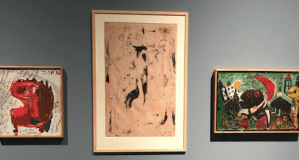
This is the title of an exhibition, showing the

Situational International en route for May ’68.

Earlier this week, well, actually already the week before, before I went to the EuroMemo conference in Helsinki last week, I was reminded of today’s understanding of occupying the streets and the meaning of the spectacle – though entirely different from the S.I.’s understanding
Germany’s “largest Festival of the Year”
showing its vedettes: So many roads closed, even part of the park between the Victory-Column and the Brandenburg Gate, the intangible power
provoking the question: what do they mean stating that this festival is
only together with you
?
There can, in some way, only be one answer: it is about the continuation and replication of how the former East had been and still is treated, prolonging the tradition of the East when that part served as corn-chamber of the West. That is what had been established also in 1989, though it isn’t about corn anymore; the new debates on the floors where the CEOs of the large national and international corporations meet in their offices and meeting rooms had been concerned with the division of work and influence and living conditions within Gemany and between Germany, the other “old Europeans” and the “newcomers”. Those years I travelled a bit across countries as Poland, Czech Republic, Ukraine, Moldova …, clearly witnessing the “occupation of the streets”, clearly witnessing a strict pattern of the positioning of the different enterprises in a well-ordered fashion, clearly showing that competition can well be about the friendly distribution of market power.
I suppose it had been around those years that I wrote on page 232 in the
– ‘We are the people’, this phrase still sounds in my ears – and I see the crumbling of ‘the wall’, socialism had been building – rightly or wrongly – to protect itself against… ‘We are the people’ they say now – and the walls of Tesco, Aldi, Mango, Springfield, Dell, MAC, BMW and all the others make it difficult to hear the real voices of many who are just following their own way, now whispering for instance in the thermal bath of Hajdubösösmerny.
Well, there are these two worlds, within Germany, within EUrope and Europe and globally: the one attend “happenings” and their spectacles are about spectacular money; others see
The first of October … – it took me much longer to go to the House of the Cultures of the World then it took me “those years” to cross at Bahnhof Friedrich Strasse – the German State needs much protection, a huge contingent of police and private security when switching to circenses while limiting panem …  
The third of October … will it ever be a day of celebrating globalism, cosmopolitan spirit and life instead of supporting strengthened nationalism?
These days in October, very often, my experience with the police, when passing the security points to enter the gated areas “outside office hours”, may be mentionable – one example: I referred to the “Nur mit Euch” (only with you) on the poster depicted above, stating something like “it is an interesting concept: ‘Only with you’, and we are all screwed …” – Comment by the officer, though surely not an official one: “I do not have a clue what they meant by this.”

Centre-Periphery reversed

It had been a strange feeling or mood – returning Sunday around lunchtime from Helsinki – taking a longish walk from the railway station zoo through the park, passing the memorial fro Rosa Luxemburg at the Landwehr Canal, doing some text editing and having an early dinner in the canteen of the Berliner Ensemble, Brecht’s place of activity – then off to the Gorki theatre: Les Justes. En route passing the metro station at Friedrichstraße where I occasionally crossed the border for visits at the peace council an others …. a bit further the Humboldt university, where I gave one of my first public presentations as young academic …. the statue which Käthe Kollwitz made before I enter the theatre for the performance of the Albert-Camus-piece.

The is still some repercussion from Helsinki – opportunity for a short visit in the national gallery. There hadn’t been the great names – most of the names never heard outside of the country, the paintings more placid than those of the great names, depicting more the landscapes, unknown people and everyday’s life – the periphery one may say. Sure, they can also be found in other galleries  some time ago the New Pinakothek came up with a special exhibition:

L WIE LAND UND LEUTE… LANDSCHAFT UND GENRE IN DER STUDIENGALERIE DER NEUEN PINAKOTHEK

But that is the point: it is more about a special exhibition – paintings that usually do not make the way in the main halls.and even there mostly it is the depiction accepted power,

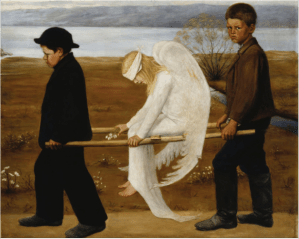
Different in the museum in Helsinki. Much could be thought and said, at the end very much concerned with the fact that the centre of power is looking too often at the periphery of culture, distracting from “ordinary life”, from the worries and joys of people in their real life, that kind of life that is not about glory and that is not reflected in income statistics, employment figures and the like. And that life in which even angels may get wounded.

(Hugo Simberg: The Wounded Angel, from the Ateneum website)

It is the normality of what actually defines life: Kaethe Kollwitz, the hesitation in Camus’ piece when it comes to revenge while facing a real human being, not just the personification of a role, a specific vulnerability that is acknowledged and offers some special strength – that kind of strength that does not need huge power centres as materialisation of control, that does not need helicopters or massive “intelligence” for its protection,

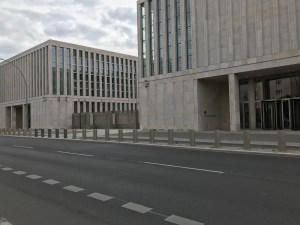
(BND – the fortress of FRGs secret service – this part of the building sowing a fraction of the entire complex)

a strength that emerges from acknowledged truth. The open centres of exhibited power

loose centrality where they loose the respect of the seeming periphery: the real life; political and imperial power moves to the periphery where the actual meaning is emerging from the way in which people shape and share every day and everywhere, where we find confirmed that

Men make their own history, but they do not make it as they please; they do not make it under self-selected circumstances, but under circumstances existing already, given and transmitted from the past. The tradition of all dead generations weighs like a nightmare on the brains of the living.

And where we have to add that it is not only history but also the attraction of present power, the presentation of power in attractiveness, meaning beauty and might that takes this nightmarish character.

Still, it remains the question. often asked: can people be just in a world that is profoundly unjust? – All this surely something to reflect upon when we talk about populism.

Avoiding Trivialities

The “Times Higher Education” published recently a piece by Adam Graycar, titled
(see also here).- one of the few occasions that I comment on any articles, briefly making two points:

All right and important. I still would like to add one point, subdivided: (i) generally, doesn’t result-oriented, mostly empirically-oriented (“evidence-based”) research as standard expectation and kind-off methodological ultimate ratio contribute very much to such competitive orientation even before it comes to considerations concerning publication? I suppose such research is more inclined to competition than “fundamental research” (“Grundlagenforschung”). (ii) isn’t already the entire system of (mass)education as PRIMARILY “vocational training like education, driving (future) researchers into the direction of competition-driven instead of knowledge-enhancement driven? – This begins already when looking at the way of dealing with applications by students for courses – see some experience-based views.

The reason for mentioning it here is a short discussion I have had here in Helsinki in connection with a PhD-student. I was wondering that his work is cumulative and also based on/linked to earlier publications, co-authored with others. In Finland, at least it is a possible. I know about “collective/collaborative work” – actually my own diploma thesis in a cooperative manner.
Sure, there are terms and conditions as especially the need to sign and thus confirm that some part is the individual work …
My habilitation can be considered as cumulative. Now, here in the Finnish case it is about cumulative and collective. Shouldn’t that be the norm, also considering that cumulative is not only about the past, but also about “a stepping stone”, part of an ongoing cumulation and growth. Doesn’t the opportunity to co-author a thesis also acknowledge and highlight that any – tiny or large – work is part of a collective effort, actually the strive if humankind for truth? Making such exception of co-authoring cumulative work as thesis could be a tiny to overcoming individualist competition as foundation of academic work, too often resulting in arrogance or failure.
Indeed, Dante expressed it succinctly, reflecting the need to think about social and societal practice:
considerate la vostra semenza: fatti non foste a viver come bruti, ma per seguir virtute e conoscenza.

The no-problem-society V – is there really no right life in the wrong one?

[the no-problem-society (I, II, III, IV)]


Adorno coined the phrase
Though without referring to him, we had been chatting about this topic, Yi wondering why “you in the West have this strange attitude: not living, working and then condensing life in a brief period called holidays …”
A few days after our chat this came back to me, 8:30, taking a morning-train to the German capital: eleven man, not too young, entering the passenger compartment, loud enough to entertain a train station, occasionally quietened by reading the famous boulevard journal … . After a short while I saw one of them sitting there with a bottle of sparkled wine, only minutes later he got a little box of Kuemmerling, the herb liqueur – don’t get misled by the name, it is not going back to any worries (the German term “Kummer” can be translated as worry).
Obviously they went for a weekend to live, forgetting existing during unbalanced work, caught in alienation.
I pointed it out to my companion: people, clearly showing the meaning of what Marx stated 1844 in the Economic and Philosophic Manuscripts:
What, then, constitutes the alienation of labor? First, in the fact that labor is external to the worker, that is, that it does not belong to his essential being; that in his work, therefore, he does not affirm himself but denies himself, does not feel well but unhappy, does not freely develop his physical and mental energy but mortifies his body and ruins his mind. The worker, therefore, feels himself only outside his work, and feels beside himself in his work. He is at home when he is not working, and when he is working he is not at home. His work therefore is not voluntary, but coerced; it is forced labor. It is therefore not the satisfaction of a need, but only a means for satisfying needs external to it. Its alien character emerges clearly in the fact that labor is shunned like the plague as soon as there is no physical or other compulsion.
It has nothing to do with what is called intelligence, it is nothing that can easily be overcome, by nobody and nowhere – again Marx, again the first volume of Capital:
If money, according to Augier, “comes into the world with a congenital blood-stain on one cheek,” capital comes dripping from head to foot, from every pore, with blood and dirt.
And more or less the same kind of blood-stain:
to the development of productivity and the more economic use of the conditions of production. It imposes on the worker an increased expenditure of labour within a time which remains constant, a heightened tension of labour-power, and a closer filling-up of the pores of the working day, i.e. a condensation of labour … the denser hour of the 10-hour working day contains more labour.
And as commodity consumption becomes “production”, the act of buying itself becomes a means of satisfaction, it is the emergence of the real life becoming itself a wrong life.
Yes, Yi, we know and still we do not fully grasp it, we remain caught with the two souls you talked about. Still … as much as we now … a stone know as well a lot, is there on the ground, condensed, the impressions of hundreds of years ingrained – but it is unable thinking to think even a nanosecond, as unable as it is to feel …, to love, to acknowledge and eve enjoy the madness of everyday’s life. No way for it to escape, to start thinking, no way to make it thinking …
The answer is prompt:
Poor stone –
And turning towards me:
If you are angry against the stone; I feel sympathetic with him.
Looking into the eyes, the face, I would like to have a stone in front of me, touching it, comforting it, softening it …
No, I am not angry with him, I feel sorry for him … There is a chapter in one of the books I wrote for children, it is about a person wo had been like a stone …. But actually he had been cured one day.
Followed by her question:
Cured by a Mr. Hammer?
Of course:
No, a hammer can only make things worse; after using it you only have more stones … wait, just a sec …
While searching the file of “Phanresias Geschichten von der Freundschaft” and the chapters dealing with Mr. Messerscharf, the train attendant walks through the train offering a cookie.
Well, it seems that there can be some realm right life in the wrong one – but looking into her face, the frozen smile of the person offering the DB-present …that thought meaning to stay for a long time with us …
*********
Isn’t it also linked to the point mentioned earlier, the West and the East: yes, there is on the one side this egoism, hedonism, egocentrism … – living for oneself – it means for a social being: not living at all. Freedom is not only the freedom of those who think differently (Luxemburg), not only the insight in necessities. It is also the lived “ubuntu” – the knowledge of and acceptance and appreciation of living ho one lives in dependency of the other. On the other hand it is also the trap in which we easily may end – with every lament concerning the “you in the West” I hear and see also the ambiguity of the other side: ubuntu as “I do not live my own life”, at times expressed as satisfaction, at times expressed as melancholy and even sadness, the feeling of loss, though never denying the devotion … – freedom brings us back to the dilemma of the right life in a wrong one, in a wring society — the price to be paid is surely high …
*********
… Those days I listend to an interview, or better to say a TV-discussion: Rudi Dutschke, Daniel Cohn-Bendit, Matthias Walden and Kurt Sontheimer (recording: 13. Juni 1978) – I do not remember exactly, was it Daniel or Rudi, talking about bottomless hatred? – The flint-stone comes to mind …, the brother of Mr. Messerscharf. And the question of directing explosions. And that would be the real end of comedians on the political stage, not only in Italy under the five “guiding stars” …