Superiority

it may be that superiority is in fact with the apes – not walking upright, not properly knowing about tools and still ..
Currently there is a poster campaign , run by the German Federal Ministry for Education and Research, celebrating the 100s anniversary of the Berufsbildungsgesetz – the Vocational Training Act. Fair enough one would say, seeing the main message:

That is what keeps our economy going ..

Still, I dare to ask, for instance:

What is this economy about? What does it mean when it is going? Are we really talking about vocations or are we talking about people just in need of a job? And aren’t those job we have to make a living, just “un-make” our living: annoying, alienating, straining …?

Pessimist? May be. Still, I dare to ask, for instance:What about job centres and regulations that make it in the first instance for so many rather cumbersome to complete forms and accept controls to avail of support (material and job search) and then, for some, so troublesome and slow to withdraw because one found income and work without the jobcentre?What about a  project application being thought through, looking at possible administrative hurdles but making all these considerations, doing all this admin work with just a vague idea of the content?What about finding a coconut, looking around, considering the ground not hard enough and looking for a stone which then is applied in a specific way to open the nut without loosing any milk from inside?  … – and whoever is behaving this way, surely knows why s/he wants to open the nut.
The last example is most likely a monkey, or some other animal acting this way. The others likely being concerned with humans’ behaviour. The question now is: which is the superior way to act? The last example with its immediate link between means and ends? Or the others where there is certain level of abstraction reached: not being hungry and thirsty here and now being the motivation to act, but the knowledge of hunger and thirst at some later time. This is still a simple one. However, there is a turning point namely when the link between means and ends is twice broken:

• The first time when some act is executed in anticipation of its need (I have to look for resources now as I will need them in the the future)

• The second time when resources are generated by means without considering their usefulness for the second-level end (I have to apply a hammer as I have one under control; it is of secondary interest for what I use it, if what I use it for is actually useful; or bluntly: I use the hammer to repair the fin watch.
Sounds absurd? AS praxis it surely is. But this is what reality looks like: economic growth for the sake of economic growth, getting a job to generate income without having any vocation that is intrinsically linked to the job’s requirement); going for projects because …, well, there is usually money or reputation in it….
Simple? Not really? Einstein, Bohr, Heisenberg did not always know exactly what they were doing? And I suppose there is noting wrong in learning “because I want to know”, without further questioning, without more requirements than necessary, setting only one interest: Being really part of a process and structure that starts from reality !
SUPERRIOTITY …. …


Worrying …

indeed it is worrying to see the right-wing, nationalist, fascist, populist spawn, occupying so may positions, spreading their words and establishing with their deeds a kind of new system (indeed, we should be careful, not just putting all of them under the hat of populism – László Andor highlighted this in a recent article. Gabor, a Hungarian colleague, now working in Milano, recently said

I think Hungary has already exited politics as we know it, and it decided to recreate Monty Python in a horror comedy version. 

The reason for his remark: I mentioned my encounter with one of the Hungarian Ministers and his nationalist tirade. Actually is reference to Christian traditions …, somewhat subtle: we are not against anybody, we just have to protect our “great traditions”, and these are those of Christianity … – well, another fundamentalist religious states like the IS, lurking on the Hungarian horizon?

The fact with many of these crops is that they establish systems that do not allow to be reversed — even if they would loose power, the authoritarian structures will survive them at least for a long time. As sich it is not just another round, part of a regular up and down of different political strands.

Now, some rumour – even that it is thinkable is disgraceful. Alexandra Brzozowski and Sarantis Michalopolous state in their EURACTIV-BRIEF, titled

Berlaymont’s rumour mill

László Trócsányi, Viktor Orban’s right-hand man in Brussels, might get the humanitarian aid and crisis management portfolio – a move that could easily fit into Fidesz’s migration narrative that instead of receiving immigrants, “help should be given at the point that it is needed.”

As said, that this is thinkable, made possible then by the German …, yes, of course, CHRIST-demagogue, uniting with Hungarian Christian fundamentalist.

There is another news these days:

Swedish FM to Resign from Her Post

As we read in the article

“I have put everything I have into the job of making Sweden safe, respected internationally and appreciated as a partner,” Wallstrom said in a statement.

I remember Margot from those years in Brussels. And I would say that there as well she put a lot into the job, without necessarily agreeing, it still had been a pleasure to find a commissioner convinced of what she was doing and convinced that it must be about opening: opening the institutions to the European citizens had been her remit at the time.
Who would deny her the right of doing what she intends to do:

It is time for me to spend more time with my husband, my children and my grandchildren.

However, so often we talk about modernity as process if reduction (“halved modernity”), its eclipse etc. And Daniel Kehlmann came up with this most telling story about Measuring the World, taking up on the tension between exploring reality (Alexander von Humboldt, and Aimé Boland) and calculating it (Carl Friedrich Gauss). Isn’t this in some way also today the baseline when it comes to artificial intelligence – the hope set into it and the fear facing it.

Part of the structure established with this process we usually refer to as modernisation/modernity had been about individualisation, a very special and specific establishment of the individual as ultimate point of reference. But isn’t this then also the need and justification of moving between the “outer world”, a public, seemingly/supposedly hostile, at least strange, alien and this cocoon of family and perhaps few very close friends, eagerly securing the borders … The public, in tis constellation, bears two labels:

HANDLE WITH CARE, MAY LEAD TO ADDICTION

says the one

DO NOT OVERUSE, SOCIETY IS CAUSES LOSS OF INDIVIDUALITY AND ENDANGERS THE PERSONALITY

states the other

Differences

Zhouxiang – we had been sitting together for breakfast in 芜湖 – looked at me, somewhat sincere – we had been taking out some professional issues and editorial work – saying:

People of your age …

and in the following he appreciated my experience, positioning them in a positive way against the way things are done today…  I admit, my first (inner reaction) had been .., I felt a bit upset, not feeling old though this is what he openly meant by “pope of my age”. Learning Chinese means also learning to feel and appreciate the deep respect behind his words – and again and again, when we meet I feel this as such an asset of our friendship.

****

Our chauffeur brought us – there had been two of us – from the airport for this three to four hours drive to the congress venue. Not knowing each other we presented ourselves, just in an informal way, talking about the work and a bit about the failure of striking a balance with life. In my case it meant taking out being in different places, giving presentations, teaching at different universities, and even in different countries and continents. May I ask how old you are … “No problem” and I revealed the middle 60s. She smiled

Isn’t it great then, being still able to do all these things.

https://cdn.cnn.com/cnnnext/dam/assets/120623104830-tall-ships-01-horizontal-large-gallery.jpg

Funnily enough, during our talk I also talked about China, the respect older people experience: an appreciation of experience. And I said, I would not know about something like it in the West”. If old age is respected, it is the respect towards somebody “who did his job, deserving to retreat. It feels different than being respected – and perhaps even challenged – with the experience one gained. It is a bit the difference between a shipwreck and a windjammer.

I WILL COME BACK TO IT …

Talking to a friend inTurkey – she was just helping her son to settle in Denmark, reading Heisenberg, what he wrote about a talk to Max Planck, being still somewhat confused by the question if there is beauty as such (I ventilated this in the Berlin Diaries) and “being on the move” again, I stumbled upon a passage in Sigfried Lenz’ “The German lesson” … – are we stuck in a non-learning curve? I will return to this but here first the quote:

Well, then, I’ll tell you why I’m on the island. Because no one dares to send the Rugbüll police station for a detox; he can stay addict, remaining  damn duty-addicted. And I’m here because he reached a certain age and age is indispensable to reeducated. Yes, I am here on his behalf, if you ask me. But maybe it will work out: maybe one day he can take over from me the progress I am making here. That is to be hoped for. But that is all there is to hope for. I cannot believe it. (translation P.H.)

Here the original, from page 554:

Na gut, dann werde ich Ihnen sagen, warum ich auf der Insel bin. Weil keiner sich traut, dem Polizeiposten Rugbüll eine Entziehungskur zu verordnen; der darf süchtig bleiben und süchtig seine verdammte Pflicht tun. Und ich bin hier, weil er ein bestimmtes Alter erreicht hat und als Alter unabkömmlich ist, um sich noch einmal umtrimmen zu lassen. Ja, ich bin stellvertretend für ihn hier, wenn Sie mich fragen. Aber vielleicht gelingt’s ja: vielleicht kann er die Fortschritte, die ich hier mache, eines Tages von mir übernehmen. Das ist zu hoffen. Aber das ist auch alles, was zu hoffen ist. Glauben kann ich es nicht.

Admittedly, it is a rather weird thought suggesting that, indeed history is not repeating itself, but actually it moved with modernity into a Procrustean bed. At least, as much as learning is about asking, (see comment on an earlier post: it has to be allowed to table some questions …, they will follow here soon.

Success

Having been awarded membership of the Institute for International Political Economy Berlin (IPE) at the Berlin School of Economics and Law has, of course a personal dimension, and looking at the colleagues and also the history of the Institute makes such award a special honour. 

The programmatic statement on the website states that the

IPE  is concerned with the relation between the economy and political power in a globalised world, and the social implications that this raises.

In this light I see myself as member of the Institute as well as support and general encouragement of a very traditional view on economic issues: they are political questions, they are concerned with the core of what society is about and they are not “standing against the social”, the question has always been and will be “Not ‘how much’ economy, but what kind of economy do we want”?

During a recent presentation I referred to a definition of capitalism by Joe Brewer, reading:

Here is how capitalism actually works — use a legal framework of private ownership to extract value from the labor of others. The end game is a system that hoards wealth, stifles innovation, and ultimately destroys the value created by cooperation among those who seek to do things that cannot be done alone.

Leaving various problematic aspects of Brewer’s view aside, it is a fine formulation of the meaning of law. Isn’t it indeed astonishing in which way law is explicitly used tome injustice the accepted foundation and framework of living together? I find this an interesting thought, which possibility culminates in a statement suggesting that law is ideologically the equivalent to what enclosure of land and primitive accumulation are as foundational act and permanent renewal and extension of the socio-material conditions of exploitation whites the expropriation of the actual worker from his/her product? Isn’t it remarkable in which law is becoming increasingly complex and differentiated, the reflecting – and justifying – the separation not only of the worker from the means of production but also the complex mechanisms of “division of labour” and the segregation of production, consumption, distribution and exchange that find they-to-day expression in the fact that (making Marx’ formulation from the Economic and Philosophical Manuscripts of 1844

The worker … feels himself outside his work, and in his work feels outside himself. He feels at home when he is not working, and when he is working he does not feel at home. His labor is therefore not voluntary, but coerced; it is forced labor. It is therefore not the satisfaction of a need; it is merely a means to satisfy needs external to it.

In the meantime this moved further, IKEA advertising now that you can book the style, though don’t need the location.

never forget: death penalty

The most severe punishment for capital is when the money it represents is used for private consumption.

Even making generous donations is more acceptable as via taxation etc., the money is not declared being private asset. Thus, there is little surprise in the mushrooming of philantrocapitalism as new form of systemic parasite-ism (see e.g. Planck, Kerstin, 2017: Philanthrocapitalism and the Hidden Power of Big U.S. Foundations; in: Momentum Quarterly; Innsbruck )

times we are living in

Karl Marx, taking up the Aristotelian spirit, stated in the Economic Manuscripts of 1857-58:

Man is a Zoon politikon [political animal] in the most literal sense: he is not only a social animal, but an animal that can be individualised only within society

Seen on allwallpapersfree.blogspot.com

In an extended version of the text About You, now submitted for a Festschrift of a dear colleague, thinking about developments as expressed in the Hyperindividualist patterns of Tinder and the like I am wondering if it should read now

Man is a Zoon politikon [political animal] in the most literal sense: he is not only a social animal, but an animal that can be socialised only when excessively individualised.

Jesters today

Again this one:

Dear Mr HerrrmannYou received new messages in the postbox of … [name of health insurance]. Do you want to have a look right now? Then click on the following link …With kind regards your [name of health insurance]

Is it appropriate to reply sth. like

(By William Merritt Chase – The Athenaeum: Home – info – pic, Public Domain, https://commons.wikimedia.org/w/index.php?curid=2060164)

Dear [name of health insurance], thank you so much for your kind message which I could read after about 5 mouse-clicks and successfully digging out my insurance number, followed by another mouse-click … – I have to admit that i could have saved the energy (my personal and that of running the computer) as the message does not in any way engage with the message it supposedly answered …
Are you interested in my detailed reply right now? Please, come to my flat, I have written it down and may even help you to decipher my handwriting, assuming that you lost some part of your reading skills over the years – as said, the message you sent suggests something like it.
此致

I am serious, especially today, after having met the last group of my students for examination. Part of the discussion had been the question how it is possible that we are apparently all (forced to) moving around in a system that makes us to something worse than jesters? The jester at court had been asked to be critical and provocative, transporting the critique to the kings and lords, the modern jester is being asked to accept eighteenths fooled and to pass critique on to those below … to those below …

Excellence

There is so much talk and wrong-doing about excellence, high performance striving for exceptional individual results. And there is so much forgetting of the fact that any human performance is part of a process, picking up the seeds and germs, delivered “for free”, often by really great minds, so often greater than the celebrities. Excellence, well understood, is about being part of a wider social and historical performance, not about individuals who – by chance or fierce violence in a competitive strive – are excluding themselves from the cooperative context, possibly even positioning themselves against it.

http://www. haleadvisors.com/wp-content/uploads/Dollarphotoclub_65673150-1024×576.jpg

William Guthrie is  somebody who showed by exposing his modesty what this actually means, writing in the second half of the19th century the following words, part of the Introduction and Translators Notes to the translation Savigny’s Private International Law and the Retrospective Operation of Statutes (A Treatise on the Conflict of Laws, and the Limits of their Operation in Respect of Place and Time)

Now, when a considerable portion lies before me completed, I might wish that much of it had been more exhaustive, plainer, and therefore different. Should such a knowledge paralyze the courage which every extensive enterprise requires ? Even along with such a self-consciousness, we may rest satisfied with the reflection, that the truth is furthered, not merely as we ourselves know it and utter it, but also by our pointing out and paving the way to it, by our settling the questions and problems on the solution of which all success depends ; for we help others to reach the goal which we are not permitted to attain. Thus, I am now satisfied with the consciousness that this work may contain fruitful seeds of truth, which shall perhaps find in others their full development, and bear rich fruit. If, then, in the presence of this full and rich fructification, the present work, which contained its germ, falls into the background, nay, is forgotten, it matters little. The individual work is as transient as the individual man in his visible form ; but imperishable is the thought that ever waxes through the life of individuals, the thought that unites all of us who labour with zeal aud love into a greater and enduring community, and in which even the meanest contribution of the individual finds its permanent place.

This is surely part of Marx probably meant when talking about the fact that humans are social beings and can even individualise only in society.Now, when a considerable portion lies before me completed, I might wish that much of it had been more exhaustive, plainer, and therefore different. Should such a knowledge paralyze the courage which every extensive enterprise requires ? Even along with such a self-consciousness, we may rest satisfied with the reflection, that the truth is furthered, not merely as we ourselves know it and utter it, but also by our pointing out and paving the way to it, by our settling the questions and problems on the solution of which all success depends ; for we help others to reach the goal which we are not permitted to attain. Thus, I am now satisfied with the consciousness that this work may contain fruitful seeds of truth, which shall perhaps find in others their full development, and bear rich fruit. If, then, in the presence of this full and rich fructification, the present work, which contained its germ, falls into the background, nay, is forgotten, it matters little. The individual work is as transient as the individual man in his visible form ; but imperishable is the thought that ever waxes through the life of individuals, the thought that unites all of us who labour with zeal aud love into a greater and enduring community, and in which even the meanest contribution of the individual finds its permanent place.

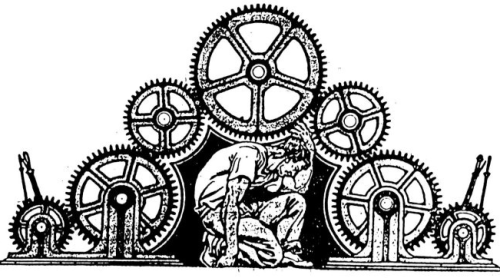
This is surely part of Marx probably meant when talking about the fact that humans are social beings and can even individualise only in society. It is not (only) the dwarf on the shoulders of giants, but (also) the cogwheel without which the entire engine cannot work.

two acting the same way does not mean twice the same thing done

The other day I read in the SZ two short notes, each referring the to a main article in other sections. The one dealing with the control of banks, the other looking at subvention of cinemas in Germany.

Remarkable is that the first shows the reference for more info being available in the section of economy, the second referring to the “Feuilleton”. It is at least worthwhile to think briefly why the support of the national industry is in one case a matter of economics and in the other case classified as supporting the national culture.

Be it as it is – and to be honest I trust that Gruetters is really concerned with the promotion of arts – there remains a bit of a riddle: Why do we speak in in the one case of economics, in the other of culture. Could it be that national interests play a role and that they are prioritised in economics whereas they remain veiled, while existing in the gap between Germany’s strive for national competitiveness and the spirit of the nation of poets and thinkers?

Perhaps it is becoming clearer when we consider another message, recently issued by a proponent of the free market. What is commonly understood as essential functioning of the market – the change of prices based on emend and supply – is criticised by rebuking the very same practice of one competitor – making offers and setting prices based on the principle of “prices following demand”. So we learn from one of the dominating figures of “market-free hotels and (chain) restaurants”:

In addition, the portals led hotel owners to so-called yield management.

He (Eugen Block, private hotel and restaurant owner) dislikes the fact that prices on the Internet are sometimes adjusted to demand every hour; guests have to pay 50 or 500 euros for the same room. “If a fair is, the emergency situation of the guest is exploited. At other times the rooms are sold at prices that threaten the existence of the guest. That, says Block, “is also simply bad marketing. He himself takes a fixed price, which fluctuates by a maximum of ten percent depending on the season.

So what? Defending the “free market” against an internet firm for applying the principle of the free market? Every Blockhouse (brand-name of Block’s restaurants acts in the same way of using quasi-monopolist power against others, though usually by seeing the price up. … Something strange here I suppose.

The decisive difference is the sovereignty linked to the person, or, using the words from the translator’s (William Guthrie) introduction to Savigny’s Treatise on the Conflict of Laws and the limits of their operation in respect of place and time:

It has to do with the capacity of persons to have rights, not with their capacity to act, i.e. to acquire or lose rights. It forms an exhaustive treatise on the person, in its legal sense, from the beginning of capacity for rights at birth until its termination by death, with all its limitations and modifications in respect of freedom, political rights, dependence arising from the family relations, and other causes of less extensive operation.