Poison, Gifts and Intoxication

Well, much can be said about China – not the issue here and not for me at the moment. Still, I am wondering if a country and continent [sorry, all links are to articles in German language]

________________

[Bei der Düsseldorfer Tafel bekommen alle Bedürftigen Lebensmittel. In Essen vorübergehend nur noch die mit deutschem Pass. – photo dpa]

_______________

should really worry about a Chinese investor, who steps substantially in at Daimler Benz? Carrying in his luggage the gift of advanced technologies for electric cars, a gift that does not promise venom-free driving[1], but is at least a small contribution to reduce emissions. – It would be more desirable to think about possibilities to move with this to cooperative advantage instead of maintaining comparative advantage as guide, – Sure, here state regulation could take new forms.

Less complains here I suppose than about google as potential competitor on the market of car manufacturing.

_______________

Two of the many points that should be mentioned in detail:

*

Quoted from the first article, in translation:

The spokesperson of the job center … says that persons who re receiving basic basic social income would not depend on begging.

It is the old flam that here is no poverty [a] because everybody has the right to receive that kind of income and [b] it is sufficient for a decent life. But it is as well a matter of defining begging as smiliar-to-employment activity.

**

In all these contexts [there are similar cases, also in other German cities, the issue of donations is coming up: basically it says money – also goods – given to people who are begging, also food and other support people receive from charities – are legally ‘donations’ [non-deductible] to the recipient, i.e, beggar.

So, playing this bitter game a bit further we arrive at the state where actually income may soon be defined as donation, the employer soon being defined as good-doer, and the employee …

Well, NOW I think it is time to return to the China issue: I discussed with a colleague more or less extensively about Corporate Social Responsibility – the project to co-author an article finally failed, admittedly it was my fault: I simply could not accept that paying business tax can be seen as corporate social responsibility … .

_______________

And all this is much about a topic I discuss occasionally with my colleague here, in a nutshell the old, and still unresolved question about justice and right. And John Stuart Mill, in Volume X of his Collected Works [Essays on Ethics, Religion and Society], in particular writing on the ‘On the Connexion between Justice and Utility’ is at least stimulating, asking us to think about social and individual.

Is it far fetched then if the gist of my presentation, titled

WYSIWYG – Also for Big Data?

is the necessity to think about the a radical ‘new beginning’ when it comes to thinking about social and welfare issues?

Now lean back and think a bit: In the presentation I mention towards the end that one of the most serious problems with the ‘new economic and juridical normal’ is the -delegalisation, ops: the fact that we find a substantial trend towards charitibilisation: the replacement of social rights by charitable activities ….

****

[1]            The German term ‘Geschenk’ translates into English as ‘gift’, the German term ‘Gift’ translates into English as venom, toxic, poison.


WYSIWYG – What you see is what you get?

A short presentation on Big Data and Digitisation at the Max-Planck-Institute fro Social Law and Social Policy

WYSIWYG[1] – Also for Big Data?

WYSIWYG, the supposed revolutionary concept that once opened a new world for computer quarter-literates is not necessarily applicable if we look at the supposed recent revolution: Big Data. More likely we find the emergence of a WYSID – What You See Is Delusion.


[from Leibniz’ writing on the Binary Code Calculating Machine]

The presentation aims on contributing from the perspective of political economy to an understanding of some systemic developments that are hidden behind a blurred understanding of Big Data and Digitisation. The following is guiding the development of the argument:

  • Moving from Adventures in Wonderland to seeing the World Through the Looking-Glass – Some Terminological Remarks
  • From Gold Standard to Sparkling Diamonds – The Economy of the Digital and Informational Revolution
  • The Lonely Crowd versus Crowded Loneliness – About Individual, Social, Public and Private Matters
  • L’État c’est moi – l’état, c’est-à-dire nous? – Socio-Eco-Legal Issues around Public and Social Responsibility

On the latter, especially four topics are seen as major challenge:

  1. Concentralisation
  2. Public-Private-Datachips
  3. Changed status of Employees or changed property issues
  4. The Firm and the loss of transaction cost

Some background material can be found here.

Here the link to the recording of the presentation  – speaker presentation: Professor Dr. Ulrich Becker.

******

[1]            What you see is what you get

Leisure Time

It is Chinese New Year and Spring Festival, Seollal in Korea, where the Olympic Games may be part of what they claim to be: a step to the peaceful unification of two countries, which would be a real and global platinum medal – and it is about celebrating and leisure time. Let us join in this difficult matter.

… unfortunately human nature improves slowly, and in nothing more slowly than in the hard task of learning to use leisure well. In every age, in every nation, and in every rank of society, those who have known how to work well, have been far more numerous than those who have known how to use leisure well. But on the other hand it is only through freedom to use leisure as they will, that people can learn to use leisure well; and no class of manual workers, who are devoid of leisure, can have much self-respect and become full citizens. Some time free from the fatigue of work that tires without educating, is a necessary condition of a high standard of life.


[Marshall, Alfred, 1890: Principles of Economics; MacMillan and Co., London, 1930: 718]

Digitalization, immigration and the welfare state – A Book Review

Just published:

BOOK REVIEW

Digitalization, immigration and the welfare state, by Mårten Blix, Cheltenham, UK & Northampton, MA, USA, Edward Elgar Publishing, 2017, 186 pp., ISBN 978 1 78643 294 0 (hardback)

One may be grateful, seeing a title as the one of the books for review, that finally it is about some- thing that can well be perceived as a crossroads for the future, defined by: digitization as one of the main new hopes, and equally a major variable of insecurity; migration is seen by many as a major threat; and the welfare state as known centre and channel, allowing taming rough sea. …

It is published in the

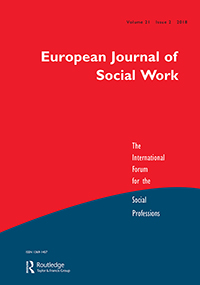
EUROPEAN JOURNAL OF SOCIAL WORK

and can be accessed – if you have access via:

https://doi.org/10.1080/13691457.2018.1434267

fortaste

It may be that future referencing look like this, at least I felt obliged to add the underlined part while having written an essay for publication

Herrmann, ongoing [a]: Is it really about Industry 4.0.?; https://www.researchgate.net/project/Is-it-really-about-Industry-40; [b] Wandel des Wirtschaftens – Wandel des Rechts. Forschungsskizze zu Sozialrecht und Sozialpolitik; https://www.researchgate.net/project/Wandel-des-Wirtschaftens-Wandel-des-Rechts-Forschungsskizze-zu-Sozialrecht-und-Sozialpolitik; 29/12/17; some of the references had been added by researchgate and are completely irrelevant to the work and/or content would be fundamentally criticised and even rejected. Actually thus confirms parts of what had been stated: the complete lack of competence of the algorithm jugglers and the lack of real power of users as those references cannot be manually deleted)

The paragraph I referred to reads as follows:

This pattern applies – cum grano salis – to many areas, and of course, it means higher efficiency, thus lower cost, the possibility of establishing user-friendly and comfortable use of services and purchase of goods, in selected cases even giving the customer/service user some space for interaction and increased influence, opening roads towards part-individualised services/goods. All this going hand in hand with decreasing prices. However, there is a price to be paid, and there are two different charges levied. The one is a – possibly twofold – pressure on working conditions; twofold means that pressure is increased on those who are directly involved as for instance UBER-drivers, foodora-deliverers but also hotels [individual or chains] that are engaging with booking.com. The other bill has to be paid by people and strata who are only peripherally concerned – we may even think about the click-workers on click-farms, boosting the image of their customers by making virtual reality to faked realities. The other reason is that the increased freedom and power of the customer/user is in actual fact more illusionary than anything else: one crucial point is that even the attempt to make use of the options requires a pre-empt formulations, making thus sure that ‘the system’ is able to process the data. In other words, increased variety is more qualitative than quantitative.

Adding a bit of the background: I am not extensively working with my researchgate-site, and the same applies to academia.edu which actually had been established a long time by my university in Budapest. Recently I saw by accident references to documents and texts as reference which had not been added by me, some of them I didn’t even know. I contacted the ResearchGate Community Support, complaining. I even received an answer whited not always been the case:

Thanks for contacting us. You are the only collaborator listed, so you are the only person who can add research items to this project.
If you are referring to the references (34), these are automatically added using the publications that you have added to your project. To remove the references, you need to remove the publication that you added as an update.

So, the first thing that can be said: they a liars – obviously they are also collaborators, to be more precise, a system that is not thought through is collaborating. On the point that this system is not thought through, the following my be said, quoting from my answer:

Thanks …, from the perspective of an academic researcher this is not reflecting how things should work. In the extreme – as known from an English case, doing research on fascism/right wing policy it ended up in the most contested position appearing as most outstanding work in this field of research. – It was not a researchgate-related case but shows that your management should revisit policies that are going into that direction.

Just showing up is thus sufficient, substance, positions of researchers are erased from the agenda. and still it has something of the Berufsverbote we had been fighting – be it under terms of Berufsverbote, McCarthyism, censorship or anything the like. All this is worrying enough.

There is still another point that deserves mention. Those days with the little encounter with the ‘community’ I wrote a mail to a friend in China:

I made yesterday a somewhat funny experience: the midwife saying something, i.e. ‘ I am obliged to inform you …. – but from my own experience …’ – so after her midwife-business was done, I asked what this would actually mean: ‘I am obliged …’. Who and what would oblige her. The professional organisation, the medical professionals, some administration …. – she did not know. All was based on some statistical surveys, not a matter of experience. – Doesn’t acceptance begin with such small things? Doesn’t it begin as well with people like myself simply completely accepting the requirements … put up by national ministries, by other universities like Bangor, Warwick, LSE etc,, by ministries from other countries … ? As said, difficult and there is probably no ‘one answer’. Refusing on some occasions to comply, I actually had to pay thousands of Euro over the years leaving aside other payments like being ignored, censored, bullied or not being accepted for certain jobs based on ‘political’ reasons. Still, this is also something linked to the issue of knowledge versus skills. Skills … it is something for computers and robots … – but knowledge …
And real knowledge is …, well another experience from one of the recent days, when I went to the opera in Munich. I met one guy who works there – after ??? some five years at least, he still remembered me …, bit of chatting, also about the performance – during the pause he said: you will enjoy the third act — one must really be a very good side and dancer to be able to sing and dance wrongly. – Similar to what Picasso once said – something like: it took me three years to learn painting like the classical painters, and it took me many more years to learn painting like a child.

The world isn’t flat – though accepting that some people suggest it would be is sad to say the least, and seeing them making a career and having the power to algorithm-ise the careers of others and the way knowledge develops is appalling. The fact that major journals do it, should for researchgate and similar a motivation to do better instead reproducing the publishers ‘artificial bashfulness’, borrowing a term from from Hito Steyerl.

When did it begin? When did we depart?

When did it begin? When did humankind depart from the path of thinking wisely instead of glamorously? And easily moving on the margin of faked realities!?
Well, apparently ist was not before 1927-28, the year of the
GIFFORD LECTURES DELIVERED IN THE UNIVERSITY OF EDINBURGH BY ALFRED NORTH WHITEHEAD.
In the book emerging from there:
PROCESS AND REALITY. AN ESSAY IN COSMOLOGY
we read on page 39:
There is no point in endeavouring to force the interpretations of divergent philosophers into a vague agreement. What is important is that the scheme of interpretation here adopted can claim for each of its main positions the express authority of one, or the other, of some supreme master of thought-Plato, Aristotle, Descartes, Locke, Hume, Kant. But ultimately nothing rests on authority; the final court of appeal is intrinsic reasonableness.
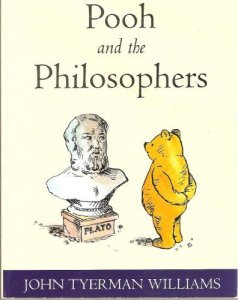
The safest general characterization of the European philosophical tradi- tion is that it consists of a series of footnotes to Plato. I do not mean the. systematic scheme of thought which scholars have doubtfully extracted from his writings. I allude to the wealth of general ideas scattered through them. His personal endowments, his wide opportunities for experience at a great period of civilization, his inheritance of an intellectual tradition not yet stiffened by excessive systematization, have made his writings an inexhaustible mine of suggestion.

May be at some stage then some people thought they can write a new body text, leaving the area of footnotes. Seeing posters, advertising a new Amazon Echo, I was getting curious what this is about – and looking it up here, I read
Amazon had been developing Echo devices inside its Lab126 offices in Silicon Valley and Cambridge, Massachusetts since at least 2010 in confirmed reports.
And I am wondering if they don’t have any better ideas about spending their time there …? Maybe reducing rubbish heaps instead of filling them up?
Sure, you may thoughtfully ask if I do not have anything better to do than commenting on it. – Yes, I do, and yes I can do and think other things – from a lovely lunch with friends, making jokes while going for a walk to tackling more profound questions, actually trying to define questions and problems instead of providing solutions to problems we do not have.
Hey, listen Mr Steve Amazon Gates, but that is exactly the point: creating and duplicating text blocks, and pretending they are more than footnotes to Plato. They are not more, they are just a stupid way of distracting reading the original – even if we are told we can make things our own.
And they are ways of distracting from reality, whitewashing as it was called, photoshopping as it is called.
Without distraction, we may then read in Plato’s Republic:
If the entire soul, then, follows without rebellion the part which loves wisdom, the result is that in general each part can carry out its own function—can be just, in other words—and in particular each is able to enjoy pleasures which are its own, the best, and, as far as possible, the truest. … When one of the other parts takes control, there are two results: it fails to discover its own proper pleasure, and it compels the other parts to pursue a pleasure which is not their own, and not true.
It continues:
In which case, I imagine, the tyrant will be furthest removed from true pleasure – how own proper pleasure – while the king will be the least far removed.
  • We have to add: there and then the king, the ideal king, was understood as philosopher.
  • We have to ‘complete’ from today that the market is our contemporary tyrant.
  • – it is surely worthwhile for everybody to read a bit further, to be ore precise to read what had been written before the quoted conclusion had been made.
So, looking at Plato’s teacher, we may have to accept the following:
Standards of beauty are different in different eras, and in Socrates’s time beauty could easily be measured by the standard of the gods, stately, proportionate sculptures of whom had been adorning the Athenian acropolis since about the time Socrates reached the age of thirty. Good looks and proper bearing were important to a man’s political prospects, for beauty and goodness were linked in the popular imagination. The extant sources agree that Socrates was profoundly ugly, resembling a satyr more than a man—and resembling not at all the statues that turned up later in ancient times and now grace Internet sites and the covers of books. He had wide-set, bulging eyes that darted sideways and enabled him, like a crab, to see not only what was straight ahead, but what was beside him as well; a flat, upturned nose with flaring nostrils; and large fleshy lips like an ass. Socrates let his hair grow long, Spartan-style (even while Athens and Sparta were at war), and went about barefoot and unwashed, carrying a stick and looking arrogant. He didn’t change his clothes but efficiently wore in the daytime what he covered himself with at night. Something was peculiar about his gait as well, sometimes described as a swagger so intimidating that enemy soldiers kept their distance. He was impervious to the effects of alcohol and cold, but this made him an object of suspicion to his fellow soldiers on campaign.
We still speak of them, admiring, criticising and even with this acknowledging their ongoing meaning. We will not know, but may ask: who will really admire, criticise and with this acknowledge Mr Steve, when possibly standing in about 2500 years at some gates that open the way across the amazon.
For my part, I am happy coexist merely as footnote, even as footnote of footnotes – and of course, I am happy when I can help students and scholars a little bit to understand the body texts of humankind and their meaning [for] today.

… boxing humans …

Well, moving in the academic realm is too often about boxing humans – yes, both sides going together: putting people into boxes and brutally beating them up. The following a letter I sent to relevant newspapers as comment on what is going on, how students [and lecturers] are mal-treated, disrespectful encounters when students are following their curiosity. It makes me increasingly sad, and I feel deeply ashamed …

******

Dear colleagues,

adding to the various discussions on ranking and formalistic approaches to studying, admission to universities and performance of third-level teaching and research, one point is easily overlooked – the following example is perhaps extreme, though not necessarily completely exceptional.

I worked for two years as professor of economics at Bangor College China, Changsha [BCC] before taking up my current position as research fellow at the Max-Planck Institute for Social Law and Social Policy in Munich, Germany. Still, one persisting bond to the previous job is concerned with writing references for some students. Some universities where students applied, accepted only references, requiring my mail-address from the previous job – but shouldn’t universities at this time and age accept that scholars are moving, following ambitions and calls in other positions? This means: they should also accept that mail addresses change, and one may even prefer to use a non-institutional address. Anyway, I mentioned the BCC-mail address – however, sending a mail to that address is answered by an auto-reply referring the sender to another address. This is the first point where the institution that was seeking the reference – the Graduate School, The Chinese University of Hong Kong – failed. They ignored the auto-reply and I did not know about the request they sent. Finally I was made aware of it [by the bright applying student], checked the dormant mail box and continued to the website for the submission of the reference. A form opened [after going through a more or less cumbersome procedure], asking for replies to multiple choice questions. I still think students are not made up of multiple choice elements, instead: they are real beings, humans with a multifaceted personality that cannot be squeezed into such forms – even when considering data-processing as an at-times appropriate tool. So, instead of ticking the boxes I preferred skipping them, attaching a recommendation letter instead. However, the system did not allow me to submit the letter unless I would first answer the multiple-choice questions which would feed into a one-dimensional profile. I complained, sent the letter as a mail attachment – and did not receive a reply by the said office of the Hong Kong University. At some stage, I agreed – honestly disgusted by the lack of qualification and respect towards students – ticked the boxes and attached the letter [again cumbersome, as one had to enter a code which was not clearly legible, not allowing to distinguish 0 and O]. I sent another letter of complaint to the Graduate School, The Chinese University of Hong Kong – which was again answered to the BCC address, and again they failed to resend the mail to the e-mail address mentioned in the auto-reply.

If these are the standards of entering higher education, one should not be surprised that at the other end, i.e. at the time of finishing studies, many people have difficulties. They feel their creativity being limited by the requirements of publishing, acquiring funding and the competition along lines of subordination under expectations instead of striving for innovation [see Maximilain Sippenauer: Doktor Bologna; Sueddeutsche Zeitung, 20.10.2017: 11]

Still, it is a bit surprising that all this is well known and still not much is changing. Surprising … ? Perhaps it is not really surprising if we consider that the income of top-administration posts increase while the income of lecturers does not follow accordingly [see for instance the article titled: Times Higher Education pay survey 2016 in The Times Higher Education; https://www.timeshighereducation.com/features/times-higher-education-pay-survey-2016%5D.

It seems that there is a long way towards ‘supporting the brightest by open systems’, overcoming the dominant administrative policy of ‘wedge the narrowest by furthering their smart submission’.

Sincerely

Peter Herrmann

precarity and digitisation – it is not just about jobs

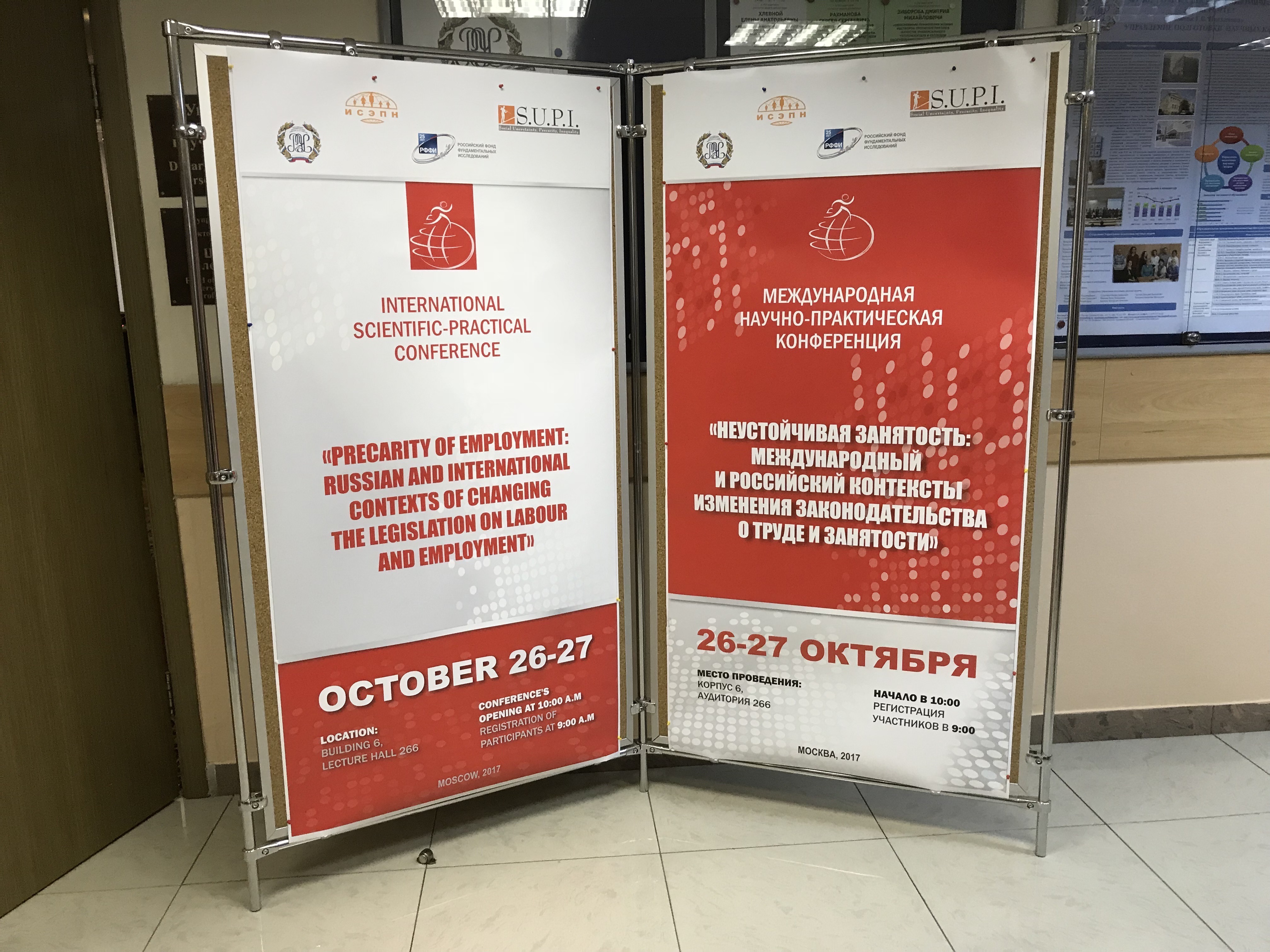
This is the title of a presentation of which the recording is online now.

It had been given during the

INTERNATIONAL SCIENTIFIC-PRACTICAL CONFERENCE on INSTABILITY OF EMPLOYMENT: RUSSIAN AND INTERNATIONAL CONTEXTS OF CHANGING THE LEGISLATION ON LABOUR AND EMPLOYMENT in Moscow at the Plekhanov Russian University of Economics [October 26-27 2017]


Overwiew:

The presentation is more in search of the question, not pretending to know answers.
The contribution is crosscutting, mainly offering a theoretical and global in orientation. The aim is to contribute against the background of digitisation to the discussion of  the changing world of the organisation of work and underlying process of accumulation.
During the era of ‘industrial capitalism’ the tension between market and society was by and large processed and channelled via the firm – a conclusion we can draw from reading R.H. Coase and Karl Polanyi. However, looking at some of the current trends as they are tied up under keywords of gig-economy, sharing economy, collaborative consumption, collaborative production, on-demand-economy and the like, we are facing at least in some areas of the economy some changes which can be captured by two keywords:
  • de-firmisation of working frameworks
  • hybridisation of work or to be more precise employment

What are and what can be the answers? We see precarisation as one route, not suggested but actually taken. But it is a route based on two questionable presumptions: the first is that work has to be organised as labour and the second is that society has to and can bear and even accept major inequalities.

[Part of] The discussion is also recorded and focuses on issues of developments in China..

Digitalwirtschaft … Flexi oder was?

unter dem Titel
ist nun ein kurzer Artikel in der Freiheitsliebe  erschienen.

ABSTRACT

Plattformökonomie ist einer der Begriffe, unter denen neue Wirtschaftsentwicklungen gefasst werden. Schon in diesem kurzen Satz, der vagen Formulierung, wird deutlich, dass es bei diesem und ähnlichen Begriffen wie Digitalisierung, gig-Ökonomie, Robotisierung um ein Feld handelt, dass einerseits durch viele Facetten mit ganz spezifischen Detailaspekten gekennzeichnet ist, aber andererseits Teil eines komplexen Feldes von Änderungen ist, die das Wirtschaften und die Vergesellschaftung betreffen.
Das wird dann auch Thema des nächsten Projektes sein, welches mich dann ein Jahr lang am Max-Planck-Institut für Sozialrecht und Sozialpolitik
beschäftigen wird.
Siehe auch hier.