Slippery Ground: Committee Society

Addiction searching for never-ending reflection, undermining in an equivocal way practice, leaves, as Kierkegaard sees it, in a fatal danger. If nobody takes a decision anymore and thus nobody emerges with such decision as self, nobody is distinct from anybody else in a true way; we face a dreary leveling. Togetherness of human beings emerges as ‘public’, being an impalpable, anonymous ‘publicity’. Its characteristic is ‘babble’; every responsible speech drowns in ‘ramblings’. “Nobody decides anymore him/herself; one is content with setting up committees; at the end the entire era emerges as committee.” “But the mass is the falsehood.”

(WILHELM WEISCHEDEL: Die philosophische Hintertreppe 34 große Philosophen in Alltag und Denken – from audio book – my transcript and translation)

Glass – perhaps stronger as metal

OR: PHOTOS NOT TO BE TAKEN
Already on the previous occasion when I had been in the city centre, I had been somewhat surprised by the amount of police around – sure it is the time before elections, the candidates just nominated; there had been demonstrations too … – and as I do not understand the language to the degree that would allow me to know what the demonstrations had been about, I feel a little bit surprised of my spontaneous disagreement, rejection. Though I am not really Hegelian, didn’t he see in his Philosophy of Right the police as particularly important in representing the even the universal?

In any case, this day I felt very much tempted to make a photo of the young women, standing next to the police bus, holding the machine gun at the ready. – But I know from a similar occasion in Ireland – a colleague from Slovakia wanted to take a photo of the guards protecting the money transport from BOI – that such photo shots are not the best idea (not in Ireland, not in Turkey and not in any other place – I have the vague feeling I know why, not least as I heard the other day that the office of the German headquarter of attac had been visited by these people in green*: they had been looking for some documents which the office could obtain and containing some information relevant with some finance market stuff ).

Another photo not taken: I am sitting already in the minibus, going back back to ODTU. The driver is first – while managing driving through the dense traffic in the centre and at the same time dealing with the money – moving the rosary through his fingers; then, after the traffic ceased a bit, he is frequently moving his fist against somebody whom he considers being in the way, or he is symbolically pushing somebody out of the minibus while stopping at one of these non-existing bus stops, thus asking by this gesture the words he doesn’t say: “Can’t you move faster?”

Or perhaps should I have taken the photo from the young woman who enters the minibus: made-up and smartened, showing with every movement, every look and with every gesture her discomfort: “This is not the place where I should be. A private limousine would be much more appropriate.” The driver is now driving most appropriate for a training session for a formula 1 competition – and the young woman’s real fear – an accident – seem to mingle with the fear of loss of status.

Well, no imagery of pretended, self-nominated nobility – finally I didn’t (even feel tempted to) take a photo of one of the many shoe polishers – some of them surely cleaning the shoes of those people who – though possibly only metaphorically – give them a kick in the …, well, a kick somewhere with the same shoe they get cleaned.

But the photos are not really my concern. Nor the deep impression the situations left behind.

It is more the road marks I mentioned in a recent post and the question they evoked: “Where is the energy of the Turkish people going to harmonise/ maintain incompatibility of the contradictoriness or to move to modernisation, the road-markings you mentioned?”

Yes, as I answered then – while making reference to army-helicopters, so frequently flying across the campus and mushrooming shopping centres – I will come back to it – and I will make another reference, one that may seem far-fetched, bizarre and it is surely not comprehendible at first sight: the reference to three of my current ‘projects’: (1) editing a book on social policy and religion, (2) preparing the workshop on Human Rights in the framework of the Forum “Human Rights in a Globalized World – Challenges to The Media” (Human Rights, a topic that will also be the focus of my later work at the MPI and (3) editing another book, looking at the question of precarity.

What all this is about is a frequent topic here – coming up when talking to colleagues and friends: hegemony, integration, control. The mode of regulation can definitely show different forms – and while writing these lines some ideas come up on how to tackle this topic later academically (I promised in Munich to link the question of “human rights beginning at the breakfast table” as Féilim apparently emphasises with the much more fundamental question of how is the breakfast table actually defined by existing accumulation regimes as there is surely a difference between the full Irish, the continental and South American etc.).

As offensive, mind-bugling it is to look after so many years again in the barrel of a riffle, it is somewhat similar offensive and mind-bugling to walk through shopping malls, seeing people who are not able to cross the glass ceilings of political institutions, hierarchies in business and go beyond the glass walls erected between affluence and poverty, put up in front of them as mirror in which they, the poor or at least not well-off, see their alleged failure, standing upright as spur to contribute to a suggested growth of the Wealth of the Nation.

In the first case Moral Sentiments are added as possible tools to clean up after the bloodshed, in the second case these very same Moral Sentiments as as reminder, aiming on evoking incitement: consumo ergo sum as moral quality of the bourgeois, suggesting ethical life by hoping for Hegel’s Sittlichkeit for the citoyen.

As said it is a topic frequently coming up, and I said for a couple of times: oppression, disguised as free market, should not be underestimated – a strong hegemonic power – not using weapons of physical violence, even if it is only by showing the potentiality of the use; not using the call of commandments: a multitude of norms reduced on ten simple rules. Instead it is using the expostulation: you are point of departure and point of destiny of all your acts – if there is any practice left it is only the aggregation of a multitude of individuals.

– It is surely a slippery ground, possibly belittling the brute violence, still bringing people into arrest in this country: people who are democratically saying their opinion, aiming on contributing to a debate and facing the odd reality: a country that does not provide space for debate, does not provide space for debaters either. And still, what is the answer on my statement: “Don’t underestimate the opressive side of the market as hegemon. A power in every day life we are not aware of, just following the flow, without considering what it actually does to our entire thinking – taking the energy out of everybody and anything we do.” You can imagine the answer of the colleagues and friends here? Well, after surely saying something like: “We know what oppression, what brute force is about.” a little surprise follows: “You say in your countries you do not mention the violence, the force of strict control. When we are there we definitely mention it … – we as foreigners.”

It is a surprise, distraction from what I mean and confirmation nevertheless too: follow the rule, be one of us – and it also asks: be ONE of us, do not be any kind of group: just an individual: behaving rationally with all the information you are given (but don’t ask for more, for really complete information) and behave to achieve your own happiness – this then will bring happiness for all. The foreigner is possibly foreigner also because s/he is not just ONE, not (yet) reducible on the one utilitarian being. And is seems simple then: if the one control mechanism doesn’t work, the other has to be used.

There is another dimension to some parts of these little excerpts from life: from beautification to militant oppression. This kind of beautification: the strive for the “Western look”, the imitation of a mirage surely contributes to an increase of GDP and looking at the armed forces and administrative units of the country we surely find the same: GDP in excess … . At least in terms of simple calculation these are all activities, part of a process of production, that cont as contribution marble, bricks and iron. If we look at the armed forces alone, this must add up to a huge amount. And if we look at the glass and concrete of the new buildings, the mirrors of the shops in the malls there are more contributions to the raise of that figure: artificially boosted figures, though only abstract, on paper and not translating into the life of the many. So the other bricks, moved by the people themselves, the polish that emerges from people’s hand, delivered on the streets remain artificial too although this is true in an entirely different way: they remain outside of the calculation of the GDP, and they remain outside as well as they will not translate into purchases of the goods of the posh high street.

Driving home, for a short second only, the question appears why the shields of the modern armed forces, though not made from glass, look like it: transparent, clean and …, repelling: you will not see any blood on them, not for long at least: who on the public would like to see private victims taken from the partners? But perhaps there is still a way: not allowing to be captured but to capture: PPP, suggested as public private partnership, and frequently being an instrument to lull citizens may then also be understood as People – Power – Participation.

I am back in the apartment, boot the computer – the humming of the machine, taking a few seconds only – mingles with the chant coming from the Mosque located off-campus. A lasting chant – a call. Excluded? Being at the ready for a conservative come back?

Contradictions, tensions. Diversity in unity, unity in diversity, naivety – sheepish

– At the end, back from the little excursion, entering the campus again, showing my card. I take my UCC-staff card now as I am sitting very close to the door through which security staff enters. And indeed, he looks closely …, and understands. It is not in any way a valid record. But why bother – he pats me on the back, knowing, and also knowing that I know … – sure there is hegemony; and not less sure: there is – even and at least – in small things some kind of resistance – reminiscence !?.

I remember words Antonio Gramsci said, something like:

One has to educate sober, patient – people who do ot despair when facing the bold terror, people ahow are not getting exciting by every stupidity. Pessimism of mind, optimism of volition.

* colour of uniforms of German police force

Captain or New Worlds in Plastic

Well, Der Hauptmann von Koepenick is well known in German, not so well in the wider world the Captain of Koepenick though even many Germans refer more to the Hero of Zuckmayer’s novel rather than to the real Friedrich Wilhelm Voigt who, in the first decade of the 20th century mislead the German authorities by using their own means: the unconditional acceptance of authorities and their symbols. Similarly the Swiss novelist Keller had been  earlier dealing with the very similar sujet: reputation, status, outwardness, symbols are decisive when it comes to assessment and recognition of people: Kleider Machen Leute (Clothes Make the Man or: Fine Feathers Make Fine Birds).

Now, times changed – and legal science and sociology for instance know too well that status doesn’t matter anymore. Today it is the contract: the law that may define status but it is the law that is decisive and it finds its expression in documents. Everything and everybody is judged according to documents and everything is documented – and even if we don’t possess the necessary document we are defined by it, for instance by being classified  as undocumented migrant (and this status is well documented somewhere).

Actually, it may be that I am currently one of them – or nearly one of them: Before traveling here I had been told I would need a visa and I would have to buy it at the airport, after arrival in Turkey. But then I had been told that I would not need one – so I am now sitting here without visa and with much hope that the latter information is true. As, of course I know: it is not man making history but historical documents making man.

And this is something we know here at my current university – Orta Doğu Teknik Üniversitesi – too. Finally it had been in some way a typical American style campus university. And although the US had been fired at a very early stage (and one may even say: literally fired) several of the features are carried on. For instance: one cannot simply enter the campus. One needs the right document: finally we know as well: it is not the consciousness nor the real existence that de4ermines the consciousness – rather it is the document that makes the human being somewhat reality.

So, as i returned Saturday from my trip to Ankara, taking one of the minibuses, we stop briefly after entering campus ground. A guy peeps into the bus and the folks show well-behaved a little plastic cards. Peepy is happy, nearly. He begins to stare at me – and even my documented ignorance towards authorities does not help. And Sibel’s letter, saying the entire truth and authorising efendi Herrmann to enter the holy grail of science and knowledge is somewhere in the apartment. And as I do not want to offend efendi peepy, I pick my little wallet out of the pocket. Star… – stars from different coffee houses: pay 9 overprized warm drinks and we earned enough to give you the impression of inviting you for the 10th. Which one …, OK, it should be plastic and it should not emphasise too much the coffee – finally science and academia is about serious work and not about drinking coffee – and finally real existence is about human serious documents and not just about dressing up and of course it is not about mimicking authority.

A Mister Guttenberg had to learn this, a Turkish army may still has to learn it – and if and to which the the world really changes may be left an unanswered question for a while. Sometimes at least one could get the impression that there is not such a fundamental difference between a wrong captain, a wrong count and a pretending document holder. Though one point is surely important in all these cases: the pretender is always depending on the believer. – This made the year Zero possible and it is a principle that still works over 2000 years later and it also works after Adorno’s book on the Authoritiarian Personality had been published little it more than 60 years ago.

Something we should not forget in a country like this – and something we should also see when we hope with huge credulity that overcoming greed will help to make a better world.

***********

Der Paß ist der edelste Teil von einem Menschen. Er kommt auch nicht auf so einfache Weise zustand wie ein Mensch. Ein Mensch kann überall zustandkommen, auf die leichtsinnigste Art und ohne gescheiten Grund, aber ein Paß niemals. Dafür wird er auch anerkannt, wenn er gut ist, während ein Mensch noch so gut sein kann und doch nicht anerkannt wird.

[The passport is the noblest part of a human being. It doesn’t come about as easy as a human being. A human being can ocur everywhere, recklessly and without brainy reason, but this will never happen with a passport. But for that reason it will be accepted, if it is a good one, whereas a human being can be as good as we can think and still will not be recognised.]

(Bertolt Brecht, ‘Flüchtlingsgespräche’, 1940; transl. PH)

Contrasts – Having Left or Arrived?

After the more or less unpleasant trip fromWarsaw to Ankara going to bed at 1ish, getting up at 4ish and feeling …, well kind of back home. The suitcase is still unpacked, I am working a bit. Jogging – not on this stupid *****hotel-gym-belt but through the forest: breathing the fresh air rather than the malodour of the fellow-gymnasiasts; listening to my audio book – and the barking of some stray dogs rather than the clatter on the other belts in the gym; having such a nice cup of Turkish coffee then – and I cannot resist a tea afterwards, much simpler, more modest than the modern furniture here in the campus rest next to the apartment building, much more genuine than the dressed-up people who had been around the days before: not to be glorified or if so than only for not denying contradictions; then strolling a bit around – adventure not because Turkish exotic life but because of the contradictoriness, the permanent changes in life: visible in faces, buildings …., visible in the tensions between different processes and the processing of the various tensions.

And an adventure by facing the dangers? At least we have now road-markings here, dominant to an extent that had not been there when I had been here the first time, some years back now. Taming or incarceration – and leaving us with the question: who tames the tamer; and how will incarcerate them when it turns out that they are just like any other deathsman, now only coming along pinstripe-suited.

Real Freedom of Choice Limited by Freedom of Market

Things happen – recently I bought much in advance a flight ticket and now it turns out that I don’t need it. A loss of approximately 80 Euro. Checked carriers website: aerlingus. I can avail of the taxes and fees being paid back: 29 Euro. The point there is: they charge 20 Euro admin fee. There is another option – perhaps somebody is interested in the ticket – a name change is possible. For a price of 100 Euro – this is free market, this is aerlingus. There may be a good reason behind the fact that it is extremely difficult to contact these people via phone or even via e-mail. …

And we can learn that reason is apparently not linked to the term reasonable. Nor has it anything to do with sanity. It is just the bold for of freedom of the market – lacking any kind of ratio except the orientation of a high profit ratio.

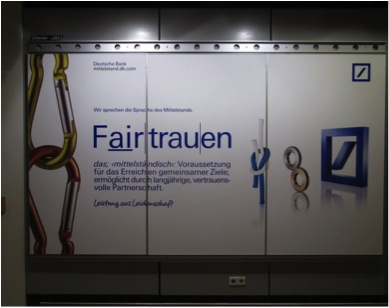
The picture shows what all this is about – faitrauen, the new term for stultification.


Add, posted by the German Bank/Deutsche Bank AG
fairtrauen - the new term for stultification

Sorry for delay …

Sorry for delay – or wor(l)d is turning around too fast OR

How “Media & Communications” at University College Cork contribute to maintaining second-rateness

Although it probably has to be said that it is a story that could happen in many other places of our “service societies”

Mail sent to UCC media:

Sent: 12 April 2010 10:24

Reply received from UCC media:

On 28/03/2011 16:04

Reply on reply sent to UCC media:

28 Mar 2011 16:08:36

change

Through consciousness spirit intervenes in the way the world is ruled. This is its infinite tool – then there are bayonets, cannon, bodies.But the banner [of philosophy] and the soul of its commander is spirit. Neither bayonets, nor money,neither this trick nor that, are the ruler. They are necessary like the cogs and wheels in a clock, but their soul is time and spirit that subordinates matter to its laws. An Iliad is not thrown together at random, neither is a great deed composed of bayonets and cannon: it is spirit that is the composer.

(Hegel)

Though the question may be asked: Is this valid in times that are  vacuous, and where  the actually existing, hegemonic spirit is based on some form of violence?

Freedom …

As said, I had been lucky, getting hold of one ticket. And thus the four of us, never leaving each other, went to the concert on Monday evening.

The one of us simply enjoying some festive mood, the pleasure of the concert hall, the opportunity of delving into the music – floating with the waves of sound, getting engaged and excited by the different compositions, each reflecting different spaces and times … – also the enjoyment of gaining new meaning by forgetting to analyse and the opportunity to allow being carried away.

Of course, it had been something special not only because the special appreciation of the ticket availed of against the odds – the other fellow of the small group, the economist, said something. At least he wanted to say something, talk a little bit about the determination of value: Scarcity …. – is this and if so, in which way is it a matter of determining value, as well economic value. Is economic value about that or about the costs of production … – Come on, don’t spoil the evening …, just enjoy rather than coming up with the macro- and possibly microeconomic debate on the value determination. We may even end up with discussing the role of speculation and the current economic crisis. That is something which finds a more appropriate place in the interview that I want to do on Wednesday.

I agree, said the historian of the gang of four – all four already occupying the one seat. There is actually something else that I think is  more interesting anyway. Look at the conductor: Hungarian. And the orchestra: Viennese, i.e. Austrian. Does it ring a bell? Do you remember, few years back you met the young Habsburg and complained about his arrogance, the way he still features the imperial tradition …, walking on heavy carpets in his noble office, representing nobility, at least pretending to represent the ancient regime in a legitimate way. As if such emporium would and could ever be legitimate. – Gosh, yes; but why does one have to remember this now? Because one can have the illusion that a Hungarian conductor in front of an Austrian orchestra things changed, the balance of the new world order is fundamentally different. A short look to the right is sufficient: the broad American accent is a reminder that such broad claims persist. An American president does not have to go to war to underscore the American claim of being a superpower. Nor does a Hungarian conductor mean that the power of traditional spirit could be overcome. – This historical discourse, surely interesting at one point, was either not suitable to make the evening just an enjoyable event. Not least as it brought up thoughts not only about history past but also about history present: the government, dancing with dark spectres of extreme conservatism for the sceptres as means of control and oppression. A clandestine joy would hardly be sufficient to make for that … – The first of us returned, leaned finally back with the other three: the economist and the historian who already commented, and the sociologist who had been silent, looking around at the people, thinking that there would surely be many who would not look like the typical visitor going for classical concerts. Most enjoyable – as said: the opportunity of delving into the music – floating with the waves of sound, getting engaged and excited by the different compositions, each reflecting different spaces and times … – also the enjoyment of gaining new meaning by forgetting to analyse and the opportunity to allow being carried away.

However, though the sociologist amongst us still did not speak it out, he was getting somewhat excited towards the end – towards the two ends. The second piece of the concert had been performed by the orchestra and as soloist a young pianist: Alice Sara Ott. Surely with some brilliance, having her own style already. But what the sociologist thought did not concern “multiculturalism in one person” (the artist being German-Japanese). Nor did it concern any demographic issues (finally being just over 20 is surely not the normal age for a superstar in this genre). The issue at stake had been …, well: Toennies, the sociologist, wrote in his main work about two kinds of will, linking the second to the higher development of the will to freestyle, to voluntarism, the the freedom of decision. And this was so obvious in the expression when the play moved on ‘from the program to the encore’. Actually it had not been an encore in the sense of repeating part of what had been played before, It had been a real add-on, now allowing the artist to enjoy gaining new meaning by forgetting to analyse and the opportunity to allow being carried away – and giving thus new meaning also to the pieces she played earlier and allowing the listener the same, gaining new and even more excitement than the already brilliant performance during the part which would in Toennies’ terms be guided by the ‘Wesenswille’: the more or less bare necessity. And the same was getting obvious at the end of the second part, the encore carrying conductor and orchestra away, allowing them to enter the sphere of freedom.

While the sociologist amongst us leaned back, somewhat satisfied with this insight, the historian chaffed about it: Sure, the Kuerwille carried the conductor away, but there had been something peculiar. The encore, the actually two added pieces had been …, yes, pieces from the Austrian tradition – engaging the Hungarian, carrying him away. The expressions being so different here if compared with the performance in particular of the first piece: Kodály’s Dances of Galanta. There, driven by the Wesenswille, being an ‘exercise of duty’, the Hungarian’s engagement had not been less, perhaps even stronger. Amazing to see his expressions at the end of the performance of the Dances. Proud, acknowledging the outstanding effort of the musicians, expressing it with unspoken words and an even stronger spoken body-language; and bending humbly, proudly, strongly … towards the audience, not saying anything, but still expressing something: Yes, we can!

We, the Hungarians, not children of the Habsburgs anymore – having a leading role now? We, the workers, people who are proud of what they can do, driven by duty and free will? We, the artists, neither being Hungarians nor Austrians but world citizens, creators and inhabitants of the universe?

All this shows also a development about which Hegel wrote. But this time it seems to move into the opposite direction. Hegel emphasised:

‘By love’s extension over a whole community  its character changes; it ceases to be a living union of individualities and instead its enjoyment is restricted to the consciousness of their mutual love.’

And the move of the concert showed how true this is, however it showed it by going the other direction: The real love as personal engagement, as direct relationship, bar of any abstraction, therefore being a matter of immediate engagement with the matter: participation as taking part and being part; appropriation as matter of ownership in terms of a mutual belonging. Hegel saw it in the idealist way, of course, claiming that ‘only that which is an object of freedom may be called an idea.’ And of course, this had been countered by Marx, claiming that freedom is the insight into what is necessary. With this, Marx allowed the subject to transcend the restrictions of certain objectivities, thus allowing the subject gaining space for practice, allowing the subject to emerge as sovereign over any idea that claims to be absolute.

Yes, barely that one really can go to a concert, leaving the others: the economist, the historian, the sociologist and all the others home, or at least at the doorstep of the concert hall – but finally: why should they remain outside: don’t they also have the right just to enjoy music, a most beautiful, engaged and engaging performance? 😉