I WILL COME BACK TO IT …

Talking to a friend inTurkey – she was just helping her son to settle in Denmark, reading Heisenberg, what he wrote about a talk to Max Planck, being still somewhat confused by the question if there is beauty as such (I ventilated this in the Berlin Diaries) and “being on the move” again, I stumbled upon a passage in Sigfried Lenz’ “The German lesson” … – are we stuck in a non-learning curve? I will return to this but here first the quote:

Well, then, I’ll tell you why I’m on the island. Because no one dares to send the Rugbüll police station for a detox; he can stay addict, remaining  damn duty-addicted. And I’m here because he reached a certain age and age is indispensable to reeducated. Yes, I am here on his behalf, if you ask me. But maybe it will work out: maybe one day he can take over from me the progress I am making here. That is to be hoped for. But that is all there is to hope for. I cannot believe it. (translation P.H.)

Here the original, from page 554:

Na gut, dann werde ich Ihnen sagen, warum ich auf der Insel bin. Weil keiner sich traut, dem Polizeiposten Rugbüll eine Entziehungskur zu verordnen; der darf süchtig bleiben und süchtig seine verdammte Pflicht tun. Und ich bin hier, weil er ein bestimmtes Alter erreicht hat und als Alter unabkömmlich ist, um sich noch einmal umtrimmen zu lassen. Ja, ich bin stellvertretend für ihn hier, wenn Sie mich fragen. Aber vielleicht gelingt’s ja: vielleicht kann er die Fortschritte, die ich hier mache, eines Tages von mir übernehmen. Das ist zu hoffen. Aber das ist auch alles, was zu hoffen ist. Glauben kann ich es nicht.

Admittedly, it is a rather weird thought suggesting that, indeed history is not repeating itself, but actually it moved with modernity into a Procrustean bed. At least, as much as learning is about asking, (see comment on an earlier post: it has to be allowed to table some questions …, they will follow here soon.

never forget: death penalty

The most severe punishment for capital is when the money it represents is used for private consumption.

Even making generous donations is more acceptable as via taxation etc., the money is not declared being private asset. Thus, there is little surprise in the mushrooming of philantrocapitalism as new form of systemic parasite-ism (see e.g. Planck, Kerstin, 2017: Philanthrocapitalism and the Hidden Power of Big U.S. Foundations; in: Momentum Quarterly; Innsbruck )

times we are living in

Karl Marx, taking up the Aristotelian spirit, stated in the Economic Manuscripts of 1857-58:

Man is a Zoon politikon [political animal] in the most literal sense: he is not only a social animal, but an animal that can be individualised only within society

Seen on allwallpapersfree.blogspot.com

In an extended version of the text About You, now submitted for a Festschrift of a dear colleague, thinking about developments as expressed in the Hyperindividualist patterns of Tinder and the like I am wondering if it should read now

Man is a Zoon politikon [political animal] in the most literal sense: he is not only a social animal, but an animal that can be socialised only when excessively individualised.

Excellence

There is so much talk and wrong-doing about excellence, high performance striving for exceptional individual results. And there is so much forgetting of the fact that any human performance is part of a process, picking up the seeds and germs, delivered “for free”, often by really great minds, so often greater than the celebrities. Excellence, well understood, is about being part of a wider social and historical performance, not about individuals who – by chance or fierce violence in a competitive strive – are excluding themselves from the cooperative context, possibly even positioning themselves against it.

http://www. haleadvisors.com/wp-content/uploads/Dollarphotoclub_65673150-1024×576.jpg

William Guthrie is  somebody who showed by exposing his modesty what this actually means, writing in the second half of the19th century the following words, part of the Introduction and Translators Notes to the translation Savigny’s Private International Law and the Retrospective Operation of Statutes (A Treatise on the Conflict of Laws, and the Limits of their Operation in Respect of Place and Time)

Now, when a considerable portion lies before me completed, I might wish that much of it had been more exhaustive, plainer, and therefore different. Should such a knowledge paralyze the courage which every extensive enterprise requires ? Even along with such a self-consciousness, we may rest satisfied with the reflection, that the truth is furthered, not merely as we ourselves know it and utter it, but also by our pointing out and paving the way to it, by our settling the questions and problems on the solution of which all success depends ; for we help others to reach the goal which we are not permitted to attain. Thus, I am now satisfied with the consciousness that this work may contain fruitful seeds of truth, which shall perhaps find in others their full development, and bear rich fruit. If, then, in the presence of this full and rich fructification, the present work, which contained its germ, falls into the background, nay, is forgotten, it matters little. The individual work is as transient as the individual man in his visible form ; but imperishable is the thought that ever waxes through the life of individuals, the thought that unites all of us who labour with zeal aud love into a greater and enduring community, and in which even the meanest contribution of the individual finds its permanent place.

This is surely part of Marx probably meant when talking about the fact that humans are social beings and can even individualise only in society.Now, when a considerable portion lies before me completed, I might wish that much of it had been more exhaustive, plainer, and therefore different. Should such a knowledge paralyze the courage which every extensive enterprise requires ? Even along with such a self-consciousness, we may rest satisfied with the reflection, that the truth is furthered, not merely as we ourselves know it and utter it, but also by our pointing out and paving the way to it, by our settling the questions and problems on the solution of which all success depends ; for we help others to reach the goal which we are not permitted to attain. Thus, I am now satisfied with the consciousness that this work may contain fruitful seeds of truth, which shall perhaps find in others their full development, and bear rich fruit. If, then, in the presence of this full and rich fructification, the present work, which contained its germ, falls into the background, nay, is forgotten, it matters little. The individual work is as transient as the individual man in his visible form ; but imperishable is the thought that ever waxes through the life of individuals, the thought that unites all of us who labour with zeal aud love into a greater and enduring community, and in which even the meanest contribution of the individual finds its permanent place.

This is surely part of Marx probably meant when talking about the fact that humans are social beings and can even individualise only in society. It is not (only) the dwarf on the shoulders of giants, but (also) the cogwheel without which the entire engine cannot work.

two acting the same way does not mean twice the same thing done

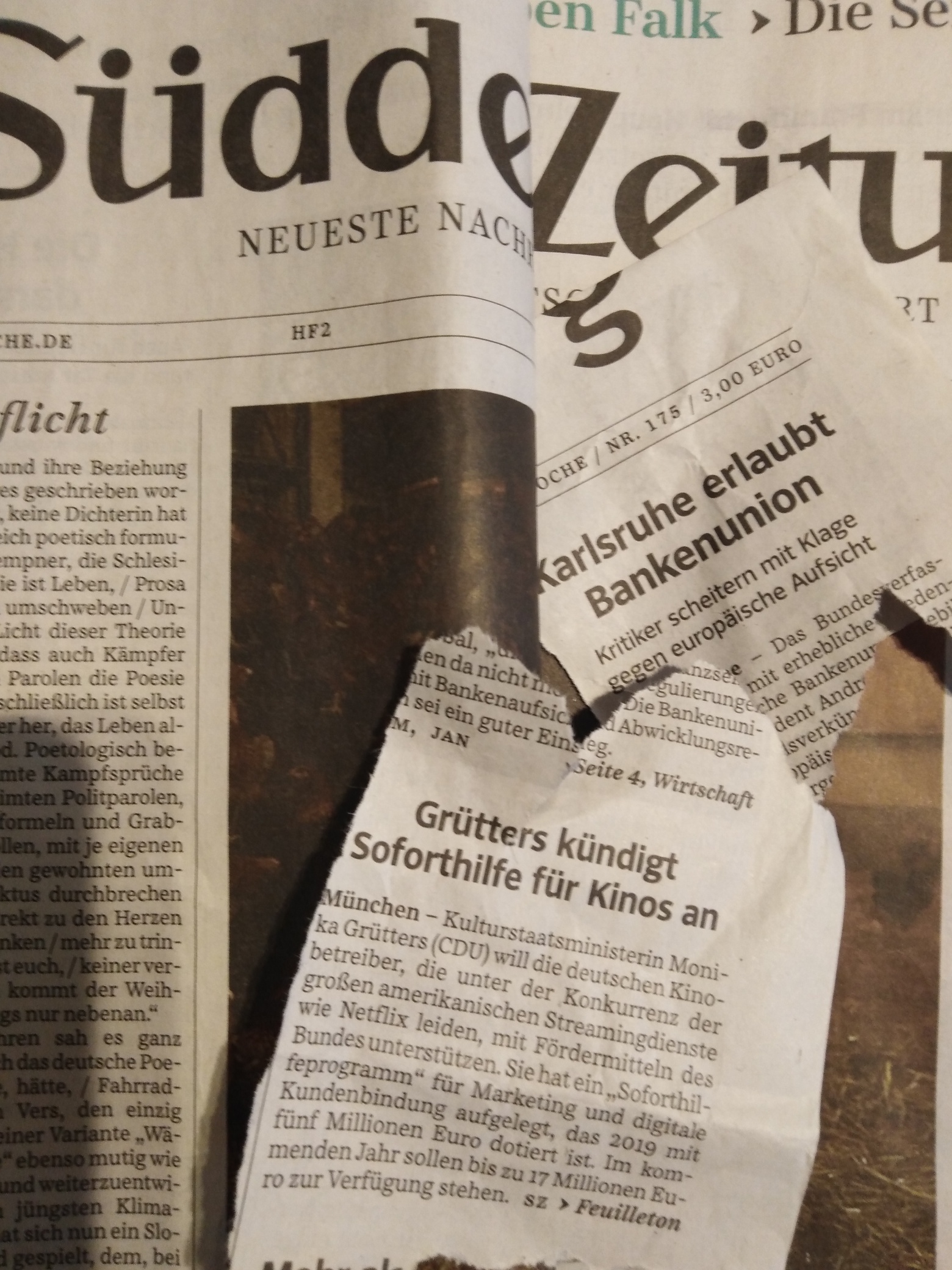
The other day I read in the SZ two short notes, each referring the to a main article in other sections. The one dealing with the control of banks, the other looking at subvention of cinemas in Germany.

Remarkable is that the first shows the reference for more info being available in the section of economy, the second referring to the “Feuilleton”. It is at least worthwhile to think briefly why the support of the national industry is in one case a matter of economics and in the other case classified as supporting the national culture.

Be it as it is – and to be honest I trust that Gruetters is really concerned with the promotion of arts – there remains a bit of a riddle: Why do we speak in in the one case of economics, in the other of culture. Could it be that national interests play a role and that they are prioritised in economics whereas they remain veiled, while existing in the gap between Germany’s strive for national competitiveness and the spirit of the nation of poets and thinkers?

Perhaps it is becoming clearer when we consider another message, recently issued by a proponent of the free market. What is commonly understood as essential functioning of the market – the change of prices based on emend and supply – is criticised by rebuking the very same practice of one competitor – making offers and setting prices based on the principle of “prices following demand”. So we learn from one of the dominating figures of “market-free hotels and (chain) restaurants”:

In addition, the portals led hotel owners to so-called yield management.

He (Eugen Block, private hotel and restaurant owner) dislikes the fact that prices on the Internet are sometimes adjusted to demand every hour; guests have to pay 50 or 500 euros for the same room. “If a fair is, the emergency situation of the guest is exploited. At other times the rooms are sold at prices that threaten the existence of the guest. That, says Block, “is also simply bad marketing. He himself takes a fixed price, which fluctuates by a maximum of ten percent depending on the season.

So what? Defending the “free market” against an internet firm for applying the principle of the free market? Every Blockhouse (brand-name of Block’s restaurants acts in the same way of using quasi-monopolist power against others, though usually by seeing the price up. … Something strange here I suppose.

The decisive difference is the sovereignty linked to the person, or, using the words from the translator’s (William Guthrie) introduction to Savigny’s Treatise on the Conflict of Laws and the limits of their operation in respect of place and time:

It has to do with the capacity of persons to have rights, not with their capacity to act, i.e. to acquire or lose rights. It forms an exhaustive treatise on the person, in its legal sense, from the beginning of capacity for rights at birth until its termination by death, with all its limitations and modifications in respect of freedom, political rights, dependence arising from the family relations, and other causes of less extensive operation.

who will be the fools then?

though it is disputed if he really said so, the following words are attributed to Abraham Lincoln:

You can fool some of the people all of the time, and all of the people some of the time, but you can not fool all of the people all of the time.

Some fooling goes obviously on when to comes to support of children, In one of the advertisement “booklets”, distributed to every household in the area where I live at the moment, it is highlighted:

buying two products = supporting holiday outings “kids farms” in Berlin.

It is this chain shop, together with a multinational and the Deutsche Kinderhilfswerk, a charity of which is said

  • it supports materially deprived children and youth
  • engages in support of children’s/youth’ rights
  • and for which transparency is important, and equally the will off the donor

20 Cent are donated to this holiday action if one buys two items of a specified range of products – it reminded me first of those activities which I know from earlier years as support measures by the welfare associations – it had been called “liberal welfare”, charitable action which is now privatised in a very specific way: transferred to the so-called free market, thus part of the so-called neo-liberal project.

Well, in some respect there is nothing wrong with it – at least some kids will have an enjoyable time – in some respect as there is a lot wrong when it comes to the political economy of it, something I issue in the forthcoming book of which I am just doing the proofreading.

There is, however, also something that has to be asked when looking at transparency: is it transparent to accept without the complete and open calculation donations

  • that are gathered by “gently convincing” customers to buy (more of) something that actually do not want to buy, at least not with such an additional incentive?
  • that donate private customers’ money under the veil of a chain shops charitability and good-doing?
  • that deduct the 20 cent from an amount of which we do not learn the composition, i.e. of which it is not clear how much profit is (still) made)?
  • that is presumably used as means of gaining special tax relief on parts of the supermarket’s turnover?

Reason becomes a sham, Beneficence a worry

These words are taken from Goethe’s Faust; perhaps one can meaningfully allude to them, stating

The jester becomes the normal, the normal is the sham.

hitherto – now – and then?

It had been well stated that

Philosophers have hitherto only interpreted the world in various ways; the point is to change it.

but so far “it changes” and philosophers and others are in a touristy mood, moving around and watching enjoyable spots.

I suppose, we lost even the ability to ask the right questions – and have to start from scratch …

There is no such thing TINA said …

A short article, published in the magazine Sozialextra, is now i open access available, looking back at the history – the ideological change – behind what is again and again called neoliberalism and austerity policies:

TINA said, There is no such thing as society.

Eine kleine Gedenk-Schrift an die geistig moralische Wende der wilden 1980er

I suppose that it presents a view on the history of “social policy”, neoliberalism and austerity that is important to understand the deeper meaning of what is actually going on today – deeper meaning in terms of the underlying ideological shift, rooted in a development for which some (to least a matter of age, though not only) of us are responsible – nolens volens. And it deserves as such attention, not least when we discuss perspectives.. – I thought it is important enough to present at least a rough translation – deepl.com as aching transition tool, with some minor corrections; And als leaving the formatting, referencing a nit chaotic spread across the text. At least you will get the gist of it …

Peter Herrmanni

TINA said, There is no such thing as society[1]

A small commemorative writing on the spiritual-moral turn of wild-west in the 1980s

So there is no alternative, because there is no society – and anyone who knew Margaret Thatcher a little bit, also knows that what she said in 1987 in an interview with a women’s magazine was by no means an unfortunate statement.

Once upon a time …

Today we are complaining about exactly what she said already then. If today anything historical appears at all with the reference, it is a general regret: egoism (sic!) is getting worse and worse, ‘greed’ was even the cause of the crisis and then – yes, only then – neoliberalism has dismantled the remnants of society: The dismantling of the welfare state, austerity, capital-friendliness or even citizenship are then quickly at hand, and if a person has to travel a little, he or she quickly gets tired, because wherever one goes in Europe, for example, the situation is supposedly particularly bad: Oh, our state of careemergency – Il numero sempre crescente di disoccupupati – qu’est-ce que l’État fait pour s’occuper des enfants – Accommodation? Who can still go for that?…. – Buteveryone knows that it’s not so bad ‘everywhere there’, because it’s especiallydramatic only in one’s own country. Irony aside, the urge to bring things to the point of one place and one time, more precisely: the urge we feel to reduce issues on the here and now, is strong – and yet this is precisely also part of the policy that was already embarking on a social restructuring at the end of the 1970s: it was the point of methodological nationalism. And with the news of the ‘weare the poorest’ the foundation was laid for special diligence, but also for the special willingness to accept political changes. Basically, the policy of sticks and carrots advocated by ‘Chancellor Bismarck’ also works here. Itis, however, more than remarkable that the so-called Bismarckian social insurance was in the end decisively enforced by the efforts of the then Minister of Trade – it can even be sharpened: Bismarck held the whip in his hand and those interested in trade, distributed pieces of sugar.

… and now it’s coming true. 

It may bea coincidence that the re-release of the film Invasion of the Body Snatchersintroduced exactly this time – according to the imdb database it is about the fact that

In San Francisco, a group of people discover the human race is being replaced one by one, with clones devoid of emotion. (https://www.imdb.com/title/tt0077745/; 23.02.19)

So the screen was free for a spectacular game, which followed – but then it followed not only on the screen, but on the massive stage called society, even if this allegedly did not exist at all.

Just a little something
relative stabilization of the post-68 period of success, although as an
unstable tension field (seehttps://www.buko.info/http/kongress/buko31/deutsch/groups/68_zeitstrahl.pdf; 23.02.19)

Opening the exit door

1979: Takeover of the government by Margaret Thatcher; takeover of thegovernment by Labour (Leonard James Callaghan).
Since 1980 in various speeches Kohl's demand for a 'spiritual-moral turn',

‘spiritual renewal’ …

September 1982: Landtag election in Hesse with the first Landtag mandates
for the Greens
October 1982: Vote of no confidence against the Schmidt government and
government declaration
March 1983: Bundestag elections, with considerable profits for the CDU/CSU and the first entry of the Greens.
First evacuation
1982 a first rejection of the EU's 'poverty reduction programmes
1995 Judgment of the European Court of Justice confirming that the EU in fact has no social policy competence
1997: EU treaty definition: Poverty reduction is labour market policy and anchored in the Amsterdam treaty.
Blocking the return path
2006 Directive 2006/123/EC of the European Parliament and of the Council of 12 December 2006 on services in the internal market[2]2
epilog

2012 – according to Wikipedia: “Helmut Schmidt, who had been overthrown,  said in 2012 in retrospect in an interview that there had been no change at all, but that the social-liberal policy had been continued and “only thepersonnel had been replaced”. (https://de.wikipedia.org/wiki/Geistig-moralische_Wende; 23.02.19)

It can’t be

A look at the mixture of those years of change must come as a little surprise, for the first impression was quite positive: just as the students had turned against the muff of thousand years, the new regulators resisted the dust that had been stirred up in less than half of a century. However, this wording should be corrected immediately: (i) It is probably more correct to speak of new founders of the old order, because at least some of the old founders had died or were expelled, such as Alt-Nazi Kiesinger. (ii) It was also about the fact that the dust whirled up was just the dust left behind by the fathers of the new founders – from Vietnam to Pinochet-Hayek’s Chile.[3]

The success and lasting effect of the ’68ers are not at issue here – but with all the necessary caution, one can probably speak of a relatively successful implementation of the welfare state concept: here, too, the whip played a role – in the form of a civil war on several fronts;[4]but the carrots seemed large enough to ensure at least a temporary peace. For Germany at least it has to be said: what presented itself as a social sector was not without problems – at least three moments should not be forgotten:

  1. The 2ndGerman ‘socio-economic miracle’ was above all the result of a rather aggressive export orientation – and thus it basically dug its own grave.
  2. Last but not least it was possible to outsource or hide large part of the problems – only later this should become really virulent: Poverty did not exist – it was officially “clere by definition”, classifying welfare payments as poverty being overcome.
  3. Germany – above all, together with Denmark, the Netherlands and the UK – also made its mark in the 1972 hesitant European policy of social order, which shows its true essence cum grano salis only in retrospect, and one must admit (at least to some of the ‘doers’) that none of them opened the exit door, but suddenly all of them were in a kind of social cold.

What lasts long won’t be good for long.

The ‘free, not success-bound’ orientation as a regular task (see Scherr in this issue) found a symbolic supplement through the programme and project policy, which indeed offered partly exciting openings5– but the sadly exciting aspect was exactly the wrong reluctance6– subsidiarity was seen by professional representatives as a possibility of securing the existence of new areas of experience and also used to open up new ones, but at the same time there was no strength, who used this as a basis for a relevant policy at the EU level and finally demanded EU responsibility – for the projects there was no scope for influence, the profession was busy with day-to-day work, colleagues from the academic world usually lacked access, as there were hardly any relevant project calls and the exceptions demanded bureaucratic effort and the courage to speak a foreign language – the welfare associations were overburdened, because the EU’s day-to-day business demanded a lot and moreover, it had been caught in nitty-gritty such as the treatment of stamps with a welfare surcharge under European tax law. Government representatives interpreted these activities more as an excuse for abstinence, because after all there was no EU competence. Border-wise we can say that it was a hike in terra nullius: the land that does not belong to anyone, which thus became the land ofthe dispossessed as well. An internal land seizure then took place, bit by bit, linking further activities more and more to the ‘core tasks of the EU’. In plain language: where most of the social affairs was already outside, the border trees were lowered: Competition was now the magic word – by no means presented as an exclusion of the social. Everything should be even better, and now, at last, truly EU-Romanian, for example through the free movement of services. That cannot be7seen as denying the social sector, can it? Rather, ironically the full recognition of the social has been achieved: social service providers as equal economic partners, for example alongside Deutsche Bank and Hoch&Tief or Flixbus.

  • see for example Herrmann, Peter, 2000: Social work and European integration – dangers of confusing the left with the right shoe; in: New practice. Zeitschrift für Sozialarbeit, Sozialpädagogik und

Sozialpolitik; Neuwied: Luchterhand, Issue 6: 601 – 607; Herrmann, Peter, 2009: Die Europäischen

Union als Programmgesellschaft. The European Social Model, Social Policy and the Third Sector

  • Herrmann, Peter, 1995: Subsidiarity and the wrong restraint or: On the meaning of European poverty

programmes; in: Intelligence Service of the German Association for Public and Private Welfare, Frankfurt/M., Issue 2: 79 – 86

  • Herrmann, Peter, 2011: The End of Social Services? Economisation and Managerialism; Bremen:

European University Publishing House

Who once looks into the metal bowl …

So it was visionary exactly in the way it happened: Kohl and Thatcher spread with their slogans the main ingredients for an ‘alchemistic circle soup’, which systematically redefined the social space as we knew it and actually let parts of the profession run in circles. Basically, we have a constellation again where trade policy and general social order policy have to come together. The EU’s fortress policy of global trade follows the usual cross-paths of a fortress wall that is only closed from one side. Moreover, it is currently also a question of far-reaching structural shifts – keywords are digitization, service capitalism, trade capitalism and financial capitalism, at least in the Western centers, and at the same time so-called Brazilianization. The crucial thing is that in this way a ‘climate’ is created which is much more radical than what is repeatedly called neoliberalism. The abandonment of the social space was more skilfully promoted than any policy of cutbacks, savings and restructuring could have achieved: It is a kind of ‘inner emigration’ – almost exactly we are writing the fortieth year of this counterrevolution: it was against the demonized socialists, clarifying in advance

Our aim is not just to remove our uniquely incompetentGovernment from office—it is to destroy the socialist fallacies— indeed the whole fallacy of socialism—that the Labour Party exists to spread.8

That was easily visibly translated as the actual combat task, far beyond serving the short-term interests of the economic bosses. In fact, the view of the economy was seen much more fundamentally – Kohl, for example, turned out to be a kind of Gramscian and stated in the government statement

The ultimate fate of the market economy is decided – beyond supplyand demand.9

(Excerpt:

https://www.1000dokumente.de/pdf/dok_0144_koh_en.pdf)

Here, too, it wasn’t simply about the real problems,10but also about the problems that had been made or, more precisely, those that allegedly didn’t exist.

“The new poverty is an invention of the socialist jet-set.”

STERN, July 24, 1986

It is significant that they are often negative statements; critiques which, as it were, also describe negatively what the conservatives did not want to be, was the main programmatic point: socially and responsibly – as early as 194911– Thatcher pleaded for the Swabian housewife who later became known through Angela Merkel. According to this, national budgets also have the primary goal of not incurring debts.

Above all, however, they did not want to be socialists – remarkable when one considers that the predecessor of this a-social era, Schmidt, said that there had been no turning point anyway (see box); and equally remarkable that then the ‘third way’, which was later allegedly longed for with Tony Blair in the UK (1997) and Gerhard Schroeder in the Federal Republic (1998) – shortly before the election – in an article in the Financial Times (international edition; passim), with the tenor that a change was necessary to secure the continuation of the conservative way. Basically, the “masterpiece” was done: the social space was abandoned, a sign was hung on the door:

Careful, don’t look back! Poisonous deposits!

And new strangleholds were trained purposefully (see Bohnenberger in this issue) – they were supposed to prepare themselves for private services, competition, division, and stress for ‘social customers’ and ‘providers’, dressed up as zeal, among other things, and finally to accept the good wishes of TINA.

These ‘socialists’ have overlooked many things, including the fact that they have paved the way for an alternative of false demagogues (see Butterwegge in this issue).

  1. Admittedly, Kohl mentions some of the core problems in the government declaration with a certain systematic approach, including those of a kind that not only concern obvious facts but also those of amore techno-political nature (monetary and budgetary policy, etc.).

11Speech at her adoption meeting as Conservative candidate for Dartford (28 February 1949);https://www.margaretthatcher.org/document/100821; 24.02.19Prof. Dr. phil., Sozialphilosoph, News. Thoughts. Provocations www.esosc.euPart of the literature is freely accessible via https://www.researchgate.net/profile/Peter_Herrmann


[1]              Thatcher, Margaret, interviewed by Douglas Keay (1987, September 23). Interview for Woman’s Own; Thatcher Archive (THCR 5/2/262): COI transcript; https://www.margaretthatcher.org/document/106689; 17/06/18

[2]       OJ L 376, 27.12.2006, p. 36-68; http://data.europa.eu/eli/dir/2006/123/oj; 24.02.19

[3]           Zu dem letzten Punkt: Farrant, Andrew, et al. “Preventing the ‘Abuses’ of Democracy: Hayek, the ‘Military Usurper’ and Transitional Dictatorship in Chile?” American Journal of Economics and Sociology, vol. 71, no. 3, 2012, pp. 513–538., http://www.jstor.org/stable/23245188.)

[4]           Strike depositions, anti-trade union activities, legal violations, bans on employment, war with/against the RAF


Power … – also of words

One of the rare occasions that I use this space for simply reproducing from another site. Words have power … – if we use them to become ourselves powerful.

On 12 June 1942, Anne Frank received a notebook covered by a red-and-white plaid for her 13th birthday. She made it her diary, which went on to become one of the world’s most famous books. She would have turned 90 tomorrow.

From this day until 1 August 1944, she put down in words what it was like to live in a ‘Secret Annex’, the cluster of rooms with blacked out windows above Anne’s father’s office in Amsterdam where Anne, her sister Margot, her parents and four of their acquaintances hid from the Nazis.

She recorded her most intimate thoughts and feelings, describing the pressures of communal living mixed with spells of raw terror at moments of near discovery.

In addressing the journal directly as “Dear Kitty”, as though composing a letter, Anne takes the reader on a journey, a very personal one, yet paradoxically, one so many of us can somehow relate to. Because it speaks a language many of us can connect to. For instance:

“It’s difficult in times like these: ideals, dreams and cherished hopes rise within us, only to be crushed by grim reality. It’s a wonder I haven’t abandoned all my ideals, they seem so absurd and impractical. Yet I cling to them because I still believe, in spite of everything, that people are truly good at heart”. 

Can we not somehow relate these words to the current political turmoil Europe is going through? Her words are powerful. And that power remains independent from age, social status, nationality. It is universal and her book rightly became iconic.

Anne Frank aspired to become a journalist, writing the following on Wednesday, 5 April 1944:

“I finally realised that I must do my schoolwork to keep from being ignorant, to get on in life, to become a journalist, because that’s what I want! I know I can write …, but it remains to be seen whether I really have talent …

And if I don’t have the talent to write books or newspaper articles, I can always write for myself. But I want to achieve more than that. I can’t imagine living like Mother, Mrs. van Daan and all the women who go about their work and are then forgotten. I need to have something besides a husband and children to devote myself to! …

I want to be useful or bring enjoyment to all people, even those I’ve never met. I want to go on living even after my death! And that’s why I’m so grateful to God for having given me this gift, which I can use to develop myself and to express all that’s inside me!

When I write, I can shake off all my cares. My sorrow disappears, my spirits are revived! But, and that’s a big question, will I ever be able to write something great, will I ever become a journalist or a writer?”

As a journalist, I take pride in sharing these words with you. This way, you and I contribute to keeping the memory of Anne Frank alive. It is also a way to recognise what a great writer she already was.

throw-away-paradoxes

Environment, sustainability, protection of resources …, a short contribution may widen the view that is usually taken.

One of the paradoxes of the societies we live in, characterised by the present pope as throw-away-culture, is the waste of those resources that are actually valued and seen in one or the other way as productive, constituting the wealth of the times we live in. We speak, importantly, without doubt, about the environment. We sure should not forget taking other aspects into account under this heading.

The Economist published on the 8th of May an article titled


Riding alone in a car is an increasingly unaffordable luxury.

We read:

The right to use scarce road space is valuable. When it is given away, drivers overuse available roads, and clog them. The waste is colossal. An estimate by INRIX, a consulting firm, suggests that the value of time lost to traffic in 2018 in America alone reached $87bn.

In an article titled

The Cost of Reading Privacy Policies

and published it the Journal of Law and Policy for the Information Society, Aleecia M. McDonald and Lorrie Faith Cranor inform the reader:

We estimate that if all American Internet users were to annually read the online privacy policies word-for-word each time they visited a new site, the nation would spend about 54 billion hours reading privacy policies.

Sure, one of the challenges our economies face today, is the lack of employment, unemployment being another waste of …, well, actually of lives as those who are unemployed are far from enjoying leisure time as “main occupation” – the main occupation is worrying about how to get bread and butter on the table, maintaining social contacts, and remaining motivated to take up what is “on offer” (often visits to museums are free), but what does not make sense as “stand alone activity” in stand-alone existences …., meaningless as certain jobs of which the only meaning is that they do exist – as Bullshit Jobs, as David Graeber calls them.Indeed, all these examples underlining what I emphasized: “It is the stable”.