Digitisation – Employment – and What?

The recording of the keynote presentation on Digitisation, Employment, and What? is already online. It is an attempt to socio-locate the challenge of today’s productivity puzzle and had been given on occasion of the symposium in Helsinki, organised by the Pellervo Society and the European Academy of Science and Arts, today on the 18th of September 2018.

Usual beginning is about “I do not know where to start” – all is so terribly confusing, a multitude of extremely different things.

There seems an obvious reply in the present case,

  • at least for digitisation – the apparent omnipresence of issues that are in one or another way about digital stuff – from the CD-player to the computer on four wheels
  • also for AI – the fact that it is not entirely clear is part of AI itself: there seems to be something that we, humankind, came up with and that is now “beyond our capacities” – the Frankenstein of Intellect if you want
  • and what seems to be equally clear: precarity in the vein of decreasing employment – another time we hear in different rhythm the old melody: there is not enough work anymore. But if we listen around we hear also something else – something we also heard for many times throughout history: There will never be an end, though there will be many changes.

Having said earlier that presentations are often started with something like “I do not know where to begin”, waiting for an Ariadne who may help. At present, my point is a different one, namely “I do not where it will end”. It is the famous Alice-in-Wonderland-situation, leading elsewhere to the conclusion “but I would not start from here”.

A Year Ahead

Well, a bit strange year coming to an end, after commencing on September the 8th 2017: taking it as “year” extended by some days, shortened by some events standing in the way of “routine work” in the office at the Max Planck Institute for Social Law and Social Policy in the Amalienstrasse 33 in Munich, standing in the way of life and living … – still several lucky events as concerts, visits of museums … or events in which I had been lucky enough to be able to do at least to some extent what I wanted to do — following the commitment of a dwarf

standing on the shoulders of giants, and even walking some distance with them, side by side.

It proved another time for me that the real – and really exciting – tension of working in academia is not so much about fundamental and applied research but between research and taking position in the biased debates of our times – the times of past, presence and future.

The list below provides gives a more or less small insight into what I could achieve, not mentioning the endless disputes with universities about references for former students, peer-reviewing (though being hesitant when it comes to accepting this task) and also not mentioning the frequent chats with colleagues becoming friends and …, well and friends becoming colleagues.

– The latter may deserve some explanation. While academic work seems to be in some way impersonal, strictly bound to rule and while this is to some extent actually true, it is important to acknowledge the most fundmental rule: any knowledge has to be aobut the acknowledgment of reality as ultimate point of reference. And reality is not primarily what we learn from textbooks, statistics, legal and administrative regulations – even economists, usually at least, do not look at figures for the sake of the figures. Instead, it is about how people act and interact …, and omit (inter)acting. Of course, it is about specific observations and observations of the specific. Nevertheless, it is also about gathering different perspectives, not those expressed in interviews but those expressed in life, or we may say in “open dialogue”. Of course, this is first and foremost a very vague approach. And as much as it may end in accidental contacts – easily ending in accidents of misjudgments due to not knowing background and context of the other – it is also something that emerges naturally when engaging with people around – and this is equally a source of possible accidents due to the limited outreach of contacts.

– Supposedly, the Brandhorsts, before buying paintings for their collection (which then became the Brandhorst museum in the Arts Areal in Munich), borrowed the pieces of art, kept them for a few weeks in their home where they received guests – the purpose was to gather loosely for some chitchat, together exploring the paintings and getting different perspectives. The end result: a new opinion, not algorithmitically defined, but by allowing something to emerge from the unexpected, also from the unknown. it is abitu to gather, merging to something, coming together.

Chats on the corridor of the institute, Wednesday’s for lunch in the Old Simpel or somewhere else: the Vietnamese restaurant next door, Limoni across the street, or the Bavarian around the corner, of course … – with so different people – I guess all this had been like I imagine those visits in the Brandhorst’s home, or like visits  to the Arts Areal in Munich, on my own, with others … – always opening the mind …, and asking only to accept one condition: a mind that is sufficiently open to further unfold – the magnificent blood of the orchards needs at least those burgeons that are ready to unravel, the light, seen somewhere in the background …

****

The list of what had been done, though still not all being dusted

Articles/Book Contributions

  • The Comedy of Big Data or: Corporate Social Responsibility Today, while Corporations wither away?, in: Tjaša Štrukelj/Matjaž Mulej/Grażyna O’Sullivan (eds.): Social Responsibility and Corporate Governance: Volume 2, The Tools for Practice; Palgrave (in print)
  • together with Grinin, Leonid E./Ilyin, Ilya V./Korotayev, Andrey V. (eds.), 2017: Global Evolution, Historical Globalistics and Globalization Studies; Lomonosov Moscow State University, Faculty of Global Studies/Russian Academy of Science, Institute of Oriental Studies/The Eurasian Center for Big History and System Forecasting International center for education and social humanity research; Volgograd: Uchitel
  • together with Grinin, Leonid E./Ilyin, Ilya V./Korotayev, Andrey V., 2017: Introduction: From the First Galaxies to the 2040s; in: Grinin, Leonid E./Ilyin, Ilya V./Herrmann, Peter/Korotayev, Andrey V. (eds.), 2017: Global Evolution, Historical Globalistics and Globalization Studies; Lomonosov Moscow State University, Faculty of Global Studies/Russian Academy of Science, Institute of Oriental Studies/The Eurasian Center for Big History and System Forecasting International center for education and social humanity research; Volgograd: Uchitel: 5-8
  • Potentials for Taking a Strategic Role for Sustainable Sociability; in: Grinin, Leonid E./Ilyin, Ilya V./Herrmann, Peter/Korotayev, Andrey V. (eds.), 2017: Global Evolution, Historical Globalistics and Globalization Studies; Lomonosov Moscow State University, Faculty of Global Studies/Russian Academy of Science, Institute of Oriental Studies/The Eurasian Center for Big History and System Forecasting International center for education and social humanity research; Volgograd: Uchitel: 349-364
  • Csoba J., Herrmann P. “Losers, good guys, cool kids” the everyday lives of early school leavers. Monitoring of Public Opinion : Economic and Social Changes. 2017. No 6. P. 276—293. DOI: 10.14515/monitoring.2017.6.15
  • Erinnerung an Paul Boccara; in: Sozialismus. Monatlich Hintergründe, Analysen und Kommentare; Heft Nr. 1 | Januar 2018 | 45. Jahrgang | Heft Nr. 425: 64
  • Art, recherché, création et politique; À la mémoire de Paul Boccara; in : Economie & Politique ; Novembre/Décembre 2017 ; no 760/761: 30
  • Nationale Entwicklungen im Bereich Sozialer Sicherheit und des Sozialschutzes in Irland. 2017-18 – Jahresbericht
  • For Him Art, Research, Creation and Politics Were the Same Thing—In Memory of Paul Boccara; in: CASS: World Review of Political Economy (WRPE)
  • Precarity – it isn’t employment, it is the economy, stupid; in: ”Living standards of the population in the regions of Russia”; Moscow, forthcoming
  • Precarity – it isn’t employment, it is the economy, stupid – extended version of article mentioned before; forthcoming
  • (together withN.Bobkov/I.B. Kolmakov/E.V. Odintsov): Двухкритериальная модель социальной структуры российского общества по доходам и жилищной обеспеченности/Two-Criterion Model of the Social Structure of Russian Society by Income and Housing Security; in: Экономика региона/”Economy of region” (http://www.uiec.ru/zhurnal_yekonomika_regiona/o_zhurnale/); in print
  • About You – Bei Strafe des Frageverbots, ob man überhaupt ist; erscheint in Tarantel. Zeitschrift der Ökologische Plattform bei DER LINKEN
  • Preparatory work for The Development of the Concept of Universal Human Rights: A Critical Perspective; In: International Human Rights, Social Policy and Global Welfare: Critical Perspectives; eds.: Féilim Ó hAdmaill/ Gerard McCann; Policy Press, forthcoming
  • A foglalkoztatás precarity – A tőke felhalmozódásának előfeltétele – A társadalomtudomány szenvedélyessége; in: METSZETEK. Társadalomtudományi folyóirat; Debrecen: Debreceni Egyetem Politikatudományi és Szociológiai Intézet

Books

  • Changing the Socio-Economic Formation: New Labour Relations, New Forms of Accumulation, New understanding of Intelligence
    • Changing the Socio-Economic Formation: New Labour Relations, New Forms of Accumulation, Artificial Intelligence and Sharing Economy
    • Value Theory – is there still any value in it? – is it still worthwhile to talk about it?
    • Migration between value and poverty chains
  • with Vyacheslav Bobkov: Digitisation and Precarisation – Redefining Work and Redefining Society (with Contributions from Australia, Czech Republic, Hungary, Ireland, Russia; Springer
    • Own Contributions:
      * together with Vyacheslav Bobkov: Foreword: Digitisation and Precarisation – Redefining Work and Redefining Society
    • Economy of Difference and Social Differentiation. Precarity – searching for a new interpretative paradigm
  • Preparatory work, together with Laurinkari, Juhani/Unger, Felix: Documentation of the Symposium of the European Academy of Science and Arts and the Pellervo Society, Helsinki: Digitisation, Artificial Intelligence and Stultification of Society; also contribution: Digitisation – Employment – and What?

Reviews:

  • Digitalization, immigration and the welfare state, by Mårten Blix, Cheltenham, UK & Northampton, MA, USA, Edward Elgar Publishing, 2017, 186 pp., ISBN 978 1 78643 294 0 (hardback) – European Journal of Social Work; 2018; https://doi.org/10.1080/13691457.2018.1434267
  • D’Aprile, Dorothee/Baur Barbara/Kadritzke, Niels (Red.): Chinas Aufstieg. Mit Kapital, Kontrolle und Konfuzius; Berlin: taz Verlags- und Vertriebsgenossenschaf; Edition Le Monde Diplomatique 23/2018; in: im Erscheinen in kritisch-lesen.de
  • Greve, Bent: Technology and the Future of Work. The Impact on Labour Markets and Welfare States; Cheltenham/Northhampton: Edward Edgar, 2017; ISBN: 9781786434289

Others:

see for some:

________

  • Phanresia, volume IV, in progress
  • Commencing Phanresia I-III audio-access, in progress
  • Commedia Della Vita or Pánta Rêi’s Firm Ground – blog entries, trying to inspire thinking – ongoing, usually twice per week

****

Well, the suitcases are packed … – off tomorrow with some hand-luggage, collecting the large bags on Friday …

Now, time to say good-bye – as done so often before,       and          again               and       again

and              even much later too.

****

There are two things to remember – and I am still grateful to the people teaching me: I will continue being scared; and I will continue even if, or probably better: because there is a light; and I am grateful for to the person that asked me many questions, allowing me to learn about the value of my freedom; and to those who stayed with me while disappearing

– Thank you – 고마워요! – 谢谢 – Köszönöm – Merci – Danke

employment – precarity – or what

Precarity of Employment – Precarity of Capital Accumulation – Helplessness of Social Science

Thoughts from the Panel during the 28thEconomic Forum, Krynica-Zdroj, Polonia:
Flexible Employment: A way to a global chaos or to a new model of labour market stability?

a brief note, while already on the way back to Munich …

And the changed title is:

Panem et circenses – but who bakes the bread?

There is no reason to carry owls to Athens – they are there, and at least also one is in Krynica, in the park

– repeating what is well known, e.g. speaking about growth and employment and looking for ways for its enhancement. Opposing is often naively just about rejecting it without thinking about viable alternatives. The core of my contribution in Krynica can be summarised in the following table and a short para, trying to get a bit closer to the ground of things:

(Click to enlarge)

and in the one paragraph:

Precarity can only be meaningfully looked at, if understood as one of two sides of the accumulation regime: there we are dealing with employment issues, around generating value; and we are dealing with accumulation as realising value by combining factors of production and by recombining in different ways use value and exchange value. The one is a matter of production, the other of distribution and exchange. The problematique emanates from the fact of what we may call a “realisation paradox”: Though the market is needed to make surplus real, it is only the productive sphere that makes it possible. The outcome is the “destruction of time“ in the sphere of production, in order to be artificially extended in the sphere of consumption. It should not surprise if one feels reminded of the process of production which consumes raw material, i.e. destroys nature in order to establish artificial consumables.

– I would not suggest that capital/capital accumulation is in a more precarious situation than employment/the employment regime and social securitisation; however, there is good reason to look at (parts of) this under the heading “sex, drugs and crime”.

On the new title: such an event has something of exactly the Panem et Circenses, trying to make us forget that somebody has to bake the bread ….
Follow the link for the recording of some schort remarks.

whereabout …?

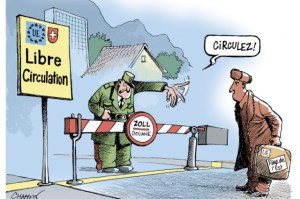
The other day I talked with Turkish colleagues – one mentioned the Ankara Agreement, making emigration easy and apparently gaining a new momentum: the opportunity to make use of a quasi-free movement being taken up by many young, qualified people (that is hat I had been told).

https: //www.swissinfo.ch/image/37930398/3×2/640/426/43d81eaeeb4ba567a36be455ccee7930/Ci/chappatte_immigration-37930404.jpg

It is funny then in the sense that young people from all countries emigrate: Turks to various EU-countries, Hungarians to the UK, Chinese to down under, Italians to Ireland, Irish to Poland, Yanks to China … though leaving it as open question to where they really move at the end … – a question if we do not accept that “somewhere” is the mental state of precarity of different forms is.

Migrants of all countries, you are united!

Though there remains the challenge of developing a truly “portable citizenship”, i.e. to become migrants not only by themselves but also for themselves.

Privatisation through the backdoor


on New Deal For Irish Families, states at the end of his article

Real choices for mothers and their partners requires a social investment state that supports families throughout their life course.

Of course, at first sight it is laudable but then …


Would it not be even more laudable and plausible to establish another reference as the words of Bertrand Russels who suggests in his In Praise of Idleness

that four hours’ work a day should entitle a man to the necessities and elementary comforts of life, and that the rest of his time should be his to use as he might see fit. It is an essential part of any such social system that education should be carried further than it usually is at present, and should aim, in part, at providing tastes which would enable a man to use leisure intelligently.

Indeed,

(l)eisure is essential to civilization, and in former times leisure for the few was only rendered possible by the labors of the many. But their labors were valuable, not because work is good, but because leisure is good. And with modern technique it would be possible to distribute leisure justly without injury to civilization.

https://www.datocms-assets.com/45/1522837592-soldi-alati-2.jpg?ixlib=rb-1.1.0&ch=Width%2CDPR&auto=compress&w=
500&h=500&fit=crop&dpr=1&fm=jpg

Isn’t the rhetoric of “social investment”, seen in connection with targeting choice between family and career, not only wrong by way of reducing social policy on a labour market instrument, but also by way of misguiding the understanding of work? Isn’t it with such social investment perspective also established as private matter through the backdoor? Instead of paying for childcare privately the state (or possibly private public partnerships) ar paid in kind, through the work they do instead. Redistribution of wealth has to go hand in hand with redistribution of  work. Indeed, Nicolas Bueno in his short Introduction to the Human Economy makes a point that is surely interesting enough to overcome the idea of social investment as a social policy. He writes

Once human beings are delivered from being thought of as mere producers of economic value, a part of the time and energy that was before only dedicated to producing goods and services can be used in order to create something else. But what can individuals create with their human potential? Human benefits.


relational processuality and processual relationality

Next then

Elastyczne zatrudnienie: globalny chaos czy nowa równowaga rynku pracy?/

/Flexible employment: a way to a global chaos or to a new model of labour market stability

It is a panel of the 28th Economic Forum, scheduled for the 4th to 6th of September in Krynica.

Looking at the announcement of the participants in the panel I see that

Guests from Russia, Germany, Hungary, Kazakhstan and Poland 

are announced. And that makes me wondering if they forgot me or in which box I am put. Well, I know that I am officially there in my Munich position at the Max Planck Institut for Social Law and Social Policy. Still, I am also “Hungarian”, due to the link with Corvinus University, and “Fin”, being pat of the University of Eastern Finland and …

… and am I joking?

http: //next.myworshiptimes31.com/wp-content/uploads/sites/55/2013/12/safety-net-copy.jpg

In some respect of course, which means that we are facing the reality and thinking remaining captured by four methodological flaws (see the contribution on Value Theory – is there still any value in it? – is it still worthwhile to talk about it?; in:Changing the Socio-Economic Formation: New Labour Relations, New Forms of Accumulation, New understanding of  Intelligence [working title; forthcoming]):

  • methodological individualism
  • methodological nationalism
  • methodological solutionismus as strategy of technicism, going hand in hand with permanent strategies of externalisation and relative downgrading of living standards
  • methodological presentism not least due to the urgency of matters that need to be addressed in the light of the previous point, i.e. methodological solutionism. Paradoxically, this implies that future is suggested to be present. While it enlarges the space for action, it reduces its substance as the latter can only be grasped in the light of the presence. Rüdiger Safranski contends

the enormous depth of interference of techno-social action strengthens its repercussions which are getting manifest only in the future. The manmade share in the future is increasing. Yet the openness of future still exists because the risk event may occur – but it may also not do so. No risk insurance can disperse the worries; worries can even increase indirectly via the increased want for security. … Security drives towards more security simply due to the fact that, getting used to security, one is hypersensitive when it comes to something menacing.

(Safranski, Rüdiger, 2017: Zeit. Was sie mit uns macht und was wir aus ihr machen; Franfurt/M.: Fischer 2017: 79)

However, as much future is integrated into the presence, it limits itself to presentism as factually only the real presence exists as point of reference. This results in linearly defined thinking.

While widely seen as separate issues, they can only be understood as entity of societal realities and their analysis, making us understanding agency, space, matter and time in specific ways and, as practice is also based on the way we are understanding realities, these pillars are also shaping these realities.

Finalising the work on the book “Digitisation and Precarisation – Redefining Work and Redefining Society”, edited together with Vyacheslav Bobkov, I am getting another time aware of the actual tension of problems “running in circles”: debates on globalisation and precarity are very much caught in such vicious circle as long as they cannot overcome those methodological limitations: there is no relational processuality, and equally no processual relationality that commences in one area: one industry, one issue (like globalisation, digitisation, precarisation …) or one locality unless we want to limit ourselves to spotuality: an unchanging world, given once for ever, not able and not destined to move. Indeed, as quoted recently

As long as something is, it is not what it will have been at some time. – Solange etwas ist, ist es nicht, was es einmal gewesen sein wird.

“political crap – well Cook-ed”

Scandals and no end … – still, there are some that deserve special attention. The Apple-tax avoidance policy is one of peculiar interest – for different reasons:
Think about the following:
I.
I pleaded on different occasions –  not least in connection with the data abuse by Facebook – for their socialisation: there seems to be little point in regulating monopolies – while at first glance tempering – it is a  no-go policy to break up monopolies that actually depend in their very functioning on being monopolies. Socialisation, e.g. state control, does not solve the problem but at least it puts it into a different regulatory perspective:
regulating private entities that are too big or securing democratic control over relevant political bodies, that is the question.
II.
Public control, then, is of course an issue that deserves …, not just special attention but a conceptualisation of the public itself that is serious about …, well , its public character. On this topic we read for instance:
public (adj.)
late 14c., “open to general observation,” from Old French public (c. 1300) and directly from Latin publicus “of the people; of the state; done for the state,” also “common, general, public; ordinary, vulgar,” and as a noun, “a commonwealth; public property,” altered (probably by influence of Latin pubes “adult population, adult”) from Old Latin poplicus “pertaining to the people,” from populus “people” (see people (n.)).
In any case, this is quite different from what we learn about the tax system in Europe and Ireland, reading in the mentioned article (my translation);
Instead, first Lienemeyer has to investigate and understand the Irish tax model as it is applied by Apple, that means first and foremost detective work.
Thus, adding value or or piracy-policies, that is another crucial question.
III.
There is the common saying about milking the cow to limits and it is commonly said that the pitcher goes often to the well, but is broken at last.
There is, in economics, so much talk about value chains – suggesting that the enterprise and country in which the enterprise is located gets a “fair share” – said in another way: as many products today – computers, phones, cars, fridges etc. – are produced in various places, with parts from different countries, the overall value of the product will be distributed between the countries, the contribution of each “valued proportionally”. One point to be considered here is that these value chains are, as Benjamin Selwyn points out, in actual fact poverty chains, the Apple-case clearly gives another good reason to question such concept.
Two passages from the said article in the SZ clearly show the contradiction:
At the time, Ireland replied in a letter to Brussels that Apple’s advanced technology, design and the intellectual property are exclusively rooted, developed and managed in the USA, thus making it impossible to attribute it to the Irish enterprises [enterprises  set up by Apple as mediators, solely dealing with sales]
However, a little later we read the following:
In the view of the head of the department at the EU-Commission it is fact that the Irish Apple-branches run their offices solely in Ireland, have their employees only there and are, thus, ordinary Irish companies. “Then the question is: who is generating the profit? A virtual headquarter or an industrial premise with real people working?” says Lienemeyer. As Apple maintains offices in the city of Cork. this is his conclusion, Apples global business is Irish. Consequently all profit has to be taxed in Ireland.
Ireland and Apple react by being shocked. In their understanding the global Apple-tree with its mature fruits always had its roots in California.
Both, Ireland and Apple see this a affront. At the end, the question is here:
eating the apples and rejecting the tree – is that a feasible option?
To be or not to be, that question needs urgently to be replaced: Who is allowed to define what being is – and who is allowed to determine the conditions of existence of others, of majorities?
Cook, Apple’s CEO, once spoke of ‘political crap’ coming from Brussels. Actually he may be not entirely wrong after all. Leaving the tax scandal aside, there are two fundamental issues that remain without consideration:
First, regulating sick and decaying systems, that are not only undermining like cancer the entire body but already replaced completely the entire body, is hardly enough as cure against the body snatchers.
Second, this requires not least to fundamentally overcome methodological nationalism: as long as we still think in competition between regions and nation states, global capitalism will unfold exponentially – paradoxically in niches of arrogant and sexist plutocracies.


Dead Clowns

meaning, relevance, sense – questions people who live are too often compelled to leave them to philosophers …. – like issues of production as reproduction of real life are, on the other hand left to people while economists read in tea-leaves of heroic, even quasi-divine formulas that are distant from peoples’ and people’s life — just remaining meaningless and non-sensual.
Some time ago already – after I gave a presentation at the Symposium organised by the European Academy of Sciece and Arts – looking at
a later presenter was carried way by
Several month later, by accident, I was getting nicely aware of the misleading question of humanoid robots replacing humans, spotting by accident a clip showing
Baseline? There is no real danger of human beings becoming replaced – the danger is that some Kurzweil’ig ‘systems’ are brought forward by those sigularitarian minds in their Plutocratic caves [see Plutocrats: The Rise of the New Global Super-Rich and the Fall of Everyone Else]. The danger is that some powerful forces succeed in reducing us to mindless clowns, caught in Platonian caves – the circle of virtuality emerging as vicious circle, its life depending on he fact that no needle will be used, by nobody.
Mind, all this is not really about  Humanoid toys – it is about comedians and actors like Beppe Grillo in Italian politics, natioal citizens attacking fellow citizens from other countries, narcissistic tyrants rethinking the liberty statue and overlookin the old rebukes
Skerbischs „Lichtschwert“ vor dem Opernhaus Graz
Von Marion Schneider & Christoph Aistleitner – Eigenes Werk, Gemeinfrei, https://commons.wikimedia.org/w/index.php?curid=5016791
And yes, it is also about administer-infantilisation.
Overcoming humankind, if it then happens, won’t be much else then the
(EN)

« My makeup is dry and it clags on my chin
I’m drowning my sorrows in whisky and gin
The lion tamer’s whip doesn’t crack anymore
The lions they won’t fight and the tigers won’t roar »

(IT)

« Il mio trucco si è asciugato e cola sul mio mento
Sto affogando i miei dispiaceri nel whisky e nel gin
Il domatore di leoni non da più colpi di frusta
I leoni non si azzufferanno più tra loro e le tigri non ruggiranno »


Social Networks and Network Effect

Today these are keywords, snatch mechanisms and catch tools – firmly anchored in many lives, seemingly providing a second skin, solidified to an extent that the idea they could disappear one day, even attempts to a controlled use as outlined in the Cor Orans occurs as weird, absurd.
But what harm one may say – looking at the wikipedia-List of social networking websites is somewhat instructive: Many of the early ones had been about people ‘just meeting’ or joining for a specific purpose as ADVOGATO, defining itself as ‘the free software developer’s advocate’. – May then be that we should not worry about these networks, instead look at their use? But then again, isn’t another great hit ‘social capital’, community building, self-orgainsation and solidarity? Sure, terms could and should be twisted and turned, social networking – its structures and use – needs to be controlled. Finally all this is not least about social responsibility – the term nowadays so often discussed with the little extension ‘corporate’- Actually not at all a new topic. Milton Friedman – writing under the title

The Social Responsibility of Business is to Increase its Profits

in The New York Times Magazine, September 13, 1970 contends:

When I hear businessmen speak eloquently about the “social responsibilities of business in a free-enterprise system,” I am reminded of the wonderful line about the Frenchman who discovered at the age of 70 that he had been speaking prose all his life. The businessmen believe that they are defending free en­terprise when they declaim that business is not concerned “merely” with profit but also with promoting desirable “social” ends; that business has a “social conscience” and takes seriously its responsibilities for providing em­ployment, eliminating discrimination, avoid­ing pollution and whatever else may be the catchwords of the contemporary crop of re­formers. In fact they are–or would be if they or anyone else took them seriously–preach­ing pure and unadulterated socialism. Busi­nessmen who talk this way are unwitting pup­pets of the intellectual forces that have been undermining the basis of a free society these past decades.

A bit later this is followed by the statement

In a free-enterprise, private-property sys­tem, a corporate executive is an employee of the owners of the business. He has direct re­sponsibility to his employers. That responsi­bility is to conduct the business in accordance with their desires, which generally will be to make as much money as possible while con­forming to the basic rules of the society, both those embodied in law and those embodied in ethical custom.

Makes sense, doesn’t it? Isn’t it correct that

in his capacity as a corporate executive, the manager is the agent of the individuals who own the corporation or establish the eleemosynary institution, and his primary responsibility is to them.

Indeed, this had been already issued much earlier – namely by Thortstein Veblen who wrote in 1904

The motive of business is pecuniary gain, the method is essentially purchase and sale. The aim and usual outcome is an accumulation of wealth.[.] Men whose aim is not increase of possessions do not go into business, particularly not on an independent footing (Veblen, Thorstein, 1904: Theory of business Enterprise: New York: Charles Scribers: 20)

There is another general point to it: Economics is since David Ricardo obsessed by the idea of comparative advantage – though originally not focusing on individuals, it is of course still based in methodological individualism: individuals act as individuals, do what they are good at, and the aggregate is a ‘supposed social’.

A recent article in the Sueddeutsche Zeitung brought back to my mind that we also have to make sure that we do not forget any of these issues, and any of these Social Networks. The article, published on May, the 20th 2018, 09:51hrs, is titled
Aufsichtsräte. Deutschlands Netz der Macht/Board of Directors. Germany’s Net of Power.
And there are so many scandalous things mentioned … – these directorates: the chairs of the 30 DAX-enterprises get in average 408,000 Euro which seems to be a nice little top-up, commonly adding to incomes that are extremely high anyway. Just Bilderberg – like … ops: Bilderbuch [picture-book]-like incomes – yes ops, yes, there is this Bilderberg-conference, there is a World Economic Forum, there is the Club of Madrid, there is the  Mont Pèlerin Society … – well, in the case of these gatherings we may not have to talk about additional income …, perhaps … – the payment for giving a presentation …, peanuts … when it comes to money we are here talking about dimensions that are negligible – at some some stage, beyond a specific threshold, it is simply getting ridiculous and we should talk about the need of psychological control – of people and societies. Here it is surely about additional power.

Il denaro regola il mondo

Money governs the world

Pecuniam regit mundi

Geld reguleert de wereld

L’argent gouverne le monde

돈이 세상을 지배하다

At stake is, however, … a kind of oxymoron or paradox. There is the simple network effect: they know each other, communicate with each other … – it is a ‘manageable circle’, the borders so tight that even leaks aren’t able to emerge. The problem is of course not that they meet for probably extensively expensive dinners – instead it is about … – ‘corporate social responsibility’, the fact that these are interlaced social networks with a clear goal and strategy:
In fact it is this network effect that secures success, make it even possible. The point here is, however, there contradictory effect. Social networks are getting more powerful as more people are part of it – the simple example is the little joy to have the only telephone in the universe – you have the item but you cannot use it. If at least one other person has a phone, you can talk – getting a bit of joy out of it. If everybody has one, communication may become universal – and in some way communication is power: you are empowered to reach out, to speak, to develop things together with others … – or, of course, also to influence others. However, the networks that are looked at here, depend on their exclusivity: the smaller the group that executes the control over a huge pool of resources, as larger the power, the influence. We may speak of an inverse network effect. — Anything new?
Well, surely one thing: The ’new’ aspect is that we are now not least dealing with ‘controllers’ and ‘directors’ who are not immediately owning the means of production. At the same time, many of the owners – or better to say: the primitive accumulators, are actually in some way disappearing, for instance Gates as well as Soros showing up on the stage of humanitarian help and supposed world liberation respectively.
May we say in this light that, taking the perspective of national origin – possibly the most ’successful’, and equally most dangerous, are Ireland and Italy  – in the first case it is explicitly a U2-showman, claiming the role of a global politician, in the second case an even further step is made: a M5S-comedian, switching on five startling stars to enlighten a country that feels in many respects happy by maintaining the status of a sleeping beauty of a special kind.
— Again though: anything new?
As we know from Matthew 13: 11ff.

He replied, “Because the knowledge of the secrets of the kingdom of heaven has been given to you, but not to them. Whoever has will be given more, and they will have an abundance. Whoever does not have, even what they have will be taken from them. This is why I speak to them in parables:

“Though seeing, they do not see;
though hearing, they do not hear or understand.
In them is fulfilled the prophecy of Isaiah:
“‘You will be ever hearing but never understanding;
you will be ever seeing but never perceiving.
For this people’s heart has become calloused;
they hardly hear with their ears,
and they have closed their eyes.
Otherwise they might see with their eyes,
hear with their ears,
understand with their hearts
and turn, and I would heal them.’

Well, political and enforced self-control obviously included.

Today – an Era?

Contemporariness-Society, it seems that this may a useful term characterising part of today’s Zeitgeist: a society that is exists in the presence, fades out its emergence from history, and fades out its developing character into the future, with this strangely enough counteracting its real self: presence is only happening in the one location, and with this the factual globality is apparently getting lost: only the we/I and the now/here counts.

(https: //irp-cdn.multiscreensite.com/2f1f8bea/dms3rep/multi/tablet/ES-JCR1-1814×1208.jpg)

Not claiming to be based on a systematic study, it is interesting to see that soccer and the EUropean migration question had been heading the weekend journals while the elections in Turkey, a truly historical and existential issue, had been sidelined. As if the Turkish history – past, presence and future – is happening without us and we could happen …, sorry: act without Turkish history. Yesterday democracy faced a major challenge and failed to master it – a victory on paper, qualified by a high price. Today democracy faces new challenges which we have to master

and this challenge does not exist since yesterday – it is about Saviour and sultan, ally and foe – west in a bind over Erdoğan