World Teachers’ Day

The 5th of October, since 1994, the World Teachers’ Day commemorates the anniversary of the signing of the 1966 UNESCO/ILO Recommendation concerning the Status of Teachers. The 1966 Recommendation provides the main reference when it comes to teachers’ rights and responsibilities on a global scale.

 

Worthwhile to remember what Alfred Marshall said in 1890.

The schoolmaster must learn that his main duty is not to impart knowledge, for a few shillings will buy more printed knowledge than a man’s brain can hold. It is to educate character, faculties and activities; so that the children even of those parents who are not thoughtful themselves, may have a better chance of being trained up to become thoughtful parents of the next generation. To this end public money must flow freely. And it must flow freely to provide fresh air and space for wholesome play for the children in all working class quarters. (Marshall, Alfred, 1890: Principles of Economics; MacMillan and Co., London, 1930: 718)

It seems that with the “refeudalisation of society” we face the situation that the positions of the revolutionaries of the olden times, whose authors had been yesterday’s conservatives, are becoming joining on the side of the revolutionaries again. In this light there is also something about the illustration, ensuring to sin – surely not catholic-literally but to accept that pupils and students are partners.

****

Worthwhile a note on the world and China: on September the 10th I received a mail from 张伟, a former student of mine – well, she would say “a student of mine”, skipping the word “former”. She sent her congrats and best wishes for the teachers day. First I was puzzled – did she mix up the date? 2018, the Chinese teachers’ day is on the 10th of September, the world teachers’ day on October 5th, a simple explanation. I checked later on the web and found something that is … – well, I leave it up to you to think about it:

10 September is an official holiday in China. This day the whole country fetes educators and teachers. This holiday, in its different interpretations, has been existed in China as early as the Middle Ages. Teachers and coaches have always been honored and respected in China. Very often teachers acted as mentors throughout the whole life; especially it is true for the traditional Chinese martial arts.

It also says something on the reason of making it a public holiday: the official acknowledgment of teachers – as intellectuals – and their important role in boosting the development of the country. Also

Since the school system in China is based on the Western model, many old traditions in honor of teachers have not been preserved today.

One may have different opinions on this, the political background …, well. But at least it seems to be worthwhile to mention that there is a deed in the one part of the world, and that there are just words, probably widely unspoken, unwritten, unheard, unread … in another part of the world.

****

Worthwhile a personal note:
Only recently, visiting with a friend the Kunsthalle in Munich, I remembered one point of all this, when standing with her in front of one of Emmanuel Maignan’s works, the “Anamorfosi San Francesco di Paola”. A pleasure to experience the amazement of both of us. Though it had not been about a visit with a student, it is very similar anyway: Something of learning together and admitting that it is about the experience of being caught by what one sees – in this case actually being caught by what one does not see: the praying person only visible from two specified angles, the sides. It reminded me of having used Holbein’s equally magnificent  work “Gli Ambasciatori” for showing the same effect: the hiding of something, the fact of leaving something invisible for those who lack the enlightenment – an enlightenment that is emerging from the standpoint, the perspective. Never having seen the original of Holbein’s work, seeing something similar entailed still the experience of being amazed. – What foolish teacher would say s/he knows the one and only perspective. Doesn’t such perspective emerge only from putting together experiences, that may at some stage get stuck, paralyse the experienced if it goes together with closing the eyes, blocking off, not allowing new experiences to be made; and even more: not allowing looking at something “known” through new spectacles and of course forcing looking at the new through the old glasses.

Teachers’ Day – an opportunity to congratulate students, and to thank my students for allowing me to learning together with them.

Avoiding Trivialities

The “Times Higher Education” published recently a piece by Adam Graycar, titled
(see also here).- one of the few occasions that I comment on any articles, briefly making two points:

All right and important. I still would like to add one point, subdivided: (i) generally, doesn’t result-oriented, mostly empirically-oriented (“evidence-based”) research as standard expectation and kind-off methodological ultimate ratio contribute very much to such competitive orientation even before it comes to considerations concerning publication? I suppose such research is more inclined to competition than “fundamental research” (“Grundlagenforschung”). (ii) isn’t already the entire system of (mass)education as PRIMARILY “vocational training like education, driving (future) researchers into the direction of competition-driven instead of knowledge-enhancement driven? – This begins already when looking at the way of dealing with applications by students for courses – see some experience-based views.

The reason for mentioning it here is a short discussion I have had here in Helsinki in connection with a PhD-student. I was wondering that his work is cumulative and also based on/linked to earlier publications, co-authored with others. In Finland, at least it is a possible. I know about “collective/collaborative work” – actually my own diploma thesis in a cooperative manner.
Sure, there are terms and conditions as especially the need to sign and thus confirm that some part is the individual work …
My habilitation can be considered as cumulative. Now, here in the Finnish case it is about cumulative and collective. Shouldn’t that be the norm, also considering that cumulative is not only about the past, but also about “a stepping stone”, part of an ongoing cumulation and growth. Doesn’t the opportunity to co-author a thesis also acknowledge and highlight that any – tiny or large – work is part of a collective effort, actually the strive if humankind for truth? Making such exception of co-authoring cumulative work as thesis could be a tiny to overcoming individualist competition as foundation of academic work, too often resulting in arrogance or failure.
Indeed, Dante expressed it succinctly, reflecting the need to think about social and societal practice:
considerate la vostra semenza: fatti non foste a viver come bruti, ma per seguir virtute e conoscenza.

Actually the plan was a different one …

– it had been early in February, and the plan was to enjoy the ease of a Jazz-concert. But it should not be that way, the venue was cramped when we arrived – trotting along for a while, not knowing what to do … .

‘The Pinakothek, is it still open?’

She asked and I replied I would think so …, until eight. So it gave us about one hour. We entered the Neue Pinakothek …

You enter at the end?

the man from the security service asked.

It does not really matter

I replied when we showed the annual tickets

We can come any time, and we can come often. In this way there is no real beginning, no real end. Coming here is a kind of never ending story.

Walking into the first room I had been asked

Which paintings do like especially?

I went directly to some favourites – favourites this day, this time, this hour …Claude Monet’s La Seine à Argenteuil [1874]; Édouard Manet’s Claude Monet in Argenteuil [1874]. We talked about forms and ways of detachment and engagement – and even detachment as engagement. We talked about the here and there – wasn’t detachment, as understood by the late realists/early impressionists, so very different from the detachment by the Nazareni, we had seen the other day when looking at F.W. von Schadow’s Die Heilige Familie unter dem Portikus.

We moved on – I wanted to point on another difference – that between the Monet/Manet and here now to Liebermann, and Menzel. But again, it should not be that way. – Gotthard Kuehl’s Vor der Schicht [ca 1895/99] caught her attention. After a while, talking, looking for appropriate terms that would make it accrues the language hurdle, I stepped back – we stepped back … .

If you can chose, which one will you take with you?

Asking this question, I pointed on Kuehl’s painting, Liebermann’s Münchner Biergarten [1884] and his Badende Jungen [1898]. But I did not strictly oppose when my friend was cheating a bit, turning around and finally drew me to Fritz von Uhde’s Schwerer Gang [1890].

Such dark, grey painting?

There was not much hesitation

Yes, overall, sad and dark, but because they are together, and … There is a far-flung looking light.

I like it because it’s not sad

Much later, after a chat over a Bavarian Pils, we walked together to the Metro – when we parted, she left me with a thought … – her thought? my thought? or our thought? A thought which is too large for one, even fore two people alone and still has to be dealt with by each of us – alone and in being together. I had been Andre Vltchek’s thought of being Scared, Therefore I am Brave!

When the desire for knowledge becomes truly overwhelming, one simply cannot stop, or slow down. The only way is to go forward, to absorb knowledge, to fight for attaining knowledge, to see the world, to understand, to feel, to listen; passionately and consistently. No fear can deter us, when we are avidly searching for truth. It is so proud, so brave, this desire to know!

When we feel ‘unbearable pity for the suffering of mankind’, when we witness how unjust is the arrangement of this world, when we truly internalize the suffering of others, of our fellow human beings living on all the continents of this beautiful but battered planet, then almost all of us, or at least those who are humanists in their core, become courageous, and brave. They suddenly know what has to be done.

As for ‘the longing for love’, it is there, it is always there, in all of us, in all human beings. To fight for love, when it comes, is brave, and to die for it, if risking all is the only way to save it, is courageous. That ‘longing for love’ is the most humble, most sacred, the most essential part of our nature, so rarely satisfied. It takes courage to love; it takes tremendous, indescribable courage!

I am wondering if there is anything like ‘energising paralysis’ – Mia Eta …. – At least there is now the time to say goodbye, moving on …, and sadly leaving, having lost sight of light since a while in the frictions of different excise – and only seeing glimpses, sparkling and floating for some time, only striving to overcome numerification.

… We can come any time, and we can come often. In this way there is no real beginning, no real end. Coming here is a kind of never ending story … – and this means at the end to stay even if parting. Good Bye, Farewell, See you …- thirteen minutes until the train leaves …

A Year Ahead

Well, a bit strange year coming to an end, after commencing on September the 8th 2017: taking it as “year” extended by some days, shortened by some events standing in the way of “routine work” in the office at the Max Planck Institute for Social Law and Social Policy in the Amalienstrasse 33 in Munich, standing in the way of life and living … – still several lucky events as concerts, visits of museums … or events in which I had been lucky enough to be able to do at least to some extent what I wanted to do — following the commitment of a dwarf

standing on the shoulders of giants, and even walking some distance with them, side by side.

It proved another time for me that the real – and really exciting – tension of working in academia is not so much about fundamental and applied research but between research and taking position in the biased debates of our times – the times of past, presence and future.

The list below provides gives a more or less small insight into what I could achieve, not mentioning the endless disputes with universities about references for former students, peer-reviewing (though being hesitant when it comes to accepting this task) and also not mentioning the frequent chats with colleagues becoming friends and …, well and friends becoming colleagues.

– The latter may deserve some explanation. While academic work seems to be in some way impersonal, strictly bound to rule and while this is to some extent actually true, it is important to acknowledge the most fundmental rule: any knowledge has to be aobut the acknowledgment of reality as ultimate point of reference. And reality is not primarily what we learn from textbooks, statistics, legal and administrative regulations – even economists, usually at least, do not look at figures for the sake of the figures. Instead, it is about how people act and interact …, and omit (inter)acting. Of course, it is about specific observations and observations of the specific. Nevertheless, it is also about gathering different perspectives, not those expressed in interviews but those expressed in life, or we may say in “open dialogue”. Of course, this is first and foremost a very vague approach. And as much as it may end in accidental contacts – easily ending in accidents of misjudgments due to not knowing background and context of the other – it is also something that emerges naturally when engaging with people around – and this is equally a source of possible accidents due to the limited outreach of contacts.

– Supposedly, the Brandhorsts, before buying paintings for their collection (which then became the Brandhorst museum in the Arts Areal in Munich), borrowed the pieces of art, kept them for a few weeks in their home where they received guests – the purpose was to gather loosely for some chitchat, together exploring the paintings and getting different perspectives. The end result: a new opinion, not algorithmitically defined, but by allowing something to emerge from the unexpected, also from the unknown. it is abitu to gather, merging to something, coming together.

Chats on the corridor of the institute, Wednesday’s for lunch in the Old Simpel or somewhere else: the Vietnamese restaurant next door, Limoni across the street, or the Bavarian around the corner, of course … – with so different people – I guess all this had been like I imagine those visits in the Brandhorst’s home, or like visits  to the Arts Areal in Munich, on my own, with others … – always opening the mind …, and asking only to accept one condition: a mind that is sufficiently open to further unfold – the magnificent blood of the orchards needs at least those burgeons that are ready to unravel, the light, seen somewhere in the background …

****

The list of what had been done, though still not all being dusted

Articles/Book Contributions

  • The Comedy of Big Data or: Corporate Social Responsibility Today, while Corporations wither away?, in: Tjaša Štrukelj/Matjaž Mulej/Grażyna O’Sullivan (eds.): Social Responsibility and Corporate Governance: Volume 2, The Tools for Practice; Palgrave (in print)
  • together with Grinin, Leonid E./Ilyin, Ilya V./Korotayev, Andrey V. (eds.), 2017: Global Evolution, Historical Globalistics and Globalization Studies; Lomonosov Moscow State University, Faculty of Global Studies/Russian Academy of Science, Institute of Oriental Studies/The Eurasian Center for Big History and System Forecasting International center for education and social humanity research; Volgograd: Uchitel
  • together with Grinin, Leonid E./Ilyin, Ilya V./Korotayev, Andrey V., 2017: Introduction: From the First Galaxies to the 2040s; in: Grinin, Leonid E./Ilyin, Ilya V./Herrmann, Peter/Korotayev, Andrey V. (eds.), 2017: Global Evolution, Historical Globalistics and Globalization Studies; Lomonosov Moscow State University, Faculty of Global Studies/Russian Academy of Science, Institute of Oriental Studies/The Eurasian Center for Big History and System Forecasting International center for education and social humanity research; Volgograd: Uchitel: 5-8
  • Potentials for Taking a Strategic Role for Sustainable Sociability; in: Grinin, Leonid E./Ilyin, Ilya V./Herrmann, Peter/Korotayev, Andrey V. (eds.), 2017: Global Evolution, Historical Globalistics and Globalization Studies; Lomonosov Moscow State University, Faculty of Global Studies/Russian Academy of Science, Institute of Oriental Studies/The Eurasian Center for Big History and System Forecasting International center for education and social humanity research; Volgograd: Uchitel: 349-364
  • Csoba J., Herrmann P. “Losers, good guys, cool kids” the everyday lives of early school leavers. Monitoring of Public Opinion : Economic and Social Changes. 2017. No 6. P. 276—293. DOI: 10.14515/monitoring.2017.6.15
  • Erinnerung an Paul Boccara; in: Sozialismus. Monatlich Hintergründe, Analysen und Kommentare; Heft Nr. 1 | Januar 2018 | 45. Jahrgang | Heft Nr. 425: 64
  • Art, recherché, création et politique; À la mémoire de Paul Boccara; in : Economie & Politique ; Novembre/Décembre 2017 ; no 760/761: 30
  • Nationale Entwicklungen im Bereich Sozialer Sicherheit und des Sozialschutzes in Irland. 2017-18 – Jahresbericht
  • For Him Art, Research, Creation and Politics Were the Same Thing—In Memory of Paul Boccara; in: CASS: World Review of Political Economy (WRPE)
  • Precarity – it isn’t employment, it is the economy, stupid; in: ”Living standards of the population in the regions of Russia”; Moscow, forthcoming
  • Precarity – it isn’t employment, it is the economy, stupid – extended version of article mentioned before; forthcoming
  • (together withN.Bobkov/I.B. Kolmakov/E.V. Odintsov): Двухкритериальная модель социальной структуры российского общества по доходам и жилищной обеспеченности/Two-Criterion Model of the Social Structure of Russian Society by Income and Housing Security; in: Экономика региона/”Economy of region” (http://www.uiec.ru/zhurnal_yekonomika_regiona/o_zhurnale/); in print
  • About You – Bei Strafe des Frageverbots, ob man überhaupt ist; erscheint in Tarantel. Zeitschrift der Ökologische Plattform bei DER LINKEN
  • Preparatory work for The Development of the Concept of Universal Human Rights: A Critical Perspective; In: International Human Rights, Social Policy and Global Welfare: Critical Perspectives; eds.: Féilim Ó hAdmaill/ Gerard McCann; Policy Press, forthcoming
  • A foglalkoztatás precarity – A tőke felhalmozódásának előfeltétele – A társadalomtudomány szenvedélyessége; in: METSZETEK. Társadalomtudományi folyóirat; Debrecen: Debreceni Egyetem Politikatudományi és Szociológiai Intézet

Books

  • Changing the Socio-Economic Formation: New Labour Relations, New Forms of Accumulation, New understanding of Intelligence
    • Changing the Socio-Economic Formation: New Labour Relations, New Forms of Accumulation, Artificial Intelligence and Sharing Economy
    • Value Theory – is there still any value in it? – is it still worthwhile to talk about it?
    • Migration between value and poverty chains
  • with Vyacheslav Bobkov: Digitisation and Precarisation – Redefining Work and Redefining Society (with Contributions from Australia, Czech Republic, Hungary, Ireland, Russia; Springer
    • Own Contributions:
      * together with Vyacheslav Bobkov: Foreword: Digitisation and Precarisation – Redefining Work and Redefining Society
    • Economy of Difference and Social Differentiation. Precarity – searching for a new interpretative paradigm
  • Preparatory work, together with Laurinkari, Juhani/Unger, Felix: Documentation of the Symposium of the European Academy of Science and Arts and the Pellervo Society, Helsinki: Digitisation, Artificial Intelligence and Stultification of Society; also contribution: Digitisation – Employment – and What?

Reviews:

  • Digitalization, immigration and the welfare state, by Mårten Blix, Cheltenham, UK & Northampton, MA, USA, Edward Elgar Publishing, 2017, 186 pp., ISBN 978 1 78643 294 0 (hardback) – European Journal of Social Work; 2018; https://doi.org/10.1080/13691457.2018.1434267
  • D’Aprile, Dorothee/Baur Barbara/Kadritzke, Niels (Red.): Chinas Aufstieg. Mit Kapital, Kontrolle und Konfuzius; Berlin: taz Verlags- und Vertriebsgenossenschaf; Edition Le Monde Diplomatique 23/2018; in: im Erscheinen in kritisch-lesen.de
  • Greve, Bent: Technology and the Future of Work. The Impact on Labour Markets and Welfare States; Cheltenham/Northhampton: Edward Edgar, 2017; ISBN: 9781786434289

Others:

see for some:

________

  • Phanresia, volume IV, in progress
  • Commencing Phanresia I-III audio-access, in progress
  • Commedia Della Vita or Pánta Rêi’s Firm Ground – blog entries, trying to inspire thinking – ongoing, usually twice per week

****

Well, the suitcases are packed … – off tomorrow with some hand-luggage, collecting the large bags on Friday …

Now, time to say good-bye – as done so often before,       and          again               and       again

and              even much later too.

****

There are two things to remember – and I am still grateful to the people teaching me: I will continue being scared; and I will continue even if, or probably better: because there is a light; and I am grateful for to the person that asked me many questions, allowing me to learn about the value of my freedom; and to those who stayed with me while disappearing

– Thank you – 고마워요! – 谢谢 – Köszönöm – Merci – Danke

How serious(ly stupid) they are

… or: the de-academisation of academia.
The other day I received a mail – one of many of this kind, though this time I have had a closer look as it had been addressed to
Dear Xiaoming,
with
Greetings from Journal of Accounting and Marketing!!
Bit strange – though I get admittedly occasionally mixed up with names of my Chinese colleagues, Xiaoming did not ring a bell at all. Also admittedly I (= Peter) published recently something on accounting, I was a bit surprised as my take on accounting is not necessarily that which suits the mainstream. Anyway, I was reading on. The usual rubbish and spam. Noting about three different URLs is surely not a matter suitable for establishing trust. The fact that the URL fur submissions is a hidden behind the term MARKETING is surely not suggesting that all this is about serious academic stuff. Also their reference to something that I supposedly wrote, read by them with great interest and appreciation …
Well, Mrs. Nancy Lisa, Managing Editor, Journal of Accounting & Marketing … E-mail: accounting@journalinsights.org – you surely deserve more and other than a personal reply, marking your stupidity. You would even deserve more than a blog-post …. (though you may read this also with great interest and appreciation … – One day you may even have to read your-journals …
******
… and still there is a big
As bad as such publishing spammers are, there is another dimension to all this: the de-academisation of academia. Another example, side by side with others mentioned  earlier, we may also look at
about whom The Economist reported a while back. There is an interesting detail that deserves attention:
… one study found that for every dollar spent to comply with government rules, voluntary spending on bureaucracy totalled $2 at public universities and $3 at private ones. Robert Martin of Centre College in Kentucky, a co-author of the study, says the real reason for the growth in spending is that administrators want to hire subordinates, thereby boosting their own authority and often pay, rather than faculty, over whom they have less power. Bureaucrats outnumber faculty 2:1 at public universities and 2.5:1 at private colleges, double the ratio in the 1970s.
Should we be surprised to see that
[o]ne result of all this is growing “resistance, anger, grumpiness, and eventually backlash” to the proliferation of diversity officials.
Well, in this light Nancy is probably just a poor person, not willing and not able to see that she is actually a cogwheel of a machinery that is not much else then a mafia of today’s time. – … scrupulous … stultification!

differences

John, we met on occasion of a couple of conferences, frequently said:

I always see you sitting with you work in the hotel lounge or in the reception area.

And indeed, for many parts of my work I like an inspiring atmosphere as I can find it in hotel lounges or …

…, yes in some cases it is a privilege, being able to sit in a spot like this
It had been a year ago, near Amsterdam, children playing nearby did not really disturb me – more the other way round: I found it even motivating as it is a bit like having the “dedication of my work” directly as motivation and appeal around:
this work is dedicated to the future generations, aiming on contributing to a society that is worth living in
Such privilege can easily reverse – an adult abruptly dragging one of the kids at the arm, shouting at him
Just leave here, don’t play while we are sitting here.
 – I felt paralyzed, I had to leave soon after this “incidence”. Because of this old fellow’s misbehavior towards the children, but also as I felt disturbed by the permanently incoming beep-sound of incoming messages and swoosh-sound of outgoing messages on his phone.
Two days later, I went there again – I urgently needed a place that provides quietness and inspiration. I was a bit …, no, I was not really surprised that nobody calls the group of adults to order: about fifteen to twenty people, sitting in one of the corners, chatting and laughing loudly, cheering at each other with the beer and wine glasses, and walking around – each of them wanted to take a photo – about about fifteen to twenty people wanted to have more or less the same photo.
I left, feeling guilty that I did not make the point there, both days – the point of difference and sameness. And I left with the confirmation of the position of a lecturer and researcher: there is no such thing as value freedom, the place, any lecturer and researcher has to look for, is the place of the future, not a future ’that happens’ but a future that we have to develop. – Well, the value-judgement dispute should never be reduced on an abstract issue of academics disputing in an ivory tower.

Samir Amin

Samir Amin (Arabic: سمير أمين‎) was an Egyptian-French Marxian economist – he passed away on the August 12th, 2018.

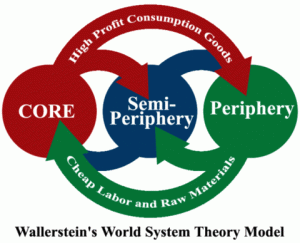
(from: https://medium.com/@kendallgrace15/periphery-role-in-the-world-systems-theory-fa5d291cac55)
I am surly not any kind of the 5th of what Immanuel Wallerstein sees in his comment 479 as a gang of four (Samir Amin, Andre Gunder Frank, Giovanni Arrighi, Immanuel Wallerstein, , himself . I have had some connection to one of the gang: Andre Gunder. Though it had been about the work of (one of his last?) publication(s), it emerged as the germ of a friendship. Reason enough, to feel close to the “family” – actually the wok of all of them very interesting and inspiring in my recent work.
Reason enough to link to the mourning … – in solidarity across borders.

a(nother) sad day, a(nother) sad policy development, a(nother) sad country


I received a mail from, Zsuzsa, a good friend of mine – she sent it also to others; Adrian and John, also fiends of mine, circulated it via some mailing lists – and I want to do my part in distributing this news, hoping also to contribute to mobilisiation of as many as possible. Thank you for standing together, the only way to overcome. — While sitting here, writing …, no, I will not cry; and I will not answer in the biblical way of Exodus 22-25

22 “If people are fighting and hit a pregnant woman and she gives birth prematurely[e] but there is no serious injury, the offender must be fined whatever the woman’s husband demands and the court allows. 23 But if there is serious injury, you are to take life for life,24 eye for eye, tooth for tooth, hand for hand, foot for foot, 25 burn for burn, wound for wound, bruise for bruise.

But I will make use of the energy, that comes from the confrontation with evil …

Here now

Zsuzsa’s mail

Yesterday [=August 8th; p.h.) (full vacation time, nobody at the universities) the government sent a government decree to all universities. There  was no previous consultation or discussion. The decree forbids the teaching of GENDER STUDIES.  Almost all universities have some such subjects, CEU and ELTE Masters degree studies. The decree allows those already enrolled to finish their degree, but nothing else. Despite the exceptionally hot weather there are already many signs of indignation and outcry, and some started to organise conferences or petitions. Civil associations will send open letters, etc.

Do you see any way foreign organisations – including SPA, BSA –  could join us? Maybe open letters to  our government? And how should it run?

Dear Prime Minister , or

To Prime Minister of Hungary, Mr. Viktor Orbán!

We have been informed by…? that a government decree enacted  without previous consultation with the interested parties have been sent out ordering the closure of the teaching of gender studies. (We understand that those already enrolled at MS courses may finish their degree but no new courses are allowed.)

Our understanding of the legal and real autonomy of higher education excludes such measures. However, even if it may be legal according to Hungarian legislation, it seems to us a major attack on social science. Gender studies form since … an integral part of …etc.

(If somebody  has official contacts with Hungarian teachers of gender studies, this may be mentioned.,)

We ask (?) the Hungarian government to withdraw the decree in order to…

….

Please, help with the letter, with possible forms of support, with whatever you think.

I have to add that 2-3 years ago they already prohibited the courses of anthropology and andrapedagogy, but then noise was not loud enough. (The original Law of higher education made it the right and duty of Univ Senates to found  or close faculties, degrees etc., but this was altered too, in 2015. Hence the current step is “legal”.)

sad greetings from a self-revelating  dictatorship,

Zsuzsa

Adrian’s mail, sent via mailing lists, accompanying Zsuzsa’s lines

I have just received this email from Zsuzsa Ferge whom I have known and admired for nearly 50 years. The first professor of social policy in Hungary, she has made a major contribution to the social sciences, and especially social policy and sociology. Recently there have been increasing attacks on the universities, reducing their powers and that of the Hungarian Academy of Science ( Zsuzsa was made the first social policy member some 15 years ago). This is the latest development.

I have a very poor record in getting my own government to change decisions, let alone another one. But it does seem to me important to show that there is wide concern at developments such as this one. I do not know whether many individual letters or group ones will have more impact – both probably.

Best wishes, yours, Adrian

Finally John’s mail

Thanks, Caroline. The BSA and European sociological networks have it in hand already. But as it hasn’t reached me via ESPAnet or the European social policy jiscmail, I’ve added them here and would encourage maximum further dissemination to all the networks we are linked with in whatever subjects even at the risk of overlap and duplication.

John

*******

Still, I may add one point – I discussed it actually frequently with John, with Zsuzsa and so many others: It is not just about Orban and Hungary, as little as the discussion about Turkey is about Erdogan and Turkey, as little as Italy is a just one single case, as much as “we are all Greek” – we are all …, if we are ready to be!

Vermeers “Woman in Blue” and the challenge to counter global hegemony of “stakeholder-democracy”

Of course, this “Davos of the East” as it is sometimes called,, and which I mentioned previously, is a special challenge as it is about an invitation to accept the rules of the hegemon, while it is for me the obligation to maintain the role of the anti-hegemeon while knowing that there is always the one option: being seen as fig-leaf or, and this is the serious problem, being absorbed: the anti-hegemonic position being reinterpreted and smoothly welded into the existing interpretation of things. – Dialectic of change one may say; there is no way to succeed but one has to try nevertheless and endlessly like Sisifo.

Part of the dialectic is of course to be in one way or another part of a group that is in line with widespread claims of a

representation of a post-nation state governance system

referring to Katerina Gladkova who is analysing Two years into the SDGs, asking if it is about neoliberalised development? What she says with respect of the SDG-strategy, finds its valid application in many of these “new institutions” – they are another

window-dressing exercise in democracy. The multistakeholder model dilutes boundaries of accountability and is not representative of the needs of the many; on the contrary, it serves the interests of the privileged minority advocating for the neoliberal world order.

******

I became aware of the task in an entirely unexpected context, namely when looking – together with Angela Maria Opel, as part of the guided tour “Love letters in the Painting of The Netherlands” – at Vermeer’s Women in Blue Reading a Letter, currently hosted in the Alte Pinakothek in Munich. A seemingly harm-, possibly meaningless painting of which the value is at first glance its beauty – and as well all know beauty is always contestable. And equally any interpretation of one painting is questionable because painters are children of their time and a single painting is only a piece of the jigsaw, composed by painter and time. The contemporary trinity of Dutch paintings can be seen in map, letter and necklace, frequently appearing not only in Vanmeer’s work. It is the trinity of the young and independent republic, the temptation by the glamorous jewellery, representing the ancient regime – and the dispute over it, now, as the weapons had been laid down. As such , reading the letter may have been not least a matter of political commitment, a question of resisting the temptations of short-sighted glamour and persisting in moving forward towards the new republic which represented at the very same time a new economic formation. Seen in this light, the review of the painting can also be seen as reflection of the close connection between the political and the personal: the urgency of reading, pushing aside the obvious temptation by vanity, the longing for true love standing against the superficial glamour, and this means also the possibility of rejection, the dispute about love going beyond the visible glamour – indeed, the rejection of such letter as depicted by Gerard ter Borch; indeed, not every gallant soldier had been a welcomed soldier.

On the other hand, the light, so typical for Vermeer, can be in some way as competent for the glamour of the pearls: the glamour of the outreaching trade of the new republic … – sending the loved one away for the explorations or receiving the news from abroad? – it had been the tension also of Gabriël Metsu, positioning the Man Writing a Letter and the Woman Reading a Letter side by side, all at a time when Claude Lorrain was painting the variations of the seaport (yes, I had been teaching on tis, in Budapest [economic thinking in six paintings])

An interesting detail may be that Vermeer actually used “real blue”, extracted from lapis lazuli – something for instance van Rijn could not afford /// …. . In other words, Vanmeer represented very much the upper class, most likely the new hegemons. This thought may be extended – the blue of the woman’s garment finds its continuation ih the cooer of the wall in front of her, where it still continues as shadow. As such it continues as well from the map – on may suggest that it is marking the seafarers nation, and it finds finally its strange settlement in the chair, covered with a material with of darker blue, kept tight with golden nubs. – Thus we would have the perfect tension: while the weapons are silent, the soldiers trying their fate in a peaceful “mission with their gallantries”, representing the old regime as much as the regime’s attempt to convince by jewelry and words, the new economic power provides a firm and guided resting point. The old and the new hegemons standing against each other, courting her, The Netherlands.

Sure, such interpretation is not least a matter of speculation, or turned positively: a matter of inspiration and reflection – the reflex of time and times, space and spaces.

******

– With this we return to the beginning, though we are not talking about any new republic, we surely talk about some far reaching changes. Understanding them, and understanding them in their deeper meaning we have to go beyond the reflection of extended stocktaking. Robert Cox actually outlined the challenge, writing about two different kinds of theory:

Beginning with its problematic, theory can serve two distinct purposes. One is a simple, direct response: to be a guide to help solve the problems posed within the terms of the particular perspective which was the point of departure. The other is more reflective upon the process of theorising itself: to become clearly aware of the perspective which gives rise to theorising, and its relation to other perspectives (to achieve a perspective on perspectives); and to open up the possibility of choosing a different valid perspective from which the problematic becomes one of creating an alternative world. Each of these purposes gives rise to a different kind of theory.

The first purpose gives rise to problem-solving theory. It takes the world as it finds it, with the prevailing social and power relationships and the institutions into which they are organised, as the given framework for action. …

The second purpose leads to critical theory. It is critical in the sense that it stands apart from the prevailing order of the world and asks how that order came about. Critical theory, unlike problem-solving theory, does not take institutions and social and power relations for granted but calls them into question by concerning itself with their origins and how and whether they might be in the process of changing.[1]

Indeed, then contributing to the debate on new technologies, unemployment and precarity, will be not least a matter of refraining from using those terms. It is more a matter of looking at the underlying overall goals and the framing contexts, the why behind the what. It is, in other words, about rejecting the mainstream principle, by Richard and Daniel Susskind[2]seen in the fact that professionals

are inclined to ask themselves what it is that they do today … and how they might make that service a bit quicker, cheaper, or better. Not often enough do professionals ask themselves the more fundamental question …” (37 f.)

which they understand as matter of defining the overall purpose of any undertaking we investigate. May be, being asked to talk about growth and security of employment, I should make socks statements that the need for growth is the real Sisyphos’ pain and security of employment a promised glamour of an ancient regime, similar to the jewelry that had been positioned as decoy against the new republic which may finally become at some stage a res publica, not worrying about privacy of data but about wrongly claimed publicness of GAFA.

******************

[1]           Cox, Robert W., 1981: Social Forces, States and World Orders: Beyond International Relations Theory; in: Millennium – Journal of International Studies; 10/2; 126-155; here: 128; DOI: 10.1177/03058298810100020501

[2]           Susskind, Richard and Daniel, 2015: The Future of the Professions. How technology will transform the work of human experts; Oxford University Press

… revisiting tea leave readings …

Some time ago some musings had been published in this blog under the tile

science – new readings from the tea leaves

[www . freeastrology123.com/wp-content/uploads/2014/03/tealeafreading1.jpg]

Without any doubt, one gets easily caught, i.e. we all make easily some mistakes, follow simplifications and do so even without being aware of it; moreover: even circumspectly proceeding in our activities, we may end in some trap. Still, especially such general awareness should encourage being [self-] critical and it should also push our attention towards the roots.

This is important as such developments occur as a somewhat new methodological imperative – I talked about it during the third IsarKanalLecture, titled ‘Digitisation – Meta-Methodological Reflections‘. There I positioned besides methodological individualism and methodological nationalism the

Methodological Solutionismus as Strategy of Technizism, going hand in hand with permanent strategies of externalisation and relative downgrading of living standards.

Of course, there are two ways of looking at it:

  • the one is part of the wider process of infantilisation, seeing it as part of a phase that will soon get in a mature form on its feet, being well able to firmly walk and stand
  • we may call the other part of denialism – suggesting that such deviations are part of cultural and intellectual development – usually phases that are as short-lived as they are noisy for that period of time.

Sure, there is always some truth in the so-called country sayings – making weather predictions possible that are definitely correct – correct in 100 % of the cases. However, every country-person, doing some farming, knows that at some stage this is not enough, well formulated in the 11th thesis on Feuerbach,

The philosophers have only interpreted the world, in various ways; the point is to change it

here adapted:

Every farmer will make some jokes while being at the cook-and-bull-story but will get serious when walking out on the field to get the work done.

Getting serious means at least the following – keep in mind that it is also some metaphorical talk:

  • It is about dealing with contradictions here and now, not even thinking about the beautiful world of harmony where everything’s and everybody’s wings are clipped, ready to be stored away
  • It is about the deep world, ‘measured’ by deep exploration – or as neighbour Andy, when I lived in Ireland, said: ‘All these measurements telling me about the chemical composition of the soil are grand – and still, I have to get the Wellies on, walk across the field and take a deep breath to know what exactly I have to do – in academia it is about reading books, engaging with complicate stuff instead of holding one of these fancy books in the hands, where looking at the title tells the entire content … – mushrooming, filling book stores, cash registers and too often emptying brains
  • it is about reduction of complexity not by way of simplification through wing-cutting but by exploring the path of El Cóndor Pasa – that means it is about actors and contradictions in daily life. Taking time to be solved while there is no time for any delay.

This [way of] presentation may also help to approach two rather fundamental flaws we witness in two disciplines – academic issues but relevant as it is not least by this thinking that we are disciplied in our daily life.

I.

Positive law and its extension into procedural law is always challenged by its own tendency to push aside questions that are concerned with right[eousness]. One point for the exploration is the thought that Gustav Radbruch formulated in his short ‘Fünf Minuten Rechtsphilosophie‘ in the following words:

Es gibt also Rechtsgrundsätze, die stärker sind als jede rechtliche Satzung, so daß ein Gesetz, das ihnen widerspricht, der Geltung bar ist. Man nennt diese Grundsätze das Naturrecht oder das Vernunftrecht. Gewiß sind sie im Einzelnen von manchem Zweifel umgeben, aber die Arbeit der Jahr- hunderte hat doch einen festen Bestand herausgearbeitet, und in den soge- nannten Erklärungen der Menschen- und Bürgerrechte mit so weitreichen- der Übereinstimmung gesammelt, daß in Hinsicht auf manche von ihnen nur noch gewollte Skepsis den Zweifel aufrechterhalten kann.

In translation:

There are therefore legal principles which are stronger than any legal statute, so that a law which contradicts them is not applicable. These principles are called natural law or the right to reason. Certainly they are surrounded by many doubts in detail, but the work of the centuries has worked out a solid existence, and in the so-called declarations of human and civil rights with such far-reaching agreement that in regard to some of them only deliberate scepticism can maintain the doubt.

II.

The other mechanism of disciplining is about economics: positive economics, equally focusing on procedural aspects, in this case dealing with exchange processes is caught in a similar vein, unable to deal with contradictions, – correctly, though not rightly – presuming equal exchange as core of the entire process determining value. However, here we are concerned with valuation – an individual issue: Everybody is allowed to highly value a palace and then pay for it – just a matter of personal choice, complementing the fact, pronouncedly highlighted by Anatole Frane:

La majestueuse égalité des lois, qui interdit au riche comme au pauvre de coucher sous les ponts, de mendier dans les rues et de voler du pain.

In its majestic equality, the law forbids rich and poor alike to sleep under bridges, beg in the streets and steal loaves of bread.

Individualisation, the reduction of a complex and contradictory social relationalities to individual, isolated acts, performed by isolated individuals that relate to each other only by way of individual contracts is the ultimate way to avoid talking about value as it is produced, defined as social value due to the fact that the process of production is itself by and large a social process, its market-defiition only ex-post used as tool for the calculation of what had been defined a long time earlier.

There is a lot of fight in a seemingly simple flight.