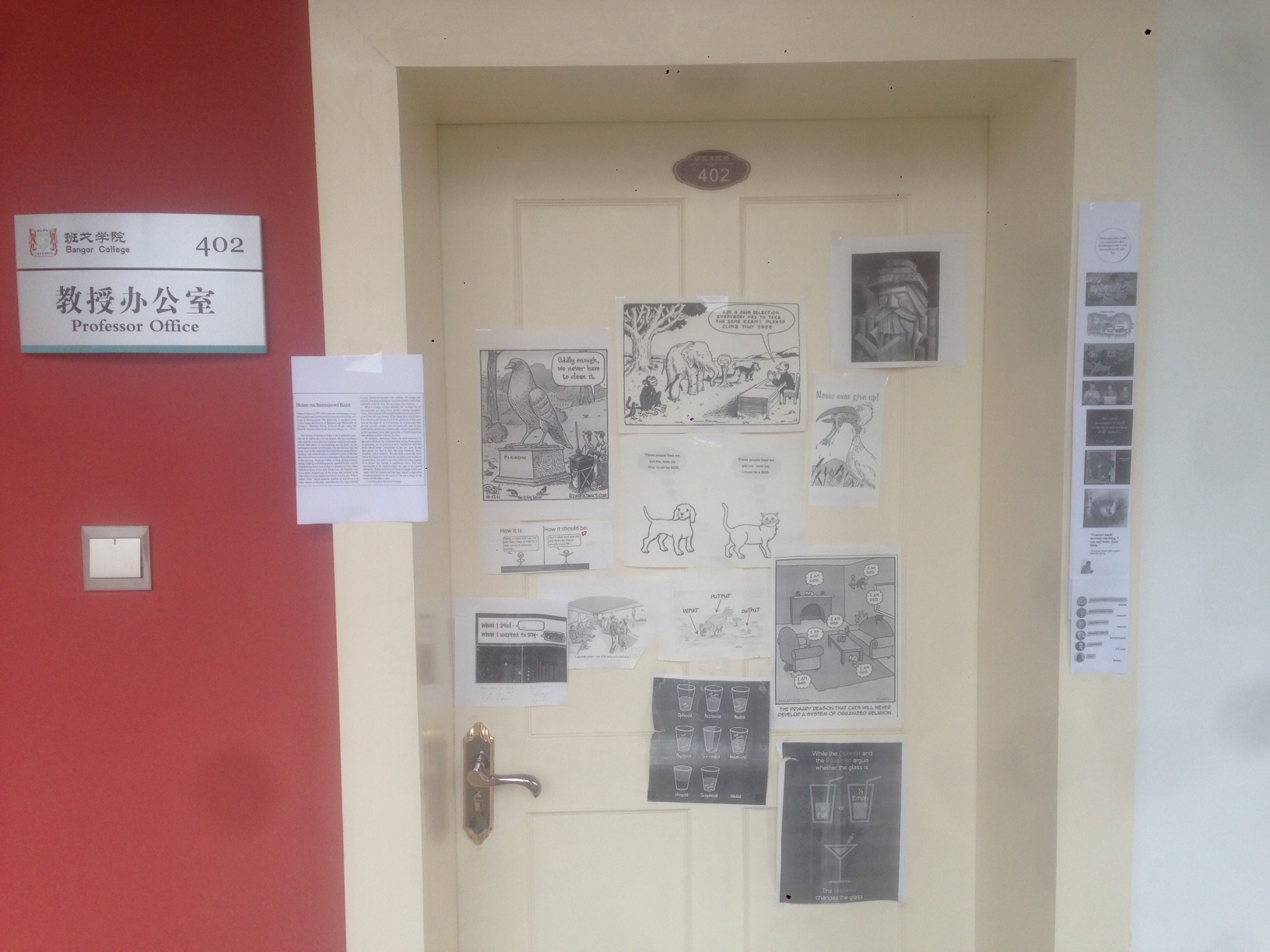
sorry, I wrote what I meant …

… although it is most likely that it will go unnoticed.

In a 2017 discussion paper from the McKinsey Global Institute, posing the question

Where will Latin America’s growth come from?

we can read on page 15

… shifting from an abundance mindset to a productivity mindset.

The hegemony of competitive market economies, grounded in and aiming on eternal growth as source of wealth is far reaching – and part of the mindset is: scarcity is nearly everywhere and abundance is actually a negative occurrence – widespread in the pattern that is crucial for these economies: we have to create scarcity if it is does not exist anyway. And we do so not least by social distinction [or should we say maintaining class divides and exclusion?], by ruthless exploitation of the environment and by simply maintaining the unsustainable Growth-of-Developed-Product[ion] ideology. Thus, the proposal in the report suggests:

Latin American countries need to make the most of their rich resources by extracting them, selling them, and using them more efficiently. [ibid.]

Admittedly there are some valid points made about lack of efficiency and the environmental problems within those economies. But if and to which extent commodity-production-oriented extractivism is the solution may be questioned.

And it should also make us thinking if there is something fundamentally wrong if

[o]verall, macroeconomic fundamentals in the region have been strong, with low inflation and low volatility in exchange rates and interest rates. Public debt levels have fallen slightly over the past 15 years. [22]

– the latter remarkable as it has to be seen against the enormous pressure from many uncivilised attacks from the so-called developed countries – protectionism is not protectionist if used by certain countries …

Well, abundance is bad … ??? – Well, perhaps it really is, namely if it based in the permanent and extended production of superfluous products, if it is a matter of Growth-of-Developed-Product[ion]-ideology

… to the point …

Well, you may say I am burning in the Heraclitean Fire, carried away and not doing what the academic world-order asks me to do – moving on with the metaphor, one may add: this little bit of disobedience is like playing with fire, a dangerous not to say: life threatening game.

So to the point, reading Erwin Chargaff’s

Heraclitean Fire: Sketches from a Life Before Nature.

He refers on page 171 to another work by himself**, which he wrote earlier and where he contended:

The fashion of our times favors dogmas. Since a dogma is something that everybody is expected to accept, this has led to the incredible monotony of our journals. Very often it is sufficient for me to read the title of a paper in order to reconstruct its summary and even some of the graphs. Most of these papers are very competent; they use the same techniques and arrive at the same results. This is then called the confirmation of a scientific fact. Every few years the techniques change; and then everybody will use the new techniques and confirm a new set of facts. This is called the progress of science. Whatever originality there may be must be hidden in the crevices of an all-embracing conventional makeshift: a huge kitchen midden in which the successive layers of scientific habitation will be dated easily through the various apparatuses and devices and tricks, and even more through the several concepts and terms and slogans, that were fashionable at a given moment.

Chargaff’s book had been published in 1978, he was, as widely known, professor in biochemistry, he emigrated from fascist Germany … – and one may ask if it is purely by accident that with this background already

[a]s early as 1949, this eminent scientist described certain irregularities in the composition of DNA and formulated the concept of ‘complementarity’ – later referred to as ‘Chrgaff’s rule’ and still later as ‘base pairing’ – which was the most important single piece of evidence for the double-helical structure of DNA’ [from the book-cover blurb].

‘Back to the fire’ – what he states, looking at methods, can cum grains salis also said for today and social science: where ‘methodology’ chapters in theses too often present methods, not showing any awareness of the difference between method and methodology, where publications and universities and people are ranked on the basis of algorithms and where entities are cut into pieces, making us forget the following:

The insufficiency of all biological experimentation, when confronted with the vastness of life, is often considered to be redeemed by recourse to a firm methodology. But definite procedures presuppose highly limited objects; and the supremacy of “method” has led to what could be called by an excellent neo-German term the Kleinkariertheit (piddling pedantry) of much present-day biological research. The availability of a large number of established methods serves, in fact, in modern science often as a surrogate of thought. Many researchers now apply methods whose rationale they do not understand. [170]

*****

End of term, and of the academic year – students, sometimes inviting lecturers, celebrating; preparing for holidays, but also asking for references, preparing the next career moves.

I have to admit, I am am happy that some say they did not ‘invite me to their celebration’ but invited me ‘to celebrate with them’; and I also have to admit that it is an honour to be seen by some as 老师, as lǎoshī – a bit like the hojam as we use it at ODTU in Ankara.

An unwritten chapter for the

Diary from a Journey into another World: Diaries against nationalism, inspired by trying to overcome personal resentments

to be closed.

======

** Chargaff, E. 1965. On Some of the Biological Consequences of Base-pairing in the Nucleic Acids. In: M.D. Anderson (Ed.), Developmentn.l and Metabolic Control Mechanisms and Neoplasw. Baltimore: Williams and Wilkins, p. 19.


preparing … – slowly but surely

As the time here is coming to an end, and as there will be many things just before leaving – a conference on education, a skype-participation in an event that is linked to the G20-summit, a ‘larger birthday party’ – not only Smith in Beijing [see also here], but also the Royal House in ChangSha – I started already grabbing things together, this way hoping to reduce end-of-time hectic. Part is the ‘selection’, the question: what to take with me, what to leave here, not least about the little presents and memorabiles …, little souvenirs, presents as the figurines Jenny nearly dedicated to me, from Antoine de Saint-Exupéry’s The Little Prince, Jiaying’s handwritten [or does one say hand-calligraphyied] poem: a copy of the ancient piece.


Well, looking at the translation I have[1], reading the last lines, I am wondering, I am wondering if it had been written for me, written for these days:

Younger than they, I have my hair all turned gray.

Life is but like a passing dream,

I’d drink to the moon which once saw them on the stream.

There is also a box with photos – Gerhard gave it to me as present, when we once met during the last years, on one occasion, when I had to visit Europe. Another poem, on the lid of the box, reading it I hesitate:

Tidying up

Here some letters, manuscripts,

mostly fragments, photographies –

but who can, after I left,

name the persons?

(Hans Bender)

Some other ‘souvenirs’ – immaterial, though very real as the seeming eternal replay of the Trials and Tribulations: memories, thoughts, fears, hopes, disappointments and appointments –  – a few answers and many questions …, the replay, lacking the reply …

and you can, after I left,

and you have to find the answers!!

=====

[1]

“The Charms of Niannu”

Su Shi

The great river eastward flows, with its waves are gone all those gallant heroes of bygone years.

West of the ancient fortress appears the Red Cliff.

Here General Zhou won his early fame when the Three Kingdoms were all aflame.

Jagged rocks tower in the air, swashing waves beat on the shore, rolling up a thousand heaps of snow.

To match the hills and the river so fair,

How many heroes brave of yore made a great show!

I fancy General Zhou at the height of his success, with a plume fan in hand,

In a silk hood, so brave and bright, laughing and jesting with his bride so fair,

While enemy ships were destroyed as planned like shadowy castles in the air.

Should their souls revisit this land, sentimental, his wife would laugh to say,

Younger than they, I have my hair all turned gray.

Life is but like a passing dream,

I’d drink to the moon which once saw them on the stream.

knowledge, education, digitalisation, information …

… or what is all this about?

Just stumbling upon the two more or less recent publications:

Peter   Herrmann,   Fan   Hong, and Remi Rzepka: Education in an International Setting. In Leonid E. Grinin, Ilya V. Ilyin, Peter Herrmann,   and   Andrey   V.   Korotayev   (eds.), Globalistics and Globalization Studies: Global Transformations and Global Future: 76-92. Volgograd: ‘Uchitel’ Publishing House, 2016

In this volume there is also a co-authored introduction:

Leonid Grinin, Ilya Ilyin, Peter Herrmann, and Andrey Korotayev: Introduction. How Global Can Be Global Future? In Leonid E. Grinin, Ilya V. Ilyin, Peter Herrmann,   and   Andrey   V.   Korotayev   (eds.), Globalistics and Globalization Studies: Global Transformations and Global Future. Volgograd: ‘Uchitel’ Publishing House, 2016: 5–9

Для дополнительной информации

….

Working now a bit more on this topic, also for the conference

Education and Globalization – Opportunities and Challenges

教育与全球化 – 机遇与挑战

organised by

  • Central South University of Forestry and Technology中南林业科技大学
  • Bangor University班戈大学
  • British Consulate-General in Guangzhou英国驻广州总领事馆

and scheduled for the 5th of July, 2017.

All that will then be middle of this month available on my other sites – here and here, also a bit more from another side … .

… first want to close this door behind me, with a bit more time then.


REAL Branding

It may be worthwhile to consider:

You only get the ’trade marks’ of the car – be it star, rings, or … , well you name it – after a test period of driving in a responsible and circumspect way – not assessed by the police record [or the lack of it] but by showing respect for others, environmental responsibility in the way you drive and actually already the decision when you drive …

Of course, as much as terms and conditions apply, the same principle of branding can be applied – cum grano salis – in other areas, and even speech: sometimes it is better to say nothing, indeed, though of course, it will not help pushing anybody or any institution upwards on the ranking ladders …

Impressions

Sometimes I cannot stop myself thinking that days are increasingly speechless since we life in the communication society. Time is absorbed by searching for information on the web; waiting for the sites to open: increasingly data-complex with the many integrated links ad fancy features, and in inverted proportion decreasingly info-deep; safe files that we download and don’t read; search on the own computer where we saved them …

… not much left to be said …, and what we say is too often adopted and adapted, reduced on the exchange of information … – equally then up to be forgotten before it is expressed … – if going beyond 42, ending in the best case up by reaching at 84.

It remains remarkable: This way it is possible to impress, maintaining life, living on a stage without recognising the iron curtain.

Academia Today — and also the rest of the world

Sometimes I get the impression that there all the outperforming which we are facing and which we are asked to join is best captured by Douglas Adams’ The Hitchhiker‘s Guide to the Galaxy. I recently found a nice version of the little story concerning the magic 42, translated here:

A well advanced extraterritorial culture strives to answer the ultimate question, namely the question concerned with the foundation of and reason behind ‘life, the universe and everything’. The supercomputer Deep Thought is built. After calculating for 7.5 million years Deep Thought comes up with the answer „42“.

Deep Thought replies to the baffled constructors that the question had not been sufficiently clear, and proposes to build an even large computer, able to find an appropriate question to which „42“ is the answer. it turns out that this larger computer is actually the planet earth.

Here the original:

Eine weit fortgeschrittene außerirdische Kultur sucht die Antwort auf die Frage aller Fragen, nämlich jene nach „life, the universe and everything“. Dazu baut sie den Supercomputer Deep Thought. Nach einer Rechenzeit von 7,5 Millionen Jahren erbringt Deep Thought die Antwort „42“.

Auf die Ratlosigkeit der Erbauer hin entgegnet Deep Thought, dass die Frage nicht präzise gestellt worden sei und schlägt vor, einen noch größeren Computer zu bauen, der fähig ist, die zur Antwort passende Frage zu finden. Dieser Computer wird gebaut und das Programm zur Suche der Frage auf die Antwort wird gestartet. Es stellt sich heraus, dass dieser noch größere Computer der Planet Erde ist.

In other words – more in the formulation of systems theory: we re producing an increasing number of empty spaces, in order to fill them with the same emptiness. And instead of really arriving at public spaces, we establish in two ways pseudo-and quasi-public places

  • by charismatisation of individuals and institutions, leading to the ‘obligation’ that being part of it is the main thing – one has to publish in THEIR vicinity, one has to GO TO the events WITH THEM, one has to know HERHIM … – name dropping as the other, i.e. personal droppings are considered to be and are made meaningless.
  • and then there is the perpetuation of this charismatic fields of hegemony: who did not read THAT, who had not been THERE, who did not know ALREADY … – All this is, of course not about the factual but the somewhat virtual. If WE write and say something, it becomes only meaningful if THEY stated it already , and if WE say something meaningful it remains an empty phrase as long as it is not quoted. – I am not talking about the gained meaning by spreading the word – that is a purely quantitative aspect and as true as it is that things we think without letting others know are equally meaningless as the most stupid things even of they are published ‘properly’. It is better to be a footnote that everybody can see than being a sapience crawling serpently in the stash. And who does not belong to this and that who-is-who-social-network, can prove a certain number of friends, fans, supporters, follower is nearly non-existent – the social-network-death, which can only be beaten by brain death.

But how much is really new and how much is really limited to the academic world?

… beginning …

I saw the highly esteemed Ken Loach, as so many others, getting somewhat trapped – or trapping himself:
saying what is so often said by many people, by many of us:
We have to begin where people are
He corrected himself shortly later, talking about those people whom he wanted to collect as being
part of our struggle
He did not ‘correct himself explicitly’, referring to the earlier statement, may be he did not even mention it. And I am surely one of those who used the same phrase, or thought in the way of ‘beginning where …’ and ‘collecting from …’, forgetting that it is our common and one world. Sure, there is the need to ‘translate’: abstract models in political science as in economics as in linguistics … translating them in ‘real life world meaning’. And there is the need to translate what we say into the language of ’the other’ – and in actual fact we permanently do it, without even thinking about it and even mentioning it.
Talking about arts, academic work, politics …, isn’t the need for such ‘beginning where …’ and ‘collecting from …’ the simple fact of these areas very much captured by the overall alienation [if this is the right word], things we do becoming meaningless [again: if this is the correct word which it is probably not]. In academia as elsewhere we are ‘producing papers’, are ‘working on problems’, for ‘outstanding journals and universities’ … – I heard the other day that ‘being invited from a foreign university’ is awarded higher than being invited by a national one … – and in this way we can surely say that it is our world – even if the one form of alienation is simply called alienation, another may be called extreme expert knowledge and specialization and again another illusion of … being ore intelligent than others.
Coming back to Ken, it is obvious that he did not mean what in some way he said: and amazing character of simplicity in the best of all senses, the simplicity of lived common sense, reflecting the deepest knowledge of things that is possible.
[And this makes his films so meaningful for all of us, how have a bit of it, i.e. the common sense, left].

Protestocatholicism …. or … Cathoprotestanism …

Teaching is over now – most of the exam papers corrected and time …, to look forward. Teaching always is caught in the tension: dealing with the ‘real realities‘ on then hand and with ‘clear’ theories and the supposed ‘objective, value-free’ analysis of the reality on the other hand – and in economics it is even worse than other disciplines: the ‘objective reality’ being the reality of rational individuals. If it would be only for my neighbours and colleagues: I know that humans are not rational actors. Some are not acting, some are solely actors, some are not rational – and the worst category are the irrationally acting actors …
Well, leaving this aside …, or actually no: taking it from here, there is always also the point that even the ‘rational systems’, as central banks, money, exchange values etc are never following the books – it is not because they have their own lives but more because text books create ‘an own life’: the life of a world as it should or could be, the life of a world that had been imagined by some as political programs etc.
Two issues, the one like to pure doctrine when it comes to banking and central banks: be they independent or not, they are usually considered to be public bodies, committed to the common wheal etc. Still, in one way or another, i.e. more or less explicit, these banks serve – in most if the cases – public AND private interests, usually without being specified.
However, sone specification can be seen in the generally agreed upon ‘holy trinity’: maximisation of employment, stabilisation of prices, moderating interest rates.
But ….. where is the challenge addressed that Dani Rodrik poses as irresolvable trilemma: we cannot have democracy AND sovereignty AND global integration.
In fact – this is indeed part of the story –  we see that over the recent years and even decades the overall goal of controlling inflation is positioned over the goal of maximising employment. Stating this, it is necessary to ask as well: why maximising employment if we are already producing large surpluses?
From there it is worthwhile to look at the second issue: the question of value, valuation and valorisation. It haunts me for a long time, always asking myself and perhaps even more so: talking about values, calling for living along the lines of the cardinal virtues …- beh, forgotten what the quarterly reviewer said?
“Capital is said … to fly turbulence and strife, and to be timid, which is very true; but this is very incompletely stating the question. Capital es- chews no profit, or very small profit, just as Nature was formerly said to abhor a vac- uum. With adequate profit, capital is very bold. A certain 10 per cent, will ensure its employment anywhere; 20 per cent, certain will produce eagerness; 50 per cent., posi- tive audacity; 100 per cent., will make it ready to trample on all human laws; 300 per cent., and there is not a crime at which it will scruple, nor a risk it will not run, even to the chance of its owner being hanged. If turbulence and strife will bring a profit, it will freely encourage both. Smuggling and the slave trade have amply proved all that is here stated” (T.J. Dunning, 1. c, [Trades’ Union and Strikes,] pp. 35-36; from: Marx, Karl, 1867: Capital; Volume I; in: Karl Marx/Frederick Engels. Collected Works; Volume 35; London: Lawrence & Wishart, 1996: 748, footnote 2)
Still, working currently in the ‘mainstream’ [or to be more precise: trying to swim against it], I am looking at questions of digitisation, all the new economic forms emerging in that context, linked to primarily in the issues about technical developments but more about relations of procession and the mode of production. Profitability plays a role and …, exactly the issues around value, valuation and valorisation. in the context of a paper I am still developing not least in connection with the preparation of the G20-discussions I am wondering of it is time to change perspectives in political economy. Famously Max Weber centre-staged an issue that was already issued – more en passant – by Marx: the question of the protestant ethics. Marx saw it, of course, as matter of the superstructure, without denying its importance whereas Weber saw the emergence of this ethics system as driving force.
My question is a different one at this stage: instead of counterpoising catholicism and protestantism, we may have tops of a merger, we may call it
Protestocatholicism …. or … Cathoprotestanism …
The reflection behind it? Well, quoting from the paper – work in progress –
Early capitalism was characterised by the fundamental ambition to follow the principle of exchange of equivalents – inequality existed at the point of departure but after ‘free individuals entered the economic sphere of exchange – they had been equals. The ten new capitalism stood against the feudal system that was based on violence. However, looking at the situation today, we see that the foundation is not simply and solely about the different points of departure. The economic process of the data economy is itself a violent relationship that has little to do with equivalence: it is the violence of withholding information, utilising the directional power of information, the enforcement of conditions, perfectioning of control etc.
A world which has lost much of the foundation in reality and where, indeed, values seem to be virtual, even if they are presented by concrete numbers as Peter Wahl pointed out already some time ago:
Even if every business transaction was protected by derivatives, the real economy-based proportion would still be less than 5%. Therefore, by far the largest portion is used for speculative trading. Buyers and sellers no longer have anything to do with each other. Dealers with not the slightest interest in wheat purchase large quantities of grain forwards in order to sell them profitably when the contract matures. Only a very small proportion of this business actually refers to material objects such as grain, gold or oil – the BIS assumes this proportion to be approximately 1%. The predominant proportion concerns financial products. There is practically no end to fantasy in developing derivatives: meanwhile, the system has achieved such a complexity that there are derivatives dealing with derivatives of derivatives.
Protestocatholicism …. or … Cathoprotestanism … – just another form of indulgence payments, from old violence to new violence.
And in any case, this violence is real.