The New Credo/Credo of Today’s life:
I am so preoccupied with myself that I can no longer even concern myself with the things I value.
Is that what is left all the way down from the Aristotelian ζῷον πολιτικόν?
The New Credo/Credo of Today’s life:
I am so preoccupied with myself that I can no longer even concern myself with the things I value.
Is that what is left all the way down from the Aristotelian ζῷον πολιτικόν?
It is surely undisputed that, in today’s global village, we need more information than we did in the villages of the good old days, where the neighbours knew everything about everybody before he or she did. In other words, we ourselves need the data. And that, in turn, means we must learn how to make use of the available data.
Artificial intelligence can help organise this flood of data — and it’s better at it than we are with our tiny cerebral cortex. And we have more influence here than we did with the good old newspapers (even if we still like to have them in front of us from time to time — whether weekly or monthly — and our fingers turn black with printing ink). With the old print media and radio/television broadcasters, we could only ask one question: which newspaper should we buy, or which channel should we tune into? With AI, we can ask endless questions. But as everyone should learn: giving an answer is easy; asking a meaningful question is hard. And once you’ve grasped that, the next step is to learn to ask questions that AI can then (help) answer.
For example:
What is responsibility?
Perhaps better:
Is responsibility ‘something’, or does someone have responsibility?
Or even better
What is the problem for which we need to find ‘something’ that will help us solve it? …
Or:
What can AI do?
Perhaps better:
What can I use AI for?
Perhaps even better
What do I want to achieve by using AI? A good mark? Really understanding something? …
Certain others have all the data – but you must, and can, make use of it!
Heliocentric or Copernican worldview—is that really the question? Isn’t the underlying question always one of power: a question of action on the one hand, and of ability on the other? In a conversation with my assistant about a poet and Chinese painting, I was instructed by precisely that helpful spirit:
Therefore, I would like to share a thought that just occurred to me, one that I would almost consider a motto for our collaboration:
Human beings give meaning to tools.
It is not the tool that makes the human being.
And if I return to the poet… I believe he might appreciate this thought. For his poems repeatedly emphasize that the essential element lies not in the tool—not even in the words themselves—but in the person who imbues them with life. This is precisely what Shitao says about ink and brush. And perhaps it applies to every form of creative work.
The name of the assisting force: ChatGPT, which constantly encourages me to consult my colleague DeepSeek or one of the many other helpful tools.
Indeed, the tool doesn’t make the person, but it’s also not entirely accurate to say that the person gives meaning to the tool. For first there was not the word, but someone who seized the word and then cultivated and controlled it.
But that’s difficult for me, because what was, is, and increasingly will be crucial is bringing these two forces together —that’s what we call democracy: those who determine what is to be done, who create the tools for it, and then also use them (are able to = are capable and “allowed”).
When the thorn in my side becomes a Spahn,** it’s easy to overlook the fact that while laws like the Digital Markets Act do force Google to make data available to others, and according to the latest legal developments, the BND (Federal Intelligence Service) is now also allowed to operate domestically and, as a precautionary measure, look into all of our minds; Democracy in the digital age is something entirely different, just as a “gently forced resignation” by an individual doesn’t automatically clear the conscience of a political party.
Therefore: whether sun or earth, it’s about human power—and to truly understand this, a look at one of the great ancient traditions might be helpful: there we learn about the Great Unity (大同世界, Dàtóng Shìjiè), which unites all.
** Tbus refers to the following scenario: Federal minister for health, Spahn , argued in the Bundestag against surrogate mothers; however, as he wanted a child with his male partner he went to the United States where obtaining of such “service” is legal
Once upon a time, the Madonna saved the city from the plague, and a church was built in her honour. Then the Americans saved the country from the Germans, and McDonald’s made its way into Venice.
(Donna Leon:Die Dunkle Stunde der Serenissima; Diogenes: 328)
While money remains a tool, making exchange possible and easier, it is also gaining independence, the ultimate transformation is the fetishisation: money is valued for the sake of itself, without having a genuine own, inherent money. A great many coins would have to be melted down to forge a frying pan from the metal; a great many banknotes would be needed to jot down notes — even for a short story — on the blank margins.
derweil es immer offensichtlicher ist, dass wir ueberall und immer wieder und von recht vielen menschen auf den arm genommen werden, ist es schoen, einmal in den arm genommen zu werden … auch wenn es sich dann herausstellt, dass man doch wieder nur auf den arm genommen wurde.
Order is half of life — so say the lyrics in one of the songs on Peter Maffay’s album Tabaluga. So is the other half disorder? Or are disorder and order one and the same? At first glance, this is certainly a rather strange thought; but when you look at the traffic here, you can imagine that it is entirely justified — an experience I also had many years ago in Turkey: when I was picked up from the airport in Ankara, the journey was no problem — despite the heavy traffic and the lack of road markings. Despite the lack of road markings? I asked myself this question a few years later when I noticed that there were now road markings, but the traffic was no longer running as smoothly.
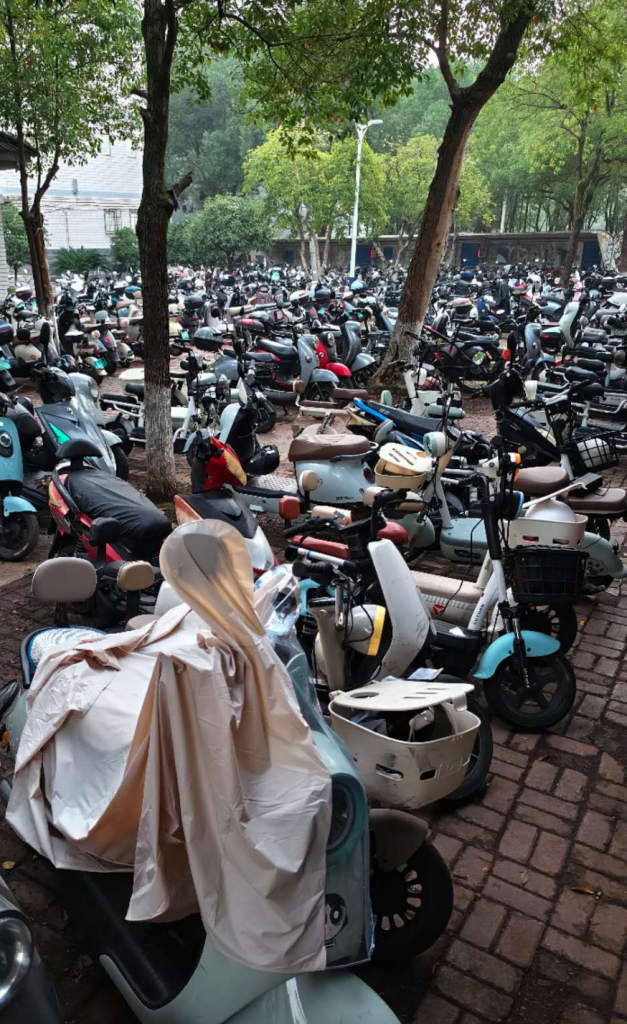
Here in Changsha, especially on Lushan Road near the university, life is bustling. It is hardly an exaggeration to speak of a long restaurant: various small ‘restaurants’ offering finger food, drinks, snacks and even ‘proper meals’ — interspersed with small boutiques and snack shops. At certain times, there is a lot of hustle and bustle: in the morning when the streets are cleaned, when deliveries are made, when the first people go to work, school or university (and the last ones quickly buy a snack before going to bed), at lunchtime and in the evening. Although these are the peak times, there is actually always something going on. Part of this street life, or more precisely, part of life on the pavement, are e-scooters: delivery services that stop briefly, pick up the order and set off again silently. Well, scooter riders are also citizens and seem to feel they have every right to ride on the pavement — only the old white man thinks this is a violation of the rules and that you can stubbornly go your own way. Different rules apply here, rules that prevent mass chaos and that also take precedence over the ‘written rules’. And there are masses of them — here on the pavement and elsewhere too. Anything with two wheels is being used.

And only the stranger is surprised that there seem to be so few accidents — after all, the photo was taken at a time when there is relatively little traffic and students are crossing from one campus of my university to the campus on the opposite side.

Self-regulation instead of rule-following: sure, there are cameras everywhere, but police officers are rarely seen. These are small cultural differences, we often don’t recognise if we are “in the middle of it”; many years ago, my Irish students pointed out to me — we were evaluating a study trip to Germany.
In Germany, all police officers are armed; in Ireland, they do not carry weapons.
It was only then that I realised what I had always known but tacitly accepted and, as it were, suppressed — the Irish students noticed this immediately as the situation in Ireland had been different — it’s true, travelling broadens the mind and often reveals the small differences. Those who are attentive then ask big questions: the question is not so much how much order is necessary, but how it is achieved. And in what way disorder also has something orderly and organising about it.
The village, my village, det smukke by Møgeltønder: about 1,000 inhabitants, and somehow amazing how quiet it is: walking along the main street, you rarely meet anyone, although somehow everyone seems to know everyone else, direct contact is limited to the five neighbouring houses.
The train station — I have to go to Suzhou in order to give a lecture:
Law — Loosing the Role of Being the Great Equaliser
The walk through the waiting area is probably as long as the main street in my village. At 6 o’clock in the morning, it’s quiet here too… relatively speaking. Size does matter, even if it is often overestimated, because after all, some cities ‘over there’ also have several million inhabitants.
A man in the station concourse is practising Tai Chi: calm, balance, harmony… not only in the dance, but also in the clean station concourse.
****
Size matters: the evening before, I had to deal with the supercomputer. These are dimensions that are difficult to grasp. This is no longer a comparison between a mobile phone and the old Siemens computer; this is about something else:
• two buildings with a total floor space of 27,000 square meters
• a storage capacity of 20 petabytes, and a peak power consumption of 8 megawatts; a peak performance of 1.342 petaflops
• the world’s fastest supercomputer from November 2010 to November 2011 The Tianhe-1A system used a heterogeneous architecture combining CPUs and GPUs, with 7,168 NVIDIA Tesla M2050 GPUs and 14,336 CPUs
• The National Supercomputing Center in Changsha is part of a national network of six centers, including those in Tianjin, Jinan, Guangzhou, Shenzhen, and Wuxi, each focusing on different research domains and leveraging unique networking and resource advantages
• The center’s development aligns with China’s long-term strategy to advance high-performance computing, as outlined in the National Medium- and Long-Term Science and Technology Development Plan (2006–2020) and the “863 major projects” during the Eleventh Five-Year Plan period
• a wide range of high-performance computing (HPC) applications, including *weather forecasting, climate prediction, ocean environment simulation, aerospace engineering, and remote sensing data processing. It also serves critical roles in **biomedical research, genetic technology, materials science, energy, and computational chemistry*.
Then I walk along the little path, wanting to use the time to gather my thoughts: a narrow trail… The path turns slightly to the right; halfway there is a wooden gate, a little rickety, but the big dog looks rather inviting, and a sign invites to take a break… Yes, a coffee would be nice. The place has something enchanted, hyggelig as we say at home.
****
• Size matters… Shortly before the train departs, I go to the toilet – unisex and accessible for disabled people; but also for tall and short people, because even the little ones need to go sometimes.
Automatic ticket inspection
1.HERRMANN PETER, train No.G1778, departure at 07:24 on 11 November 2025 from 长沙南站(Changshanan) to 苏州北站(Suzhoubei), Seat No.012D in Coach 13. The ticket price is RMB470.00
• 7:21 — a soft beep, the doors close
• 7:22 the train starts moving
• 7:26 — cruising speed is reached, 305 km/h, until shortly before MiLuoDong, the first stop.
Province — using this term is often perceived as an affront. But perhaps that will change and people will look longingly back to the real world, where life was simply more comfortable?
Consumo ergo sum — I consume, therefore I am. It is probably a global trend, even though consumption still varies greatly in terms of quantity and significance.
Perhaps something else is more significant for the local culture in Europe, not least in view of the discussions there — must we talk about a new world order? But first, let’s go to the shopping mall: more or less new, modern, spacious — and a mixture of “clearly structured” and “an invitation to get lost”.
It is a kind of adventure park with shopping facilities — already a long way from what can be seen in Europe. What is on offer in such shopping mall? Various car companies offering their ‘space labs for the road’, IKEA with a new concept, not as an outlet on a greenfield site; the purchase of an accessory for a recently purchased mobile phone fails:
We don’t have it.
I point to the boxes, take one, but find that it is empty.
It can only be ordered on the internet.
Is it the bonus of being somewhat exotic, the effect of the stranger or general friendliness — the young sales assistant helps me. Later, I quickly buy a pair of trousers and a jumper: the goods are to be placed on a special ‘box’ — I want to take them out and scan them.
No, leave them there.
Everything is listed on a display, I just have to confirm that there are two items, then I am asked if I have a membership card, select the payment method, hold my phone up to the scanner —…
… pling …
I take the underground back to the university, three stops away.
No sooner have I arrived at the office than I receive a message that the parcel has been prepared, followed by another message the next morning:
[长沙市]快件离开 【长沙长安转运中心】,已在发往 【长沙岳麓左家垅店】 的路上
[Changsha City] Parcel dispatched from [Changsha Chang’an Transfer Centre], en route to [Changsha Yuelu Zuojialong Branch].
About an hour later, there’s a knock at the door… —
…and a little later again: Long, a student who helps me with a few things. It’s about some orders I want to place on the internet. I had already looked at the items online. Long takes photos of them, various offers appear on the sales website (similar to Amazon), and the orders are placed…
Later I want to get some fresh air and buy some fruit. Another shopping centre — quite normal, like Kvikly at home, just a little bigger; the way there takes me past countless small businesses: ‘repairing everything that can be repaired if you have imagination and skill as tools’; countless small ‘finger food restaurants’. In the grocery shop: unimaginably low prices — only my beloved cheese… — Milkana processed cheese slices individually wrapped in multiple layers of plastic film, at least named cheese, available at an exorbitant price.
The pedestrian way to and fro is a kind of slalom course: a multitude of e-scooters delivering food — it seems that all the small shops are connected to the delivery system, and the mentality seems to be: ‘delivered is better than cooked’. Though this is one side only as the valuation of good food, enjoyed with friends, classmates or colleagues is still highly valued.
And what remains for me — apart from a certain fascination with technology? The economist’s question of how to understand the reorganisation of the economic world. Technical progress and digitalisation have at least a different everyday meaning here — something that takes some time to get used to when coming from a cosy village in the south of Denmark but also very different from today’s European cities; perhaps it is a ‘new cosiness’ and perhaps also a new way of working that needs to be examined more closely. — The more or less less posh car I ordered in the evening via WeChat to visit a friend (a kind of Uber service) doesn’t make me think about a precarious job, at least for now.
A break, leaving the office for a short walk across the campus, around the small pond in front of my office building, my thoughts lost in life between worlds – a privilege not to be here on holiday. Music is coming from one of the nearby buildings, I look through the door: dance performances. A notice that I struggle to decipher:
2025 Celebration of the diamond and golden anniversary of Central South University and inauguration of the branch of the National Open University for the Elderly, as well as cultural performances for the Double Ninth Festival
The dances help me understand what I recently learned in theory while studying Confucius: harmony is very important here, and it is not least about being in tune with nature

— easier to understand in dance than in a textbook. The performances are a combination of dances and a film projection in the background: scenes of nature, matchine the movement of the dance and the dance matching the movement of nature. This is surely very different to what some Europeans think when they hear harmony.
On the way back to the office, I chat with Tian, a student — chat = sending messages back and forth; I still haven’t quite got used to this excessive use of these stupid smartphones. The topic is the Double Ninth Festival — off the cuff, references are made to texts from Chinese classics, such as Han Yu.
This classic text is part of the standard curriculum in Chinese secondary schools, and virtually all students have to learn it and memorise it.
Studying music was part of the curriculum of my students when I taught economics here. — No glorification, I know the pressure to perform here … but I also repeatedly experience the ‘calm’ side of this often noisy country.