
Well, it may be that it is really one, but even if this is the case it can make us thinking. Only recently Iearned that the London Stock Exchange, reasonabky well know to me from analysing economic developments, is also well known as LSE. For me this always had another connotation, standing for the London School of Economics. Seeing the same acronym being used, I am wondering if there is some special meaning in the fact that the latter is rarely mentioned by its full name: London School of Economics and Political Science. It may well be that the accident turns out to be part of a system: a reality, where the exonomy is gaining dominance, being lead by the spirit of economics, a discipline, that is geared to a well-functioning, i.e. profit-msaximising stock exchange, not people oriented.
Categoria: Slow Reading
a question
Our answer to the question what the most thought-provoking thing might be is the assertion : most thought-provoking for our thought-provoking time is that we are still not thinking.
Martin Heidegger, 1968 (German original 1954): What is called thinking? – A translation of Was ist Denken? by Fred D. Weck and J. Glenn Gray; with an introduction by J. Gay Glenn; New York and later: Harper & Row: 17
Remarkable proposal by artificial intelligence – I came across Heidegger’s book – and then this quote, when working on the internet, searching for something on today’s high-tech/AI-ideology and their manipulation of the world — no need to think, everything made to measure.
never getting this …
How is it that a car, driven by electricity, cleans the air from the polution that is caused by generating the energy? Please, submit answers until 31. of December 4217 – earlier submissions will be stored …
no doubt
There cannot be any doubt – leaving all qualification aside – the “Me Too Movement” had been necessary and, while equally doubtless there had been flaws and negative effects, it produced many positive results. – As Lewis said
you can’t go back and change the beginning but you can start where you are and change the ending,
Thus I dare to ask if
Me Too
did not need another, complementing, movement or had been such double movement, one that said

Without Me
Unfortunately the Me-Too-Movement had been been necessary by the “detestable behaviour”, women had been confronted with and – at least for some time, surely for different reasons – “lived with without accepting it”. But hadn’t it been also – then – a movement of women who now said “I do not accept it anymore”? And had it possibly also before a lack of men who resisted peer-pressure, following peers and societal images that suggested such assaults being “normal”, at most trivial offences — part of the story reminds me a bit of the debate in Marxism, looking a the development of the class in itself (defined by the situation as such) to the class for itself (defined by the perception and the subsequent joining in with others and acting “solidaristically against the other” (the one class defined by the existence of the other; the raped, abused, disrespected … defined by the rapist, abuser, disrespectful …). And all this is in part a somewhat paradoxical constellation: acting “social” requiring gaining independence from the social settings and environments.
There is this ambiguity – on the one hand, MeToo had been
“a movement about the one in four girls and the one in six boys who are sexually abused every year, and who carry those wounds into adulthood,”
as Tarana Burke said – a much too high number though still a minority. On the other hand she also highligthed
We start by dismantling the building blocks of sexual violence: power and privilege. This starts by shifting our culture away from a focus on individual bad actors or depraved, isolated behaviour.
Without aiming on de-victimising anybody, without aiming on excusing anybody, without suggesting that “all problems are the same, of the same gravity” …. I am wondering if we should not be stronger in building up
Without Me Movements
not just rejecting and detesting What others do, by accusing “them”, but accusing ourselves as long as we bear the role of victims (yes, of course regards from Foucault). So, establishing such movements, in daily life has to be about
- not allowing sexual abuse – and not giving in when peers suggest “it is nothing nit fun”,
- not accepting precarious jobs and working conditions – though others may suggest that we are lazy, and tough real life suggests that a bird in the hand might be worth two in the bush
- not allowing administrations taking the lead in universities, schools and political affairs though we risk rebukes
- …
and not allowing others using the mobile phone, permanently interrupting the communication, not allowing the other to remain without answering and not allowing the mocking, suggesting that parents now, using their e-vehicle to bring the kids to the Friday rally asking for effective climate protection. Isn’t our acceptance to often a neglect easy ending up in rape of minds and praxis? Finally, all this is about self-determination as a fundamental right.
An interesting constellation …, or: anything goes
(well, anything though surely no slide-presentation-simplification)
A colleague in Turkey had been
charged with “propagandizing for a terrorist organization” (Article No. 7/2 of Turkey’s Anti-Terror Law No. 3713) for signing the Academics for Peace statement “We will not be a party to this crime”. The statement criticized military actions in the Kurdish regions of Turkey and called for international observers to monitor the situation in place.
The colleague had been charged, and confronted with a “choice”: accepting being sentenced, with this admitting that the political activism had been a criminal verdict – then being “gratified” with the suspension of the sentence – the alternative: appealing and going to jail if the appeal is rejected.
Looking at it as matter of human rights, the case grasps attention on this/such case as it is the state who hinders the citizen to express a personal opinion – other issues may be raised.The human rights issue is about the fact, that HR emerged especially (if not only) as matter of protecting citizens (thought as being “global”, though implicitly “private”) against arbitrariness of the state.
So far, so good. Only now comes the interesting part.The message – and call for action – came from the UK, currently also known as BREXITUK and had been sent by a colleague, using the university office mail at the
University of [… ] which is a charity and company limited by guarantee, registered in England (reg.no …)
Hesitation: First, I simply thought “a university”
Second thought (not the first time though): uni as charity sounds strange – education as charity, doing good. Doing so but to and for whom in whose name?
charity (n.)
late Old English, “benevolence for the poor,” also “Christian love in its highest manifestation,” from Old French charité “(Christian) charity, mercy, compassion; alms ….caritas by ‘charity.’ But the 16th c. Eng. versions from …
Doesn’t it say in Mathew 5.3.
“Blessed are the poor in spirit, for theirs is the kingdom of heaven.
Well, this opening for other field . I will have a go for that in another occasion …

For here and now, adding to the puzzlement: does it mean a private body, engaging something like “spirit of general interest”, benevolent to society by providing education. This is actually a tricky one (yes, sloooooooooww reading, more thinking): it easily entails
- the public, commonly understood as “statutory”, provided by the state, is not providing what it should provide, thus some other instance has to do it
or
- The public cannot look after itself, thus an “instance from outside”, e.g. a benevolent “private”
Or it is
- possibly “benevolence” itself the public and finally becoming true (well, for the philosophers, of course, a bit of Hegel’s cunning of reason and the absolute idea)?
Now, down to earth, nearly trivial, my question was and is: are (those) universities public institutions or not. Later I met Jeremy, how is fearing about the future of his home [he is European] as the Brexiters want to take it off him [well, their name does not say it clearly: they are Brits = they do not want to leave Britain but that want Britain to leave]) and asked him – he confirmed that nearly all British universities are public.
Part of the exact definition of these universities is then, institutionally and legally that in this case we are dealing with a body that is
“registered as a higher education provider with the Office for Students (OfS) and is subject to the OfS Regulatory Framework. The OfS is also the University’s principal regulator for charity law purposes on behalf of the Charity Commission for England and Wales.”
Is then the OfS the public and who/what is it? Possibly a kind of council, or “soviet” to use another term?
So, coming back to the HR-issue: Having stated
The human rights issue is about the fact, that HR emerged especially (if not only) as matter of protecting citizens (thought as being “global”, though implicitly “private”) against arbitrariness of the state.
it now means that one state (to be more precise: an institution from one state, or even more precise: somebody working in a representative position of one institution of one state has to stand ups against one the breach of HR by another state.Did I say by another state? Well, more precision would suggestBreach of HR by one person (Erdogan) who claims that he represents the state – as the public – and can thus oblige every citizen to accept those rules, even if they are finally private rules in the sense of the rules an individual defines …
Still to be added: representing in the one case means “speaking for”, in the other case it claims to mean “to be”. ‘L’État, c’est moi’
At the end it surely still remains a lot to be clarified, and even to be formulated as question. I suppose it is a challenge I may pass on to my new students, when commencing teaching next week
Company, business, work
five years ago
“It’s indisputable that there’s a real pay gap. People can argue about how big, but that’s almost besides the point, The point is that every woman, every girl deserves to get paid what they’re worth.”
These are words by Sheryl Sandberg, taken from the Huffington Post, looking only on the year, not day, it had been five years ago. I am wondering if this is about a modern form of slavery and trafficking? Is payment about worth, even value of people in monetarised form? The difference is today’s deference of women: in old slave societies “owners”, the previous slave owner had been paid; Sandberg proposes to pay the slaves themselves. Hummmm, enslave yourself as alternative to wage work? Or is it just the same?
Surely an interesting question, most appropriate for the 8th of March, the International Women’s day.
A different point – as matter of a different chapter in the same book. In a brief note, titled
Was Studenten im Job wollen (What students are expecting in their job)
(even) the IWD (Institute of the German Economy) contends that inequality is going far beyond the gender pay gap, engraved in the entity and the expectations:
Although an attractive basic salary is at the top of the employers’ wish lists for both sexes, women in the various disciplines have on average significantly lower expectations than men in this respect.

www. assignmentpoint.com/wp-content/uploads/2015/08/labor-theory-of-value1.jpg
While my perspective on some of these questions concerned with the
Value Theory – is there still any value in it? – is it still worthwhile to talk about it?
is still waiting for final publication (just looking at the proofs), Amit Bhaduri’s
On the Significance of Recent Controversies on Capital Theory: A Marxian View
may be of interest.
conventions
Conventions – one of the meanings is the following, taken from an online etymology dictionary I occasionally use:
In the social sense, “general agreement on customs, etc., as embodied in accepted standards or usages,” it is attested by 1747 (in a bad sense, implying artificial behavior and repression of natural conduct, by 1847). Hence “rule or practice based on general conduct” (1790).
Yes, there is a bad sense to it – in a book, I was reading I stumbled upon the phrase of the
Interwar Years

http://peacefultomorrows.org/stories/promoting-peace/
I hesitated: as the book – talking about education and democracy during that period – was not clearly European, British, US-American … , I was wondering what this could mean: interwar years? Of course, the convention refers to the years between WW I and WW II, and this is what showed up when looking up on google, also on wikipedia a special site dedicated to this period. However, digging a bit further, there is on the same conventional site (yes, google and wikipedia managed to become some kind of today’s “convention”) one titled
Quite a result:
148 incidents, counting wars and conflicts commencing between 1919 and 1938, thus definitely “between” the two world wars, literally interwar years.
A piece of peace, if one wants, and if understands piece as “a little bit”. Easily overlooked when reading too fast, just accepting conventions: The INTERwar years had been years engaged in many wars
You should sleep nine hours without dreams. Then you have the day for dreams
Herbert Marcuse supposedly said this … Is it another version of the words written on a postcard I recently received?
Swim to Nowhere, With No Thoughts.
So there we are worrying about big brother, watching us, algorithms rule the world and with Artificial Intelligence taking over.
Sure, there are important issues linked to these catchwords – though one seemingly tiny point is a negligence, not just as matter of language I suppose.

Just a few mails, from a Spam-poor night, and a mail-free one too. Leaving the obvious SPAM aside, to mails are perhaps even more worrying: the one at the top …, well, is there a term like SPAM-IFICATION? At least it does exist now.
* Instead of thoughtful targeting advertisement and communication in general, we accept the wikiwiki culture, leading us to just throw things out, without much thinking.
* Instead of “academic matchmaking”, I mean: bringing me/us academics in contact with relevant other academics, sites like academia, researchgate … often come to the most confusing proposals: does it really make sense to send me a link to an article on trading chemical products between China and Europe, presumably on ground of the fact that I gave a presentation on OBOR or the fact that I lived some time in China?
* hat is the premium of having access to something that is out of reach in terms of manageability?
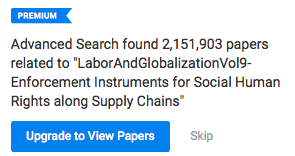
over two million papers …? What are the criteria forlinking them …, and when will I be able to read them?
Artificial Intelligence?
Indeed, I read an article some time ago, a short one in a newspaper, talking about
artificial stupidity
… which is too often more characterising.
BUT HANG ON …
Don’t we have to blame ourselves for it – not because of using FB; twitter etc.. It is probably a much more serious problem that we – living and working in academia – accept this world and work being directed by ranking; publishers’ journal sites that manipulate our reading behaviour by aggressively suggesting that “readers of this article also read … — and quoted ….” and boxing our thinking and acting.
A new trinket in the jewel case of administrative stupidity, with which the Polish government (as a Czech friend said yesterday on the phone “we are joining”) is blessing us: every academic, working in a university, has to commit her/himself to two subject areas: sociology, economics, medicine … – sure, they are very broad which may be taken as some comfort. Articles for the assessment of the academic will only be taken into account if it is in line with this self-attribution. What now if I am looking into
as M. Keith Chen did.
What if I am looking at the question of European unemployment insurance in the light of legislation, sociological aspects and the economic development, possibly publishing the results in a journal on European history …?
There is not only direkt and outspoken censorship but also the seemingly “tame brother”,
And predictive shopping is not really new – though earlier it occurred in different forms

(Saw this the other day in Berlin: “What is missing today?” – Bakingpowder, bread, butter, eggs … onions)
Still, there is surely the need to resist …
… though there is also the time … – well, as said the other day I received a postcard, with a colour drawing, not algorithm-based but manufactured in the true sense by the sender, much appreciated by the recipient …, occasionally I allow myself resisting the need to resist, sitting there

and looking at it,
Swim to Nowhere, With No Thoughts
as the few words under the drawing suggest. And making me think, energising me … to resist!
Privatisation through the backdoor
on New Deal For Irish Families, states at the end of his article
Real choices for mothers and their partners requires a social investment state that supports families throughout their life course.
Of course, at first sight it is laudable but then …

Would it not be even more laudable and plausible to establish another reference as the words of Bertrand Russels who suggests in his In Praise of Idleness
that four hours’ work a day should entitle a man to the necessities and elementary comforts of life, and that the rest of his time should be his to use as he might see fit. It is an essential part of any such social system that education should be carried further than it usually is at present, and should aim, in part, at providing tastes which would enable a man to use leisure intelligently.
Indeed,
(l)eisure is essential to civilization, and in former times leisure for the few was only rendered possible by the labors of the many. But their labors were valuable, not because work is good, but because leisure is good. And with modern technique it would be possible to distribute leisure justly without injury to civilization.

https://www.datocms-assets.com/45/1522837592-soldi-alati-2.jpg?ixlib=rb-1.1.0&ch=Width%2CDPR&auto=compress&w=
500&h=500&fit=crop&dpr=1&fm=jpg
Isn’t the rhetoric of “social investment”, seen in connection with targeting choice between family and career, not only wrong by way of reducing social policy on a labour market instrument, but also by way of misguiding the understanding of work? Isn’t it with such social investment perspective also established as private matter through the backdoor? Instead of paying for childcare privately the state (or possibly private public partnerships) ar paid in kind, through the work they do instead. Redistribution of wealth has to go hand in hand with redistribution of work. Indeed, Nicolas Bueno in his short Introduction to the Human Economy makes a point that is surely interesting enough to overcome the idea of social investment as a social policy. He writes
Once human beings are delivered from being thought of as mere producers of economic value, a part of the time and energy that was before only dedicated to producing goods and services can be used in order to create something else. But what can individuals create with their human potential? Human benefits.
Hot air …
Some time ago I talked to Rainer – the gist and my suggestion: we need a new approach when it comes to digitisation – and part of it is to look at the side of capital – not simply as ongoing concentration and centralisation – or as matter of concentralisation as I call it, but by focussing on …, well, that day I said money laundering. Sure, more appropriate is the debate under terms as over-accumulation/devalutation as Paul elaborated.
[Yes, such sermon as the following needs slow reading, or slow listening, making sure that one gets every single word of nonsense, of being fooled …].
Sometimes, spotting Apple’s Angela Ahrendts on the new in-store experience, or listening/reading about Microsoft’s next Act, presented by Satya Nadella, I am wondering about change and stability.
For the second I would say that all this stands in the well-known tradition of ripping people off, extensively using different forms of brain-washing . The change is also clear I guess: the times of good fairy tales is over.

[royalty free from https://www.dreamstime.com/stock-photo-rotten-apples-compost-heap-allotment-site-image59349576]
The hope for more change – Snow White found a prince to revive her – let us hope that today men and women awake themselves, seeing the rotten fruit.


 COMMEDIA DELLA VITA OR PÁNTA RÊI'S FIRM GROUND
