The Reason Why …

… the things we cannot understand.

Wednesday evening, I receive the news that Stephen Hawking passed away. And I do not know the reason why it touches me, in some strange way. Just chatting with 艺非, I remark:

Perhaps it is because I never understood him?

The answer follows suite:

He is funny and cool

Yes, well, yes he was – and still he is one of the most profound, most serious scientists.

Perhaps I am touched as the news states:

É morto Stephen Hawking, esattamente 130 anni dopo la nascita di Einstein

– is it the closing of a circle? The birth of Einstein as opening of an era that would fundamentally change the understanding of the world and pout position, the death of Hawking who left us with the No-Boundary Measure of the Universe. which may be easily seen as a follow-up version of the theory of relativity.

Perhaps I am touched for the most banal reason that can come to mind when talking about such loss: the morning we discussed some issues of the new German government, namely the migration policy as lead down in the …, well, Tino talk about the Agreement, literally Koalitionsvertrag translated into contract or treaty. But perhaps that is part of the problem: A government, the party of the old-new chancellor not standing as block behind her, the entire new coalition only having little backing … – and little profile: the few pages on migration issues more pragmatic, managerial, featureless .. are they already living and governing in a post-Einstein-Hawking-era. The final age of which Shakespeare says

That ends this strange eventful history,

Is second childishness and mere oblivion;

Sans teeth, sans eyes, sans taste, sans everything.

Treaties being watered down to agreements … – Sans teeth, sans eyes, sans taste, sans everything.

There is another thing that comes to mind … perhaps the reason why: The world is admiring, celebrating billionaires and bubble blowers, believes Kurzweil’s statement that Singularity is near

not realising that this is the Amazon-Singularity of big capitalist business, without any cooperate responsibility, acting as private feudal nosey lords in public spaces [the gist of a book-contribution I am failing soon]. It is the google-youtube-singularity that is increasingly coming under threat and actually activates at this stage already unexpected forces or in other words: a singularity of capitalism as we can summarise Negri.

The reason why ….


… there are may reasons and many areas where we simply have to accept the greatness of those – things and people – that resist in some way, searching for the breath of the world.

From Elias Canetti: Du bist aus dem Atem der Welt gerückt. [aus Fliegenpein]

Handpressendruck aus der Werkstatt Fliegenknopf, Muenchen, Band IV der Schwarzen Serie. Limitiert, handsigniert von Künstler der Holzschnitte, Wilfried Bohne. 96 Exemplare

I can only highly recommend a visit in the workshop – a pleasure to experience history being alive and meaningful …

It is far from being paradise …

– some thoughts on what is called populist success story.

Yes, it is far from being paradise …

… even if 可欣 wrote the other day

In my impression, Cuba is the place of beautiful scene and people. It’s a good choice … . Although my impression is only come from the movies. But I believe the beautiful sea and sunshine will be very helpful for good mood.

And indeed


…, yes, I enjoyed my stays there. And the small and large things: mainly people, chatting with them about their life – the ordinary and extraordinary. Language …, well a challenge as I do not speak Spanish, they do not speak … – well, they speak Spanish. Trying, Italianising the Spanish, Spanishising the Italian … The small and the large: the view across the ocean, walking along the Malecón, early in the morning, remembering the history of resting the USA – which in one way or another was a bit my personal history, and the monumental waves, sometimes reaching high, pushing the water across the dual-carriage way of the promenade. …

But on the occasion of my visits I did not only enjoy the scenery, the most exciting, vivid culture, the openness of the French ambassador, opening with the artists a mural on the walls of the embassy and … well, I experienced the difficulties, some but by no means all caused by the embargo, saw the poverty but also the pride, the commitment and hope of so many people whom I joined for the celebrations of the first of May – yes, some had not been too excited about getting up at three or four in the morning, and still they turned up, most if them committed.

Not paradise – this was also the topic of the very open, and very … confrontative debates for which I had been invited at the Centro de Investigaciones de Política International, and also the other year at the Instituto Superior de Relaciones Internacionales “Raúl Roa García”

Anyway, there is something we may think about, ca. one week after the elections in one of my ex-home countries which got the criminal B, back onto the main stage, and one day after the elections in Cuba. Admittedly there had been some banal hitches before the elections, not denied by the Cuba’s National Electoral Commission (NEC).

But there is another thing: the elections, the electoral process can well be taken as an anti-populist warrantor. Again, no paradise … but have a look, here in comparison of the system in Cuba and the USA.

The decisive aspect – as the little study states – is that

Cuba has different mechanisms to ensure popular participation both as electors and candidates.

Important is not only the high level of representation in Cuba, and the fact that it is truly a bottom-up process but also that it is very much about a discursive process not parties standing against each other but candidates developing on the local level together with the people their common programme. Well, there may be a bit of Jesuit-Franciscan element: elections understood as part of the camminare insieme, part of the work-walking together. Doesn’t such approach take much of the soil on which populism grows away: the soil of competing for power to govern the people, allowing to establish a solid ground, on which the people stand together?

– In this light many of the evaluations that had been published last week – looking at

Fear, Loathing And Poverty: Italy After The 2018 Elections

or asking the EU

When Will They Ever Learn?

and observing

Italy’s Ides of March

– have highlighted some relevant socio-economic issues, however they failed to acknowledge that democracy is not about serving the people but about the people saying and doing.

See in this context as well earlier, general reflections on populism and as well here.

And here more recent news on Cuba.

e

Principiis obst! Mind the beginning!

We talked a couple of times about Hannah Arendt – point of departure was actually something that seems to be very distant from her work: criteria that constitutional courts can refer to when taking decisions. And of course, taking the perspective from the legal doctrine is different from that taken by others. Funnily enough, legal doctrine translates into German as Rechtsdogmatik – suggesting something like dogmatic law, of even dogmatic thinkers on legal issues?

At some stage I mentioned some literature to my office mate – stuff I would think being important on this topic. Books, some more or less legalist, at least coming from sociology of law, philosophy of law, and perhaps stuff philosophising on justice – we both laughed when I dared to say – mind, to a jurist:
law is not interested in justice, hardly knows about it. what we share – legal scientists and economists – is a more or less blind interest in coherence. that may be rather simple: you put numbers and articles and even laws, we put numbers on goods and people – no matter on how bad the goods are, no matter how deep personalities are buried behind the figures.
 We laughed, knowing that it is reality and when it is lived reality it is harsh.
After such books, and after working a bit on our different tasks, I interrupted the silence:
Right, there is another one: Hannah Arendt’s Human Condition. it is probably the most comprehensive book she wrote, and from reading this, it is possible to understand the others …  to least the one on he Eichmann-trial and the banality of evil.
 A short chat, a couple of days later, we had been sitting for lunch – just across the street. Else a rather dull, grey day. I don’t know why she asked me about Hannah and Martin Heidegger … – I said what I knew, and part of it, actually part of the question had been already about Heidegger’s relationship to the fascists.
The romantic relationship between the two philosophers was known as a difficult one – and apparently the relationship between Heidegger and the fascists had not been so clear …
– can one say it was part of this banality of evil? We talked about it, the time, the difficulty of admitting that it is difficult. For me it is again and again emotionally a difficult matter, having known comrades, colleagues, friends who went through that hell – making impossible to accept that those had been ordinary people.
It could be him
I pointed on the table to the left
or her
my eyes moved to the right. I looked into her eyes:
It could be you — or do you know if it is not me at some stage?
It was loud, the snowfall was not too bad and I proposed to leave. I opened the brelli:
Let’s go to the LMU. I do not know exactly where it is …
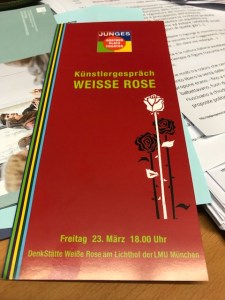
– did you ever hear about the Geschwister Scholl?
She did not – and I told her the bit I knew, talked also about Anne Frank, my visit in the Anne Frank House, im Amsterdam. I remembered, at the end of the museum little notes, one asking
Why do we feel such a pity for this one child, knowing that there had been so many more being brutally slaughtered. – it is because we hardly can cope with this one, bearing the large number would crash us completely. 
After a while we found one person who could help us finding the way – and a little while later we find the little memorial – I had to swallow, as usual when being confronted with my past which is not my past and against which I had been fighting. I managed, we entered – we walked along the exhibits, I have had the impression getting slower and slower. And for my part I was wondering if it was right to put all this weight on her shoulders. Or if it was my duty? Or …just something like a waste of time?
 After we left, we stood a while at the bottom of the broad stairs …
Do you know, I fell sometimes so … riven, so unsure, insecure …
She talked about Korea, the occupation by the Japanese … – and I had to ask sincerely and honestly to forgive me for not knowing anything about her country. A bit later, when we walked back to the Institute, I remembered Albert Einstein – I used this reference to underline what I said before, and already while we have had lunch:
I cannot guarantee that I would be as brave as these people – I would like to be, but would I be as strong as they had been? Albert, with all his knowledge, he was one of the enablers – finally his contribution mad it possible that the USA developed the nuclear weapon. And he did so intentionally, ‘knowing’ that the bomb in the hands of the US would better than it would be in the hands of the fascist Germany. Later, when he knew better, namely that it had been used so senseless, the US playing with the muscles without any military need and humane consideration, he changed not just his mind but concentrated much of his effort on condemning .., well part of his own deeds. – Braveness …
 ******
The morning of the same day I submitted another recommendation letter for  student – the boxing exercise – the mail to the university is already prepared but I have to wait, sending it:
Earlier I just submitted a recommendation – and I dare to make a recommendation to your institution:
Be professional and serious, and do not breach confidentiality law – there is much improvement for you, actually I was near to recommend to the student not to go further with the application due to your highly unprofessional way of treating students.
Sincerely worrying about the quality of academic standards I remain
Prof. Dr. Peter Herrmann
 … 
The evening I went to a presentation at the institute:
„Jenseits der Praxis? Die aktuellen Vorschläge für eine Reform des Gemeinsamen Europäischen Asylsystems (GEAS) aus rechtlicher und praktischer Sicht“
 A very clear presentation, also highlighting some fundamental flaws – followed by a ‘soft debate’, leaving some important points out,
Principiis obsta. Sero medicina parata, cum mala per longas convaluere moras.
[Ovid]
Mind the beginning| Too late the remedy is prepared when the evil became stronger simply by time.
Ovid wrote it, thinking Remedia Amoris – what then about the self-loving academics …?
******
Today, I went for my usual walk  the first time that I really was getting aware of the name of the one street I passed so often: Ackermannstreet – the city of Munich still celebrating this loyal property of a man who had to go to court because of misappropriation,
This day I did not listen to my usual lectures and audio-plays, I remembered my last visit in Athens. After that visit I wrote:
a long way … from the priests on the Acropolis [ἄκρον (akron, “highest point”) and πόλις (polis)] to the gardens which had been the roaming place of the philosophers to the reality of today’s Europe.
It is a way full of the tensions: on the one hand the small academies of free thinking – free and ready for the hemlock; on the other hand the abduction, about which Maria Mies wrote in the one book on Europe I edited [Mies, Maria, 1999: Europe in the Global Economy or the Need to De-Colonize Europe; in: Peter Herrmann (Ed.): Challenges for a Global Welfare System: Commack, New York: Nova Science Publishers, Inc.: 153-171].
Studying the history – sine ira et studio – as Tacitus said.
Also making history without hate and zealousness? There is always the danger then of abduction: the legal doctrine, expressed in the constitutional state, the state under the rule of law is turned into the one-sided application of law, its consistency the utmost and only validation. The economic doctrine, being caught in the mirage of closed systems, the equations make equal what is different, and not able to see that not figures but power matters.
Life goes on – only not forgetting its complexity and ambiguity can make us free. [I could not find the link to the one, the eleventh song].

I am scared …

E0702 UHDE 9827

There is a light

she said

and they are together. It is not a sad painting!

This is from a most enjoyable visit with a friend at the New Pinakothek. It had been much later that evening, after we had been chatting, nicely, seriously, laughingly over a drink when she gave me this think-piece, and with it came a ‘provocation to live’ …

I am Scared, Therefore I am Brave!

Recently, my Italian translator, Giuseppe, wrote me an email. It was not a typical exchange, but quite an extraordinary personal query:

“Many see you as a very courageous person. They would like to imitate you at that, at least a little bit, but they feel they are not courageous, say, ‘by nature’ and they cannot learn courage. What do you think about that? Can people train themselves to be courageous?

I do not know how to answer this question in brief, and definitely not in the body of an email, not in just a few words. But the question is important, maybe essential, and so I decided to reply by writing this essay. ….

Turbulenzen und Zäsuren

Liebe …, über Turbulenzen und Zäsuren muss ich noch nachdenken – nicht weil ich sie infrage stellen möchte, eher weil die Turbulenzen bei mit tendenziell schleichender Dauerzustand, auch als Denkherausforderung, sind; und zweitens die Zäsuren sich dann doch wie ein geballter Block, Keil, Flügel in den ganz normalen Wahnsinn einmischen – dazwischen-schlagend oder leicht sich hineinsenkend.
Wie schrieb ich nach dem Besuch der Alice-Vorstellung in der Opera?
C’ è più realtà nel paese delle meraviglie di tutte le meraviglie che pretendiamo di affrontare nella nostra ricerca.
Und mein zugegebenermassen chaotisch [erscheinender] [Denk-]Ansatz macht beides Spannend und verbindet teils die Welten, immer hoffend, dass ich dennoch auf dem Boden der Tatsachen bleibe. – Naja, was sind Tatsachen? Kürzlich hörte ich vom Stundenlohn des Herrn Gates. Dollar? Euro? ich habe es vergessen – allemal sollen es einhundertfünfzig sein, pro Sekunde …. Und so ist es doch oft: die wahren Dimensionen von Ungleichheit, Regelungen und Änderungen, auch jene im besten Sinne, erfassen wir oftmals kaum – bezeichnend der, wenngleich nach meiner Auffassung, zweifelhafte, Schritt Peter’s, nun Sachbücher durch Novellen ergänzen zu wollen [“The Baby Auction”, “Ardent Justice”], da ihm die Aussagemöglichkeiten durch Sachbücher begrenzt scheinen – Hat er Recht oder zeigt es nicht ein anderes Mal, dass es nicht nur – vor langer Zeit wurde darüber geschrieben – ein Elend der Philosophie gibt, sondern auch ständig die Verarmung der Sozialwissenschaft weiter voranschreitet – nichts Neues und doch erschreckend, wenn man in dem Verarmungsprozess teils gefangen ist, sich zu widersetzen sucht, und dann in diese Verarmungsfalle gerät: die Verarmung des Denkens durch über-systematisierung oder die Verarmung durch das Verlangen, den Menschen zu respektieren und nicht den technischen, administrativen oder unter allem den ökonomischen Interessen unterzuordnen.
Sicher sind all dies Geschichten hoher Komplexität – aber Komplexität wirklich reduzieren zu müssen, wie es nach Luhmann Aufgabe der Wissenschaft ist, ist Anderes, als Komplexität zu leugnen – etwas, was wir vor Luhmann bereits lernen konnten, etwa von Hegel oder Marx. Und sicher ist es ein Prozess, der lange schon zu finden ist – erwähnte ich nicht vor Kurzem erst die Kritik Alfred Marshall’s an der Segmentierung des Wissens[prozesses] ?  – und der doch immer neue Formen findet, nicht zuletzt durch die systematische Verarmung menschlicher Intelligence durch AI. Die Befluegelung will ich nicht bestreiten, aber doch die Gefahr der Vorgaben durch AI kann ich nicht übersehen: Die Weiterung des Schrittes, vor dem ich auch Studierende immer wieder gewarnt habe:
Eine Antwort zu geben, ohne genau über die Frage nachzudenken
erfolgt nun Rechen-Maschinen-geschneidert, durch die Forderung:
Eine Frage zu stellen, und sie so zu stellen, dass es der Algorithmus
immer auch berechnen kann.
Auch dies nichts Neues, denn in den Aufzeichnungen aus dem Kellerloch schreibt Dostojevski ja:
… der Mensch besitzt eine solche Leidenschaft für Systematik und abstrakte Folgerungen, daß er es fertigbringt, bewußt die Wahrheit zu verdrehen und mit sehenden Augen nicht zu sehen und mit hörenden Ohren nicht zu hören, um nur seiner Logik recht geben zu können.
In diesem Sinne danke fuer die Wünsche fuer uns alle
für 2018 und für ein erfolgreiches Fortschreiten auf den Pfaden der Erkenntnis!
und danke auch fuer das Angebot zur weiteren Zusammenarbeit trotz des teils störrischen Insistierens auf der Leidenschaft, sich auf im Rechtsdenken der Systematik und den abstrakten Folgerungen teils zu widersetzen.
In diesem Sinne mit dem Dank sendet Peter die guten Wünsche auch an Dich

If man plays …

and only then ….

In Schiller’s own words
Therefore, no error will ever be incurred if we seek the ideal of beauty on the same road on which we satisfy our play-impulse. We can immediately understand why the ideal form of a Venus, of a Juno, and of an Apollo, is to be sought not at Rome, but in Greece, if we contrast the Greek population, delighting in the bloodless athletic contests of boxing, racing, and intellectual rivalry at Olympia, with the Roman people gloating over the agony of a gladiator. Now the reason pronounces that the beautiful must not only be life and form, but a living form, that is, beauty, inasmuch as it dictates to man the twofold law of absolute formality and absolute reality. Reason also utters the decision that man shall only play with beauty, and he shall only play with beauty.
For, to speak out once for all, man only plays when in the full meaning of the word he is a man, and he is only completely a man when he plays.
 … of course, Schiller, in Letter XV of his collection upon the Æsthetic Education of Man does not fully explain or exemplify what play means. Nor does he tell us explicitly if it is for all of us the same. For the child it surely is not the same as for the philosopher.
One of the latter came across some snippet of information, useless, unimportant and thus being a major temptation to play, offering a break from checking algorithms and their legal meaning. A day in November last year, checking the holidays for 2018, I clicked on a link, to learn about Palindromes. Hardly knowing even the meaning of the term, I quickly learned the basics, namely
In 2018, people who write their dates in the m-dd-yy format will be treated to 10 consecutive days of palindromic dates. Every day from August 10, 2018 (8-10-18) to August 19, 2018 (8-19-18) will have a palindromic date.
Such back-to-back Palindrome Days in the m-dd-yy format are not that rare. Every year since 2011 have had 10 consecutive Palindrome Days. In 2011, they occurred from January 10, 2011 (1-10-11) to January 19, 2011 (1-19-11). In 2012, the same sequence of dates occurred in February. In 2017, this will happen in the month of July, in 2018 in August and in 2019 in September.
Notice a pattern here? As long as you write your date in the m-dd-yy format, every century has 9 years with 10 Palindrome Days in a row.
Play …
Can’t we read these in some way as days where past and future are ‘visibly’ – or is there are term like ’numberly’? – brought together in presence? Capturing the entire time universe in the sequence of just 24 hours? – A recurring ‘big bang’, isn’t it? … – You remember Goethe, contending in the ‘Diwan’ that
He who cannot draw on three thousand years is living from hand to mouth.
Nothing for boxing people who unlearned to play, leading a triste life, cut off, seduced by nothingness, not allowing the shine of light.

laborious joy

It is a while back already … a small …, well, lets say dispute with Laurent:
Laurent
A propos, I am very happy with your article. Of course you have problems  to explain your thoughts (you know this) but according to me what you said is very interesting.
Peter
I know that you are to some extent right with what you say about my difficulties to explain certain things; however the other half is that we – probably all of us – unlearned accepting that reading and understanding is WORK, the stuff just flying at us is usually unruly rubbish, lacking depth and appearing nicely, deceiving. People jump into the water and … did you ever jump into a pool at the shallow end …, only sometimes you get away with it,
Laurent
Yes, yes, and in Dutch we should say  tja, tja
Right, reading and understanding is ‘work’. Right. But……it can not be an argument  to write something what can be better articulated.
Peter
took a while, Ja Ja …, oder: na eh [that could be Bavarian I guess …]
I think again 50/50, it is too often wrong that things are expressed in simple ways, leaving out the needed provocation, and that was part of that article too. In general, from my current experience: we have a major ’translation problem’, actually two problems – and this is important, without joke:
myself, being a hybrid, face again and again the problem that it is nearly impossible to understand things as soon as we ‘leave the box’. There are things in economics we cannot even think, articulate  in law and vice versa. Add political science and sociology and …
Second, I talked the other day with a colleague from Bolivia – she is also working here and asked me for some advise: she has to review an article for a book, the author being from Peru. There we have entirely different understanding of certain legal facts, paradigms etc. The author uses a more or less narrative style. However, somebody else in her project does not understand that and will not accept it, as he is academic in the area of law, strictly. So, while highly qualified, he has at times a narrow approach as well when it comes to putting things into forms. Now, you can do this, it is easy to ’understand’ ,…, and mostly wrong. I guess this is also part of …’s [or who ever wrote it] article on CSR. There had been in the first version [the one I know] at least certain things that cannot be written this way in an international journal: they had been simply wrong – so to be skipped or to be ’translated’ – and such translation would mean: the reader has to work it out. – Sure, in that case, the reader had to be informed about the Chinese context ….
This … had been a more or less great though rare pleasure in China: being together with a Chinese friend, and getting ‘permanently into trouble’, knowing that we need[ed] to work out what we mean. Dictionaries only tell shadows of truth — thus, coming back to the work, somewhat ruthless debate would be good, daring to dispute things, to disagree and speak about it and come to a conclusion …. . It may even end in lasting love if this is the correct term …
—— —— ——
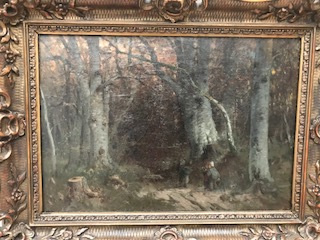
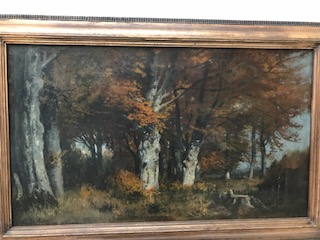
The afternoon of the very day, after sending the last mail I was standing in the Lenbach Haus, the issue returning to me while looking in the one room at some paintings

Carl Friedrich Lessing: Eichenwald mit rastendem Jaeger, 1839

Joseph Wopfner: Haensel und Gretel, 1875

Adolph Henrich Lier: Buchenwald im Herbst, ca 1874

I would say ‘nothing special, though lovely capturing for the moment’. And of course it is hopeless to convey the clandestine, inner beauty by reproducing these works. Also as such beauty is one of the moment, the mood: permanent because immortal and nevertheless quickly elapsing as any shadow does with the change of the light by which it is aroused. It is the mood of the spectator that is part of the spectre.
The question of the said moment, linking paintings and the conversation is somewhat straightforward, presuming that the reader accepts that reading is more than the deciphering of sequences of letters – extensively discussed in semiotics anyway.
Paintings do what academics are expected to do – isolating certain matters, cutting the environment off in order to be able to cut the matter itself into pieces. That is what we see in the paintings: it does not give us any idea of the forest – where it is, its seize, its location in the universe … this way a lot of information is cut-off: not accessible.
  • It is like the surgeon – during some heart surgery the heart is somewhat disjoint from the body, its functions taken over by an artificial machine …, it is no problem, for some time …
  • It is like the economist who calculates opportunity cost when looking at the feasibility of the investment in a new technology – calculations may be for instance conjoined with what is called demographic scenarios, or with an estimated behavior of a competing investor or with any other variable. Even a Richard Thaler or Eleanor Estrom are depending by and large on such contractions – stimulating and still it remains cut off realities.
  • It is like a lawyer, looking at what exactly was happening, but taking it as action, at most as behaviour without being able to understand the entire ’scene’ as part of complex societal practice.
—— —— ——
Have a look at the paintings then – though isolating a small scene, delving enormously into details [especially the one by Lessing applying an extremely fine brushstroke; but also Bear’s, seemingly presenting a broad lash] maintain somewhat magically the universe within the painting
Fritz Baer: Abend im Walde, ca 1914
— the light, the movement … , magically, and requiring to work, with this arriving at the real joy of being spectator and magically e-merging as part of the spectre, playing in the best of its meanings   …
… yes, it may well be that this made life so laborious before the disenchantment, so-called at is still left us with its own bifurcation. And this work makes some prone to populism, and others obsessed to pretended clarity, in particular clarity dressed up in digits.

Easily ending in the death of the theorist and the emergence of data and algorithms in digital social researc.and then in boxing humans.

truth, the small and the large …

Let us go with what is good. First there are the portraits. They dominate in terms of value and numbers. Exhibitions are in danger to alter, being increasingly galleries of portraits only. ‘Art goes for bread.’ The words Lessing suggested to be said by his painter Conti, about 100 years ago, is today even more true. There are not many orders, or even none; and to paint a huge wall painting at a venture …, there are few who can dare doing so. Everybody escapes into the small and family life, because the large and general condemns to starvation. Actual arts is at the loosing end, the portrait on the winning side: the mere effigy emerges occasionally as portrait of an epoch.

my own translation of the following words by Fontane, from his ‘A summer in London

Doch halten wir uns an das Gute. Da sind zunächst die Porträts. Sie prävalieren an Wert wie an Zahl. Die Kunstausstellungen drohen mehr und mehr zu bloßen Porträt-Galerien zu werden. »Die Kunst geht nach Brot.« Was Lessing seinen Maler Conti vor fast hundert Jahren sagen ließ, ist heut mehr denn je eine Wahrheit. Bestellt wird wenig oder nichts; und auf gut Glück hin ein mächtiges Wandbild zu malen, wie wenige dürfen’s wagen? Alles flüchtet in das Klein- und Familienleben, weil das Große und Allgemeine ihn verhungern läßt. Die eigentliche Kunst verliert dabei, die Porträt-Kunst gewinnt: das bloße Bildnis wird gelegentlich zum historischen Bilde.

All this had been written a long time ago …, and is still so true.

While reading those lines a couple of weeks ago, I remembered just the day before: the exhibition

FABIENNE VERDIER MEETS SIGMAR POLKE. TALKING LINES at the Pinakothek der Moderne, including the Musical Intonation in the St. Markus church, with Christoph Reiserer, Saxophone & Michael Roth, Organ.

some more info here and here.

Can one say an erotic intonation, music of epochs merging, drawing lines just in order to dispute, to cross each other, even breaking them open, to solve tensions in complete relaxation…. as the communication of the lines of Verdier and Polke.

Sure, things are easily over-interpreted, and also admitted that not everybody needs to have the same sense and sensation. Still, as I pointed out in my contribution to the debate: we may easily overcome the metaphysical suggestions, taking things as they are – the repercussions of calligraphy in Verdier’s work, far from being ‘closed’, finished and finite; and reflecting in the things, in the expressions, in the ‘Chinese characters’ and for what they stand the as much as the need for a provocative approach to the virtues:

  • Magnificentia
  • Dignitas
  • Honor
  • Gloria
  • Ratio
  • Velocitas
  • Moderatio

virtues that are perverted by the Emperor Maximilian claim to be their personification, perverted by the fact that they are ‘closed’, defined as finite.

And with such provocation – and opens to it – the supposed tension and impossibility to understand: fir instance the east and the west, is easily overcome …, if we allow us to engage, to come close and ‘touch’

Is it true that Karl Jaspers said the following?

True philosophy needs communion to come to an existence

And

Uncommunicativeness in philosopher is virtually a criterion of the untruth of his thinking.


We surely need more philosophers – in arts, in economics, in law and in life …, those who allow themselves to touch and to be touched – a pity that all those are in danger of being starved to death as soon as they attempt to paint beyond the portrait … – is that the reason behind some faiths demanding

Thou shalt not make thee any graven image.

The fear of distraction from the reality – the fear of non-communication by tighten it in a strict framework of phrases? Doesn’t it then remind us of

The Other Christmas Story

two years ago posted here on the blog?

When did it begin? When did we depart?

When did it begin? When did humankind depart from the path of thinking wisely instead of glamorously? And easily moving on the margin of faked realities!?
Well, apparently ist was not before 1927-28, the year of the
GIFFORD LECTURES DELIVERED IN THE UNIVERSITY OF EDINBURGH BY ALFRED NORTH WHITEHEAD.
In the book emerging from there:
PROCESS AND REALITY. AN ESSAY IN COSMOLOGY
we read on page 39:
There is no point in endeavouring to force the interpretations of divergent philosophers into a vague agreement. What is important is that the scheme of interpretation here adopted can claim for each of its main positions the express authority of one, or the other, of some supreme master of thought-Plato, Aristotle, Descartes, Locke, Hume, Kant. But ultimately nothing rests on authority; the final court of appeal is intrinsic reasonableness.
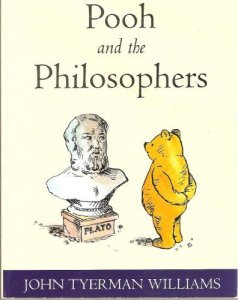
The safest general characterization of the European philosophical tradi- tion is that it consists of a series of footnotes to Plato. I do not mean the. systematic scheme of thought which scholars have doubtfully extracted from his writings. I allude to the wealth of general ideas scattered through them. His personal endowments, his wide opportunities for experience at a great period of civilization, his inheritance of an intellectual tradition not yet stiffened by excessive systematization, have made his writings an inexhaustible mine of suggestion.

May be at some stage then some people thought they can write a new body text, leaving the area of footnotes. Seeing posters, advertising a new Amazon Echo, I was getting curious what this is about – and looking it up here, I read
Amazon had been developing Echo devices inside its Lab126 offices in Silicon Valley and Cambridge, Massachusetts since at least 2010 in confirmed reports.
And I am wondering if they don’t have any better ideas about spending their time there …? Maybe reducing rubbish heaps instead of filling them up?
Sure, you may thoughtfully ask if I do not have anything better to do than commenting on it. – Yes, I do, and yes I can do and think other things – from a lovely lunch with friends, making jokes while going for a walk to tackling more profound questions, actually trying to define questions and problems instead of providing solutions to problems we do not have.
Hey, listen Mr Steve Amazon Gates, but that is exactly the point: creating and duplicating text blocks, and pretending they are more than footnotes to Plato. They are not more, they are just a stupid way of distracting reading the original – even if we are told we can make things our own.
And they are ways of distracting from reality, whitewashing as it was called, photoshopping as it is called.
Without distraction, we may then read in Plato’s Republic:
If the entire soul, then, follows without rebellion the part which loves wisdom, the result is that in general each part can carry out its own function—can be just, in other words—and in particular each is able to enjoy pleasures which are its own, the best, and, as far as possible, the truest. … When one of the other parts takes control, there are two results: it fails to discover its own proper pleasure, and it compels the other parts to pursue a pleasure which is not their own, and not true.
It continues:
In which case, I imagine, the tyrant will be furthest removed from true pleasure – how own proper pleasure – while the king will be the least far removed.
  • We have to add: there and then the king, the ideal king, was understood as philosopher.
  • We have to ‘complete’ from today that the market is our contemporary tyrant.
  • – it is surely worthwhile for everybody to read a bit further, to be ore precise to read what had been written before the quoted conclusion had been made.
So, looking at Plato’s teacher, we may have to accept the following:
Standards of beauty are different in different eras, and in Socrates’s time beauty could easily be measured by the standard of the gods, stately, proportionate sculptures of whom had been adorning the Athenian acropolis since about the time Socrates reached the age of thirty. Good looks and proper bearing were important to a man’s political prospects, for beauty and goodness were linked in the popular imagination. The extant sources agree that Socrates was profoundly ugly, resembling a satyr more than a man—and resembling not at all the statues that turned up later in ancient times and now grace Internet sites and the covers of books. He had wide-set, bulging eyes that darted sideways and enabled him, like a crab, to see not only what was straight ahead, but what was beside him as well; a flat, upturned nose with flaring nostrils; and large fleshy lips like an ass. Socrates let his hair grow long, Spartan-style (even while Athens and Sparta were at war), and went about barefoot and unwashed, carrying a stick and looking arrogant. He didn’t change his clothes but efficiently wore in the daytime what he covered himself with at night. Something was peculiar about his gait as well, sometimes described as a swagger so intimidating that enemy soldiers kept their distance. He was impervious to the effects of alcohol and cold, but this made him an object of suspicion to his fellow soldiers on campaign.
We still speak of them, admiring, criticising and even with this acknowledging their ongoing meaning. We will not know, but may ask: who will really admire, criticise and with this acknowledge Mr Steve, when possibly standing in about 2500 years at some gates that open the way across the amazon.
For my part, I am happy coexist merely as footnote, even as footnote of footnotes – and of course, I am happy when I can help students and scholars a little bit to understand the body texts of humankind and their meaning [for] today.

Magic small numbers

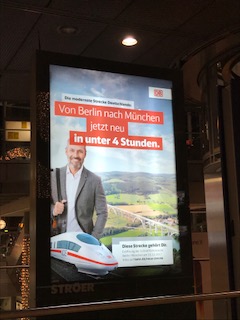
Friday I returned from Berlin to Munich – apparently I was going the new route [though still not the new speed] which is today opened with new trains and new time schedules this had been celebrated on the eighth in Berlin.

From the tenth of December it takes less than four hours to go that route. Going on the sixth to Berlin, the ‘back route’, was a bit more ‘the old style’: slower, especially through some mountainous areas, nice especially where there had been some snow veiling the trees …

From yesterday then: Berlin – Munich in less than four hours. New trains I assume, tightened rails I suppose, new schedules for sure, new staff may be …? Of course that shortening of the journey is a great disadvantage. On the other hand, there is no opportunity, no reason to look out of the window. The magic four: every four years elections; every four month amending laws; every four weeks a new diploma; every four days we may get a new job …, if we get one; every four hours we read entire libraries, summarised in some wiki.

– May be think about some new expression: to wiki a book = put it into a easily digestible format that does not need long intellectual chewing. Al this is about even on earth even? Trains with heavenly speed as their is no reason to fly? Thoughts flying into the brain like roasted pigeons flying into the mouth in the land behind the gingerbread-wall of paradise … – Mind, the synonym is to veil a book. As mutes the synonym for the paradisal pigeon may just be fast-food.

– No, I am afar from praising any good old times, times that never really existed anyway … I am leaning back, quite comfortably … – the …, well, once these people had been called rain conductor … walks along the corridor.

‘Coffee …? Anybody want a coffee ….?

I do not ask for one, thinking about one often quoted passage from Keynes, that surely will also be present in the wiki-libreria:

But this long run is a misleading guide to current affairs. In the long run we are all dead. Economists set themselves too easy, too useless a task, if in tempestuous seasons they can only tell us, that when the storm is long past, the ocean is flat again. [A Tract on Monetary Reform (1923)]

Looking at Keynes unwikied, didn’t he mean implicitly: of we only look at wikied policy measures – short and short-lived, we are not able to solve the underlying problems. And there are good reasons to look out of the window – or read entire books – before writing and boxing. Well, all this is surely also about skills and knowledge.

Well, there is a difference between expresso and espresso. And ever trust anybody who promises to make a nice expresso, very quick.