‘BEING ECONOMIST’ – AN INTERVIEW

[to the recording]

[see also here for some reflections on academic work]

Peter Herrmann教授,班戈学院金融学专业教师

2015年夏,曾任中国浙江大学公共事务学院高级外国专家

2015年春季,俄罗斯普列汉诺夫经济大学(Plekhanov Rusian University of Economics)客座教授

2012年起 匈牙利布达佩斯考文纽斯大学(Corvinus Univesity经济学院访问学者

Peter Herrmann教授曾在世界多个国家任教,包括俄罗斯、匈牙利、德国等,主要研究领域为宏观经济学,微观经济学,政治与社会学。

读万卷书,行万里路。Peter Herrmann教授给我的第一印象是,一个高挑的学者,脖子上随性地搭着一条意大利风格的围巾,手里握着一把雨伞,一举一动都让我觉得有一种“大师”的风范。


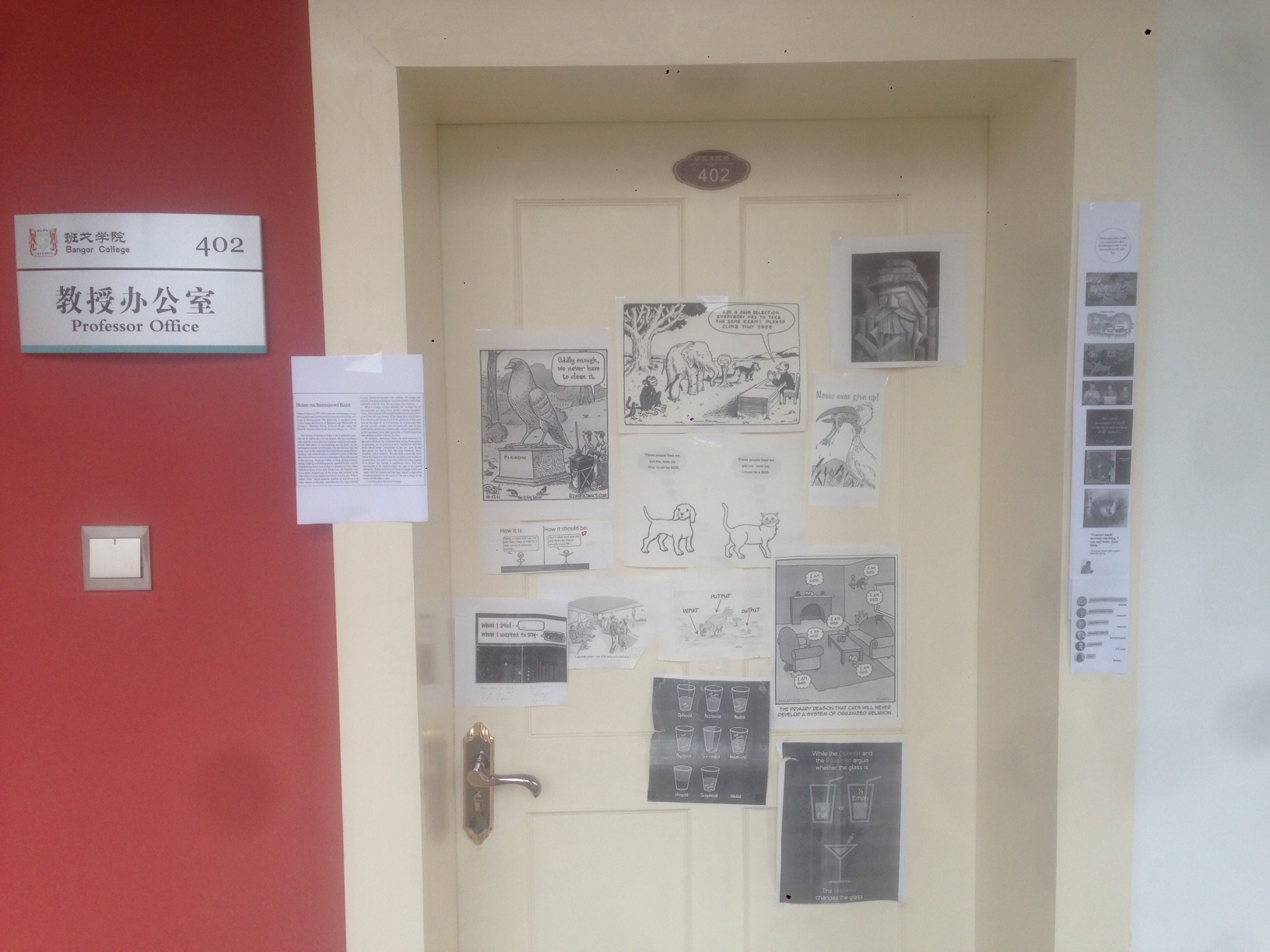
这次,Herrmann教授接受了小编的采访。小编一行人来到Herrmann教授的办公室,发现整个办公室都被悠悠轻放着的意大利音乐所包围,配着门上贴着的经济学卡通画像。就这样,一位教授把自己的办公处变成了一处带有艺术气息的地方。


Q

请问教授当初是怎么想到以后都要从事经济学领域研究的呢?总体上来说认为经济学是一门什么样的学科呢?

A

我当初做这个选择是很多因素的结合,可以说是我的热情所在与当时的政治动机相结合。

我认为经济学是一门研究组织关系的学科。关于经济学的作用,我认为可以从两个方面来概括。一个是形成经济价值观,另一个是研究隐藏在世界背后的逻辑,明白世间万物都是相互联系的。

Q

经济学学习,您对班戈学院的学生有什么好的建议吗?

A:

我有两条建议:第一,多阅读世界历史;第二,努力去探索人们的价值观是什么,人们所创造的万物中什么是美。

第二,不仅要阅读,而且要思考、要学会去观察世界并且将自身投入其中。要擅于抓住机会去做许多的尝试,而不是被父母推着向前走。此外,不要害怕犯错,因为你可以从错误中汲取经验,而且经济与我们的生活是息息相关的。

Herrmann教授也谈到了自己女儿小时候的故事。有一天当女儿走在路上看到了一只蜗牛,不是选择绕开,而是理解女儿的好奇心。让她静静地看着那只蜗牛,去观察它。去看那只蜗牛在做什么,去体会它怎么动的,之后当你有了好奇心你便会有更多的动力去学更多去了解更多。


之后,采访小组成员还与Herrmann教授一起讨论了当今中国的热点话题“共享经济”。

Herrmann教授分享了一个他对共享的认识。他向我们介绍在国外有一个网站,可以联系到其他国家的人来share accommodation,当你外出旅行不需要住在家里的时候。这是他对“共享”的认识。

采访尾声,Herrmann教授对班戈学院学生的评价比较高,他认为班戈学院的学生都非常努力,但希望学生们能够把理论与实践相结合;他相信,在老师们的教导下,在同学们的努力下,一定能够取得好的成绩。

****

看完今天的推送,大家是否对我们亲爱的Herrmann教授有了更多的了解呢?

在班戈学院,你有喜欢的老师吗?

TA们在你们眼中又是怎样的呢?

欢迎留言哟(*^__^*)

Living in and for academia – an international[ist] perspective

Published is a presentation given on the 4th of July in ChangSha, PRC, looking against the personal background from an academic perspective at the topic of international and global education. While sociology, economics, political science, law and arts are explicitly mentioned, philosophy remains as companion of all in the background. Highlighted is the need to regain and maintain academic integrity.

The video-recording, in some respect an extension to the interview published recently, can be found here.

Learned from the time I lived in Australia, and altered all this is not least about the statement that

I fully acknowledge the Right and Duty of the students to learn in a way that allows not only to administer their own life and land in a globally respectful way, to study the possibilities to work and connect with the world that is respectful against themselves, against their fellow beings past, present and emerging.

On studying, teaching, responsibility … and a bit on economy and economics

Students at Bangor College China asked me for an interview – some would say it is about god and the world – but that is not really an appropriate wording when it comes to talking with an atheist about studying, teaching and responsibility, is it?

It may well be of interests to a wider audience — trying to make sense of studying today. And it surely links to many other statements made on various occasions of looking for firm grounds in a world of flux.

The students:

采访:李雨欣 彭博 龚佳亮 刘佳浩

文字:李雨欣

编辑:章孛

… to the point …

Well, you may say I am burning in the Heraclitean Fire, carried away and not doing what the academic world-order asks me to do – moving on with the metaphor, one may add: this little bit of disobedience is like playing with fire, a dangerous not to say: life threatening game.

So to the point, reading Erwin Chargaff’s

Heraclitean Fire: Sketches from a Life Before Nature.

He refers on page 171 to another work by himself**, which he wrote earlier and where he contended:

The fashion of our times favors dogmas. Since a dogma is something that everybody is expected to accept, this has led to the incredible monotony of our journals. Very often it is sufficient for me to read the title of a paper in order to reconstruct its summary and even some of the graphs. Most of these papers are very competent; they use the same techniques and arrive at the same results. This is then called the confirmation of a scientific fact. Every few years the techniques change; and then everybody will use the new techniques and confirm a new set of facts. This is called the progress of science. Whatever originality there may be must be hidden in the crevices of an all-embracing conventional makeshift: a huge kitchen midden in which the successive layers of scientific habitation will be dated easily through the various apparatuses and devices and tricks, and even more through the several concepts and terms and slogans, that were fashionable at a given moment.

Chargaff’s book had been published in 1978, he was, as widely known, professor in biochemistry, he emigrated from fascist Germany … – and one may ask if it is purely by accident that with this background already

[a]s early as 1949, this eminent scientist described certain irregularities in the composition of DNA and formulated the concept of ‘complementarity’ – later referred to as ‘Chrgaff’s rule’ and still later as ‘base pairing’ – which was the most important single piece of evidence for the double-helical structure of DNA’ [from the book-cover blurb].

‘Back to the fire’ – what he states, looking at methods, can cum grains salis also said for today and social science: where ‘methodology’ chapters in theses too often present methods, not showing any awareness of the difference between method and methodology, where publications and universities and people are ranked on the basis of algorithms and where entities are cut into pieces, making us forget the following:

The insufficiency of all biological experimentation, when confronted with the vastness of life, is often considered to be redeemed by recourse to a firm methodology. But definite procedures presuppose highly limited objects; and the supremacy of “method” has led to what could be called by an excellent neo-German term the Kleinkariertheit (piddling pedantry) of much present-day biological research. The availability of a large number of established methods serves, in fact, in modern science often as a surrogate of thought. Many researchers now apply methods whose rationale they do not understand. [170]

*****

End of term, and of the academic year – students, sometimes inviting lecturers, celebrating; preparing for holidays, but also asking for references, preparing the next career moves.

I have to admit, I am am happy that some say they did not ‘invite me to their celebration’ but invited me ‘to celebrate with them’; and I also have to admit that it is an honour to be seen by some as 老师, as lǎoshī – a bit like the hojam as we use it at ODTU in Ankara.

An unwritten chapter for the

Diary from a Journey into another World: Diaries against nationalism, inspired by trying to overcome personal resentments

to be closed.

======

** Chargaff, E. 1965. On Some of the Biological Consequences of Base-pairing in the Nucleic Acids. In: M.D. Anderson (Ed.), Developmentn.l and Metabolic Control Mechanisms and Neoplasw. Baltimore: Williams and Wilkins, p. 19.


preparing … – slowly but surely

As the time here is coming to an end, and as there will be many things just before leaving – a conference on education, a skype-participation in an event that is linked to the G20-summit, a ‘larger birthday party’ – not only Smith in Beijing [see also here], but also the Royal House in ChangSha – I started already grabbing things together, this way hoping to reduce end-of-time hectic. Part is the ‘selection’, the question: what to take with me, what to leave here, not least about the little presents and memorabiles …, little souvenirs, presents as the figurines Jenny nearly dedicated to me, from Antoine de Saint-Exupéry’s The Little Prince, Jiaying’s handwritten [or does one say hand-calligraphyied] poem: a copy of the ancient piece.


Well, looking at the translation I have[1], reading the last lines, I am wondering, I am wondering if it had been written for me, written for these days:

Younger than they, I have my hair all turned gray.

Life is but like a passing dream,

I’d drink to the moon which once saw them on the stream.

There is also a box with photos – Gerhard gave it to me as present, when we once met during the last years, on one occasion, when I had to visit Europe. Another poem, on the lid of the box, reading it I hesitate:

Tidying up

Here some letters, manuscripts,

mostly fragments, photographies –

but who can, after I left,

name the persons?

(Hans Bender)

Some other ‘souvenirs’ – immaterial, though very real as the seeming eternal replay of the Trials and Tribulations: memories, thoughts, fears, hopes, disappointments and appointments –  – a few answers and many questions …, the replay, lacking the reply …

and you can, after I left,

and you have to find the answers!!

=====

[1]

“The Charms of Niannu”

Su Shi

The great river eastward flows, with its waves are gone all those gallant heroes of bygone years.

West of the ancient fortress appears the Red Cliff.

Here General Zhou won his early fame when the Three Kingdoms were all aflame.

Jagged rocks tower in the air, swashing waves beat on the shore, rolling up a thousand heaps of snow.

To match the hills and the river so fair,

How many heroes brave of yore made a great show!

I fancy General Zhou at the height of his success, with a plume fan in hand,

In a silk hood, so brave and bright, laughing and jesting with his bride so fair,

While enemy ships were destroyed as planned like shadowy castles in the air.

Should their souls revisit this land, sentimental, his wife would laugh to say,

Younger than they, I have my hair all turned gray.

Life is but like a passing dream,

I’d drink to the moon which once saw them on the stream.

knowledge, education, digitalisation, information …

… or what is all this about?

Just stumbling upon the two more or less recent publications:

Peter   Herrmann,   Fan   Hong, and Remi Rzepka: Education in an International Setting. In Leonid E. Grinin, Ilya V. Ilyin, Peter Herrmann,   and   Andrey   V.   Korotayev   (eds.), Globalistics and Globalization Studies: Global Transformations and Global Future: 76-92. Volgograd: ‘Uchitel’ Publishing House, 2016

In this volume there is also a co-authored introduction:

Leonid Grinin, Ilya Ilyin, Peter Herrmann, and Andrey Korotayev: Introduction. How Global Can Be Global Future? In Leonid E. Grinin, Ilya V. Ilyin, Peter Herrmann,   and   Andrey   V.   Korotayev   (eds.), Globalistics and Globalization Studies: Global Transformations and Global Future. Volgograd: ‘Uchitel’ Publishing House, 2016: 5–9

Для дополнительной информации

….

Working now a bit more on this topic, also for the conference

Education and Globalization – Opportunities and Challenges

教育与全球化 – 机遇与挑战

organised by

  • Central South University of Forestry and Technology中南林业科技大学
  • Bangor University班戈大学
  • British Consulate-General in Guangzhou英国驻广州总领事馆

and scheduled for the 5th of July, 2017.

All that will then be middle of this month available on my other sites – here and here, also a bit more from another side … .

… first want to close this door behind me, with a bit more time then.


At least somewhat ‘strange’ or: occupying the occupied

At least somewhat ‘strange’ – or at least remarkable: the fact of being occupied by social spaces and occupying social spaces, namely cities.

It is several years ago that I visited Vienna the first time, and I returned a couple of times. The first time was somewhat unpleasant – unpleasant in terms of disliking the place as exhibiting imperial power. Indeed, having known Budapest already, I joined in the popular saying: Budapest is the ‘nicer Vienna’. The nicer Vienna because it was seen as the city where people, real people, would live. One could surely move towards issues like the ‘Hungarian soul’: a bit of permanent resistance and suffering going hand in hand – Leiden, dass dann führt zu Leidenschaft und Leidenschaft, die Leiden schafft.

Vienna … a space that presented itself to me as occupying, remaining unapproachable, remote … . Anyway, what did it matter? It had been another business trip amongst many. Not so on one later occasion. Actually it may be that I went there for business but in the meantime a friend of mine, Viennese whom I knew for many years from Brussels, lived in Vienna again and I remember that I stayed in his apartment. Another district, in short: Working class Vienna. Much could be said … In a nutshell it was the experience that allowed me to occupy space. Sure, local knowledge helped – the ‘local guide’ who showed me also those places next to the ‘imperial exhibits’: the people’s park, one or the other coffeehouse: and as much as Vienna is shaped by the gallant Cafe Centrale, Vienna is characterised by those Kaffeehäuser that are a bit dingy, humming along with the croaking sound of the violin, the waiters apparently competing in ignoring the guests, the Volksbuhne and those spaces that are occupied the peculiar charm of bohemian, intellectual, critical debates …

Anyway, I returned later on different occasions, stayed in different quarters, though mostly in district VII and VIII. The city gained space, I gave it space in my life even if only for the short times of my stays, always remaining visitor even barely coming as tourist – it had been about short business trips to the government, to conferences, or as the last time for teaching … and of course unforgettable: one year the visit with my students and my friend Joe.

The city gained space, I gave it space in my life …. – even visiting the imperial places as the museum of history of arts – a specifically lost ground which, by the way, hosts also a beautiful collection of Pieter Bruegel’s the older works –, the Albertina and its private collection, the state opera, the Burgtheater and yes, the Cafe Centrale, I visited as well the people’s park, the People’s opera, and the several small galleries and theaters, local stages, the Kaffeehäuser and restaurants … Mixing, merging … becoming a place where the different circles of debates, culture, ordinariness are emerging as a new normal, merging as living space, lived space for some time – not necessarily to be agreed with, but to a large part challenging, demanding to be … occupied again and again.

*****

And Budapest? – Yes, it is still, with its own eccentricities, the beloved place, also the place to meet a good friend …, and yes, there is the shadow of de-occupation: the city loosing its very specific charm which I learned to love, I tried to capture a little bit in the Diary from a Journey into another World: Diaries against nationalism, inspired by trying to overcome personal resentments.

challenges – attempts to move forward

05/05/17

Attributed to Johann Caspar Lavater, the words

Those who do not strive to move forward, are not taking themselves seriously

are at the House of Science in Bremen. It is the venue of yesterday’s symposium to honour Rudolf Hickel.

The symposium is aiming on addressing the

Herausforderungen für Politik und ökonomische Wissenschaft im 21. Jahrhundert/ Challenges for politics and scientific economic disciplines in the 21st century.

The event was organised by the University of Bremen, its Institute for Labour and Economy and the Arbeiterkammer Bremen.

In particular André Heinemann put a huge effort into compiling an interesting programme. – And actually he brought me back to Bremen, to the university, from which I obtained my doctorate. A long way if you want as André and myself actually met on occasion of the Shanghai Forum.


Importantly, the sessions and the overall event aimed on creating some space for really reflecting on some of the issues, allowing for more than presentations and Q&As only, and furthermore crossing borders. This did not (only) mean to look at wider issues of political economy but also emphasising the need of developing questions. The evening before we had been actually sitting together, mocking about parts of the current mainstream:

It is not really so important to have a question. Relevant is having data – and then you can define a question from calculating the data in some way that allows you to arrive at some interesting result.

Of course, some answers had been given during the event; and many questions had been raised. For my part, I was continuing [here and here frequently updated information the work] to ventilate the issue of precarity, in this case in close connection with the challenges posed by ‘Industry 4.0’. Soon an update will follow – linking to a text with some background considerations on the topic, titled

Beklagen von Prekarität oder Forderung nach neuen Sicherheiten/Sicherungsstrukturen – Herausforderungen durch Industrie 4.0

the audio recording of the presentation of during the symposium is available and another, more extensive presentation, to be given in early next week in Changsha will follow.

First, back to my students in Vienna … – teaching European integration at times of increasingly disintegrating pressures an interesting topic.

A Debate

It is – in its own right – an interesting question why and how some ‘books make a career’ – in this case referring to Mazzucato’s ‘The Entrepreneurial State’. I am always skeptical when hearing about such ‘bestsellers’ and actually really hesitant to read, let alone to buy them. Having been invited to take part in a debate on the book I read the text – and now I am somewhat surmised to see that my ‘prejudice’ is in actual fact very much a ‘judice’, i.e. a reflection confirmed by this reading experience. There is not much new in it – it surely summarises important points, and even more sure is that it’s radical character has to be seen in ensuring that there will be no radical change.

Some points from the debate my be of some wider interest – and what follows is not a systematic critique of Mazzucato’s work or even one of the ‘one book’.
The foundation from which her argument is developed remains by and large unclear: there is a bit of economics, some political economy, some political theory and some philosophy and … a lot of confusion caused by not developing from all the wealth of borrowings a systemic approach. Thus, the possible wealth of a merger is lost to eclecticism. And the loss – or wasted opportunity – is even larger when considering the shallow reception of some of the references … – yes, of course, the Smithian ‘invisible hand’, which is taken out of its original context and supposedly suggests that Smith rejected any state intervention – generally and fundamentally and for everybody and at any time. It is not quite true, and leaving aside that there is a
Book V: Of the Revenue of the Sovereign or Commonwealth
there is in my reading of Smith another relevant point. He left with us another major piece of work, namely the
THEORY OF MORAL SENTIMENTS. An Essay towards an Analysis of the Principles by which Men naturally judge concerning the Conduct and Character, first of their Neighbours, and afterwards of themselves. TO WHICH IS ADDED, A Differentiation on the Origin of Language
In some way this was one of the genius acts: splitting the task in order to maintain through the backdoor its unity … – and much later this allowed him, namely Smith, to turn up in Beijing, with this remark I am obviously alluding to the highly interesting book
ADAM SMITH IN BEIJING. Lineages of the Twenty-First Century by Giovanni Arrighi. 
Discussing in this context secular stagnation: if one really wants to address this in a radical way, one has to take note of much more radical views, as expressed already a long time ago, for instance by Keynes – here reference is usually made to his writing on the
Economic Possibilities of our Grandchildren
and even earlier by Mill [for instance in chapter xi ‘Of the Law of the Increase of Capital’ in his
Principles of Political Economy with Some of Their Applications to Social Philosophy].
Such radical ideas, however, are just what Mazzucato strictly rejects – instead she searches for ways that ensure that there is no ‘quasi-blasphemic’ attitude and politics towards the gods of eternal growth. And her proposal is that, if laymen’s activities are not sufficient, the entrepreneurial state could emerge as high priest, collecting the lost sheep, developing new grazing lands for their new thriving.
Indeed, there are interesting facts on the cowardliness of the stray sheep …, risk averse behaviour which are expressed in the statement
I think there is a world market for maybe five computers,
allegedly said 1943 by Thomas Watson, chairman and CEO of International Business Machines (IBM). The entirety of the  story, beyond the exiting individual chapters, is not much more than overcoming the stagnation of the history of great men by pulling now women on the same stage, while actually the real problems are about the need of changing the stage. Green growth remains commodity growth, regulated and controlled data extraction remains data extraction, prone to abuse and in need of a real public, common ownership, going much beyond the provision of a seedbed for renewed private profitability, retrieving new sources of value production needs a new understanding of what value is about, going beyond the concept of exchange values only.
The one fundamental problem with the work I see is as follows: As one of the colleagues mentioned during the discussion here in Vienna, he reads the text as reference to the rejection of private entrepreneurs to accept sitting down at the roulette table. And I would agree with such interpretation to some extent – to the extent to which we are talking about the simple game, played by simple minds. The limitation of such metaphor is soon showing up: While accepting ‘The Entrepreneurial State’, thus following Mazzucato’s suggestion, we would be accepting the specific hegemony, i.e. the need and justification of downgrading ourselves to the Dostoyevsky’ian Gamblers, in other words: the acceptance of a new round of what became known as casino capitalism.
It is the acceptance of the reality that I saw expressed in the slogan which was spray-painted on one o the walls:
…. Human capital of all countries, accumulate …

Dulcinea …

PS: why we all need our Dulcinea … – or: carrying on the dream.
May-day not anymore … – back to everyday …!! ??
Facts are the enemies of truth
as Cervantes says in his defense … – And he says
it is the most severe frenzy to see life as it is and not as it should be.
Sure, there are two versions of it … the one idealistically glorifying things by white washing, the other demanding, fighting for the visions that are hidden as germs in the dung heap through which, according to Dulcinea, we walk.
And this is, why at the end, she beckons to be Dulcinea, not Aldonza anymore ….
… nous sommes …
– at least we have to try! Try together … as
only when everything is said and done, one is alone
[as I found it remarked in the Schiele-exhibition, at the moment in the Albertina]