Variations*: Omne ens habet aliquod esse proprium

– every entity has a singular essence(Johannes Duns Scotus, Opera Omina [1266 à Duns 1308] quoted in: Suarez-Nani, Tiziana: Pietro Pomponazzi et Jenas Duns Scot critiques de Thomas d’Aquin; in: Biard, Joel/Gontier, Thierry (dir.): Pietro Pomponazzi entre traditions et innovations; Amsterdam/Philadelphia: B.R. Gruener Publishing, 2009: 29-67; here:  33)

or: About Academic Responsibility between Dynamics and Statics.
*****

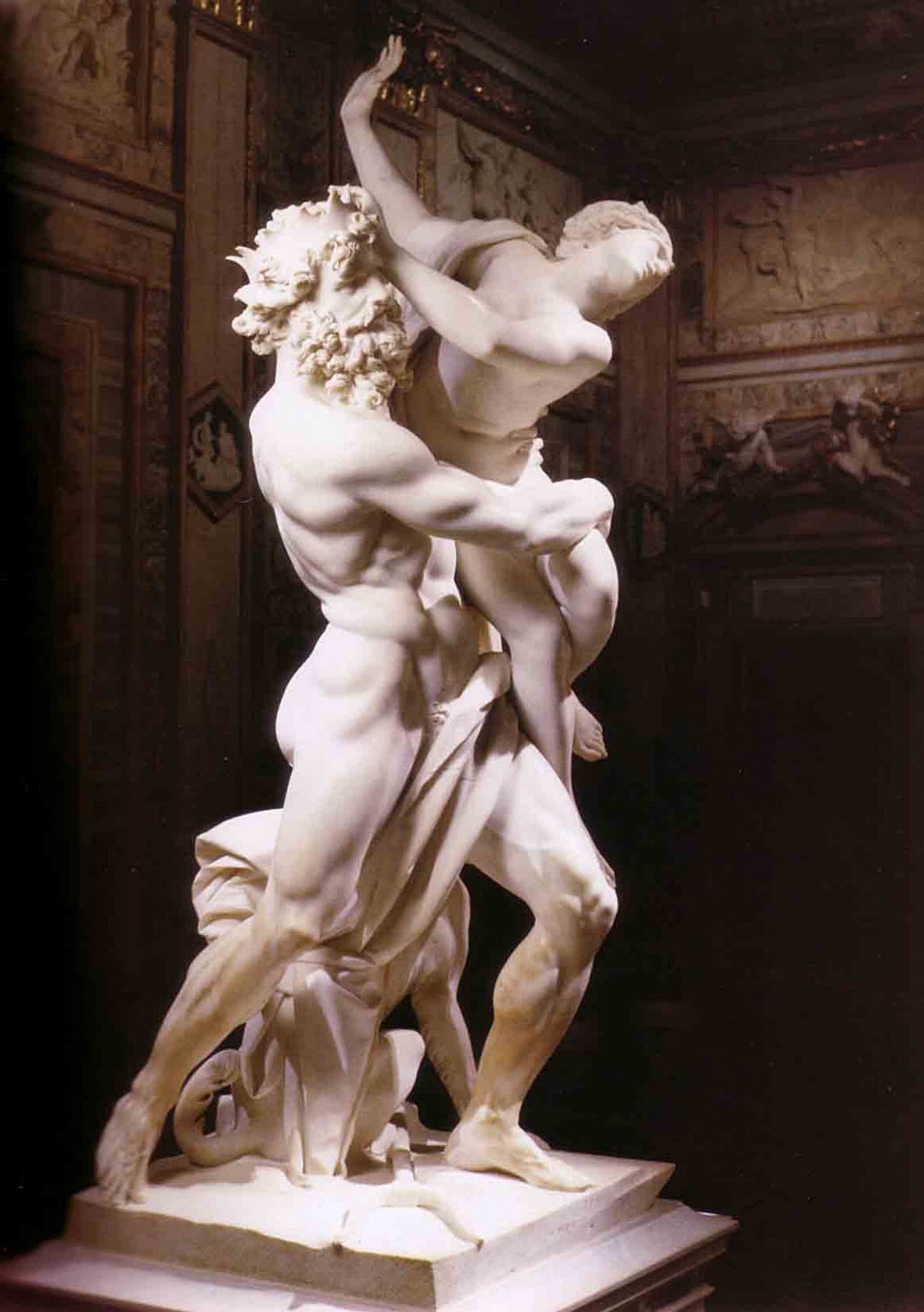
Recently I had to go to Rome – and if ever possible I take it as opportunity at least for a short visit to the Villa Borghese. It is actually not really about visiting the palace and the multitude of exhibits, most of them surely admirable objects in their own right. My visit there is usually solely dedicated to Gian Lorenzo Bernini’s statue Ratto di Proserpina – the rape of Proserpina.[1]

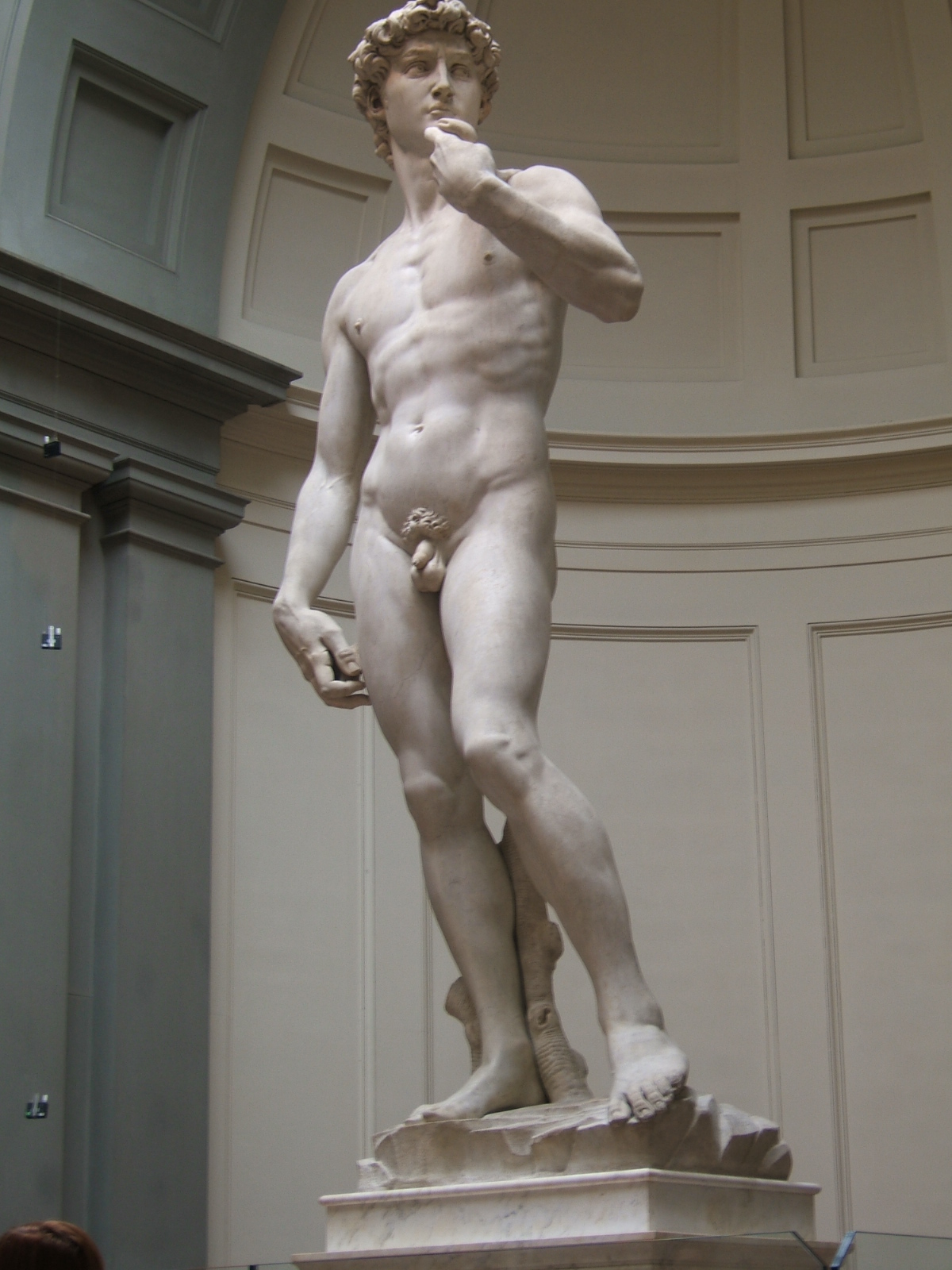
It surly is the most dynamic statue I ever saw. For me it is actually not about rape or abduction. Instead, I see it as visualisation of abhorrence of power: the questioning of power and apparent superiority. A woman challenging the given reality by facing it and at the same time refusing to accept it – she turns away from it. Of course, it is easy to see the historical newness – in sculpting and also in societal realities. Bernini’s work is the dialectical repeal of earlier sculptures as for instance Michelangelo di Ludovico Buonarroti Simoni’s masterpiece David.

Supposedly David had been the first free-standing sculpture: firm, independent, disjointed from the environment …. – the beauty and arrogance of the claim of the emerging new era:

Omne ens habet aliquod esse proprium

– every entity has a singular essence

However, paradoxically it had been this new era – the Renaissance and later also the enlightenment – that needed something completely new and even opposing, the upcoming era needed a Proserpina: aware of the abduction, ready to confront herself with this fact because only this allowed to resist. It had been not really about a new moral, about taking a different position. What – in my opinion – Bernini actually expressed is about the opposite: dynamics, allowing the emergence of traction, pulling forces, attraction and surely also the acceptance of possible failure.

In other words the singular essence of every entity is only emerging – and this is the apparent paradox – from the very relationship in which this entity is located and locates itself. And in this light every singular essence is about the dynamic and/or static the entity engages in.

NB: Mentioning dynamics here, I am speaking of statues – not of installations as they are now dominating the arts world. I know that I stand somewhat as a loner in the world of critics, seeing the latter very much as frantic attempt to dynamise the static – frantic like the attempt to use administration as substantial tool. Frantic like using grades and degrees and computerised quotation indices as means of assessing qualification.

*****

Now, something apparently completely different. Recently the German minister for education had been asked to resign – and she even dared to refuse (though finally she had to step back). The background is apparently simple: plagiarism.

But Ulrike Baureithel on the 6th of February in Der Freitag points on a much wider and deeper meaning of the entire debate on an increasing number of leading politicians being caught in comparable scandals – her article is titled Core of the Spectacle. She notes that doctoral dissertations had been for long times already subject to critical disputes. However, in earlier times these disputes had been about substantial matters, highlighting (or searching) political positions that are contestable in terms of political correctness. Baureithel states:

Today politicians do not have to fear to be criticised because of questionable politicial statements they made in works that are already forgotten for long time. Instead, they have to fear the detection of the fact that their statements are not traced back to the original author. This is in an era in which copyrigth is increasingly under pressure and in which blithe transfer of knowledge is advancing to a political flagship rather remarkable.

[Heute müssen sich Politiker nicht mehr vor verdächtigen Inhalten einer längst vergessenen akademischen Arbeit fürchten, sondern davor, den Inhalt nicht auf ihren Urheber zurückgeführt zu haben. Das ist in einer Ära, in der das Urheberrecht wie nie zuvor zur Disposition steht und der unbekümmerte Wissenstransfer zum politischen Aushängeschild avanciert ist, doch immerhin bemerkenswert.]

And indeed it highlights a shift of academic consciousness that marks the fundamental reference of work: it is not about daring ideas, bringing thinking forward, developing original ideas – rather it is about forms. Following this line we easily end in at most positivist research … at most … .

Thus we come now back to the earlier statement:

In other words the singular essence of every entity is only emerging – and this is the apparent paradox – from the very relationship in which this entity is located and locates itself. And in this light every singular essence is about the dynamic and/or static the entity engages in.

And it is exactly here where we find in current academia a new self-localisation. At surface level it is of course about commonly known and accepted matters: the overwhelming influence of management, the financial dependencies and obligations, the constraints within research projects emerging from the conditions for obtaining grants etc.

All this is surely true. But all this is at the end very much about blaming “the other” – a kind of trading indulgences, fading out important parts of our own responsibility as academics – and on this occasion I do not refer primarily to our positioning but to our thinking.

*****

Few of you know me well enough, are aware of the very fact that I am easily getting lost in time, in figures – in general such “hard data” are somewhat meaningless for me. Academically this in some respect of course wanton – isn’t science something “positive”, something that deals with facts as they can be expressed in figures? Sine ira … as Weber said. Still, this “getting lost” has also something that I want to defend – it allows abstractions, something that

separates things out, isolating them from our concerns as social beings immersed in particular cultural practices. As Locke once put it: “Words become general by being made the signs of general ideas: and ideas become general, by separating from them the circumstances of time and place, and any other ideas that may determine them to this or that particular existence.” The problem, however, is that we tend to be interested in things as they exist in a context with others. Indeed, the very word “interest” comes from the Latin inter-esse, which means “to be between,” while the Oxford English Dictionary tells us that the root of “abstraction” denotes a “drawing away from” and that the root of its opposite, “contextual,” means “woven together”.

(Blattberg, Charles, 2009: Patriotic Elaborations: Essays in Practical Philosophy; Montreal/Kingston: McGill-Queen’s University Press: 45; with reference to John Locke, An Essay Concerning Human Understanding, ed. Peter H. Nidditch [Oxford: Oxford University Press, 1979], bk 3, ch. 3, sec. 6)

Very much the same is stated in the comments of an exhibition, I recently visited in Copenhagen:

On the one hand, details cannot be ignored if one wishes to depict reality in a convincing manner. On the other hand, however, focusing on a detail threatens to impede our understanding of how it fits into the overall whole.

(from one of the explanations on the wall of the exhibition ‘detaljer’ in the Statens Museum for Kunst)

All this allows us bringing things together – matchmaking if you want; matchmaking even if the matches are extremely distant. Distant as the German ex-minister is from the Kunsthistorische Museum Wien. Distant in time as my visit there – and distant as the time with which I had been confronted when entering a special exhibition: I had to walk up onto a scaffold close to the wall pantings which had been presented by one of the most contested artists of the early 20th century: Gustav Klimt. To cut a long story short: I stepped up, the leverage of the scaffold covered by a black cloth. Arriving on the platform of the exhibition “face to face”, I had been forced to turn around – a crossroads of which I took the option to rue to the right. Now, not concentrating on stepping up the stairs, I could also lift my head. I experienced a kind of numbing, looking into the eyes of the work of this artist: a goddess, not despising, not inflicting but sending a chill down my spine. Only once before I experienced the very same awe, standing just on my own in front of Picasso’s Guernica (At the time of my visit even the security guards keeping in the background.)

I said before “to cut a long story short” – and I know that this is a frequent mistake: we cut long stories short, we squeeze complex issues into power point presentations. And as much as we are in danger to loose the ability to read handwriting as we a dominated by computer scripts, we are in danger to loose the ability to listen, to look – be it at others or at ourselves. And we loose the ability to bear somebody looking at us. Somebody as the history of Guernica! Somebody as Pallas Athena.

Of course it is challenging – not so much to understand but to accept that understanding actually means that we are permanently questioning ourselves, our practice. And we have to do this not as academic exercise but as matter of questioning what we are doing, how we are acting. Things and people come back, even if they leave us. I read recently, in connection with the death of one of the examiners of my doctoral thesis, Hans Heinz Holz, a statement, contending that the important question is not

… ob man prinzipiell damit einverstanden ist, dass nicht in erster Linie Ideen den Lauf der Dinge bestimmen, Kopfgeburten, sondern die ökonomischen Bedingungen –

… if one is in general agreement that not ideas determine history, …, but the economic conditions –

Important is

ob man auch bereit ist, im Sinne von Gleichheit und Gerechtigkeit Schlüsse daraus zu ziehen

if one is ready to accept practical consequences in the sense of equality and justice

– I write this as something that employed my thinking very much over the last years, a matter that I saw and see as permanent challenge. It is the challenge to develop a truly historical perspective. It is about capturing presence not as such but in a light of history – past, present, future – but as matter of exploring history in the light of the presence and future. It had been exactly this responsibility that I felt while standing in front of Picasso’s Guernica and Klimt’s Pallas Athena. The … – yes, it has been a kind of trauma – this trauma did not come from an explicit or implicit accusation. Instead, it emerged from the implicitly asked question:

What do you do? Are you able to relate or are you only following the relations that are put in front of you? Is your strength about the resisting static self-positioning within a hostile dynamic of the environment or is it about the dynamic movement against a more or less static block as it is characterised by Antonio Gramsci. Stephen Gill, in his work on Power and Resistance in the New World Order (Palgrave, Macmillan – 2002, p. 58) captures it, saying

An historical bloc refers to an historical congruence between material forces, institutions and ideologies, or broadly, an alliance of different class forces politically organized around a set of hegemonic ideas that gave strategic direction and coherence to its constituent elements. Moreover, for a new historical bloc to emerge, its leaders must engage in conscious planned struggle. Any new historical bloc must have not only power within the civil society and economy, it also needs persuasive ideas, arguments and initiatives that build on, catalyze and develop its political networks and organization – not political parties such.

Or, coming back to Hans Heinz Holz: the question of not being

ready to accept practical consequences in the sense of equality and justice

And this surely means to look for new Berninis – for new dynamics that are transcending the given system by openly facing the challenges from within by positi0ning ourselves in a fundamentally critical position – fundamentally critical also meaning: taking positions that may fail but that are open to contest.

*****

Well, nobody said it is easy – and I leave it to you, better: invite you to think about the connection and disconnection between the steady David, supposedly the first statue standing on its own and the dynamics of the Bernini’s Ratto di Proserpina – the woman courageously facing the situation in order to draw away not by way of abstraction but by its opposite: inter-esse, drawing things together by tearing them apart.

Still, I do not want to conclude without some reflection on the issue by myself, directing this matter in particular to an academic audience I may conclude by the following – drawing a very broad line. When I studied we had been captured by the idea of a scientific community. Although we had been – part of and inspired by the revolutionary movements of the late 1960s – critical about such elitist community, we maintained the fundamental notion. And we joined in this critical spirit the various movements that engaged for democratic progress. Moreover we joined in this critical spirit the trade unions and the working class. Sure, this had been an imagined community, and it had been a community that had been full of contradictions. But looking back I think it is fair to say that it had been a community that had been by and large a disputatious community. Personally I remember these contests with and against Luhmann, Offe, Kaufmann, …, to name but a few, people that many of you will also know at least by name. Actually it had been an interesting development at the time: a new science developing and claiming to be acknowledged. Though heated debates took place with conservative colleagues, it had been very much about claims against them – the ongoing quest against the  “mustiness of 1,000 years covered by the gowns of academics” (Unter den Talaren – Muff von 1,000 Jahren). Part of this contest had been surely successful: positions taken, contests taken into the system and finding a stable foundation. However, the crux of history, like Hegel’s ‘cunning of reason’ emerged, cutting the dialectical of enlightenment short of the emancipative side.

So, academia replicated the development of modern society: structures, in the beginning surely necessary, became an “independent force”: a structure, obedient to its own rules, having lost out of sight that it can only then be justified if it maintains practice.

Sure, this is the same as a society that maintains a structuralist take on citizenship, perverting it to such an extent that citizens, the original sovereign of the modern state, are incapable to act. And it is even defined by its structural position, any consideration on practice being pushed aside (see in this context for instance Lister, Ruth, 1997: Citizenship. Feminist Perspectives; Palgrave Macmillan; Houndsmills, 20032: 42; cf. Oldfield, Adrian, 1990: Citizenship and Community. Civic Republicanism and the Modern World; London: Routledge).

Coming back to the two paintings – Athena/Atlas and Guernica: facing history as actual reality, as genuine presence, can hurt – it can severely hurt. Still, it is probably easier to deal with such injuries than to deal with the permanent intoxication, causing a slow death, still leading first to the suicide of social science, then to the suicide of people.

I do not mean this literally. I speak of the danger of accepting to be buried in structures, being battered to death by what had been once necessary, that could claim legitimacy: a steadfast claim of liberty now perverted into an iron cage of commodification ….: dispute seemingly only possible by taking the form of war. That is the dimension of suicide Carin Holmquist and Elisabeth Sundin do not mention, it can be grasped as discerping the quadriga of social science

  • self-critique,
  • critique of the other,
  • critique of processes and
  • critique of structures.

In any case we can see a wide bracket: academic performance – and the lack of it – is measured in PhD-cases and the de-recognition of the degree on grounds of formal rules: originality is only a matter of sufficiently and clearly making reference; impact is measured in computerised citation indices rather than in actual debates; and publication-output is in this narrow-minded attitude only relevant if it is squeezed in the suicidal framework of peer reviewed articles. Books don’t count and subsequently contributions to books do not count – and …

… and the murderers a still free, in well-paid positions in academia and parts of the publishing world with its vested interests …

… and fortunately some woke up, repeal their admiration of the form. It is so to say the move from David to Proserpina, the move from a rigid position to the readiness to move again. Many universities are turning their back against rankings, are looking for innovative publications and are demanding the publication of ‘work in progress’, fostering open source software etc. Those stubborn David’s – having concrete blocks where there should be a creative brain, will at some stage have to face the fact that their static version of enlightenment only pretends vision. However, in reality, at the end of a single-line tunnel the light at the end of it turns out to be the light of the train driving towards us.

It should not be a surprise that under these conditions live becomes deception – we find a line from

  • disavow of historicity to
  • personal self-deception to
  • subordination under form to plagiarism to
  • the loss of responsibility.

With the shift of references to different individualities, thus the loss of social references we loose of course responsibility – not as moral decay but as absurdity of today’s realities. A lengthy statment from Theodor W. Adorno’s Minima Moralia (published 1945 – here refering to the 1951 edition to which Adorno addded a dedication, and taken from the dedication) regains importance:

What the pilosophers once knew as life has become the sphere of private existence and now of mere consumption, dragged along as an appendage of the process of material production, without autonomy or substance of its own. He who wishes to know the truth about life in its immediacy must scrutinize its estranged form, the objective powers that determine individual existence even in its most hidden recesses. To speak immediately of the immediate is to behave much as those novelists who drape their marionettes in imitated bygone passions like cheap jewellery, and make people who are no more component parts of machinery act as if they still had the capacity as subjects, and as if something depended on their actions. Our perspective of life has passed into an ideology which conceals the fact that there is life no longer.

But the relation between life and production, which in reality debases the former to an ephemeral appearance of the latter, is totally absurd. Means and end are inverted.

(Theodor W. Adorno, 1951: Minima Moralia. Reflexions from Damaged Life; translated from the German;London: Verso, 1978: 15)

[Was einmal den Philosophen Leben hieß, ist zur Sphäre des Privaten und dann bloß noch des Konsums geworden, die als Anhang des materiellen Produktionsprozesses, ohne Autonomie und ohne eigene Substanz, mitgeschleift wird. Wer die Wahrheit übers unmittelbare Leben erfahren will, muß dessen entfremdeter Gestalt nachforschen, den objektiven Mächten, die die individuelle Existenz bis ins Verborgenste bestimmen. Redet man unmittelbar vom Unmittelbaren, so verhält man kaum sich anders als jene Romanschreiber, die ihre Marionetten wie mit billigem Schmuck mit den Imitationen der Leidenschaft von ehedem behängen, und Personen, die nichts mehr sind als Bestandstücke der Maschinerie, handeln lassen, als ob sie überhaupt noch als Subjekte handeln könnten, und als ob von ihrem Handeln etwas abhinge. Der Blick aufs Leben ist übergegangen in die Ideologie, die darüber betrügt, daß es keines mehr gibt.

Aber das Verhältnis von Leben und Produktion, das jenes real herabsetzt zur ephemeren Erscheinung von dieser, ist vollendet widersinnig. Mittel und Zweck werden vertauscht.]

++++++++++++++++++

* This is very much another approch to questions that had been recently issued in another post.


[1]            The translation is not quite clear. It is sometimes also translated as ‘abduction’, not ‘rape’.

REINVENTING THE WHEEL OR SQUARING THE CIRCLE – SUSTAINABLE SOCIAL QUALITY VS SOCIAL POLICY

Notes in Connection with a Presentation on Occasion of Retiring from University College Cork, School of Applied Social Studies

Introduction

Social policy arrives frequently at junctures, being a non-discipline, bordering and combining elements from various other disciplines. The presentation will look at two major challenges:

(1) Academic work frequently overlooks that division of labour, i.e. the establishment of subjects in research and teaching is also about disciplining. But is the notion of Spinoza’s time, suggesting that Omne ens habet aliquod esse proprium – every entity has a singular essence is true? Who and what is setting the references?

(2) Part of the process of (self-)disciplining is about defining points of references. The ongoing challenge is not least about balancing politics and policies. Sustainable Social Quality is an attempt to integrate these dimensions.

(3) To arrive at the trinity, that we have to look for a definite point of reference in societal practice not (only) as matter of analysis but also by way of taking the role of “organic intellectuals” (Gramsci)

It is another attempt – after many predecessors, and competing with other paradigms. So are we then just reinventing the wheel or squaring the circle?

The presentation will, of course, not provide the answers – but it may be able to put forward some questions that need attention and demand us as collective to thoroughly think about.

Language matters – and it is also important to look at from where language actually comes – easily seen by Norbert, being asked for a power point presentation. Well, yes, here it is

In general and for the purpose of this presentation we should not establish too high expectations: take things as they are said – and be aware of the fact that they are stated in a very specific socio-historical context. In order to understand this, the presentation will occasionally make some inspiring detours – hopefully allowing also enjoying some beauties of life that carry historical messages about structure and change – be aware: exploring the beauty of history and the meaning of society takes time, requires patience …

Although we may say that it goes without saying, we are frequently forgetting the deep meaning of exactly this fact: In any scientific work we are dealing with both, structure and process.

*****

We may usefully start from Aristotle’s zoon politicon, the human being seen as social being. This does not simply look at the interaction between human beings – surely an important factor. There are already difficulties as it is not clear in which way the politicon has to be interpreted. There is both, the reference to the state, to politics and to a very general understanding of togetherness, interaction.

Importantly it is clear that with all this we are not least acting beings – only our own action, i.e. societal practice actually defines our very existence. Thus includes the ability not to act. Now, we may think of Friedrich Schiller who sees the highest form of existence, as

man only plays when in the full meaning of the word he is a man, and he is only completely a man when he plays.

(Schiller, letters, XV/9)

Here we surely find a complex understanding dealing with regaining power over the will not only by way of control, i.e. oppression, but by way of developed forms of free play.

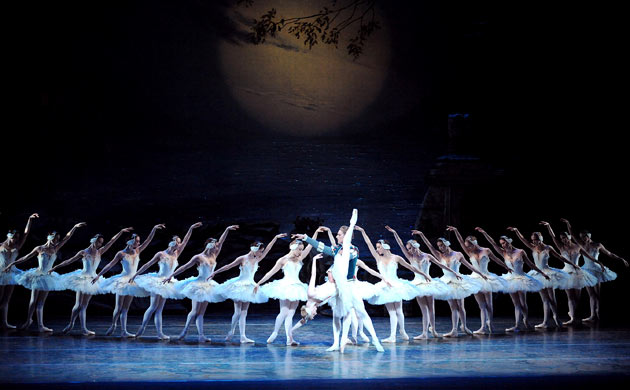
– What do we commonly think when it comes to these terms: play, freedom …? Children, unhindered in their naïveté is in may cases likely the first connotation. And the second connotation may be the artful play of … – for instance the reasonably uncontested beauty of a harmonious dance.

It is the beauty of clarity, order and balance. It seems to be a self-explanatory approach, allowing us to accept without asking, looking at something that has its own order, being independent. Probably this is part of our tendency to perversely celebrate power: the monuments of past and present oppression – yes, I had been in the German Reichstag not only due to business, and part of the study trips I did with the students here from Cork had always been the admiration of some of these ‘monuments’, the last one the most impressive town hall in Paris.

It is the admiration of something able to stand without support. Supposedly in sculpturing Michelangelo’s statue David is a very early example for such order: the first free-standing statue, the young man standing on his own. As such, standing upright, the statue had been sending a strong – and actually hugely contested – message.

As the Florentine chronicler Luca Landucci noted in his diary, stones were thrown at the collossal sculpture even if it was being transported from the Office of Works, so that a guard had to be mounted to protect it.

Importantly

The stone-throwing youth’s came from pro-Medici families for whom the prospect of a figure with republican connotations being installed in front of the seat of the Florentine government must have been thorougly unpalatable.

(Zoellner, Frank/Thoenes, Christoph, 2007: Michelangelo. 1475-1564. Life and Work; Koeln:Taschen, 2007/2010: 46)

Giorgio Vasari chronicled in this context a little story that has some metaphorical meaning.

It happened at this time that Piero Soderini, having seen it (the statue, P.H.) in place, was well pleased with it, but said to Michelangelo, at a moment when he was retouching it in certain parts, that it seemed to him that the nose of the figure was too thick. Michelangelo noticed that the Gonfalonier was beneath the Giant, and that his point of view prevented him from seeing it properly; but in order to satisfy him he climbed upon the staging, which was against the shoulders, and quickly took up a chisel in his left hand, with a little of the marble-dust that lay upon the planks of the staging, and then, beginning to strike lightly with the chisel, let fall the dust little by little, nor changed the nose a whit from the what it was before. Then, looking down at the Gonfalonier, who stood watching him, he said, ‘Look at it now.’ ‘I like it better,’ said the Gonfalonier, ‘you have given it life.’ And so Michelangelo came down, laughing to himself at having satisfied that lord, for he had compassion on those, who, in order to appear full of knowledge, talk about things of which they know nothing.

(Vasari, Giorgio, 1568: Lives of Painters, sculptors and architects. Vol 2: translated by Gaston du C. de Vere. With an Introduction and Notes by David Ekserdjian; New York et altera: Alfred Knopf, 1996: 654 f.)

From here it takes some steps to the question of the disciplining effects of which I promised to talk. But with a little bit of common sense, putting away the cultural bias it will actually be soon clear.

  • One of the fundamental demands put forward in science is concerned with the discovery of structures that are characterising any given reality. Methodologically this is a complex process – and speaking of methods it seems to be a rather simple matter of the famous bean counting. And with the latter we usually overlook that even the counting of beans isn’t as simple and without presumptions as we like to see it. On the contrary – and I quote Joe Finnerty

one of the most effective applications of indicators is not merely to describe but also to analyse, thereby sometimes changing the definition of a problem.

(Finnerty, Joseph, 2005: Social Indicators: Pitfalls ad Promise; in: Herrmann, Peter (ed.): Utopia between Corrupted Public Responsibility and Contested Modernisation. Globalisation and Social Responsibility; New York: Nova Science Publ.; 61-76; here: 69)

  • With this we arrive at the fact that paradoxically a second and simultaneous fundamental rule of science is construction – though analysing reality, this reality isd also constructed by the process if selection and combination. If we focus on elementarity as core moment of the research process, i.e. if we look for what is elementary, we are always applying a histrocial and social (class) dimension.
  • The story of David and Michelangelo’s presentation captures both, the determination of structure based on some form of de-construction and the construction according to the interest that is standing behind research:
  • * David stands in front of his colossal enemy, finding the small point of his vulnerability: the gap through which he could throw the fatal stone
  • * Michelangelo interpreted this: emphasising David’s beauty, virginity and power: a firm independence. However, this translates into some inability to move. It is correct to speak of structure; and it is equally correct to say that this structure follows in some way a rule that is inherent in the person of the David – later in history this is fully spelled out, the early modernity suggesting

Omne ens habet aliquod esse proprium (every entity has a singular essence)

(Johannes Duns Scotus, Opera Omina [1266 à Duns 1308] quoted in: Suarez-Nani, Tiziana: Pietro Pomponazzi et Jenas Duns Scot critiques de Thomas d’Aquin; in: Biard, Joel/Gontier, Thierry (dir.): Pietro Pomponazzi entre traditions et innovations; Amsterdam/Philadelphia: B.R. Gruener Publishing, 2009: 29-67; here:  33)

  • * And finally, the supposedly neutral viewer – the Gonfalonier – is getting lost in all of this: being deceived by falling dust and taking it for change. It is the lack of ability to understand the rigidity caused by looking at isolated ‘facts’. We may take it as metaphor, seeing it as confirmation of Michael Hardt’s and Antonio Negri’s stance:

The triple imperative of the Empire is incorporate, differentiate, manage.

(Hardt, Michael/Negri, Antonio, 2000: Empire; Cambridge, Mass./London,Engl.: Harvadd University Presee: 201)

Now it is not a major step anymore – David can be seen as anticipated manifestation of modern understanding of Anglo-American social policy as academic discipline: it is a discipline that defines itself by de-contextualising the subject matter; it is a discipline that looks at social administration of the good and the evil, the deserving and the non-deserving … .

  • Of course, it is a long and winded road …, at the end of which structuralism evolves. We may speak of Davidian social science and can easily see the fatal development: ‘methodological individualism’. Social processes are dissolved, deconstructed. And from here this social science – always being applied social science – supports in real history the emergence of something new, namely the modern individual, reflecting only him or herself. As we know from Descartes, it is the individual that comes only with this reflection to its existence. It is this reification of Narcissus that leads then Adam Smith to look for an invisible hand – power and security standing outside, being seen as independent from the dynamic processes.
  • However, as much as we are dealing with ideal figures: imagined independent structures, we should not forget that these constructions are not based on free will. They are reflecting societal and eco-technical circumstances as they are given in the social structures: the productive forces and the mode of production – the pedestal on which Davidian thinking stands.

So much on David and the meaning for social science: established had been a figure that expressed

compassion on those, who, in order to appear full of knowledge, talk about things of which they know nothing.

The Gonfalonier, Michelangelo is facing is manifest in today’s office worker: senior officials and the administrator depending on their instructions, immersed in seemingly neutral rules; rules themselves presenting themselves as technical whereas their essence is substantially about socio-political power: law and administration as presented by Max Weber, speaking of

[s]pecialists without spirit, sensualists without heart; this nullity imagines that it has attained a level of civilization never before achieved.

Max Weber, The Protestant Ethic and the Spirit of Capitalism. 1905,Chapter V, Asceticism and the Spirit of Capitalism

Karl Marx refers to this in the famous statement from the 18th Brumaire.

Men make their own history, but they do not make it just as they please; they do not make it under circumstances chosen by themselves, but under circumstances directly encountered, given and transmitted from the past.

(Marx, Karl, 1852: The 18th Brumaire of Louis Bonaparte; in: Karl Marx/Frederick Engels: Collected Works; Colume 11: Marx and Engels: 1851-53; London: Lawrence&Wishart, 1979: 99-197; here: 103)

The dream of freedom emerges turns into its opposite

The tradition of all dead generations weighs like a nightmare on the brain of the living.

(Marx, Karl, 1852: The 18th Brumaire of Louis Bonaparte; in: Karl Marx/Frederick Engels: Collected Works; Colume 11: Marx and Engels: 1851-53; London: Lawrence&Wishart, 1979: 99-197; here: 103)

And exactly this is Michelangelo’s paradox as much as it is the frequently re-emerging paradox of history: the dwarf, the powerless gaining power and establishing him/herself as giant. I am not talking about the tyrants, emerging for usually brief periods in history. I am talking about the tyrannical systems for which they are only mere backers.

Coming back then to Marx contending that

[m]en make their own history

we have to recognise that this claim stands fundamentally in opposition to structuralism – be it as closed and disciplining scientific methodology or be it as ‘way of life’. It stands against the rigidity of oppression, against the abduction and rape of the freedom of thought.

The most impressive statue I ever came across is Bernini’s Rato di Proserpina.

For me it is an amazing, most powerful expression in sculpturing or even in art expressing the victory of process over structure. Sure, the title still focuses on the old hegemony: abduction and rape. Nevertheless, it also suggests a different focus. At the centre we find Prosperpina: fighting, resisting. Her rejection and aversion is expressing a new beauty: the beauty of action, the beauty of a revolutionary process.

According to Simon Schama in a BBC-feature, this statue, Bernini’s great work, is the first piece in the history of art that dynamises sculpturing in a serious way (Schama: passim). Behind this we find in very broad terms two inventions:

  • the invention of the now ‘civilised individual’, distanced from nature and distanced from the social
  • and the invention of the economic sphere as distinct area – a ‘de-socialised sphere of social action’, organised by stratified-functional segmentation.[4]

Of course, this meant not least that the process had been a matter of dialectical development: clearly positioning structures as independent of each other, the escape of the individual from the oppression of the political power had been simultaneously the establishment of new structures. In methodological terms it is what Karl Marx develops, contending that

proletarian revolutions, like those of the nineteenth century, constantly criticise themselves constantly, interrupt themselves continually in their own course, come back to the apparently accomplished in order to begin afresh, deride with unmerciful thoroughness the inadequacies, weaknesses and paltrinesses of their first attempts …

(Marx, Karl, 1852: The 18th Brumaire of Louis Bonaparte; in: Karl Marx/Frederick Engels: Collected Works; Colume 11: Marx and Engels: 1851-53; London: Lawrence&Wishart, 1979: 99-197; here: 106)

But importantly we find this as a process of a permanent restructuration and reconstruction – this is only possible by way of fundamentally accepting the ‘blurring of boarders’. With this we arrive at a point not only of questioning given border lines, but also as matter of establishing new points of reference. Processes of change are of course again linked to real processes – at stake is not an intellectual exercise of ‘reordering the world’. Instead we are dealing again with the fact that processes and structures alike are reflecting societal and social structures: the productive forces and the mode of production. Proserpina is, in this interpretation, not just expressing her rejection but she is also expressing part of another world, now being possible. And now also being necessary as matter of developing independence.

The actual challenge for (social) science is to find a way that allows the construction of an ongoing structured processualistion – in actual fact a rather harsh process of open battles, reminding me of Pablo Picasso’s masterpiece Guernica.

Such quest may replace at least to some extent the dominant discussion of social science that juxtaposes function and structure. Critical realism – for instance being brought forward by Roy Baskar and Margaret Archer – can be an important inspiration for this process. The social quality approach makes importantly reference to this work. At the same time it emerges from the analysis of concrete policy processes, in particular in the area of EUrope – and looking back to art we come at this stage really back to dance – earlier reference had been made already earlier to its beauty.

At the core this new approach in discussing social policy is about a more radical version of dance, not limited top the disciplined form of an academic subject. Even as somebody who had been not only teaching social policy but who had been working for a quite a while in the lobbying industry for changes of social policy I dare to say that the social quality approach is about rejecting the concept of social policy at least in its mainstream understanding. This is not primarily about a rejection by way of criticising certain measures or policy programs. Nor is it about a rejection due to social policy being annexed to other areas of policy making, in particular economics, captured as social investment, the productive role of social policy, the increasing subordination under managerial, legal and financial requirements and regulations. At the core of the critique stands something else: the conceptual framework that is based in two fundamental flaws – with this I come back to matters that had been mentioned already on more general terms.

  • It is about the definition of social policy as something that is rooted in processes and structures that are seemingly standing outside of society. Although social policy is surely seen as something that deals with issued that ‘emerge from society’, social policy itself is considered to have somewhat different roots: it is about intervention, activities ‘on behalf’ or ‘in the interest’ of certain groups, pursuing certain moral ideas and … – and predominantly at the end society comes into play and social policy strives for a better society.  – In short, the social is by and large something imagined, not something real. It is a ‘distinct state’ in some ways similar to Benedict Anderson’s Imagined Communities.
  • * To put it on its feet, we would need a clear and explicit understanding of what the social actually is – the proposal by the social quality approach is to understand it as

outcome of the interaction between people (constituted as actors) and their constructed and natural environment. Its subject matter refers to people’s interrelated productive and reproductive relationships. In other words, the constitutive interdependency between processes of self-realisation and processes governing the formation of collective identities is a condition for the social and its progress or decline.

(van der Maesen, Laurent J.G./Walker, Alan, 2012: Social Quality and Sustainability; in: van der Maesen, Laurent J.G./Walker, Alan (Eds.): Social quality: From Theory to indicators; Basingstoke: Macmillan: 250-274: 260)

  • * Furthermore, the real ground has to be seen in the production and reproduction of daily lives. David Harvey asserts that

[a]t Marx’s conception of the world lies the notion of an appropriation of nature by human beings in order to satisfy their wants and needs.

(Harvey, David, 2006: Limits to Capital; London/Brooklyn, Verso 5)

This brings us immediately to the point Marx himself emphasises. Point of departure is a simple relationality:

[i]ndividuals producing in a society

(Marx, Karl: Introduction (to the Economic Manuscripts of 1857-1858 [First Version of Capital]); in: Karl Marx. Frederick Engels. Collected Works; volume 28: Karl Marx: 1857-61; London: Lawrence & Wishart, 1986: 17-48; here: 17)

And he ascertains:

The further back we go in history, the more does the individual, and accordingly also the producing individual, appear to be dependent and belonging to a larger whole. At first, he is still in a quite natural manner part of the family, and of the family expanded into the tribe; later he is part of a community, of one of the different forms of community which arise from the conflict and the merging of tribes.

(ibid.: 18)

Now it is important to emphasise that

[a]ll production is appropriation of nature by the individual within and by means of a definite form of society. In this sense it is a tautology to say that property (appropriation) is a condition of production.

(ibid.: 25)

However, social policy in its mainstream thinking – including approaches claiming radical changes – are lacking a proper reference in this respect. Instead, arguments are brought forward from idealist perspectives. A confirmation is that social policy, at least in its mainstream and especially in its Anglo-American perspective, does look at the exclusion and oppression of the working class – but it hardly recognises that it had been the working class and the relevant movements that led to what we see as social policy today.

  • The other reason for rejecting mainstream views on social policy is a variation of the first: although the dominance of economic interests is frequently highlighted and criticised – and although it is even recognised as matter of power relationships – the concept of economy is de-socialised. This could be further elaborated; and it could also be elaborated by way of extending the analytical alienation by showing a similar process of de-socialisation in political thinking. In the same way in which Alfred Marshall deprived political economy from the political dimension it can be said that Hobbes (to name just one) the state from the political. The Leviathan is an anonymous institution, bar of a political dimension, reduced on its instrumental and thus technical character of controlling individuals. – And paradoxically we find in both cases the emergence of superpowers that exist as a kind of cloud-castle.

Society is dissolved into three spheres: market, state and communities – and politicians as well as academics fit easily into the role of secular priests, celebrating the economy as father, confirming the state in the role of the obedient son, and hoping for the community and family as emerging holy spirit.

Of course, law plays a role too – presenting itself as a kind of Holy Scripture: a skeleton, keeping things together by way of a seemingly neutral, formal framework – claiming universalism, pertaining particularistic class interests. On the one hand

[a]n understanding of law’s nature is hard to attain because, on the face of things, law seems to possess characteristics that cannot be combined within a single entity: law is an established social institution, but also a guiding ideal for such institutions; an apparatus of organized force, but also the antithesis of force; a product of authority, but also the source of any such authority. It is in this quality that has some theorists to conclude that traditional ideas of law embody a belief in the ‘incarnation’ of the ideal within the realm of the actual, or a belief that law is ‘brooding omnipresence in the sky’.

(Simmonds, Nigel, 2007: Law as a Moral Idea; Oxford: Oxford University Press: 21)

    On the other hand

[m]en and women create their moral identities and values as by-product of interaction and mutual acknowledgement, just as they create culture, language and the structures of thought. The relationships in which we associate together can embody values that structure our choices and decisions.

(ibid.: 7)

And in a society in which power is not distributed equally, the meaning is clear: it is about the moral identities and values of the ruling classes.

  • And to produce then myself such trinity, I come to the next point of rejecting the stance of mainstream social policy: the externalisation of nature – actually we are still dealing with more or less a variation or even the accumulation of the first point, namely the dissociation and idealisation of individual action. From here anthropocentrism is nearly unavoidable

Leaving detailed discussion aside, we find human beings loosing the ability to act – or more precise: they are able to act but there is no space left for developing practice.

For social policy it means that it is fundamentally characterised by especially two flaws:

α) It is highly individualistic, even to such an extent that so-called social rights are only conceptualised as rights of individuals;

β) furthermore social policy is systematically limited by being detached from the socio-ecological causal and contextual foundation, i.e. the (re-)productive existence.

Consequently – and wrongly – social policy as theory and practice – avoids economy (and economics) like the plague. The celebration of noble ambitions, the striving for values that are proclaimed as universal is not simply a quirk of academic thinking – it is in actual fact a dangerous des-empowerment.

– It may be worth a nota bene that it is also undermining academic work: values are stated, remain unquestionable and opposing them is similar to opposing god. A new Alighieri may tell us if Benedict has to go through similar pain, as we know from Pope St. Celestine V, left to ‘gran rifiuto’ – the great refusal (see Alighieri, Dante, 1308-21: La Divina Commedia. Inferno; illustrata da Gustavo Doré, con commenti di Eugenio Camerini; Roma: Fratelli Spada Editori, without date: 36). And furthermore somebody else may show us how this kind of academic dislocation will be end in vein – if we won’t see it already with our own eyes.

I do not want to delve into details of social quality as alternative approach. Shortly, however, one point. I had been asked last week during a debate in Rome as seemingly question: Why don’t you call it socialism?

  • The initial answer had been straightforward: Personally I call it a socialist strategy.
  • Nevertheless, there is a more complex answer: we have to look for ways to adapt socialism and the search for socialist policies to the changed conditions. I.e. we have to find sound answers to the questions of the development of the productive forces, the meaning of such development also in a global, not only a national or regional perspective. Only from here we can understand the meaning of these changes for needs and also for governance. Though this surely means claiming socialist orientation it goes also further. It is a matter of analysing contemporary conditions, it is a matter of social practice in a conscious way. Taking the Marxist tradition, it means to use a permanently critical approach.

Critique is the practice of exposing the social basis underlying an argument. Marxist critique is generally immanent critique, that is, critique springing from inside. …

… critique implicitly recognises that the argument it opposes is right, but right in the context of a specific form of social practice which may not be declared.

(Marxists Internet Archive: Encyclopedia. Critique;)

– Another nota bene: It is exactly this approach that is applied in some work by the Centro de Investigaciones de Política Internatioal (CIPI) in Cuba in which I am involved. It is also something that has important repercussions in countries like Bolivia, Venezuela etc. I make this remark as it highlights that we can expect in particular from peripheral countries and regions inspiring theoretical challenges in this context.

Furthermore, the approach of Social Quality Policies instead of social policy is also not simply socialist as it is an approach that still ask for small measures, traditional policies and reforms that may be departure for further and more radical developments.

  • But having said this, at the end of the day it is a socialist approach to the extent to which it focuses on the social as complex structure of power-based interactions. Here we can briefly look at Antonio Gramsci’s discussion of hegemony and the role of the organic intellectual. Important is to recognise first of all that the core of Gramsci’s work is concerned with the structural conflict in society and the need for addressing it as question of clashing class interests – for those who don’t like the term: just refer to fundamental and antagonist conflicts between different interests. Second, Antonio Gramsci speaks of different forms of power – much later Michel Foucault comes up with this as well, transposing it from the Gramscian view on class struggles into a more generic context of different forms of power imbalances on the one side, power struggles on the other side – culminating in the view on the indivisible relationship between power and knowledge. The important point is that for Gramsci power is only real when it is intermingled with knowledge – deep knowledge leading to organic power reflected in and by the organic intellectuals. Briefly quoting the Quaderni

The criterion on which we should base our analysis is this: that the supremacy of a social group manifests itself in two ways, as ‘domination’  and as ‘intellectual and moral leadership’. A societal group is dominant over opposing groups which it tends to ‘liquidate’ or which it even aims to subdue by armed force and it is leading the allied groups and immediate allies.[7]

With this I am coming to the end by highlighting four points that are in my opinion central for the development for taking responsibility in teaching sustainable social quality.

First, I said in the beginning language matters. It does so in a twofold way: it is about clarity of language and at the very same time about use of language to substantially engage with what is going on around us. Engagement may be about going with the stream of beauty; and it may also require taking up fundamental challenges of disputes.

Second, it is also about the clarity of analysis: only posing an exact question will allow us to find exactly the causalities – and of course the casualities of wrong politics and policies. This is conditio sine qua non for finding therapies: answers to the burning questions.

Third, it requires looking at the realities – not as they appear but as they are. If we then say social policy – to use this term, though not the concept – is predominantly about Social Justice (Equity), Solidarity, Equal Valuation, Human Dignity (the four normative factors elaborated by the Social Quality Theory) and if we see that these values are decomposing, it is because the reality that had been behind them is decomposing. And without falling into relativism, we should not forget that our understanding of Social Justice (Equity), Solidarity, Equal Valuation, Human Dignity is always a historical one. Without this recognition – and without taking firm responsibility for a clear analysis and open dispute, we arrive indeed at reinventing the wheel or squaring the circle.

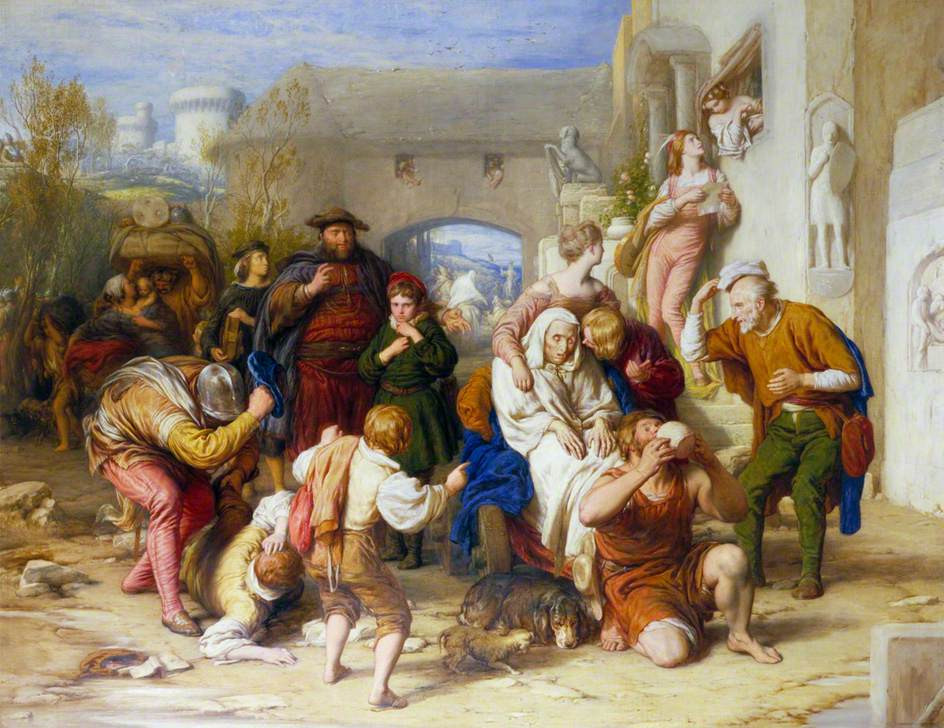
– Of course fourth: Have  look, the little boy, stepping out.

If you ant, this kind of enlightenment is then leading to paradise – referring to another time to Dante, now the third volume, tha Paradiso

Like sudden lightning scattering the spirits
of sight so that the eye is then too weak
to act on other things it would perceive,


such was the living light encircling me,
leaving me so enveloped by its veil
of radiance that I could see no thing.


The Love that calms this heaven always welcomes
into Itself with such a salutation,
to make the candle ready for its flame.[9]


[4]            We can leave the further consideration aside, including the fact that actually globalisation is to a large extent a kind of replication of stratificatory differentiation; see in this context already Herrmann,Peter, 1994: Die Organisation. Eine Analyse der modernen Gesellschaft; Rheinfelden/Berlin: Schäuble

[6]            http://www.birdnest.org/edensk2/dance4.jpg – 27/02/2013

[7]            Il criterio su cui occorre fondare il proprio esame è questo: che la supremazia di un gruppo sociale si manifesta in due modi, come ‘domino’ e come ‘direzione intellettuale e morale’. Un gruppo sociale è dominante dei gruppi avversari che tende a ‘liquidare’ o a sottomettere anche con la forza armata ed è dirigente dei gruppi affini e alleati.

Gramsci, Antonio, 1934-35: Quaderni del Carcere. Vol 3: Quaderni 12-29; Edizione Critica dell’Istituto Gramsci. A Cura di Valentino Gerratana; Torino: Giulio Einaudi editore, 1977: 2010

[8]            “Seven Ages of Man” William Mulready, 1838 – http://upload.wikimedia.org/wikipedia/commons/9/9e/Seven_ages_of_man.jpg. 27/02/2013

[9]            Dante Alighieri: Paradiso, Canto XXX, lines 46–54, Mandelbaum translation. http://www.worldofdante.org/comedy/dante/paradise.xml/3.30 – 27/02/2013

Details

or leaving me aside. Leaving me aside – my excitement when experiencing Russian history n a nutshell, really compressed in a short paragraph, a long sentence if you want: Compressed to the imagination of walking along the Nevsky Prospect on the pavement of which once Alexander Sergeyevich Pushkin walked …., a Zeitgeist that drove Fjodor Michajlovitsj Dostojevski to gambling; allowing me now to think in similarly eccentric ways as Lev Nikolayevich Tolstoy did, when he may have visited this city that has now the name Saint Petersburg; thinking about the greatness of Peter and the likes who, when time matured had been dwarfs standing in the way of the largess of a new society which chased them away, following the call coming from the Aurora and standing at the beginning of conquering the Winter Palace – the storm that later still required The Mother taking rigorous steps, standing up when she had been called.

Details are often forgotten while looking at the large picture. Or is it more that we are blinded by some grandeur?
There are surely the great politicians, the large lines and also the large crimes. And even if one should be careful with premature joys or anger, one should not take the required circumspection as an excuse for holding back with political judgement. And this is a matter of current governments here (yes: HERE) and there (for instance the ridiculous sentence for Berlusconi and the reduction of even this modest conviction. Nevertheless, leaving this major lines aside, looking at something that is more hidden it is sometimes the really small things that make huge differences.
When I went  he other day by train with Viacheslav to Petersburg – and while we had been comfortably sitting in the fast train, we had been chatting with Natasha (who is Natasha  – It could be a long story now like the many stories usually told from the transsib, even if the train trip took definitely much less time than one of those famous (or infamous?) trips in the “old times”. At some some stage we talked, of course, also about politics – Natasha recalled pre-Perestroika-times (“What are you talking about? When was that?” Viachselav intervened, half jokingly). The woman continued undeterred, though with a little smile:

You know, those times, before Gorbachev. We had been … – we. You,

she pointed on me, as on somebody coming from another world, the world of old capitalism

you start you sentence with I. And you write it with a capital letter, even in the middle of the sentence. it had been different here. It had been about us, about we …

Viacheslav intervened:

Peter knows. He studied also in

Looking at me I helped:

Leipzig – when it still had been in the GDR, although the Campus had been near Berlin.

Yes, the times and the circumstances had been different. But there seems to be more to it. One could speculate about this “it” constituting the we and the I … – and as much as times and circumstances matter, something seems to be still alive here where pure capitalism is on the advance to complete final victory. I thought about this “we” the evening when visiting with Viacheslav and Olesya the Mariinsky theatre, enjoying Glinka’s Ruslan and Lyudmila … – in the program brochure so many details had been listed, the soli in the orchestra even if they seemed to play a minor role. It seems to be a paradox: but here, where it is still about a “we-society”, the I becomes much more important than in societies that pretend individuality and can only do so by limiting it to a sole mate, who has lost the soul.
And in actual fact, the detail gains grandeur when being really part of the we. – And history is a little bit like a love story – a love story being felt like the “story line of history” …

Enigmas of Mastery – or Arts Challenges Academia

A side remark – isn’t all this blog-epistle a side remark, personal reflections on various issues in which personal, social and societal issues conflate?

So then a short note on dialogue. There is perhaps a reason for talking about the master and bachelor in ARTS that we should not push aside without reflection – as social scientists in particular we are part of a complex social structure – its history in past, present and future. And though we are not independent, we are part of a process that we may consider as symphonic piece of war and peace (borrowing the title from Tolstoi). Monumental and complex, full of contradictions and thoroughly determined by our readiness to truly engage in looking for collective solutions. Yesterday I have had the opportunity to attend an exciting concert here in Munich – exciting not least as it presented a tensional line from Bach’s 5th Brandenburgische Concert, passing Schubert’s 4th Symphony (‘The Tragic’), leading to Strauss ‘Thus Spoke Zarathustra’. Being confronted with the latter, consequently with the highly problematic oeuvre by Wagner provoked to move further moving beyond the smooth integrity of the Court Society, overcoming the tragedy and crossing the borderline of nihilism – not by denying it but by looking for a synthesis, for instance offered in the magnificent masterpiece provided by Shostakovich in the Symphony No.12 in D minor, Op.112 ‘The Year 1917’ – Admittedly something one has to learn listening – Barenboim once had been teaching me to admire Shostakovich’s work. And admittedly revolutionary processes and ‘results of revolutions’ (which, of course, will always be processes themselves) have to be learned. And looking at processes of learning the words by Albert Schweitzer on Bach’s work gave to come to mind:

It is not about alternating between the Tutti and the Concertino. ; the different bodies are related to each other in an intrinsic tension, penetrate, differentiate and conflate for another time – and all this emerges from an unfathomable necessity, inherent in the art. … One gets the impression to really face what philosophy throughout all times presented as a higher occurrence, the unfolding of an idea, creating its contradiction in order to overcome it, creates from here a new contradiction, overcoming it again and so forth, until it returns to itself, after it went through all stages of life. It is the same impression of unfathomable necessity and enigmatic satisfaction while listening to these concerts, following the subject matter as it first presents itself in the Tutti, then being subject to enigmatic divisive powers, finally returning in the final Tutti again to its inner entity, coherence.

(quoted in Wolfgang Stähr, 2003: Nicht nur zur Weihnachtszeit – Konzerte von Arcangelo Corelli bis Carl Philipp Emanuel Bach. Berliner Philharmony Programmheft Nr. 25 zum 21.12.2003)

Wouldn’t this be a matter we should revive in academic culture? A Sunday visit in the Alte Pinakothek paradoxically confirmed this when I joined a new format of arts education: Cicerone. As much as it is about the utilisation of great speeches the visit showed so much that all this is about dialogue, with the paintings, even between the paintings, between the presenters and not least by including the visitors.

Yes, academic life, if it takes itself serious is about the mystery of mastery of arts.

The Emperor and Wolfgang Amadeus

The other day I saw on facebook an advertisement – apparently a new game.

KINGDOMS OF CAMELOT

I didn’t have a look at it. But of course, there is always this notion of ‘My home is my castle’ – although it is an illusion and the home of many is actually the home of their bank – in the best case. I write ‘in the best case’ as for probably most of the people it is not ‘my castle’ but a loan granted by their prince, the bank. And for increasing numbers it is victim of the loan-givers meddling collectors – the Deutsche Bank showing ‘German perfection’ even in crime.

The other day I talked to Marco, after we watched on RAI the report on Il Palio – he wanted to draw my attention to the anthropological side:

Isn’t there some medievalism in us: we are engaged in all these personalised and irrational attractions.

And he, the catholic, also wondered about the masses going to mass.

The recent visit of the pope in Milano caught the attention of …

I forgot the number, but it had been large enough to justify his words:

There is obviously something of this irrationality we need!? The feeling of security? Comfort?

Sure, this may also be an eternal resonance of the lost paradise, sadly looked at by Eve – captured by Antonio Allegretti with the masterful scuplture Eva doppo il peccato allegretti. And it is surely this challenge, defined by the gained independence and responsibility and the difficulty even of a genius as Euclid to fully master this independence.

*****

But Euclide’s problem had been the effort of keeping the world moving by handling a set of numbers and geometric forms. More radical attempts, for instance Stefano Porcari’s strive for a Catholic Republic had been cruelly rebuked. Not only that ‘he left life’, i.e. had been hang. But apparently he also failed to represent a demos – at least this is what we can concluded from Marion Crawfords who contends in the work Ave Roma Imortalis

The name Porcari calls up another tale of devotion, of betrayal, and of death, with the last struggle for a Roman Republic at the end of the Middle Age. It was a hopeless attempt, made by a brave man of simple and true heart, a man better and nobler than Rienzi in every way, but who judged the times ill and gave his soul and body for the dream of a liberty which already existed in another shape, but which for its name’s sake he would not acknowledge. Stephen Porcari failed where Rienzi partially succeeded, because the people were not with him ; they were no longer oppressed, and they desired no liberator; they had freedom in fact, and they cared nothing for the name of liberty; they had a ruler with whom they were well pleased, and they did not long for one of whom they knew nothing. But Stephen, brave, pure, and devoted, was a man of dreams, and he died for them, as many others have died for the name of Rome and the phantom of an impossible Republic; for Rome has many times been fatal to those who loved her best.[1]

It is somewhat symbolical that the space that accommodated the house where Porcari had been born and where he lived is now an empty space: in the middle of Rome, in a small street next to the Pantheon – a space where it is prohibited to erect a building. Is it prohibiting people to develop as collective and social demos, claiming a real res publica?

One can turn it around: The modern state, not least going back to Montesquieu’s ‘Spirit of the Laws’, never ever succeeded, and even aimed on, taking the res publica serious, the establishment of a public space. Not least as such public space is always a process as it had been shown in parts of that early French revolution that had been employed by processes rather than building up structures. The public had been systematically reduced on a gathering of individuals. At this point we may leave it open if and in which way this had been different in ancient times. But Euclidian arithmetical reductionism had to lead to the claim of private property being the ultimate ‘natural right’ as spelled out for instance by Locke. And even more, the individual had to be the ultimate point of reference – this had been the true spirit that Montesquieu managed to breath into history of modernity.

And as such, the state emerged as seemingly independent force not as what it is usually presented: the servant of the people. This res publica is a scattered mirror: Eve could only fall in despair, Euclid could only wonder why his genuine attempt crashed and Alfonso Balzico’s Cleopatra could seemingly choose but had been distracted from the affluence in front of her eyes by the permanent presence of the hissing snake.

*****

 And this allows to return to the remark on the

KINGDOMS OF CAMELOT

It is this ongoing and strengthened individualism that actually allows the new, now hidden emperors standing over the princes – and it allows the suggested servant of the people to act like a jester. Though the difference is: the real jester had been mocking about the ruler – and here it is the ruler, mocking about the people. Of course, this may easily be seen as clandestine clue: at the end of the day, the day that may well mark the beginning of real history, it will be the people ruling themselves.

But for the time being jestering is very similar to Euclid’s play with numbers and forms. It is not really far fetched: We find the very same picture in today’s economic policies: number crunching – even in many cases of the search for radical growth policy (my little project with Marica), the strive for Millennium Development Goals (topic of a new little project with Almas) and even the search for niches. As Brigitte says in a recent mail, referring to a book by Raul Zibechi

but he also thinks that the control over territories is getting increasingly important for the rulers and for social movements – something that also points on the re-emergence of feudal forms. Of course, the question is then how such theses can be applied here in Europe.[2]

This is exactly the problem: that many of the solutions are caught in the dilemma Einstein supposedly put into the words:

We cannot solve our problems with the same thinking we used when we created them.

This search for solutions by following the same thinking that created them is not new – though Charles Anthony Smith, Thomas Bellier and John Altick present it as new. Be this as it is, it is heuristically surely interesting to read

the ego-panoptic construct we identify has two related but discreet dimensions. First, the individual has a greater capacity to keep the powerful in check through individual level surveillance of society. Second, the individual is more capable of constructing the world that exists around them. State and society have an increased susceptibility to control by or influence from the individual while there is also a simultaneous limitation on the ability of state and society to force the individual to conform.[3]

*****

All this may sound rather abstract – but actually it has a very simple expression in today’s economic policies. Though all this is a central part of the crisis, it is nevertheless a frequently forgotten one. Debt and in particular indebtedness by the states is undeniably a major problem. It is again and again highlighted by reference in particular to crisis in Greece. And it is made increasingly a topic in supposedly rich nations, complaining about the ‘cost of solidarity. And it is also frequently – even by several conservatives – brought to the fore that austerity policies are at least not without problems. Such policies are not so much ‘imperial’ than ‘medieval’: the brute force against the subject by the use of violence; requesting increased dues. However, there is another dimension to today’s policies in dealing with public debt. And saying today does not refer only to the current crisis but to historical predecessors from the previous century. For Western Germany it is generally accepted that special conditions after WW-II – in particular the support received by the Marshall Plan and the advantage of a near to completely destroyed material foundation of the industrial process (means of production), allowing a kind of ‘new start’, condition for a major competitive advantage on the global level – fostered a period of exceptional growth. But with this we reach implicitly another point: the problem of ‘growth’ – not least since W.W. Rostow growth is considered to be a magic driver, a self directing pattern that does not require any justification as the attraction is given by the Platonic understanding of numbers as real, gaining their justification from a supposedly natural order: 1 naturally followed by 2 naturally followed by 3 naturally followed by 4 maturely followed by … – ops, naturally maturely as the given and unquestionable order of development. And it is the competitive-individualist growth pattern. The Cartesian

proposition, I think, therefore I am, is the first and the most certain which presents itself to whoever conducts his thoughts in order

– later we will come back to it – is now perverted. We can reword: The

capitalist proposition, I grow, therefore I am, is the first and the most certain which presents itself to any economy conducting its balance sheets in order.

As this is a purely individualist principle, and furthermore: as this subsequently is a purely competitive principle, it is also a matter of permanent externalisation of costs. Investment is not aiming on

the production and reproduction of the immediate essentials of life.[4]

And as much as this is still an important aspect – and at the very end the decisive point, it emerges in its capitalindividualist perversion into a rat-race of accumulation of supposed wealth and the permanently enforced externalisation of costs.

We may leave at the moment an important point aside: the fact that the suggested wealth is an illusion. Instead a seemingly technical aspect of maintaining this illusion is worth mentioning.

Germany’s exceptional post-WW-II-growth had been mentioned. But after 1945/49 other economies had been growing with exceptionally high rates too, including the United States of North-America and the United Kingdom of Great Britain and Northern Ireland. And indeed, this had been based in – on the one hand – increasing income at least of the so-called middle classes and – on the other hand – the availability of an increasing number of long-term mass consumables (refrigerators, automobiles, household appliances, TV/colour-TV etc.). Interesting is to relate the growth rate for instance in the USNA, the increase of public debt and the inflation rate. The problem of public debt is not the fact itself, but the use of such debt as means of permanent and massive re-distribution. Inflation is an effective instrument – and not least an instrument that allows dispossession: the assets of citizens with an average income are not only eaten up by the changing cost-benefit ratio on the market for every-day’s consumables. Inflation is also a means of public debt relief.

As Carmen Reinhart and Belen Sbrancia state

financial repression is most successful in liquidating debts when accompanied by a steady dose of inflation. Inflation need not take market participants entirely by surprise and, in effect, it need not be very high (by historic standards).[5]

This is a mechanism that works directly against the population and also via redistribution where banks and funds are working as intermediaries.

*****

Indeed, here we find a ‘love-story’ between the different profit-making and –taking mechanisms – complementing and competing roles at the very same time – that evokes repercussions of the first lines of the recitative in Mozart’s Così fan tutte, Despina contending

Now I can see

You’re a woman of sense.

and Dorabella answering

In vain, Despina, I tried to resist:

that little devil has such tricks,

such eloquence, such a way with him,

that he’d melt the heart of a stone.[6]

And in actual fact the problem of the entire story is brought to the point by Guglielmo, just a short time before expressing his pure egoism, expressing a misunderstood individualism:

such treatment of so many

is pernicious and a bore

… you treat so many thus,

that if your lovers complain

they have a good reason indeed.[7]

It is like the state which can easily be seen in sustaining a function of an indeed self-interested court: the emperor frequently changing clothes, appearing as social and welfare state, activating state, bureaucratic state etc.. There is no doubt, all these different appearances matter – politics do matter. But they do matter not least as part of a historically long battle about hegemony where Wolfgang Amadeus Mozart’s life may be metaphorically telling. A genius of a world that had not been invented yet, and a world that surely did not allow to live this collective notion – a world that finally deflated the genius, causing a puny withering away of a flower that lost its inner buoyancy at the age of 35.

a man defeated by life[8]

It had been and is world in which

[c]oncepts like ‘civility’ or ‘civilisation’ on the one hand and ‘culture’ on the other were used in Germany as symbols of different canons of behaviour and feeling. It was possible to show that the use of these words reflected the chronic tension between court establishment circles and bourgeois outsider groups. This also highlighted certain aspects of the bitter class struggles between the bourgeoisie and the aristocracy.[9]

However, there are two points that should be reconsidered when reading Norbert Elias’ analysis and reflections: The first is to put a big question mark behind his thesis that this struggle

finally came to an end in the twentieth century with the rise of the two classes related to the productive economy and the de-funtionalisation of the nobility as a social stratum.[10]

Fact is that the ‘productive economy’, i.e. capitalism, actually systematically undermined productivity if productivity is seen as matter of use value. If

[i]t is not from the benevolence of the butcher, the brewer, or the baker, that we expect our dinner, but from their regard to their own interest[11]

it must be something else – and indeed: it is exchange value that – by an invisible hand – creeps into all pores of life, absorbing meaning and sociability with every breath, with every stroke of the hand. The Cartesian proposition

Ac proinde hæc cognitio, ego cogito, ergo sum, est omnium prima & certissima, quæ cuilibet ordine philosophanti occurrat

had been frequently criticised for the inherent idealism. But its utmost individualist stance had been barely objected – Descartes speaks of those individual

whoever conducts his thoughts in order.

And this is it: the order of the mind and thought of the individual philosopher – sitting on an earthly cloud, playing a virtual harp: professional perfectionism, excellence of universities: the realisation of

their own interest.

Second, it is too often forgotten that this new ruling class is in itself split: citoyen and bourgeois inevitably interconnected and nevertheless unavoidably in conflict, avoiding each other like the plague: The idealist freethinker – and Mozart had been one of them – standing against the materialist utilitarian for whom paradoxically the only ‘use value’ is a creature that lost its feet and legs: ‘use value’ is – for the utilitarian – the ‘uselless’ profit, a ‘social construct’ based on the alienation also of the product from itself. A social construct that does not have any own use despite being a placeholder for any use-valuable; interchangeable even with itself.

Thus – coming back to Mozart – he had been not just in a quandary. The individual solution obstructed by the lack of inalienable social integration, thus undermining socio-individual integrity. And the social integration undermined by the individual not accepting to be a mere part of an disruptive system of …, yes: self- obstructing individuals.

Sure, the privileged Tamino can live this role. But really: Papageno cannot.

*****

It surely matters in which way we look at things, the perspective we take. Recently, visiting the Kunsthalle in Mannheim, I had been fascinated by overlooking the town through the window.[12]

Actually it may be said that it had been more overlooking history. An inexpressible notion. Depending on the position, the ‘images’ change. What seems to be a from a more distant position as Napoleonic visage, withers into a small house covered by a dark roof – youy see it in the middle of the diagonal that spans from the Eifeltower to the house with the red roof. The imperial greatness, the appropriation of historical power by one person transforming into people’s life, translating into an authoritarian character of bourgeois society.

For the time being we play in our little realms as for instance a

KINGDOM OF CAMELOT

– not seeing the invisible hand of the emperor, in fomer eras claiming to be representing the devine, then the emperor by grace of god, in extremes the claims of being God’s chosen people and today enthroned by the new god of mammon – money as the ultimate good. – To make sure: this is not the failure of individuals. Nobody can ‘see reality and act in a free will’. Rather, it is a forceful reality – gods are always misleading: the ancient and the modern gods, deceiving for a while by golden fleece und the cover of which the collective knowledge of the abys is darkened.

Delaunay’s La Fenêtre sur La Ville allowing to overlook Paris – the metropole that may claim to at least one of the legs of modernity’s cradle; and allowing to see that

make their own history, but they do not make it as they please; they do not make it under self-selected circumstances, but under circumstances existing already, given and transmitted from the past. The tradition of all dead generations weighs like a nightmare on the brains of the living.[13]

Delaunay’s La Fenêtre sur La Ville: a painting with an inexpressible notion – evokeing helplessness. But even more suggesting the power of the de-indivdualised being – the kindness, solidarity, empathy and real self-realisation … – Herr Messerscharf und die Ameisenmenschen (Mr. Trenchant and the Human Ants) from Phanresia’s Stories of Friendship[14] once learned this lesson.


[1]            Crawford, F. Marion (Francis Marion), 1902: Ave Roma Imortalis

http://archive.org/stream/averomaimmortal04crawgoog/averomaimmortal04crawgoog_djvu.txt

[2]            may translation

[3]            Smith, Charles Anthony/Bellier, Thomas/Altick, John: (2011): Ego-Panopticism: The Evolution of Individual Power; in: New Political Science, 33: 1, 45-58; here: 46

[4]            Engels, Frederick, 1884: Origins of the Family, Private Property, and the State. Preface to the First Edition – http://www.marxists.org/archive/marx/works/1884/origin-family/preface.htm – 5/5/11 11:47 AM Online Version: Marx/Engels Internet Archive (marxists.org) 1993, 1999, 2000 – Volume 26. Frederick Engels. 1882-89

[5]            The liquidation of government debt; nber working paper series; National Bureau of Economic Research 1050 Massachusetts Avenue Cambridge, MA 02138 March 2011; Working Paper 16893 http://www.nber.org/papers/w16893

[6]            Così fan tutte. Drama Giocoso; Wolfgang Amadeus Mozart; Libretto by Lorenzo da Ponte. Première: Vienna, January 26th, 1790. Wiener Staatsopernchor/Wiener Philharmoniker/Karl Böhm; Live Recording from the Salzburg Festival on the occasion of Karl Böhm’s 80th birthday, 28 August 1974; Hamburg: Polydor International/Deutsche Gramophon; Libretto (Engl.: Lionel Salter) 32-205; here: 166

[7]            ibid.: 164

[8]            Elias, Norbert, [1991]: Mozart: The Sociology of a Genius; in: Nobert Elias: Mozart and Other Essays on Courtly Art. The Collected Works of Norbert Elias. Vol. 12: Edited by Eric Baker and Stephen Mennell; Dublin: University College Dublin Press, 2010; 55-167; here: 57 – it had been an uncompleted work by Elias, first published in 1991, edited by Michael Schröter who had been authorised by Norbert

[9]            ibid.: 64

[10]            ibid.

[11]            Smith, Adam, 1776: The Wealth of Nations. Books 1-111; Edited with an introduction and notes by Andrew Skinner; London: Penguin Books, 1999: 119

[12]            Robert Delaunay, 1885-1941 – La Fenêtre sur La Ville, 1910-1914

[13]            Marx, Karl: The Eighteenth Brumaire of Louis Bonaparte. 1852; here quoted from the internet-version http://www.marxists.org/archive/marx/works/1852/18th-brumaire/ch01.htm – 15/12/2008 11:21 am .

[14]            Peter Herrmann: Phanresias Geschichten von der Freundschaft. Ein Kinderbuch; With Illustrations by/Mit Illustrationen von Franziska Herrmann; Bremen: Europaeischer  Literaturverlag, 2010

Mocking and Roots

Returned from Rome – not only known as Santa Sede, but also known as one of the main “sites of antiquity”, seen as cradle of civilisation. Sure, it may be contested if such a claim is actually legitimate – there had been many antiquities and consequently there are many places that can be equally seen as such main sites. Having been there – this time actually not as long as on other occasions – I had been drawn immediately and tensely into this question. Perhaps it is our new office, if you want you may say the ultimate tension between times: an old building (though not reaching as far back as antiquity, a most elegant interior: with columns, arches and nearly monumental vases and statues, and at the same time accommodating one of the most modern social and economic research institutes. But all this …, does it go hand in hand? Is it compatible at all? On my facebook-site I surely made several disrespectful remarks – and I am not tempted to deny them. And I also made several remarks that simply reflect some general criticism: immeasurable wealth in the face of increasing world-poverty … With all this one should surely not simplify things – even personally I know a reasonable number of people: honestly faithful, honestly working for human rights, for combating poverty, trying to build up a just society. Actually the other day a leading figure of the Italian catholic church plead for a stronger influence of his organisation in politics – let us even assume that  he is a god-willing, honest person. But there we are in the middle of a first fundamentally critical point: This organisation claims not only influencing the state – we surely have to admit that there are several organisations, with different political couleurs, claiming the same. But this organisation, the Holy See as calls itself, calims TO BE the state, at least a state. What we easily overlook begins – symbolically – with the Vatican’s own Euro coins, and being surely expressed by the huge number of embassies. Actually walking through Rome, in most varied places, you find the embassies, the Diplomatic Mission to the Holy See. Btw., I think our Finish embassy has the most stunning location, overlooking Rome … Sure, btw. – but there is another point to it: next to it, there is a wall – narrow, just a small protection for the tourists that are roaming across this space: in memory of Garibaldi. On the wall you can read the Roman constitution – and there is surely a reason to mention and celebrate Garibaldi and the modern constitution in one breath. Literally, standing there, looking across the city, the Holy See is at your back – and you may want to say, it is in a position that is left behind. But you have to say: the church is a kind of backbone of this current system. There is no simple answer – on the cover of a book I bought in the Gallery of Modern Arts (Galleria nazionale d’arte moderna), I read:

Ogni epoca, per trovare identità e forza, ha inventato un’idea diversa di “classico”. Cosí il “classico” riguarda sempre non solo il passato ma il presente e una visiona del futuro. Per dar forma al mondo di domini è necessario ripensare le nostre molteplici radici. (Salvatore Settis: Futuro del “Classico”; Giulio Einaudi editore; 2004 [nuova edizione])

I think it is in some way remarkable that I bought the book in an arts gallery: arts seems to be much better able to reflect its origins without sticking to it like the fly in the trap, sweetened by honey, pleasing like Adonis, in Greek mythology the god of beauty and desire and dazing like opium. If life, real life, would support us in every day to live history in this “dialectical way”: keeping the valuable, but push the overcome part on the rubbish heap of history, mutual respect would surely be easier to reach. But as long as organisations claim to be states … All this has surely another dimension too: if and to the extent to which the church did have a legitimate role society it had been at times that are in social science frequently looked at in terms of cooperative, associational, communal … . There is much transfiguration going hand in hand with this – the golden ages of harmonious communities have never been really prevalent, at least not during those times that we may consider as sufficiently known. Nevertheless, there surely had been times preceding the modern state. and this brings us to a critical point, looking at many of today’s political movements, not least some of those claiming very critical positions against the current mainstream. Again. I do not want to question the credibility of these claims. Nor do I want to claim knowing the answers. To be honest, I am still looking for the exact question. At least I feel uncomfortable, looking at solutions based in values, in good will, in general feelings and partial analysis, not considering the fundamental changes of the productive systems. New quest for salvation: in old religions, revived Evangelism or new claims of excellence are unlikely to help. As said, I had been in the Galleria nazionale d’arte moderna. Entering the exhibition-hall, there is first a fascinating …, installation: The floor of the entire hall is a mirror, a broken mirror. Old statues standing on it … Can we say: Antonio Allegretti’s “Eva dopo il peccato” (1881) in desperation of what she lost? Giacomo Ginotti’s “Euclide” (1883) not understanding that the blueprints he made, didn’t work out? Alfonso Balzico’s “Guiletta” (1884-1886) hesitatingly-amused by looking at what emerged and could have been known by everybody? And the same Balzico’s “La Civetta” (1856-1860) even openly positioning herself beyond these worldly trivialities? Still, for all of them it is still very much a game – a bright light still shining – not victims like those who did the actual work, the ones, for which the hope of the regeneration of the soul, which is supposed to happen every seven years, doesn’t exist. It may be pure incidence that I communicate these days with Rainer about an article he sent in connection with some debate on some writing on religion: Hearing the Voice of God. Anthropologist Tanya Luhrmann studies how American evangelicals experience the friend they have in Jesus (article by by Jill Wolfson; July/August 2012). He asked me for my opinion on it:

…. In the meantime I have had a look at the text you sent. It looks as if there is quite a lot in the book in question that is in one or another way complementing the book “Gewinn in alle Ewigkeit” (Fleischmann). The first impression is striking: “Society outside [outside of the life of the sect] doesn’t exist.” And subsequently there is immediately a second point for debate: In which way did “our generations” – at least some of us – supported a development which is actually at least in analytical terms well reflected in Thatcher’s statement that “there is no such thing as society.” It is this question, so difficult to answer and even so difficult to ask: the search for personality as social being, linked to the point that the social is not just subordination and adaption. Looking at it in terms of class analysis: How can we understand Marx’ notion of a “class for itself” as development towards respecting personality, avoiding that everybody has to look individually for meaning in some dialogue: bound to an authority, without necessarily being a religious issue but easily being religious. ….

Is that really so different from how he interprets the text? His thoughts are mainly concerned with the freedom of thought, the freedom from dogmatic incrustation and the nearness to or distance from the state. Yes, indeed, the critic of the history of religion needs surely a new approach. And surely it is about how we produce and reproduce out daily life: the goods we need, the means we use and the way we produce and live together – in a way, distribution is only second stage here. That is part of what real critique of political economy is about.

Lost Ground

It is a narrow staircase only, and a short one. Three steps to go, two, one – the way to climb up to her is as short as it is leading through a dark space. Even the very moment before I turn around the corner I am not even aware of the fact that she is there, just the second I move the head up I look in her face and sense the impossible. – A placid, warm breath, touching my face, adulating gently my neck and resting on my shuoulders and I am looking into the eyes of this woman.

It is nothing like short meeting in the coffee shop near the train station – the encounter of two travellers, eternal tourists and the modern travellers’ life as jigsaw as I mentioned it when I wrote about the visit in Copenhagen. And nevertheless there is something that reminds me of that sweet encounter.

– Yes, a placid, warm breath, touching my face, adulating gently my neck and resting on my shuoulders and I am looking into her eyes, she is looking into my eyes: Pallas Athene.

It is not only the nearness I feel, the imagination of being physically tapped, the experience of naturalness. It is also something of the eternal tourist – though now not moving in space but in time – the goddess as an authentic Time-Traveller’s real wife. It is an all-embracing feeling with its own dynamic: the paradox of losing control emerging from the feeling that this single existence is real part of the universe of space and time. One of the innumerable single existences without which the world would not be the very same reality that it is and at the very same time one of the innumerable single existences that actually cannot make a real difference, a moment that cannot shape reality. Captured by the genius of Gustav Klimt.

–––––––––––––––––––––––

Perhaps it is in particular when facing Klimt – and some of his contemporaries – that it is easy to forget about academic classifications. Perhaps one can go even a step further: it is difficult to think in terms of classifications although and because one is permanently confronted with academia. The famous dispute which developed around the faculty paintings went far beyond the topical issues on the spectacular debates of the time – for instance the one on medicine. And the other equally provocative on philosophy.

Trusting many sources about his life, Klimt had surely been an enfant terrible of his time. And as two major reasons the following may be brought forward: first, entering the world of arts had not necessarily been what he heard at his cradle. Second, one may say especially as Klimt has been – enfant terrible – a most pronounced representative of true, unbribed academy. In this respect being enfant terrible had been so different from expressing his anger and concern in a helpless scream – the provocation depicted in Edvard Munch’s famous painting The Scream. Gustav Klimt had been looking for radically questioning the conditions of the time. It is not least the difference between lament and accusation that marks the difference between the two.

Munch once said:

One should not paint interiors peopled by reading men and knitting women. One ought to deal instead with living human beings capable of breathing and feeling, suffering and loving.

And probably his most famous piece – The Scream is a paradox expression of this. On the one hand we feel the instant message: the devotion to this sujet. We can see the immediacy of the artist being directed towards and guided by these ‘living human beings’. Nevertheless, the fact that Munch could bring this immediacy to the fore is based in grasping the paradox, namely depicting a being that is pushed to the margins: somebody who is facing the situation of loosing ground, of suffocating because of not being honestly allowed and able to

breath and feel, suffer and love.

Feeling and suffering is limited to and compressed into a scream – diffuse, unknown by way of it’s origin and direction. And as much as it is such real person, it is hindered by the fact of one-sidedness, or even more so: in-sidedness.

In which way ever, it is obvious that the viewer is a most important part of entire account: accused, beseeched – but always only in this perspective of a self that lost ground, that misses anchoring: de-rooted as the soil is poisoned.

All this is not least part of a socio-economic situation that can be characterised by a very similar pattern as we find it today: middle classes, reasonably secured in – or at least: feeling reasonably accommodated by – a now stabilised capitalist system (the early stage of industrial capitalism had been now at a stage that can be considered as consolidated) had been increasingly becoming aware of the fact that this capitalism had not been a threat to the living of industrial workers but also to their own position and also to the life of society: alienation can be seen as the foundational principle of the life perspective especially for many of the privileged middle class strata and in particular of the Bildungsbuergertum[1]. An important point in this context is the emergence of some form of – for the time – new inwardness, using Egon Schiele’s words: the quest to

Work from the heart. – And you have the chance to ‘imbue your work with spirit’

and the opening towards new options, suggesting – in the words of Baudelaire – that

Modernity (der neue Stil) is the transitory, the fugitive, the contingent …

In particular Baudelaire’s statement is telling as it allows to understand the permanency of transition, the presence of change which we can only understand when we understand ourselves as fundamentally social beings in the deepest meaning: part and parcel of history in the strict sense – recalling another time Goethe’s words

He who cannot draw on 3000 years is living hand to mouth.

For me, this feeling of being genuinely part of history is so poignant when looking into Athene’s eyes, that I write later in a mail to Joe, a friend of mine

Had been in the Historische Kunstmuseum today …, just unbelievable !! Yes, even after all these privileges of seeing and experiencing so many things that are sealed for so many people, I still can be impressed by many things; but I didn’t believe that I would stand another time in front of a fresco, very close to crying (the other time that this happened is nearly obvious: Picasso’s Guernica – while writing it comes to my mind: in both cases standing alone there: the small Peter from a tiny Irish village, being confronted with history, so to say: squeezed by this monumental existence, the nightmare Karl had been talking about.[2]

All this has, however, another dimension too – the 3,000 years Goethe refers to, still being important as score of historical consciousness, are at this point in time increasingly a matter of the immediate presence: for people like Klimt and Munch compressed in a blink of an eye, and moreover: rather than being a matter of intellectual reflection but as matter of actual life, emerging from the inside. With this, it is of course something that is extremely difficult to handle: the felt isolation and indolence stands against the objective socialisation and fluidity.

Even small details of a technical kind are emerging as important – condition of the new style even if only by allowing change to happen and reinforcing it. In 1841 the tube had been invented, making it easily possible for the painter to move away from the studio, capturing landscapes, capturing – we may remember Edvard Munch’s words –

living human beings capable of breathing and feeling, suffering and loving.

It had been a move that allowed the artist to work not only by imagining people who are capable, but who are actually doing it. Moving out of the studio, thus, had been a step towards moving inside of people’s life. And furthermore it allowed moving inside the own impression – the artist now being encouraged to express the immediate impression. We may remember what had been said on another occasion, looking at a

fast stroke with a brush in paintings like that of a tree, just Over In An Instant

When quoting Sean Seal’s words earlier it had been to highlight the factor of time: compressing time in such fast strokes as means of capturing historical reality in a condensed way. And the same can be said now for space.

In this way we may extend the look on Gustav Klimt and Edvard Munch by claiming that this is by and large true for an entire new generation of artists: the Impressionists as masters of spaces, timespaces and spacetime in entirely new ways – and opposing what the great Vasari claimed, saying ablout paintings that they are

laid on flat with most simple strokes of the brush and having but one light, shows but one aspect

(Vasari, Giorgio, 1550: Lives of the Most Eminent Painters Sculptors and Architects ; here quoted from the Internet-version)

There had been another technical development, opening arts for new ways: the invention of photography, seriously beginning in 1820s. ‘Exact depiction’ now being easily possible meant loosing ground for ‘realist’ paintings. Basically two answers had been possible. The one had been the emergence of a new realism, in the extreme case much later put on firm feet by Bert Brecht in his theory of theatre and developed under the term of Verfremdung, i.e. disassociation. Cum grano salis this can be said for much of early realism even of artists as Munkácsy Mihály that had been looked at earlier. On the other hand we find the Impressionists, breaking with reality in the strict sense and moving forward – in economic terms: moving beyond assemblage. Of course this had been a complex development, full of contradictions. But in any case the Impressionists can also be seen as very early avant-garde of a new mode of production.

Avant-garde – a complex and surely tricky issue. Looking at the economic developments this new mode of production had been characterised by an escalating separation of exchange value from use value. In some way, the reality as such lost meaning: it had been only a construct, assembled as matter of actual production; but in addition assembled by the ongoing social construction. Issues as fetishism, consumerism, alienation, isolation and the like come immediately to mind. And at the very same time, this emerging hedonist person comes now increasingly only into being by relating to the social and inorganic environment.

One indicator for this is the emergence of ‘social actors’ or as it is nowadays frequently itemised in social science: agency. Émile Durkheim still concentrated on the fait sociale. If we see such social facts, undeniably existing as presented in Durkheim’s study Le Suicide (1897), it had been very much a passive reflex, something like the supposed move of the lemmings: an activity initialised by some unknown impulse, a mass, acting unconsciously, a direction that seems to be determined by an external and eternal law. Of course, this needs to be qualified as Durkheim had been interested in detecting this ‘unknown impulse’. Actually his analysis had been driven by the conviction that cause of action and its direction can surely be detected – and changed.

In any case, this interpretation of the social fact changed completely – and this happened in historical perspective around the same time, literally before Durkheim published his major works (Le Suicide [1897]; De la Division du travail social [1893]). Karl Marx and Frederick Engels – in thinking and social practice – emphasised the emergence of the social actor. Karl Marx’ made this point clear in his famous work on Poverty of Philosophy with respect of the development of the class struggle.

Economic conditions had first transformed the mass of the people of the country into workers. The combination of capital has created for this mass a common situation, common interests. This mass is thus already a class as against capital, but not yet for itself. In the struggle, of which we have noted only a few phases, this mass becomes united, and constitutes itself as a class for itself. The interests it defends become class interests. But the struggle of class against class is a political struggle.

(Marx, Karl, 1847: The Poverty of Philosophy Answer to the Philosophy of Poverty by M. Proudhon; chapter two).

Brought to the point: the individual proletarian is not more than a commodity; the proletarian who is consciously and actively relating to others, being in this way part of the class, is not only gaining power as part of a larger entity but also gaining power over him/herself, developing as real personality.

Coming back to Munch on the one hand and Klimt on the other we find the difference between them on this abyss: the first confronts us with a scream, expressing helplessness and equally leaving us helpless, shocked and uncomfortable – but uncomfortable also the poisoned ground on which we stand seemingly does not allow to move. Klimt, however, offers a look back and Athene’s demand to stand up and change – we may even hear her using Marx’ words from the 11th thesis on Feuerbach:

Philosophers have hitherto only interpreted the world in various ways; the point is to change it.

(Karl Marx 1845: Theses On Feuerbach)

And with Klimt we can probably say: the new interpretation is a matter of change. Isn’t this the message of the most contested paintings Klimt’s – the infamous ‘university paintings’? Isn’t it indeed his active contestation against a society which Sigmund Freud would see as mostly oppressive super ego, at least as controlling instance.

We find again a parallel with today, the matter of precarity as it had been briefly mentioned earlier. The bewilderment of a class that is not as privileged as the working class at its outset. There we could see a class

free in the double sense, that as a free man he can dispose of his labour-power as his own commodity, and that on the other hand he has no other commodity for sale, is short of everything necessary for the realisation of his labour-power.

(Marx, Capital I: Chapter 6)

And freedom in this double sense also meant that this freedom would inevitably be linked to the potential of bursting the fetters which are strangulating the further development of the means and mode of production and with this the further development of humankind.

The class we are looking at today may at some stage develop that potential – but for this it will be necessary to properly understand the new terms of freedom: it is now a class of which the freedom is limited, a class that owns in some way part of the means of production, namely the productive force of knowledge and science.[3]

*****

The other day, on the train to Vienna, I had been reading a book about the intellectual foundations of our time: Christoph Fleischmann writing on Gewinn in alle Ewigkeit which I received for review. What makes the book especially interesting is not what it says but what it systematically fades out, although stating the opposite: These intellectual foundations are actually only the offspring of the societal development itself.

One crucially important point going hand in hand with this development is a further step in the development of the individual – further, after it’s ‘invention’ in the course of enlightenment, now emerging in the form of hedonistic obscurity.

Imagine you go to the theatre – but nobody is there: no spectator, well two only. Already at the entrance I had been surprised. Asking for the seat, the usher showed around the corner:

It is right on the stage.

And the stage had been where people had been sitting, following the performance of two people who acted in the room where usually the spectators would sit.

Crusoe, who objected his father’s wish and order, had been centre-‘stage’: the adventurer and explorer of early capitalism. Opposing the boredom of the world in which his father lived and which the young Crusoe rejected as Leitmotif for his future. Capitalism of that time had been still very much trade capitalism, going hand in hand with craftsmanship and based on a principle that we may classify as ‘linear circularity’: simple perpetuation, or simple reproduction, as Karl Marx defines in chapter 25 of the first volume of The Capital:

As simple reproduction constantly reproduces the capital relation itself, i.e., the relation of capitalists on the one hand, and wage workers on the other

And although Marx speaks of wage workers, it is wage work also in a very simple way, at least initially still part of the patriarchal mode of regulation. It had been a phase of temporary stability and self-content reaching its own limits. At least for some time society could do without growth: the previous era had been a phase of consolidation, especially marked by the given productive forces being ‘sufficient’ for the permanent reproduction on the given level. However, new forces emerged, potentials not least coming up against the background of increasingly open borders: as much the given system depended on nothing else than the continuation of a circular movement of trading activities, it has been also a system that inherently pushed beyond it’s own borders: looking for the extension of trade. Capitalism as industrial capitalism only lurked around the corner, hesitantly showing up. The hesitation of the historical forces coming to the fore expressed in a short outcry of the maturing Crusoe, asking himself[4]

Am I not doing the very same what my father asked me to do – and what I rejected as way of life? Is my life not very much nothing else than the perpetuation of the same? Progress being hidden behind a seeming move?

And indeed it seems that the progress is forged: growth as matter of linearity that is caught in repetition – extended reproduction, growth needed only in order to maintain itself. And the period is at the very same time characterised by a drive towards overcoming the circularity, unfolding the circle and transferring it towards a new accumulation regime. The temptation had been initially to write a push towards a new mode of production – and although there would be some justification for it, it is probably more precise to speak of a new mode of production. The development is at its very core about the change towards a substantial development of the productive forces and the fundamental shift of valuation – in some way we may interpret it as the final redemption of the finally hegemonic chrematisticsthe from the original oikonomia. It is the definite shift towards an imperialist strategy – exchange, i.e. trade not primarily annexed to the core of the production of use values. Instead production is now annexed to the realisation of monetary values on a globalising market. In this light, bridging the different developments is easy: Defoe’s piece had been first published in 1719 – and with this date one may say it stands at a rather meaningful border of the economic culture and the ways of thinking – both reflecting each other. For the development of literature we find the 17th century marked by the writing of travellers who had been interested in scientific explorations; later the 18th century saw the writing of travellers that had been guided by their very private and romanticist ideas.

Paradoxically production for its own sake is now gaining a much more pronounced position – it is about the emergence of productive, or later industrial capitalism. And as such it is surely the definite abolition of trade capitalism. However, the paradox is that this is also a shift towards a system that generates value only by realising the product on the market. Already here it emerges as trivial truth that

today’s entrepreneurs … produce increasingly products and services that are not essential for humankind.

(Clemens, Reinhard, 2011: Ehrbarer Kaufmann und Silicon Valley …; in: Spangenberger, Michael: Rheinischer Kapitalismus und seine Quellen in der Katholischen Soziallehre; Muenster: Aschendorf, 69-75; here: 75)

Of course, this looks different for the actors on that initial economic stage. On the one hand they are genuine explorers, oscillating between the imperialist mission – seeing trade of pearls against little glass globes even as bliss for a people that had been seen as inferior; on the other hand it had been seen as matter of exploration – again in the spirit of a mission though now coined by an honest search for a better life. The imperialist arrogance and equally the social-romantic apotheosis are not least an expression of the debasement of a new class: the increasing accessibility of nature went hand in hand with the decreasing direct control. And in particular the privileged strata suffered specifically from alienation. However, in their case not so much in the understanding it had been presented by Karl Marx, writing in the first volume of The Capital in the second chapter on alienation

In order that this alienation may be reciprocal, it is only necessary for men, by a tacit understanding, to treat each other as private owners of those alienable objects, and by implication as independent individuals.

In actual fact, this alienation can be seen as condition for the class developing as class for itself – insofar as the reciprocity is broken open.

But here and now we are concerned with a process that leads on the contrary to the alienation of individual’s from their own class – a needed process of self-distancing. The adventurer, the romanticist, the bohemian – all in their own way helplessly screaming, in desperation looking for securing their privileges.

Romanticism meant not least that the commitment to truth had been somewhat limited, taken over by the ideas of yearning and daydreams, imaginations of some form of a better life, a vision of life rather than its sober analysis. The novel clearly emerged to novelty in the understanding of an act of creation that emerged from voluntarism, the German term for novel: the Roman shows clearly the Zeitgeist: upheaval, braking out of the given frame of time and space had been the underlying the search for a new world.

At least everybody who had been following literature on Orientalism, in particular inspired by the works of Michel Foucault and Edward Said, will be well aware of the fact that this search for a new world had not by any means been a peaceful undertaken. This may be the case for naïve proposals à la Rousseau. But the real romanticists had been characterised either by another naivety: namely the wrongly ‘projective perception’ of the other as natural, genuine, pristine …; or it had been the adventurism of a Robinson Crusoe.

–––––––––––––––––––––––

I finally look back – the last weeks and month: the teaching on painting and economic thinking.

Wolf rejected, on the INKRIT-Gramsci conference during one of the adjunct workshops that there had been any arts before commodification. But doesn’t art first and foremost concern the art of life, l’art de vivre et vie avec l’art? Isn’t arts first and foremost the increasing freedom in every day’s activity even if it is fundamentally the production of life – Engels had been already quoted with the words

The materialist conception of history starts from the proposition that the production of the means to support human life and, next to production, the exchange of things produced, is the basis of all social structure; that in every society that has appeared in history, the manner in which wealth is distributed and society divided into classes or orders is dependent upon what is produced, how it is produced, and how the products are exchanged. From this point of view, the final causes of all social changes and political revolutions are to be sought, not in men’s brains, not in men’s better insights into eternal truth and justice, but in changes in the modes of production and exchange. They are to be sought, not in the philosophy, but in the economics of each particular epoch.

It is surely not freedom for everybody – and in this way we may even say that commodification actually even sublimely suppressed arts, only allowed its development in a fenced area, outside of society, distant from real life.

Being back to Vienna, I am getting in its own way aware of it – visiting Bizet’s Carmen. This time I’m not going to the Wiener Staatsoper but my feet bring me to the Volksoper – to be more precise not my feet; I am comfortably brought there, Marcella safely driving the limousine through the city. I doubt that it is purely my mood, or the fact that it is the first time that I experience this place; I doubt that it is just the light-heartedness of this early summer evening, and the frivolous attunement I take with me from the earlier chat; and I doubt that it is this appealing sweetness of the clichéd Spanish-gipsy sex idol of the time anticipated when going there. Be it as it is, for some reason I feel a special flair around this place, the people being more vivid, showing more openness towards a new experience. And in several ways it is a new experience for me too. Leaving other things aside, the newness initially shows when the conductor arrives: a woman, obviously from somewhere in Asia – and as I am looking on the orchestra pit, I see from her gestures and behaviour that she is surely also socialised in that tradition. Those who are familiar with such events know why it is remarkable: it surely stands against the traditional patterns of a male and western dominated arts-world. I know that it is a ‘new trend’ that shows up on this occasion, surely only a small germ, but … – and by the way, the but is later confirmed when I visit Het Concertgebouw in Amsterdam, enjoying Simone Kermes, together with the Concerto Köln under the direction of Mayumi Hirasak.

– Back to that evening in Vienna, there is something else that catches my attention – reminding me of the time when I lived for a short while in Florence. And also reminding me of the visits to opera houses in Riga, Vilnius and other places of ‘that part of the world’, those countries that strived for building up socialism. It is peoples’ opera – not by way of panem et  circenses, but as joy- and playful, and also critical concern of the people. Even as performed art, it has an additional dimension to it: the active part of the recipient who is in some way ‘depicted’ but who is with this very same act of depiction the actually and real performer. – Only later – already back home in Budapest, reading in the programme booklet I bought that evening in the Volksoper – I find a confirmation, though the crossing of boarders is now projected into Bizet’s piece itself. Leo Karl Gerhartz, looking at the theatrical reality, contends

As in the score of Carmen most different moments are set side by side, the production at the Volksoper of Bizet’s opera understands itself as (theatre) clutter, a space for many different things to meet, to clash and to confront each other: emotion (truth) and theatre (presentation, pathos and ordinariness), solemnity and entertainment, surprise (impact) and atmosphere (charm), opera and revue, cabaret and opera.[5]

(Gerhartz, Leo Karl, 1993: Theatralische Wirklichkeit; in: Luc Joosten/Christoph Wagner-Trenkwitz: Georg Bizet. Carmen. Programmheft; Wien: Volksoper; 28-31; here: 31)

This occurs to be so very close to the idea of adventurous travelling. Another example of the movement of and between space and time and body?

As it is well known, the famous formula Albert Enstein’s reads E=m2. A little less known may be the meaning, namely that it presents not more and not less than the equivalence between mass and energy. And though we don’t have to enter the detailed discussion of it (good excuse, isn’t it? I have to admit huge difficulties if you would ask me to do so) the following can be safely said. It all hints towards the historical struggles between time and space, being caught between circularity and linearity. It is a variation of another theme: generating meaning in a reflexive process, finding it in oneself and ‘projecting’ it on the world stands on the one side; on the other side we find generating meaning by referring to the world as it is. Of course, this is in some respect not a contradiction. We can see it more as matter of different weighing of the components within the process of relational appropriation as it had been frequently presented on earlier occasions.

–––––––––––––––––––––––

We may leave this to later though – later in time, in a compressed time of overlapping developments. Developments from Impressionism, ‘Klimtism’, ‘Munchism’ to Cubism, in the perspective of Russian avant-gardism with their cubo-futurism, developments that occasionally seem to be so far away from the popular gusto, and nevertheless claiming itself to be closely linked to the working class, and specifically to Bolshevism. Indeed – and you may feel some repercussison to what Munch said:

Clear the old trash from your hearts!
The streets will be our paintbrushes, the public squares our palettes …

(Vladimir Mayakovsky: An Order to the Art)

The way to move forward as

… life has invaded art, it is time for life to invade art.

(Ilja Zdanevich/Mikhail Larionov, 1913: Why we paint ourselves)


[1]            Surely not simply translatable as highly educated middle-class as it is frequently suggested.

[2]            Obviously referring to Karl Marx’ The 18th Brumaire

[3]            There had been already in the 1970s an exploration of the development of science/ knowledge as immediate productive force – reference

[4]            The following is not literally quoted.

[5]            reading from the context it is in the last instance most likely meant operetta.

For the unknow mothers

Wikpedia another time showing incompetence. Had to go to the Doria Pamphilj – and just wanted to look a bit what this family is about … – wiki as first hit, but only on the gallery (Gosh lads, in history/reality the hegemon comes first, then the structures they set up!!!. On this site it is the other way round). Well, then they mention the most ordinary paintings on the site – a Velázquez’s, a Titian,  Caravaggio … – actually, when I looked at the latter I thought having a great name is one thing; doing great work is another.

Now, to be clear, I saw a couple of Carravaggios works – and there are some that are without any slight question great pieces. But in this case I see the confirmation of what Miró said in 1933 (job is job, I had to go the other day to that exhibition too – sure, one of THE names in this world):

Il quadro deve essere fecondo. Deve dar nascere un mondo.
A painting must be fertile. It must give birth to a world.

The arts world is there very much like the rest of the world: there are the many mothers giving birth without being seen. There are many children without being known. But it is them who make history, and it is them who will one day make a better world.

De Nieuwe Kerk and attac

Can there be anything more appropriate than sitting in De Nieuwe Kerk, listening first to the smaller transeptorgel – while looking at the windows that depict the relationship between church, state and capital -, then the hoofdorgel – with this facing the established power, as later personalised by Napoleon Bonaparte, ruling between 1803 and 1813 The Netherlands – and preparing the SOAK-session on economic theories for next week, when going to the attac summer academy?
What is so often forgotten when discussing economic theories is the fact that they have to be seen in the historical context.
Karl Marx gives one example, writing in 1864 in the Inaugural Address
of the International Working Men’s Association:

This struggle about the legal restriction of the hours of labor raged the more fiercely since, apart from frightened avarice, it told indeed upon the great contest between the blind rule of the supply and demand laws which form the political economy of the middle class, and social production controlled by social foresight, which forms the political economy of the working class. Hence the Ten Hours’ Bill was not only a great practical success; it was the victory of a principle; it was the first time that in broad daylight the political economy of the middle class succumbed to the political economy of the working class.

This means not less that the solutions we are looking for today have to be the solutions for today …. – not simply claming moral behaviour within an amoral system, not looking for new Napoleonic leaders; but it is about solutions that are founded in and approproate to today’s development of the productive forces.

Why then de Nieuwe Kerk and attac? It is rather obvious: solutions that are founded in and approproate to today’s development of the productive forces means to look for ways ofdeveloping a new hegemony (or counter-hegemony). Is there any better place to think about it when looking at the old ones? Seeing where they had been successful and knowing where they failed? The bourgeoisie, surely, had been at some stage a progressive force – as Marx states in chapter 26 of the first volume of Capital:

Hence, the historical movement which changes the producers into wage-workers, appears, on the one hand, as their emancipation from serfdom and from the fetters of the guilds, …

He speaks of the chevaliers d’industrie and continues:

The industrial capitalists, these new potentates, had on their part not only to displace the guild masters of handicrafts, but also the feudal lords, the possessors of the sources of wealth. In this respect, their conquest of social power appears as the fruit of a victorious struggle both against feudal lordship and its revolting prerogatives, and against the guilds and the fetters they laid on the free development of production and the free exploitation of man by man.

And today we see not amoral hoarding etc., we see that the accumulation by dispossession (Harvey) – or accumulation by appropriation of all pores of life is again such a fetter of new developments – cum grano salis what Marx said in chapter 3:

The monopoly of capital becomes a fetter upon the mode of production, which has sprung up and flourished along with, and under it. Centralization of the means of production and socialization of labour at last reach a point where they become incompatible with their capitalist integument. This integument is burst asunder. The knell of capitalist private property sounds. The expropriators are expropriated.

This is what we truly need today – and reflecting thoday’s hegemony.

Incidence?

Pure incidence? Less than one week, four small pieces, fitting so well …

* Monday I gave a presentation in Cork, questioning the obsession by calculability and the mathematisation of social science, and putting this into a wider context:

A fundamental problem has to be seen in the very limitation of our thinking as it had been outlined under the major headings: quantification/mathematisation, equivalence principle and claim of exchangeability, individualisation and finally evidence.

* Thursday, just before leaving Budapest,  I received a mail by Marica Frangakis – we are planning now to elaborate a little piece on “A left growth policy agenda for Europe”. Any perspective for today’s economies, and this means in the cases of our presentation for Greece from where Marica is and for Ireland, where I lived for some time now, cannot be about returning to the path which actually brought us into this deep crisis.

* Then, yesterday I had been in the Burgtheater – Robinson Crusoe (will soon have to do some more writing on this and some related reflections on this blog).
It had been an exciting reading of Defoe’s masterpiece Robinson Crusoe in the Burgtheater, highly critical about the permanent striving for growth, the obsession by movement and search of the unknown.

* And today, earlier I had been reading Goethe’s Faust.
It is highly critical about the calculation of and with time. An understanding of time as if it would be linear and “calculable”, a utility like any other utility – and as any other utility today a commodity. Re-reading Goethe shows the highly critical undertone of a growth which is only caught by the idea of movement, a permanent circle that does not allow any reasoning, that forbids exit, for which any standstill is like suicide.

Stuerzen wir uns in das Rauschen der Zeit,
Ins Rollen der Begebenheit!
Da mag dann Schmerz und Genuss,
Gelingen und Verdruss
Miteinander Wechseln, wie es kann;
Nur rastlos bestaetigt sich der Mann.
(Goethe: Faust)

And on another occasion in the piece, Goethe describes how this is capturing the entire life, getting hold of all pores – and all people, not stopping even when it comes to the life of children and the aged.

And all this may well remind us of the famous words we find in The Capital, Karl Max quoting T.J. Dunning

Capital is said by a Quarterly Reviewer to fly turbulence and strife, and to be timid, which is very true; but this is very incompletely stating the question. Capital eschews no profit, or very small profit, just as Nature was formerly said to abhor a vacuum. With adequate profit, capital is very bold. A certain 10 per cent. will ensure its employment anywhere; 20 per cent. certain will produce eagerness; 50 per cent., positive audacity; 100 per cent., will make it ready to trample on all human laws; 300 per cent., and there is not a crime at which it will scruple, nor a risk it will not run, even to the chance of its owner being hanged. If turbulence and strife will bring a profit, it will freely encourage both. Smuggling and the slave-trade have amply proved all that is here stated.” (T. J. Dunning, l. c.,[Trades’ Uion and Strikes,] pp. 35-36).
(Marx, Karl, 1867: Capital, Vol. I;  in Karl Marx. Frederick Engels. Collected Works. Volume 35; London: Lawrence&Wishart, 1996: 748)

Or we may see a very subtle army in front of us – living in a society that is

so fully instructed in the art of [commodity] warfare, so perfectly knowing and following their colours, so ready to hear and obey their captains, so nimble to run, so strong at their charging, so prudent in their adventures, and every day so well disciplined, that they seemed rather to be a concert of organ-pipes, or mutual concord of the wheels of a clock, …

of course, the [commodity] added by me to the quote from Rabelais’ Gargantua and Pantagruel.