REINVENTING THE WHEEL OR SQUARING THE CIRCLE – SUSTAINABLE SOCIAL QUALITY VS SOCIAL POLICY

Notes in Connection with a Presentation on Occasion of Retiring from University College Cork, School of Applied Social Studies

Introduction

Social policy arrives frequently at junctures, being a non-discipline, bordering and combining elements from various other disciplines. The presentation will look at two major challenges:

(1) Academic work frequently overlooks that division of labour, i.e. the establishment of subjects in research and teaching is also about disciplining. But is the notion of Spinoza’s time, suggesting that Omne ens habet aliquod esse proprium – every entity has a singular essence is true? Who and what is setting the references?

(2) Part of the process of (self-)disciplining is about defining points of references. The ongoing challenge is not least about balancing politics and policies. Sustainable Social Quality is an attempt to integrate these dimensions.

(3) To arrive at the trinity, that we have to look for a definite point of reference in societal practice not (only) as matter of analysis but also by way of taking the role of “organic intellectuals” (Gramsci)

It is another attempt – after many predecessors, and competing with other paradigms. So are we then just reinventing the wheel or squaring the circle?

The presentation will, of course, not provide the answers – but it may be able to put forward some questions that need attention and demand us as collective to thoroughly think about.

Language matters – and it is also important to look at from where language actually comes – easily seen by Norbert, being asked for a power point presentation. Well, yes, here it is

In general and for the purpose of this presentation we should not establish too high expectations: take things as they are said – and be aware of the fact that they are stated in a very specific socio-historical context. In order to understand this, the presentation will occasionally make some inspiring detours – hopefully allowing also enjoying some beauties of life that carry historical messages about structure and change – be aware: exploring the beauty of history and the meaning of society takes time, requires patience …

Although we may say that it goes without saying, we are frequently forgetting the deep meaning of exactly this fact: In any scientific work we are dealing with both, structure and process.

*****

We may usefully start from Aristotle’s zoon politicon, the human being seen as social being. This does not simply look at the interaction between human beings – surely an important factor. There are already difficulties as it is not clear in which way the politicon has to be interpreted. There is both, the reference to the state, to politics and to a very general understanding of togetherness, interaction.

Importantly it is clear that with all this we are not least acting beings – only our own action, i.e. societal practice actually defines our very existence. Thus includes the ability not to act. Now, we may think of Friedrich Schiller who sees the highest form of existence, as

man only plays when in the full meaning of the word he is a man, and he is only completely a man when he plays.

(Schiller, letters, XV/9)

Here we surely find a complex understanding dealing with regaining power over the will not only by way of control, i.e. oppression, but by way of developed forms of free play.

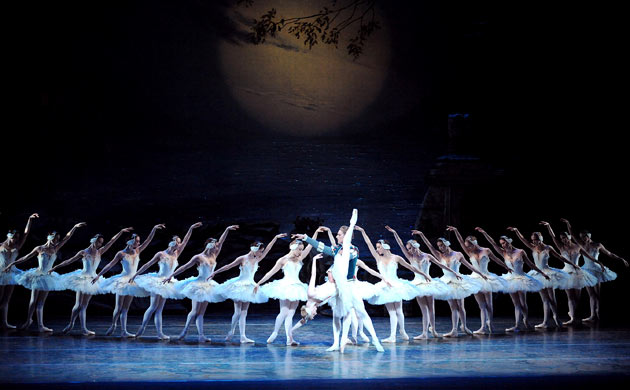
– What do we commonly think when it comes to these terms: play, freedom …? Children, unhindered in their naïveté is in may cases likely the first connotation. And the second connotation may be the artful play of … – for instance the reasonably uncontested beauty of a harmonious dance.

It is the beauty of clarity, order and balance. It seems to be a self-explanatory approach, allowing us to accept without asking, looking at something that has its own order, being independent. Probably this is part of our tendency to perversely celebrate power: the monuments of past and present oppression – yes, I had been in the German Reichstag not only due to business, and part of the study trips I did with the students here from Cork had always been the admiration of some of these ‘monuments’, the last one the most impressive town hall in Paris.

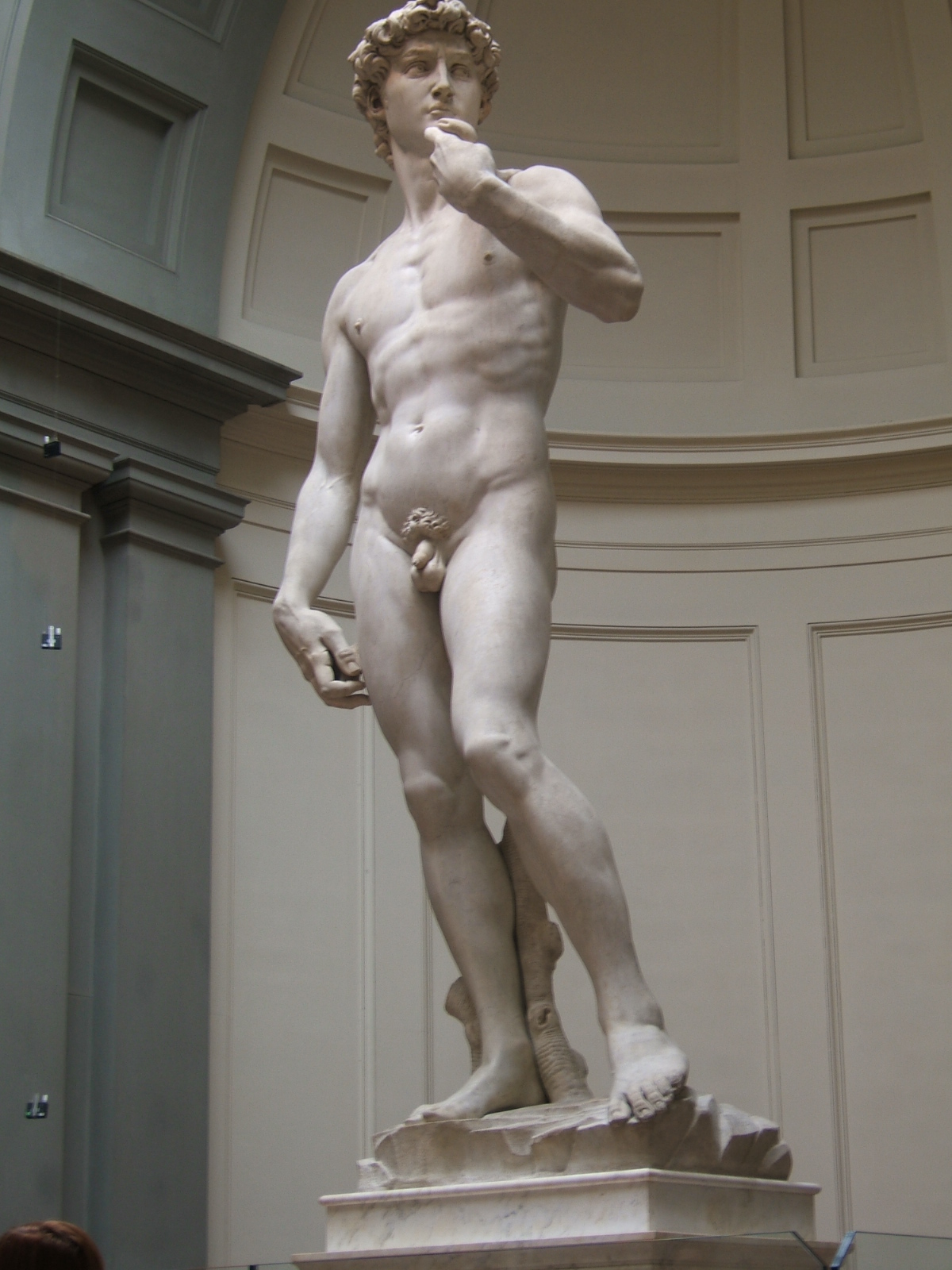
It is the admiration of something able to stand without support. Supposedly in sculpturing Michelangelo’s statue David is a very early example for such order: the first free-standing statue, the young man standing on his own. As such, standing upright, the statue had been sending a strong – and actually hugely contested – message.

As the Florentine chronicler Luca Landucci noted in his diary, stones were thrown at the collossal sculpture even if it was being transported from the Office of Works, so that a guard had to be mounted to protect it.

Importantly

The stone-throwing youth’s came from pro-Medici families for whom the prospect of a figure with republican connotations being installed in front of the seat of the Florentine government must have been thorougly unpalatable.

(Zoellner, Frank/Thoenes, Christoph, 2007: Michelangelo. 1475-1564. Life and Work; Koeln:Taschen, 2007/2010: 46)

Giorgio Vasari chronicled in this context a little story that has some metaphorical meaning.

It happened at this time that Piero Soderini, having seen it (the statue, P.H.) in place, was well pleased with it, but said to Michelangelo, at a moment when he was retouching it in certain parts, that it seemed to him that the nose of the figure was too thick. Michelangelo noticed that the Gonfalonier was beneath the Giant, and that his point of view prevented him from seeing it properly; but in order to satisfy him he climbed upon the staging, which was against the shoulders, and quickly took up a chisel in his left hand, with a little of the marble-dust that lay upon the planks of the staging, and then, beginning to strike lightly with the chisel, let fall the dust little by little, nor changed the nose a whit from the what it was before. Then, looking down at the Gonfalonier, who stood watching him, he said, ‘Look at it now.’ ‘I like it better,’ said the Gonfalonier, ‘you have given it life.’ And so Michelangelo came down, laughing to himself at having satisfied that lord, for he had compassion on those, who, in order to appear full of knowledge, talk about things of which they know nothing.

(Vasari, Giorgio, 1568: Lives of Painters, sculptors and architects. Vol 2: translated by Gaston du C. de Vere. With an Introduction and Notes by David Ekserdjian; New York et altera: Alfred Knopf, 1996: 654 f.)

From here it takes some steps to the question of the disciplining effects of which I promised to talk. But with a little bit of common sense, putting away the cultural bias it will actually be soon clear.

  • One of the fundamental demands put forward in science is concerned with the discovery of structures that are characterising any given reality. Methodologically this is a complex process – and speaking of methods it seems to be a rather simple matter of the famous bean counting. And with the latter we usually overlook that even the counting of beans isn’t as simple and without presumptions as we like to see it. On the contrary – and I quote Joe Finnerty

one of the most effective applications of indicators is not merely to describe but also to analyse, thereby sometimes changing the definition of a problem.

(Finnerty, Joseph, 2005: Social Indicators: Pitfalls ad Promise; in: Herrmann, Peter (ed.): Utopia between Corrupted Public Responsibility and Contested Modernisation. Globalisation and Social Responsibility; New York: Nova Science Publ.; 61-76; here: 69)

  • With this we arrive at the fact that paradoxically a second and simultaneous fundamental rule of science is construction – though analysing reality, this reality isd also constructed by the process if selection and combination. If we focus on elementarity as core moment of the research process, i.e. if we look for what is elementary, we are always applying a histrocial and social (class) dimension.
  • The story of David and Michelangelo’s presentation captures both, the determination of structure based on some form of de-construction and the construction according to the interest that is standing behind research:
  • * David stands in front of his colossal enemy, finding the small point of his vulnerability: the gap through which he could throw the fatal stone
  • * Michelangelo interpreted this: emphasising David’s beauty, virginity and power: a firm independence. However, this translates into some inability to move. It is correct to speak of structure; and it is equally correct to say that this structure follows in some way a rule that is inherent in the person of the David – later in history this is fully spelled out, the early modernity suggesting

Omne ens habet aliquod esse proprium (every entity has a singular essence)

(Johannes Duns Scotus, Opera Omina [1266 à Duns 1308] quoted in: Suarez-Nani, Tiziana: Pietro Pomponazzi et Jenas Duns Scot critiques de Thomas d’Aquin; in: Biard, Joel/Gontier, Thierry (dir.): Pietro Pomponazzi entre traditions et innovations; Amsterdam/Philadelphia: B.R. Gruener Publishing, 2009: 29-67; here:  33)

  • * And finally, the supposedly neutral viewer – the Gonfalonier – is getting lost in all of this: being deceived by falling dust and taking it for change. It is the lack of ability to understand the rigidity caused by looking at isolated ‘facts’. We may take it as metaphor, seeing it as confirmation of Michael Hardt’s and Antonio Negri’s stance:

The triple imperative of the Empire is incorporate, differentiate, manage.

(Hardt, Michael/Negri, Antonio, 2000: Empire; Cambridge, Mass./London,Engl.: Harvadd University Presee: 201)

Now it is not a major step anymore – David can be seen as anticipated manifestation of modern understanding of Anglo-American social policy as academic discipline: it is a discipline that defines itself by de-contextualising the subject matter; it is a discipline that looks at social administration of the good and the evil, the deserving and the non-deserving … .

  • Of course, it is a long and winded road …, at the end of which structuralism evolves. We may speak of Davidian social science and can easily see the fatal development: ‘methodological individualism’. Social processes are dissolved, deconstructed. And from here this social science – always being applied social science – supports in real history the emergence of something new, namely the modern individual, reflecting only him or herself. As we know from Descartes, it is the individual that comes only with this reflection to its existence. It is this reification of Narcissus that leads then Adam Smith to look for an invisible hand – power and security standing outside, being seen as independent from the dynamic processes.
  • However, as much as we are dealing with ideal figures: imagined independent structures, we should not forget that these constructions are not based on free will. They are reflecting societal and eco-technical circumstances as they are given in the social structures: the productive forces and the mode of production – the pedestal on which Davidian thinking stands.

So much on David and the meaning for social science: established had been a figure that expressed

compassion on those, who, in order to appear full of knowledge, talk about things of which they know nothing.

The Gonfalonier, Michelangelo is facing is manifest in today’s office worker: senior officials and the administrator depending on their instructions, immersed in seemingly neutral rules; rules themselves presenting themselves as technical whereas their essence is substantially about socio-political power: law and administration as presented by Max Weber, speaking of

[s]pecialists without spirit, sensualists without heart; this nullity imagines that it has attained a level of civilization never before achieved.

Max Weber, The Protestant Ethic and the Spirit of Capitalism. 1905,Chapter V, Asceticism and the Spirit of Capitalism

Karl Marx refers to this in the famous statement from the 18th Brumaire.

Men make their own history, but they do not make it just as they please; they do not make it under circumstances chosen by themselves, but under circumstances directly encountered, given and transmitted from the past.

(Marx, Karl, 1852: The 18th Brumaire of Louis Bonaparte; in: Karl Marx/Frederick Engels: Collected Works; Colume 11: Marx and Engels: 1851-53; London: Lawrence&Wishart, 1979: 99-197; here: 103)

The dream of freedom emerges turns into its opposite

The tradition of all dead generations weighs like a nightmare on the brain of the living.

(Marx, Karl, 1852: The 18th Brumaire of Louis Bonaparte; in: Karl Marx/Frederick Engels: Collected Works; Colume 11: Marx and Engels: 1851-53; London: Lawrence&Wishart, 1979: 99-197; here: 103)

And exactly this is Michelangelo’s paradox as much as it is the frequently re-emerging paradox of history: the dwarf, the powerless gaining power and establishing him/herself as giant. I am not talking about the tyrants, emerging for usually brief periods in history. I am talking about the tyrannical systems for which they are only mere backers.

Coming back then to Marx contending that

[m]en make their own history

we have to recognise that this claim stands fundamentally in opposition to structuralism – be it as closed and disciplining scientific methodology or be it as ‘way of life’. It stands against the rigidity of oppression, against the abduction and rape of the freedom of thought.

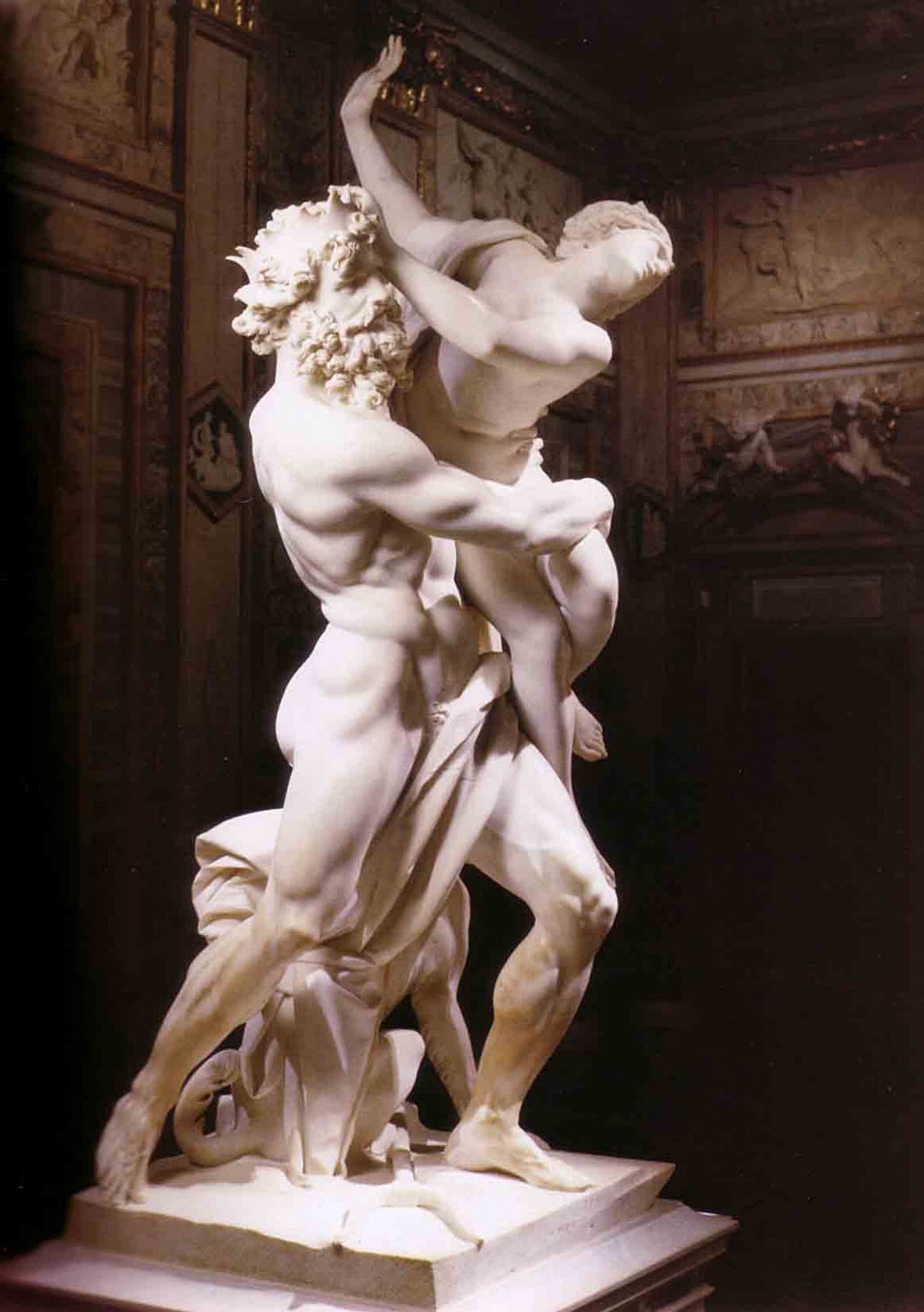
The most impressive statue I ever came across is Bernini’s Rato di Proserpina.

For me it is an amazing, most powerful expression in sculpturing or even in art expressing the victory of process over structure. Sure, the title still focuses on the old hegemony: abduction and rape. Nevertheless, it also suggests a different focus. At the centre we find Prosperpina: fighting, resisting. Her rejection and aversion is expressing a new beauty: the beauty of action, the beauty of a revolutionary process.

According to Simon Schama in a BBC-feature, this statue, Bernini’s great work, is the first piece in the history of art that dynamises sculpturing in a serious way (Schama: passim). Behind this we find in very broad terms two inventions:

  • the invention of the now ‘civilised individual’, distanced from nature and distanced from the social
  • and the invention of the economic sphere as distinct area – a ‘de-socialised sphere of social action’, organised by stratified-functional segmentation.[4]

Of course, this meant not least that the process had been a matter of dialectical development: clearly positioning structures as independent of each other, the escape of the individual from the oppression of the political power had been simultaneously the establishment of new structures. In methodological terms it is what Karl Marx develops, contending that

proletarian revolutions, like those of the nineteenth century, constantly criticise themselves constantly, interrupt themselves continually in their own course, come back to the apparently accomplished in order to begin afresh, deride with unmerciful thoroughness the inadequacies, weaknesses and paltrinesses of their first attempts …

(Marx, Karl, 1852: The 18th Brumaire of Louis Bonaparte; in: Karl Marx/Frederick Engels: Collected Works; Colume 11: Marx and Engels: 1851-53; London: Lawrence&Wishart, 1979: 99-197; here: 106)

But importantly we find this as a process of a permanent restructuration and reconstruction – this is only possible by way of fundamentally accepting the ‘blurring of boarders’. With this we arrive at a point not only of questioning given border lines, but also as matter of establishing new points of reference. Processes of change are of course again linked to real processes – at stake is not an intellectual exercise of ‘reordering the world’. Instead we are dealing again with the fact that processes and structures alike are reflecting societal and social structures: the productive forces and the mode of production. Proserpina is, in this interpretation, not just expressing her rejection but she is also expressing part of another world, now being possible. And now also being necessary as matter of developing independence.

The actual challenge for (social) science is to find a way that allows the construction of an ongoing structured processualistion – in actual fact a rather harsh process of open battles, reminding me of Pablo Picasso’s masterpiece Guernica.

Such quest may replace at least to some extent the dominant discussion of social science that juxtaposes function and structure. Critical realism – for instance being brought forward by Roy Baskar and Margaret Archer – can be an important inspiration for this process. The social quality approach makes importantly reference to this work. At the same time it emerges from the analysis of concrete policy processes, in particular in the area of EUrope – and looking back to art we come at this stage really back to dance – earlier reference had been made already earlier to its beauty.

At the core this new approach in discussing social policy is about a more radical version of dance, not limited top the disciplined form of an academic subject. Even as somebody who had been not only teaching social policy but who had been working for a quite a while in the lobbying industry for changes of social policy I dare to say that the social quality approach is about rejecting the concept of social policy at least in its mainstream understanding. This is not primarily about a rejection by way of criticising certain measures or policy programs. Nor is it about a rejection due to social policy being annexed to other areas of policy making, in particular economics, captured as social investment, the productive role of social policy, the increasing subordination under managerial, legal and financial requirements and regulations. At the core of the critique stands something else: the conceptual framework that is based in two fundamental flaws – with this I come back to matters that had been mentioned already on more general terms.

  • It is about the definition of social policy as something that is rooted in processes and structures that are seemingly standing outside of society. Although social policy is surely seen as something that deals with issued that ‘emerge from society’, social policy itself is considered to have somewhat different roots: it is about intervention, activities ‘on behalf’ or ‘in the interest’ of certain groups, pursuing certain moral ideas and … – and predominantly at the end society comes into play and social policy strives for a better society.  – In short, the social is by and large something imagined, not something real. It is a ‘distinct state’ in some ways similar to Benedict Anderson’s Imagined Communities.
  • * To put it on its feet, we would need a clear and explicit understanding of what the social actually is – the proposal by the social quality approach is to understand it as

outcome of the interaction between people (constituted as actors) and their constructed and natural environment. Its subject matter refers to people’s interrelated productive and reproductive relationships. In other words, the constitutive interdependency between processes of self-realisation and processes governing the formation of collective identities is a condition for the social and its progress or decline.

(van der Maesen, Laurent J.G./Walker, Alan, 2012: Social Quality and Sustainability; in: van der Maesen, Laurent J.G./Walker, Alan (Eds.): Social quality: From Theory to indicators; Basingstoke: Macmillan: 250-274: 260)

  • * Furthermore, the real ground has to be seen in the production and reproduction of daily lives. David Harvey asserts that

[a]t Marx’s conception of the world lies the notion of an appropriation of nature by human beings in order to satisfy their wants and needs.

(Harvey, David, 2006: Limits to Capital; London/Brooklyn, Verso 5)

This brings us immediately to the point Marx himself emphasises. Point of departure is a simple relationality:

[i]ndividuals producing in a society

(Marx, Karl: Introduction (to the Economic Manuscripts of 1857-1858 [First Version of Capital]); in: Karl Marx. Frederick Engels. Collected Works; volume 28: Karl Marx: 1857-61; London: Lawrence & Wishart, 1986: 17-48; here: 17)

And he ascertains:

The further back we go in history, the more does the individual, and accordingly also the producing individual, appear to be dependent and belonging to a larger whole. At first, he is still in a quite natural manner part of the family, and of the family expanded into the tribe; later he is part of a community, of one of the different forms of community which arise from the conflict and the merging of tribes.

(ibid.: 18)

Now it is important to emphasise that

[a]ll production is appropriation of nature by the individual within and by means of a definite form of society. In this sense it is a tautology to say that property (appropriation) is a condition of production.

(ibid.: 25)

However, social policy in its mainstream thinking – including approaches claiming radical changes – are lacking a proper reference in this respect. Instead, arguments are brought forward from idealist perspectives. A confirmation is that social policy, at least in its mainstream and especially in its Anglo-American perspective, does look at the exclusion and oppression of the working class – but it hardly recognises that it had been the working class and the relevant movements that led to what we see as social policy today.

  • The other reason for rejecting mainstream views on social policy is a variation of the first: although the dominance of economic interests is frequently highlighted and criticised – and although it is even recognised as matter of power relationships – the concept of economy is de-socialised. This could be further elaborated; and it could also be elaborated by way of extending the analytical alienation by showing a similar process of de-socialisation in political thinking. In the same way in which Alfred Marshall deprived political economy from the political dimension it can be said that Hobbes (to name just one) the state from the political. The Leviathan is an anonymous institution, bar of a political dimension, reduced on its instrumental and thus technical character of controlling individuals. – And paradoxically we find in both cases the emergence of superpowers that exist as a kind of cloud-castle.

Society is dissolved into three spheres: market, state and communities – and politicians as well as academics fit easily into the role of secular priests, celebrating the economy as father, confirming the state in the role of the obedient son, and hoping for the community and family as emerging holy spirit.

Of course, law plays a role too – presenting itself as a kind of Holy Scripture: a skeleton, keeping things together by way of a seemingly neutral, formal framework – claiming universalism, pertaining particularistic class interests. On the one hand

[a]n understanding of law’s nature is hard to attain because, on the face of things, law seems to possess characteristics that cannot be combined within a single entity: law is an established social institution, but also a guiding ideal for such institutions; an apparatus of organized force, but also the antithesis of force; a product of authority, but also the source of any such authority. It is in this quality that has some theorists to conclude that traditional ideas of law embody a belief in the ‘incarnation’ of the ideal within the realm of the actual, or a belief that law is ‘brooding omnipresence in the sky’.

(Simmonds, Nigel, 2007: Law as a Moral Idea; Oxford: Oxford University Press: 21)

    On the other hand

[m]en and women create their moral identities and values as by-product of interaction and mutual acknowledgement, just as they create culture, language and the structures of thought. The relationships in which we associate together can embody values that structure our choices and decisions.

(ibid.: 7)

And in a society in which power is not distributed equally, the meaning is clear: it is about the moral identities and values of the ruling classes.

  • And to produce then myself such trinity, I come to the next point of rejecting the stance of mainstream social policy: the externalisation of nature – actually we are still dealing with more or less a variation or even the accumulation of the first point, namely the dissociation and idealisation of individual action. From here anthropocentrism is nearly unavoidable

Leaving detailed discussion aside, we find human beings loosing the ability to act – or more precise: they are able to act but there is no space left for developing practice.

For social policy it means that it is fundamentally characterised by especially two flaws:

α) It is highly individualistic, even to such an extent that so-called social rights are only conceptualised as rights of individuals;

β) furthermore social policy is systematically limited by being detached from the socio-ecological causal and contextual foundation, i.e. the (re-)productive existence.

Consequently – and wrongly – social policy as theory and practice – avoids economy (and economics) like the plague. The celebration of noble ambitions, the striving for values that are proclaimed as universal is not simply a quirk of academic thinking – it is in actual fact a dangerous des-empowerment.

– It may be worth a nota bene that it is also undermining academic work: values are stated, remain unquestionable and opposing them is similar to opposing god. A new Alighieri may tell us if Benedict has to go through similar pain, as we know from Pope St. Celestine V, left to ‘gran rifiuto’ – the great refusal (see Alighieri, Dante, 1308-21: La Divina Commedia. Inferno; illustrata da Gustavo Doré, con commenti di Eugenio Camerini; Roma: Fratelli Spada Editori, without date: 36). And furthermore somebody else may show us how this kind of academic dislocation will be end in vein – if we won’t see it already with our own eyes.

I do not want to delve into details of social quality as alternative approach. Shortly, however, one point. I had been asked last week during a debate in Rome as seemingly question: Why don’t you call it socialism?

  • The initial answer had been straightforward: Personally I call it a socialist strategy.
  • Nevertheless, there is a more complex answer: we have to look for ways to adapt socialism and the search for socialist policies to the changed conditions. I.e. we have to find sound answers to the questions of the development of the productive forces, the meaning of such development also in a global, not only a national or regional perspective. Only from here we can understand the meaning of these changes for needs and also for governance. Though this surely means claiming socialist orientation it goes also further. It is a matter of analysing contemporary conditions, it is a matter of social practice in a conscious way. Taking the Marxist tradition, it means to use a permanently critical approach.

Critique is the practice of exposing the social basis underlying an argument. Marxist critique is generally immanent critique, that is, critique springing from inside. …

… critique implicitly recognises that the argument it opposes is right, but right in the context of a specific form of social practice which may not be declared.

(Marxists Internet Archive: Encyclopedia. Critique;)

– Another nota bene: It is exactly this approach that is applied in some work by the Centro de Investigaciones de Política Internatioal (CIPI) in Cuba in which I am involved. It is also something that has important repercussions in countries like Bolivia, Venezuela etc. I make this remark as it highlights that we can expect in particular from peripheral countries and regions inspiring theoretical challenges in this context.

Furthermore, the approach of Social Quality Policies instead of social policy is also not simply socialist as it is an approach that still ask for small measures, traditional policies and reforms that may be departure for further and more radical developments.

  • But having said this, at the end of the day it is a socialist approach to the extent to which it focuses on the social as complex structure of power-based interactions. Here we can briefly look at Antonio Gramsci’s discussion of hegemony and the role of the organic intellectual. Important is to recognise first of all that the core of Gramsci’s work is concerned with the structural conflict in society and the need for addressing it as question of clashing class interests – for those who don’t like the term: just refer to fundamental and antagonist conflicts between different interests. Second, Antonio Gramsci speaks of different forms of power – much later Michel Foucault comes up with this as well, transposing it from the Gramscian view on class struggles into a more generic context of different forms of power imbalances on the one side, power struggles on the other side – culminating in the view on the indivisible relationship between power and knowledge. The important point is that for Gramsci power is only real when it is intermingled with knowledge – deep knowledge leading to organic power reflected in and by the organic intellectuals. Briefly quoting the Quaderni

The criterion on which we should base our analysis is this: that the supremacy of a social group manifests itself in two ways, as ‘domination’  and as ‘intellectual and moral leadership’. A societal group is dominant over opposing groups which it tends to ‘liquidate’ or which it even aims to subdue by armed force and it is leading the allied groups and immediate allies.[7]

With this I am coming to the end by highlighting four points that are in my opinion central for the development for taking responsibility in teaching sustainable social quality.

First, I said in the beginning language matters. It does so in a twofold way: it is about clarity of language and at the very same time about use of language to substantially engage with what is going on around us. Engagement may be about going with the stream of beauty; and it may also require taking up fundamental challenges of disputes.

Second, it is also about the clarity of analysis: only posing an exact question will allow us to find exactly the causalities – and of course the casualities of wrong politics and policies. This is conditio sine qua non for finding therapies: answers to the burning questions.

Third, it requires looking at the realities – not as they appear but as they are. If we then say social policy – to use this term, though not the concept – is predominantly about Social Justice (Equity), Solidarity, Equal Valuation, Human Dignity (the four normative factors elaborated by the Social Quality Theory) and if we see that these values are decomposing, it is because the reality that had been behind them is decomposing. And without falling into relativism, we should not forget that our understanding of Social Justice (Equity), Solidarity, Equal Valuation, Human Dignity is always a historical one. Without this recognition – and without taking firm responsibility for a clear analysis and open dispute, we arrive indeed at reinventing the wheel or squaring the circle.

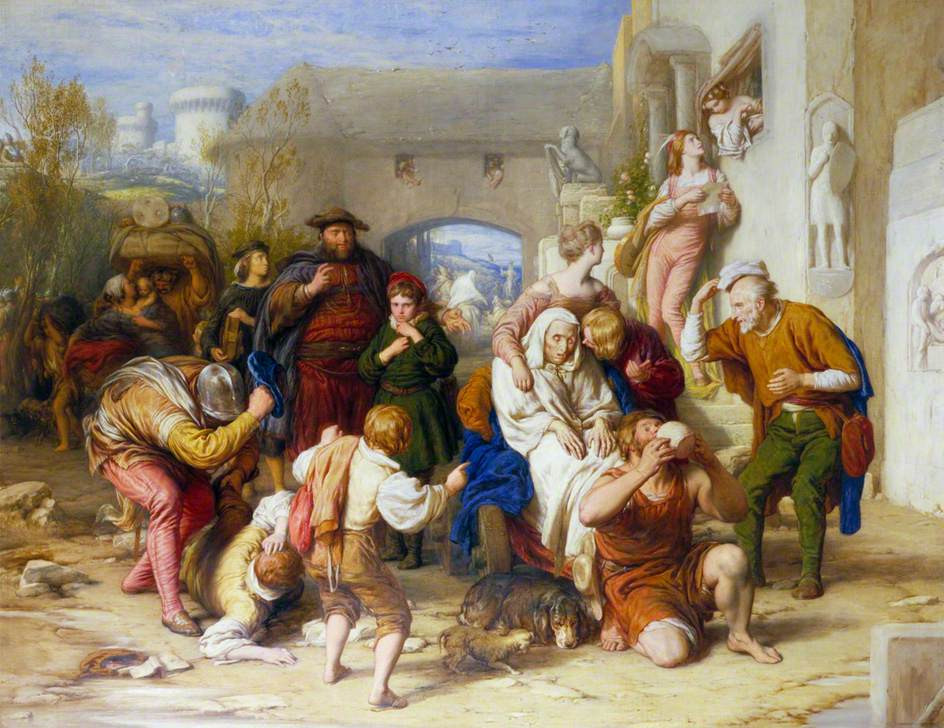
– Of course fourth: Have  look, the little boy, stepping out.

If you ant, this kind of enlightenment is then leading to paradise – referring to another time to Dante, now the third volume, tha Paradiso

Like sudden lightning scattering the spirits
of sight so that the eye is then too weak
to act on other things it would perceive,


such was the living light encircling me,
leaving me so enveloped by its veil
of radiance that I could see no thing.


The Love that calms this heaven always welcomes
into Itself with such a salutation,
to make the candle ready for its flame.[9]


[4]            We can leave the further consideration aside, including the fact that actually globalisation is to a large extent a kind of replication of stratificatory differentiation; see in this context already Herrmann,Peter, 1994: Die Organisation. Eine Analyse der modernen Gesellschaft; Rheinfelden/Berlin: Schäuble

[6]            http://www.birdnest.org/edensk2/dance4.jpg – 27/02/2013

[7]            Il criterio su cui occorre fondare il proprio esame è questo: che la supremazia di un gruppo sociale si manifesta in due modi, come ‘domino’ e come ‘direzione intellettuale e morale’. Un gruppo sociale è dominante dei gruppi avversari che tende a ‘liquidare’ o a sottomettere anche con la forza armata ed è dirigente dei gruppi affini e alleati.

Gramsci, Antonio, 1934-35: Quaderni del Carcere. Vol 3: Quaderni 12-29; Edizione Critica dell’Istituto Gramsci. A Cura di Valentino Gerratana; Torino: Giulio Einaudi editore, 1977: 2010

[8]            “Seven Ages of Man” William Mulready, 1838 – http://upload.wikimedia.org/wikipedia/commons/9/9e/Seven_ages_of_man.jpg. 27/02/2013

[9]            Dante Alighieri: Paradiso, Canto XXX, lines 46–54, Mandelbaum translation. http://www.worldofdante.org/comedy/dante/paradise.xml/3.30 – 27/02/2013

It all starts with a form – and a remark by Albert Einstein

In fact continuing an earlier post)

Well, at least all this shows that things can apparently still be taken with humour – as written in one of the mails

The last time I saw a person from Buildings and Estates in Carrigbawn he told me that the internal building was laughable, it was so poor. That was nearly two years ago.

Sure, never forget to approach things in a humorous way – though some people go even with a smile to the gallows. Of course, the question is then why do in this case the victims go to the gallows – and not the perpetrators? The definition of gallows says that it is

for the hanging of criminals.

The only reason I can imagine for feeling criminal is bringing me back to Plato who said

One of the penalties for refusing to participate in politics, is that you end up being governed by your inferiors.

May be that ‘being governed’ by administrators who need to fill in a form to switch on the heating is a gallows-like penalty.

Or it is the good laugh we may get out of it: at least taken from the one mail the state of some buildings seems to be a joke – herfe it is quoted again

The last time I saw a person from Buildings and Estates in Carrigbawn he told me that the internal condition of the building was laughable, it was so poor. That was nearly two years ago.’

– Though I can understand the colleague from buildings I am not entirely sure if the laugh is so good that one comes near to suffocation, thus having another form of gallows … .

There is another thing: all this had been and is an excellent example: My entire social policy teaching yesterday had been based on this little incidence. In class we talk currently about rights and law – you may refer to this concise definition by Kant, stating:

Right is therefore the sum of the conditions under which the choice of one can be united with the choice of another in accordance with universal law.

(Kant, Immanuel, 1797_E: The Metaphysics of Morals. Translated and edited by Mary Gregor. With an Introduction by Roger J. Sullivan; Cambridge: Cambridge University Press, 1996: 24)

And of course, the problem is the reflexive (or we may say tautological) character, typical for ‘modern societies’ and in very simple terms already criticised by Einstein, saying

we cannot solve our problems with the same thinking we used when we created them.

The challenge then is to overcome the permanent tension, immanent in law of the modern capitalist society, a political system that is characterised by liberality of economic activity based on private property executed by individuals within the framework of the nation state …

Of course, the limitation is already visible in the claim of general moral and intellectual virtues as spelled out by Aristotle in the Nicomachean Ethics:

  • prudence, justice, fortitude, courage, liberality, magnificence, magnanimity, temperance
  • justice, perseverance, empathy, integrity, intellectual courage, confidence in reason, autonomy.

One of the very fundamental flaws with it can be grasped by the inherent naive individualism and protectionism which then later could serve as fertile ground for individualism – and as such it is about a paralysing effect of a normative system that claims to inform individual, however is reduced to permanently reproducing itself within this idealist gist without being able to emerge as actual social force.

What remains in this perspective as solution is limited: the self-construction of individuals, the justification of the Leviathan as personification of the social and evidencing its individualist stance: the superpower, allowed to do everything, by Weber (in his Politics as Vocation) said to have the

monopoly of the legitimate use of violence

and with all this lacking the fundamental force of genuine relational sociability. The state based on righteousness emerging as state based on law. The state as ré-total instead of being a ré-publique – already outlined in much earlier writing by Emanuel Joseph Sieyes.

And the only legitimate power can then even come along and deny the rights: class education, institutional racism, gender inequality. Of course, it is the social science that occupies the part of the five-start-university’s infrastructure that are in the worst conditions; of course it is the working class that is still hugely underrepresented in third-level education; of course it is gender that plays a role when it comes to the choice of subjects and of positions in the hierarchy of academic positions; of course it is the working class that is still largely left outside of the equation when it comes to reflecting on social policy which limits itself on administration, good-doing and injustice rather than talking about class conflict – and of course we decry the discrimination of individual students on ground of ‘race’ without however honestly contesting the fundamental parochialism of our Western societies that allow capital to move freely within a globalised economy (that is still hugely structured by centre-periphery inequalities), a parochialism that consoles ‘ordinary people’: as long as they adopt the culture of wingless consumers: chicken nuggets, wrapped in tight seats of low-fare airlines, allowing the illusion of also living in the global village. Sure, those who do not adopt the rules have to adapt to other rules: detention, deportation and/or permanent control and oppression … – all part of the of picture which the German writer Bert Brecht once characterised by the words: ‘The lap is still fertile that allowed this to grow …’ (Brecht had been reflecting on fascism – at a time what it had been overcome, but its roots had still been in place). And just while writing these lines I receive the news that some German parliamentarians lost their immunity because they participated in a protest action against a gathering of fascists in Dresden.

All these ‘injustices’ and ‘social imbalances’ remain within the outlined system – legitimate as long as they are geared towards spaces for this self-construction. Surely a painful process – even if self-construction is about self-deconstruction of those victims who are blamed to be responsible for their situation: suicide, addiction, consumerism, criminality, the victims made to those ‘perpetrators’ that become ‘clients’ of social professions. And it is a painful process even if it is only the pain of a cold office, or the pain of

‘part of the roof of Carrigbawn (the decorative wooden bit, complete with nails sticking out) which fell off during last night’s storm’

and which had been picked up by Angela and luckily did not hurt anybody.

Dyl Ulenspegel clould not beat it

You know, I can gain some pleasure from some foolish acts – and I also think that much of what we are teaching, be it on rights, politics and policies etc. can be literally found in any day-to-day situation within institutions like for instance any university. Finally I still think there is some meaning in making such follies of public services public (you think it is a play with words? – Not really!) [well, all this shows there had been something I learned from one of my teachers, Rudolph Bauer – and I am still grateful for his teaching many years back and his ongoing friendship over the years].

So, here another little story.

***********

I sent a mail to “buildings office” – after suffering in a lecture room and after seeing the students suffering even more (at least I could move a bit around while lecturing). So here is the text of the mail sent on the 24th:

Dear …, I had been teaching today from 11 to 1 in the Distillery, room G01. The students complained about the lack of heating – and I only made the session myself as I had been able to stand and move at least a little bit – not keeping warm but at least maintaining a temperature that allowed me teaching. However, students said as well that they had been over long phases not in a position to concentrate.

Be it as matter of citizens rights to education provided by the Irish state or by way of customers of UCC as service provider, this is an unbearable and unacceptable condition. I am writing not least as this is not the first time it happened, though it had been previously in different venue.

I hope that this issue will be investigated in a sincere way and the issue will be corrected.

Thank you very much,

Peter

I then received on the 28th of January an answer by the Buildings Office Helpdesk – yes, I received one.

Just an attachment – a form

WORK REQUEST/ORDER

NO: 62025

Requested by: Herrmann, Peter

Dept.: … Location: ….

Description of work request:            turn on heating in G.01

One page (A4) with different sections:

To be completed by Supervisor

To be completed by Assignee

For Office Use

Mind, especially the stuff noted under Safety Notice:

All works is to be undertaken by suitably qualified and competent persons, and in compliance with the Buildings and Estates Office Safety Statement and College Safety Procedures.

Work should be supervised as appropriate by the relevant foreman.

What is said in respect of qualification and competence may be questioned when it comes to the folks that is engaged with defining the admin side of a simple act: switch the heating on before teaching commences.

**************

May be … – if Kafka would be still around, he surely would write another of his famous stories based on this. And this story could surely be sufficient for Erving Goffman, Norbert Elias and the like to get them an hour and more exploring phenomenology of institutions and the Sociogenetic and Psychogenetic Investigations of the Process of Civilisation … .

One point may be added: Norbert had been strong believer in the process of civilisation – and although he had been (as Jew) forced by fascism to leave Germany, he had been until the end of his life convinced of such civilisational progress, rejecting any proposals to talk about de-civilisation and even remerging barbarism. Later, such discussions emerged by people who based their arguments on his work. Though I assume he would not have agreed. He had been just too gentle to think that we can step back. And with all conviction I still try to maintain such gentleness that I have had the honour to experience during our meetings, not possibly getting seriously damaged by being forced into such an iron cage (as Weber would have had it).

You see? Such a little story, and so much in it … – Occasionally I feel myself being seen as a very abstract thinker – but there is something I learned from somebody else who had been teacher and somewhat mentor: Niklas Luhmann, showing me that these apparently very abstract terms, categories and relationalities are just in front of us in tiny pieces – and it is up to us to leave it there on the ground: scattered and dangerous with the sharp edges of the heap of shards; or if we draw attention: allowing us to detect the essence of what all this is actually about: simplicity of oppressive hegemonic of which we are all part.

There could be an endless chain of examples we may add:

  • Grants for conference participation given to full time staff – maintaining establishment – rather than promoting with the meager means colleagues who may be in precarious situations, just starting careers … – sorry, didn’t older colleagues have enough time to establish themselves to be invited and get the conference fees covered by the organizers?
  • Issues of teaching and learning decided by administrative rules (or administrators as rulers?) rather being assessed in the light of needs of students – and staff that are preparing relevant material, sessions and excursions
  • publications rated on grounds of quantity and of ‘reviewed’ quality instead of quality and quality emerging from collective disputes

Well, we may leave it with the trinity – sure, in this light we come to the conclusion – taken from Marx’ ‘Grundrisse‘ – that

[t]he concrete is concrete because it is the concentration of many determinations, hence unity of the diverse. It appears in the process of thinking, therefore, as a process of concentration, as a result, not as a point of departure, even though it is the point of departure in reality and hence also the point of departure for observation [Anschauung] and conception.

PS: in this context perhaps of interest my publication

More recent and relevant:

And finally:

  • Research on demand. Academics between self-consciousness and self-chastisement; forthcoming in the documentation of the ÖFEB-annual meeting)

Guest Contribution: Children’s Rights in Social Care Setting under Irish law: Reality or Myth??

Lucy O’Leary *

Children’s Rights in Social Care Setting under Irish law: Reality or Myth??

Introduction

The recent Irish referendum has given the impression that children’s rights in Ireland will be placed on some sort of an equal footing with that of their parents. However, the reality is somewhat different. The social care setting is an area of law that is of particular controversy due to the inability of the courts to look at these children as independent entities from their biological parents, foster parents and social workers. Their opinions and feelings are largely framed in terms of the opinions of the social work profession and despite the referendum, aimed at placing children at the forefront of all matters concerning them, this will not change. This is due to the lack of a child based approach in the courts and the adversarial nature of this arena.

This article shall look at the reality of children’s rights in the social care setting in Ireland in light of the referendum, and see what, if any, changes have been made to place the child at the forefront of these disputes. It shall place particular emphasis on the right of the child to have a say in where and who shall take responsibility for their everyday care. It shall also look at the impact that both European and international standards play or should play in the voice of the child being properly heard in these cases.

The Irish Perspective

Children’s rights in Ireland have been the source of debate for decades, especially given that Ireland signed and ratified the Convention on the Rights of the Child as early as 1992, and 20 years later, children’s rights had still not been placed within the constitutional framework of this jurisdiction. While the legislative provisions protecting children and potentially giving children a voice are vast[1], the ‘inalienable and imprescriptible’[2] rights of the marital family are regarded as the “fundamental law of the state and must be taken as overriding any pre-existing law inconsistent therewith”[3].

The reality of the marked absence of a child centred approach in the courts has led to much criticism of how Ireland[4] effectively regards the independent rights of the child, as a separate consideration from that of their parents, social worker, foster parents and all other interested parties. The rights of the marital family have led to some extremely contentious decisions by the courts[5], where the best interests of the child were clearly contrary to the outlook of their parents, but due to the hierarchical system that exists within the Constitution, and the placement of article 41 at the top of that system, the rights of the child were outweighed by the rights of their parents.

This was thought to have changed in light of the recent referendum on children’s rights in Ireland. During the campaigning for the yes vote, many criticisms were made about the language of the new article 42A and how this would not, in reality, change the previous hierarchical system[6]. Despite these assertions, there were also fears that the new amendment would dilute the rights of parents to ‘parent’ their children[7]. The reality however is far removed from these fears. The Supreme court has stated time and time again, that the “sanctity of the family and the enduring existence of parental authority seem….to be guaranteed by the provisions [of article 41 and 42]…..and that the framers of the Constitution considered, and enacted, that the best interests and happiness of the child would be served by its being a member of the parental household”[8]. It is very difficult to see how this will change, given the wording of the new article 42 A.

The wording of the amendment, while it does provide some rights to children, is restricted to cases of guardianship, custody and access[9], and is preceded by the words “provision shall be made by law”, as is every insertion of the various provision of article 42A. This means that legislation will need to be implemented, in order to give effect to the rights of the child as asserted by this amendment. The Child Care Acts 1991-2011 and the Children Act 2001 provide for all matters regarding children. These are the legislative provisions available to children in Ireland and therefore, it could be said that this amendment offers nothing new to the realm of children’ rights in Ireland.

It could be said that the most important right for a child to have, is the right to have their views taken into consideration in all aspects of their care, a provision that is contained in the Guardianship of Infants Act 1964, s 25[10], a provision that has not been commenced yet, and which has been described as a ‘relatively mild obligation as it leaves the discretion to the court in relation to the child’s capacity to understand’[11]. While the amendment provides that legislation must be enacted in order to give this provision effect, in the absence of a child centred approach by the courts and the adversarial nature of the system, it could be said that a radical overhaul of the court process would need to be implemented, in order to give proper enjoyment of these rights to children.

The social care system is a further barrier to overcome for children that find themselves encapsulated within it. Not only do they have to try and be heard by their parents and the courts, they also have to try and be heard by their social workers. While the social worker will try and ascertain the views of the child, their obligation is to act in the child’s best interest, which may not correlate with what the child actually wants. This can lead to a further ostracising of the child and a feeling of helplessness in an environment where they already feel loss of control. It has been well established that involvement in the decision making process can increase a child’s “sense of identity, self esteem and personal autonomy”[12]. However, the absence of this approach within the system, can only serve to be of further detriment to the child.

_______________________

* Lucy O’Leary
BCL 2009 in Griffith College Cork
Studied H Dip in Social Policy 2011-2012, UCC
Currently studying LLM Child and Family Law in UCC 2012-2013

This contribution had been written in preparation for publication in SOZIALEXTRA (issue 4/2013). As it is dealing with the situation in Ireland and gives at the very same time an insight into questions that are of general relevance it is worthwhile to be published also in English, not only in the German translation in the journal.

See on this topic also my own post.


[1] Child Care Act 1991-2011, Children’s Act 2001

[2] Article 41.1.1 Bunreacht na hEireann

[3] Re O’Brien (an infant) (1954) IR 1 at 10, per Davitt P

[4] Concluding observations of the UNCRC, CRC/C/IRL/CO/2, 29 September 2006, p.2

[5] N v HSE [2006] 4 I.R, Northern Western Health Board v H.W and C.W, (2001) 3. IR 622.

[7] ibid

[8] Re O’Brien (an infant) (1954) IR 1 at 10

[9] Article 42A.4.1º ii

[10] As inserted by Children Act 1997

[11] Annual Review of Irish Law 2004 (Dublin: Round Hall Sweet and Maxwell, 2005) as cited in O’Callaghan, “ Realising the Child’s Right to be Heard in Private Child Contact Disputes: Progress in Practice?” (2010) Irish Journal of Family Law at 9

[12] J.E Timms, Children’s Representation: A Practitioners Guide (London: Sweet and Maxwell, 1995),p 440 as cited in O’Callaghan, “ Realising the Child’s Right to be Heard in Private Child Contact Disputes: Progress in Practice?” (2010) Irish Journal of Family Law at 1.

Details

or leaving me aside. Leaving me aside – my excitement when experiencing Russian history n a nutshell, really compressed in a short paragraph, a long sentence if you want: Compressed to the imagination of walking along the Nevsky Prospect on the pavement of which once Alexander Sergeyevich Pushkin walked …., a Zeitgeist that drove Fjodor Michajlovitsj Dostojevski to gambling; allowing me now to think in similarly eccentric ways as Lev Nikolayevich Tolstoy did, when he may have visited this city that has now the name Saint Petersburg; thinking about the greatness of Peter and the likes who, when time matured had been dwarfs standing in the way of the largess of a new society which chased them away, following the call coming from the Aurora and standing at the beginning of conquering the Winter Palace – the storm that later still required The Mother taking rigorous steps, standing up when she had been called.

Details are often forgotten while looking at the large picture. Or is it more that we are blinded by some grandeur?
There are surely the great politicians, the large lines and also the large crimes. And even if one should be careful with premature joys or anger, one should not take the required circumspection as an excuse for holding back with political judgement. And this is a matter of current governments here (yes: HERE) and there (for instance the ridiculous sentence for Berlusconi and the reduction of even this modest conviction. Nevertheless, leaving this major lines aside, looking at something that is more hidden it is sometimes the really small things that make huge differences.
When I went  he other day by train with Viacheslav to Petersburg – and while we had been comfortably sitting in the fast train, we had been chatting with Natasha (who is Natasha  – It could be a long story now like the many stories usually told from the transsib, even if the train trip took definitely much less time than one of those famous (or infamous?) trips in the “old times”. At some some stage we talked, of course, also about politics – Natasha recalled pre-Perestroika-times (“What are you talking about? When was that?” Viachselav intervened, half jokingly). The woman continued undeterred, though with a little smile:

You know, those times, before Gorbachev. We had been … – we. You,

she pointed on me, as on somebody coming from another world, the world of old capitalism

you start you sentence with I. And you write it with a capital letter, even in the middle of the sentence. it had been different here. It had been about us, about we …

Viacheslav intervened:

Peter knows. He studied also in

Looking at me I helped:

Leipzig – when it still had been in the GDR, although the Campus had been near Berlin.

Yes, the times and the circumstances had been different. But there seems to be more to it. One could speculate about this “it” constituting the we and the I … – and as much as times and circumstances matter, something seems to be still alive here where pure capitalism is on the advance to complete final victory. I thought about this “we” the evening when visiting with Viacheslav and Olesya the Mariinsky theatre, enjoying Glinka’s Ruslan and Lyudmila … – in the program brochure so many details had been listed, the soli in the orchestra even if they seemed to play a minor role. It seems to be a paradox: but here, where it is still about a “we-society”, the I becomes much more important than in societies that pretend individuality and can only do so by limiting it to a sole mate, who has lost the soul.
And in actual fact, the detail gains grandeur when being really part of the we. – And history is a little bit like a love story – a love story being felt like the “story line of history” …

student accommodation, studying facilities ….

or what is studying about?

Dear Students – here in Ireland and probably elsewhere.
Recently a mail had been sent to the staff at UCC – it originated from a Senior Lecturer in Science Education at the Department of Education, Uiversity College Cork and stated the following

I am writing to ask you to encourage your students to make use of the weekend study facilities now available in the Campus Kitchen. From now until next May the Campus Kitchen will be open on Saturdays, Sundays and bank holiday Mondays from 9 a.m. to 10 p.m. each day. Feedback from recent talks on “Steps to ensure success in your study of science and engineering in UCC” that I gave to all first year science and first year engineering student students indicates that a significant number of students living in student apartment complexes find it difficult to study in this apartment environment.

Many thanks to Mr … and his security staff as well as … for making this facility available. The Students’ Union will be informing students of the study facilities available but a few words of encouragement from yourselves may help students to settle down to study and to start using the weekend study facilities to help them to keep up with their work. Recent statistics from the HEA (Mooney et al., 2010) on drop-out rates from universities in Ireland are cause for serious concern.

Now, I will be the least to complain about providing additional study facilities to students – when I had been studying, I had been in the privileged position that I could use the library 24 hours a day – there had been one exception throughout the year. though I do not remember exactly, I think it had been the 25th of December that the facilities had not been available.

Leaving various things aside that could be said in this context, I want to raise at least three points:
* is the provision of study-facilities really an appropriate answer on the lack of quality-accomodation for students? – This laves aside the fact that this accommodation is in many cases completely overpriced, pushes students out on the private market, thus contributing via a more or less long chain to problems on the housing markets. If landLORDS (are we still living in feudal times, or is it even meant as prayer?) are making easy money, this, of course, maintains high rents …
* is teaching, organisation of seminars and discussion opportunities so limited during the week that there is urgent need for facilitating additional studies during the week – especially: additional space for individual studies?
* finally, is the lack of space for studying a real and major problem for “high drop-out rates for universities”?
Perhaps such Higher Education Authorities should step down from their pedestals – having a look at the reality of all these supposed  *****-universities, excellence universities may cure them. Though it is boring and we all know it it may be stated again: education is perverted to a commodity. It is “goal-oriented” and the sole goal is availing of a paper that states a degree. I do not want to write a plea for the humanist tradition in its traditional form: it had been highly idealist and elitist in its very foundation. Nevertheless, it surely had been more of an empowering spirit than much today’s skill-orientation. And surely had been more emancipatory, independent it is orientation than social scientists who state in a complaining, and even depressed mood:

This is the consequence of liberalism

Turning around after a deep sigh …., continuously walking the old ding-dong-trotten path, welcoming any success, any start gained or maintained, as a success – it is a little bit like Christmas:

Mai le campane risuonano più dolcemente

Isn’t it time to wake up? – Can be sweet too!

At least this colleague seems to have slept while he had been studying … and needs to improve skills, then justifying a position as Senior Lecturer in Science Education at the Department of Education

We Got IT – Update Your CV …

Dear Colleagues,
as it is now clear that EU had been awarded the Nobel Peace Prize 2012, there is some rumour that every EU-citizen can claim to be winner of this prestigious accolade.
You may consider this  when updating your IRIS and other information relevant for Quality Assurance.

Most of you know that I had been engaged for many years in EU-policy making – on different levels. From direct contact I know also – just to mention one tiny point – the the current president of the Commission (in my experience the least qualified during my “term in office” which reaches back into middle 1980s) appropriated the responsibility on “social services of general interest”, taking it away from Vladimír Špidla, then Commissioner for Employment, Social Affairs …. – I mentioned this occasionally publicly and do it again although it may have been confidential information I obtained in a personal conversation from the Commissioner. Still, although I left that field of activity for different reasons (leaving some minor engagement aside) I am in principle very much a supporter of the European idea. And I am well aware of the ambiguity – what is today the EU surely being an institutional setting that succeeded on many issues we can relate to in positive ways. Nevertheless, I have my serious doubts that the awarding is in any way justified. An idea that is valuable, being set in a harsh structural setting, is as valuable as the chitchat of a smart society in an increasing “refeudalising” economic environment (having used this term, and having published in 2010 on this [the second of the “New Princedoms” just went to the printer] I am myself aware that much economic analysis is still needed to back this thesis).

Anyway, EU-staff and students may claim that they had been awarded. Colleagues from “Third Countries” (sorry, this is the official terminology) may possibly claim that they know Laureats (which is something, isn’t it).
The details on the award ceremony are not yet clear – so, refrain at this stage from buying flight tickets to Stockholm.
Some additional information for foreward looking people: There is some hope that The Sveriges Riksbank Prize in Economic Sciences in Memory of Alfred Nobel may be soon going to the EU too.

Customer Care or Criitique of Political Economy for everyday’s life

There had been a problem with my address – stuff the bank sends frequently doesn’t arrive as it should – well, Irish addresses …
So, I sent a mail, mentioning this and I receive the answer:

If you do online banking this problem doesn’t occur.

I am hesitating to answer

If I and all the others do online banking you will loose your job.

And I am also wondering – thinking about this tiny incidence in connection with the recent experience in a travel agency (one of these old-fashioned places where one can book flights ..). – distinctly attentive and friendly staff really obliging. And extremely well organised. Just a blink before I am told

And you will receive a notification on your mobile phone as well

I feel the soft touch of the vibrating phone on my chest – as if it would be a version of modern life’s love story …. – and I pay, of course, without hesitation the 40 Euro more the flight costs me if compared with the web-booking. Well, there is a little more to it – the actual reason for booking with the travel agency had been less about this little love story and more about getting without complications the insurance needed for the visa-application.

In any case, sufficient stuff to work along and give a four hour lecture on economics and the economy … – but this I will leave to September when my students return and when I will look with them at Queens, Quesnay, Smith and …, yes, sure, at some stage also at Marx who famously clarifies fetishism as objective mechanism in capitalist societies:

As against this, the commodity-form, and the value-relation of the products of labour within which it appears, have absolutely no connection with the physical nature of the commodity and the material relations arising out of this. It is nothing but the definite social relation between men themselves which assumes here, for them, the fantastic form of a relation between things. In order, therefore, to find an analogy we must take flight into the misty realm of religion. There the products of the human brain appear as autonomous figures endowed with a life of their own, which enter into relations both with each other and with the human race. So it is in the world of commodities with the products of men’s hands. I call this the fetishism which attaches itself to the products of labour as soon as they are produced as commodities, and is therefore inseparable from the production of commodities.

Lost Ground

It is a narrow staircase only, and a short one. Three steps to go, two, one – the way to climb up to her is as short as it is leading through a dark space. Even the very moment before I turn around the corner I am not even aware of the fact that she is there, just the second I move the head up I look in her face and sense the impossible. – A placid, warm breath, touching my face, adulating gently my neck and resting on my shuoulders and I am looking into the eyes of this woman.

It is nothing like short meeting in the coffee shop near the train station – the encounter of two travellers, eternal tourists and the modern travellers’ life as jigsaw as I mentioned it when I wrote about the visit in Copenhagen. And nevertheless there is something that reminds me of that sweet encounter.

– Yes, a placid, warm breath, touching my face, adulating gently my neck and resting on my shuoulders and I am looking into her eyes, she is looking into my eyes: Pallas Athene.

It is not only the nearness I feel, the imagination of being physically tapped, the experience of naturalness. It is also something of the eternal tourist – though now not moving in space but in time – the goddess as an authentic Time-Traveller’s real wife. It is an all-embracing feeling with its own dynamic: the paradox of losing control emerging from the feeling that this single existence is real part of the universe of space and time. One of the innumerable single existences without which the world would not be the very same reality that it is and at the very same time one of the innumerable single existences that actually cannot make a real difference, a moment that cannot shape reality. Captured by the genius of Gustav Klimt.

–––––––––––––––––––––––

Perhaps it is in particular when facing Klimt – and some of his contemporaries – that it is easy to forget about academic classifications. Perhaps one can go even a step further: it is difficult to think in terms of classifications although and because one is permanently confronted with academia. The famous dispute which developed around the faculty paintings went far beyond the topical issues on the spectacular debates of the time – for instance the one on medicine. And the other equally provocative on philosophy.

Trusting many sources about his life, Klimt had surely been an enfant terrible of his time. And as two major reasons the following may be brought forward: first, entering the world of arts had not necessarily been what he heard at his cradle. Second, one may say especially as Klimt has been – enfant terrible – a most pronounced representative of true, unbribed academy. In this respect being enfant terrible had been so different from expressing his anger and concern in a helpless scream – the provocation depicted in Edvard Munch’s famous painting The Scream. Gustav Klimt had been looking for radically questioning the conditions of the time. It is not least the difference between lament and accusation that marks the difference between the two.

Munch once said:

One should not paint interiors peopled by reading men and knitting women. One ought to deal instead with living human beings capable of breathing and feeling, suffering and loving.

And probably his most famous piece – The Scream is a paradox expression of this. On the one hand we feel the instant message: the devotion to this sujet. We can see the immediacy of the artist being directed towards and guided by these ‘living human beings’. Nevertheless, the fact that Munch could bring this immediacy to the fore is based in grasping the paradox, namely depicting a being that is pushed to the margins: somebody who is facing the situation of loosing ground, of suffocating because of not being honestly allowed and able to

breath and feel, suffer and love.

Feeling and suffering is limited to and compressed into a scream – diffuse, unknown by way of it’s origin and direction. And as much as it is such real person, it is hindered by the fact of one-sidedness, or even more so: in-sidedness.

In which way ever, it is obvious that the viewer is a most important part of entire account: accused, beseeched – but always only in this perspective of a self that lost ground, that misses anchoring: de-rooted as the soil is poisoned.

All this is not least part of a socio-economic situation that can be characterised by a very similar pattern as we find it today: middle classes, reasonably secured in – or at least: feeling reasonably accommodated by – a now stabilised capitalist system (the early stage of industrial capitalism had been now at a stage that can be considered as consolidated) had been increasingly becoming aware of the fact that this capitalism had not been a threat to the living of industrial workers but also to their own position and also to the life of society: alienation can be seen as the foundational principle of the life perspective especially for many of the privileged middle class strata and in particular of the Bildungsbuergertum[1]. An important point in this context is the emergence of some form of – for the time – new inwardness, using Egon Schiele’s words: the quest to

Work from the heart. – And you have the chance to ‘imbue your work with spirit’

and the opening towards new options, suggesting – in the words of Baudelaire – that

Modernity (der neue Stil) is the transitory, the fugitive, the contingent …

In particular Baudelaire’s statement is telling as it allows to understand the permanency of transition, the presence of change which we can only understand when we understand ourselves as fundamentally social beings in the deepest meaning: part and parcel of history in the strict sense – recalling another time Goethe’s words

He who cannot draw on 3000 years is living hand to mouth.

For me, this feeling of being genuinely part of history is so poignant when looking into Athene’s eyes, that I write later in a mail to Joe, a friend of mine

Had been in the Historische Kunstmuseum today …, just unbelievable !! Yes, even after all these privileges of seeing and experiencing so many things that are sealed for so many people, I still can be impressed by many things; but I didn’t believe that I would stand another time in front of a fresco, very close to crying (the other time that this happened is nearly obvious: Picasso’s Guernica – while writing it comes to my mind: in both cases standing alone there: the small Peter from a tiny Irish village, being confronted with history, so to say: squeezed by this monumental existence, the nightmare Karl had been talking about.[2]

All this has, however, another dimension too – the 3,000 years Goethe refers to, still being important as score of historical consciousness, are at this point in time increasingly a matter of the immediate presence: for people like Klimt and Munch compressed in a blink of an eye, and moreover: rather than being a matter of intellectual reflection but as matter of actual life, emerging from the inside. With this, it is of course something that is extremely difficult to handle: the felt isolation and indolence stands against the objective socialisation and fluidity.

Even small details of a technical kind are emerging as important – condition of the new style even if only by allowing change to happen and reinforcing it. In 1841 the tube had been invented, making it easily possible for the painter to move away from the studio, capturing landscapes, capturing – we may remember Edvard Munch’s words –

living human beings capable of breathing and feeling, suffering and loving.

It had been a move that allowed the artist to work not only by imagining people who are capable, but who are actually doing it. Moving out of the studio, thus, had been a step towards moving inside of people’s life. And furthermore it allowed moving inside the own impression – the artist now being encouraged to express the immediate impression. We may remember what had been said on another occasion, looking at a

fast stroke with a brush in paintings like that of a tree, just Over In An Instant

When quoting Sean Seal’s words earlier it had been to highlight the factor of time: compressing time in such fast strokes as means of capturing historical reality in a condensed way. And the same can be said now for space.

In this way we may extend the look on Gustav Klimt and Edvard Munch by claiming that this is by and large true for an entire new generation of artists: the Impressionists as masters of spaces, timespaces and spacetime in entirely new ways – and opposing what the great Vasari claimed, saying ablout paintings that they are

laid on flat with most simple strokes of the brush and having but one light, shows but one aspect

(Vasari, Giorgio, 1550: Lives of the Most Eminent Painters Sculptors and Architects ; here quoted from the Internet-version)

There had been another technical development, opening arts for new ways: the invention of photography, seriously beginning in 1820s. ‘Exact depiction’ now being easily possible meant loosing ground for ‘realist’ paintings. Basically two answers had been possible. The one had been the emergence of a new realism, in the extreme case much later put on firm feet by Bert Brecht in his theory of theatre and developed under the term of Verfremdung, i.e. disassociation. Cum grano salis this can be said for much of early realism even of artists as Munkácsy Mihály that had been looked at earlier. On the other hand we find the Impressionists, breaking with reality in the strict sense and moving forward – in economic terms: moving beyond assemblage. Of course this had been a complex development, full of contradictions. But in any case the Impressionists can also be seen as very early avant-garde of a new mode of production.

Avant-garde – a complex and surely tricky issue. Looking at the economic developments this new mode of production had been characterised by an escalating separation of exchange value from use value. In some way, the reality as such lost meaning: it had been only a construct, assembled as matter of actual production; but in addition assembled by the ongoing social construction. Issues as fetishism, consumerism, alienation, isolation and the like come immediately to mind. And at the very same time, this emerging hedonist person comes now increasingly only into being by relating to the social and inorganic environment.

One indicator for this is the emergence of ‘social actors’ or as it is nowadays frequently itemised in social science: agency. Émile Durkheim still concentrated on the fait sociale. If we see such social facts, undeniably existing as presented in Durkheim’s study Le Suicide (1897), it had been very much a passive reflex, something like the supposed move of the lemmings: an activity initialised by some unknown impulse, a mass, acting unconsciously, a direction that seems to be determined by an external and eternal law. Of course, this needs to be qualified as Durkheim had been interested in detecting this ‘unknown impulse’. Actually his analysis had been driven by the conviction that cause of action and its direction can surely be detected – and changed.

In any case, this interpretation of the social fact changed completely – and this happened in historical perspective around the same time, literally before Durkheim published his major works (Le Suicide [1897]; De la Division du travail social [1893]). Karl Marx and Frederick Engels – in thinking and social practice – emphasised the emergence of the social actor. Karl Marx’ made this point clear in his famous work on Poverty of Philosophy with respect of the development of the class struggle.

Economic conditions had first transformed the mass of the people of the country into workers. The combination of capital has created for this mass a common situation, common interests. This mass is thus already a class as against capital, but not yet for itself. In the struggle, of which we have noted only a few phases, this mass becomes united, and constitutes itself as a class for itself. The interests it defends become class interests. But the struggle of class against class is a political struggle.

(Marx, Karl, 1847: The Poverty of Philosophy Answer to the Philosophy of Poverty by M. Proudhon; chapter two).

Brought to the point: the individual proletarian is not more than a commodity; the proletarian who is consciously and actively relating to others, being in this way part of the class, is not only gaining power as part of a larger entity but also gaining power over him/herself, developing as real personality.

Coming back to Munch on the one hand and Klimt on the other we find the difference between them on this abyss: the first confronts us with a scream, expressing helplessness and equally leaving us helpless, shocked and uncomfortable – but uncomfortable also the poisoned ground on which we stand seemingly does not allow to move. Klimt, however, offers a look back and Athene’s demand to stand up and change – we may even hear her using Marx’ words from the 11th thesis on Feuerbach:

Philosophers have hitherto only interpreted the world in various ways; the point is to change it.

(Karl Marx 1845: Theses On Feuerbach)

And with Klimt we can probably say: the new interpretation is a matter of change. Isn’t this the message of the most contested paintings Klimt’s – the infamous ‘university paintings’? Isn’t it indeed his active contestation against a society which Sigmund Freud would see as mostly oppressive super ego, at least as controlling instance.

We find again a parallel with today, the matter of precarity as it had been briefly mentioned earlier. The bewilderment of a class that is not as privileged as the working class at its outset. There we could see a class

free in the double sense, that as a free man he can dispose of his labour-power as his own commodity, and that on the other hand he has no other commodity for sale, is short of everything necessary for the realisation of his labour-power.

(Marx, Capital I: Chapter 6)

And freedom in this double sense also meant that this freedom would inevitably be linked to the potential of bursting the fetters which are strangulating the further development of the means and mode of production and with this the further development of humankind.

The class we are looking at today may at some stage develop that potential – but for this it will be necessary to properly understand the new terms of freedom: it is now a class of which the freedom is limited, a class that owns in some way part of the means of production, namely the productive force of knowledge and science.[3]

*****

The other day, on the train to Vienna, I had been reading a book about the intellectual foundations of our time: Christoph Fleischmann writing on Gewinn in alle Ewigkeit which I received for review. What makes the book especially interesting is not what it says but what it systematically fades out, although stating the opposite: These intellectual foundations are actually only the offspring of the societal development itself.

One crucially important point going hand in hand with this development is a further step in the development of the individual – further, after it’s ‘invention’ in the course of enlightenment, now emerging in the form of hedonistic obscurity.

Imagine you go to the theatre – but nobody is there: no spectator, well two only. Already at the entrance I had been surprised. Asking for the seat, the usher showed around the corner:

It is right on the stage.

And the stage had been where people had been sitting, following the performance of two people who acted in the room where usually the spectators would sit.

Crusoe, who objected his father’s wish and order, had been centre-‘stage’: the adventurer and explorer of early capitalism. Opposing the boredom of the world in which his father lived and which the young Crusoe rejected as Leitmotif for his future. Capitalism of that time had been still very much trade capitalism, going hand in hand with craftsmanship and based on a principle that we may classify as ‘linear circularity’: simple perpetuation, or simple reproduction, as Karl Marx defines in chapter 25 of the first volume of The Capital:

As simple reproduction constantly reproduces the capital relation itself, i.e., the relation of capitalists on the one hand, and wage workers on the other

And although Marx speaks of wage workers, it is wage work also in a very simple way, at least initially still part of the patriarchal mode of regulation. It had been a phase of temporary stability and self-content reaching its own limits. At least for some time society could do without growth: the previous era had been a phase of consolidation, especially marked by the given productive forces being ‘sufficient’ for the permanent reproduction on the given level. However, new forces emerged, potentials not least coming up against the background of increasingly open borders: as much the given system depended on nothing else than the continuation of a circular movement of trading activities, it has been also a system that inherently pushed beyond it’s own borders: looking for the extension of trade. Capitalism as industrial capitalism only lurked around the corner, hesitantly showing up. The hesitation of the historical forces coming to the fore expressed in a short outcry of the maturing Crusoe, asking himself[4]

Am I not doing the very same what my father asked me to do – and what I rejected as way of life? Is my life not very much nothing else than the perpetuation of the same? Progress being hidden behind a seeming move?

And indeed it seems that the progress is forged: growth as matter of linearity that is caught in repetition – extended reproduction, growth needed only in order to maintain itself. And the period is at the very same time characterised by a drive towards overcoming the circularity, unfolding the circle and transferring it towards a new accumulation regime. The temptation had been initially to write a push towards a new mode of production – and although there would be some justification for it, it is probably more precise to speak of a new mode of production. The development is at its very core about the change towards a substantial development of the productive forces and the fundamental shift of valuation – in some way we may interpret it as the final redemption of the finally hegemonic chrematisticsthe from the original oikonomia. It is the definite shift towards an imperialist strategy – exchange, i.e. trade not primarily annexed to the core of the production of use values. Instead production is now annexed to the realisation of monetary values on a globalising market. In this light, bridging the different developments is easy: Defoe’s piece had been first published in 1719 – and with this date one may say it stands at a rather meaningful border of the economic culture and the ways of thinking – both reflecting each other. For the development of literature we find the 17th century marked by the writing of travellers who had been interested in scientific explorations; later the 18th century saw the writing of travellers that had been guided by their very private and romanticist ideas.

Paradoxically production for its own sake is now gaining a much more pronounced position – it is about the emergence of productive, or later industrial capitalism. And as such it is surely the definite abolition of trade capitalism. However, the paradox is that this is also a shift towards a system that generates value only by realising the product on the market. Already here it emerges as trivial truth that

today’s entrepreneurs … produce increasingly products and services that are not essential for humankind.

(Clemens, Reinhard, 2011: Ehrbarer Kaufmann und Silicon Valley …; in: Spangenberger, Michael: Rheinischer Kapitalismus und seine Quellen in der Katholischen Soziallehre; Muenster: Aschendorf, 69-75; here: 75)

Of course, this looks different for the actors on that initial economic stage. On the one hand they are genuine explorers, oscillating between the imperialist mission – seeing trade of pearls against little glass globes even as bliss for a people that had been seen as inferior; on the other hand it had been seen as matter of exploration – again in the spirit of a mission though now coined by an honest search for a better life. The imperialist arrogance and equally the social-romantic apotheosis are not least an expression of the debasement of a new class: the increasing accessibility of nature went hand in hand with the decreasing direct control. And in particular the privileged strata suffered specifically from alienation. However, in their case not so much in the understanding it had been presented by Karl Marx, writing in the first volume of The Capital in the second chapter on alienation

In order that this alienation may be reciprocal, it is only necessary for men, by a tacit understanding, to treat each other as private owners of those alienable objects, and by implication as independent individuals.

In actual fact, this alienation can be seen as condition for the class developing as class for itself – insofar as the reciprocity is broken open.

But here and now we are concerned with a process that leads on the contrary to the alienation of individual’s from their own class – a needed process of self-distancing. The adventurer, the romanticist, the bohemian – all in their own way helplessly screaming, in desperation looking for securing their privileges.

Romanticism meant not least that the commitment to truth had been somewhat limited, taken over by the ideas of yearning and daydreams, imaginations of some form of a better life, a vision of life rather than its sober analysis. The novel clearly emerged to novelty in the understanding of an act of creation that emerged from voluntarism, the German term for novel: the Roman shows clearly the Zeitgeist: upheaval, braking out of the given frame of time and space had been the underlying the search for a new world.

At least everybody who had been following literature on Orientalism, in particular inspired by the works of Michel Foucault and Edward Said, will be well aware of the fact that this search for a new world had not by any means been a peaceful undertaken. This may be the case for naïve proposals à la Rousseau. But the real romanticists had been characterised either by another naivety: namely the wrongly ‘projective perception’ of the other as natural, genuine, pristine …; or it had been the adventurism of a Robinson Crusoe.

–––––––––––––––––––––––

I finally look back – the last weeks and month: the teaching on painting and economic thinking.

Wolf rejected, on the INKRIT-Gramsci conference during one of the adjunct workshops that there had been any arts before commodification. But doesn’t art first and foremost concern the art of life, l’art de vivre et vie avec l’art? Isn’t arts first and foremost the increasing freedom in every day’s activity even if it is fundamentally the production of life – Engels had been already quoted with the words

The materialist conception of history starts from the proposition that the production of the means to support human life and, next to production, the exchange of things produced, is the basis of all social structure; that in every society that has appeared in history, the manner in which wealth is distributed and society divided into classes or orders is dependent upon what is produced, how it is produced, and how the products are exchanged. From this point of view, the final causes of all social changes and political revolutions are to be sought, not in men’s brains, not in men’s better insights into eternal truth and justice, but in changes in the modes of production and exchange. They are to be sought, not in the philosophy, but in the economics of each particular epoch.

It is surely not freedom for everybody – and in this way we may even say that commodification actually even sublimely suppressed arts, only allowed its development in a fenced area, outside of society, distant from real life.

Being back to Vienna, I am getting in its own way aware of it – visiting Bizet’s Carmen. This time I’m not going to the Wiener Staatsoper but my feet bring me to the Volksoper – to be more precise not my feet; I am comfortably brought there, Marcella safely driving the limousine through the city. I doubt that it is purely my mood, or the fact that it is the first time that I experience this place; I doubt that it is just the light-heartedness of this early summer evening, and the frivolous attunement I take with me from the earlier chat; and I doubt that it is this appealing sweetness of the clichéd Spanish-gipsy sex idol of the time anticipated when going there. Be it as it is, for some reason I feel a special flair around this place, the people being more vivid, showing more openness towards a new experience. And in several ways it is a new experience for me too. Leaving other things aside, the newness initially shows when the conductor arrives: a woman, obviously from somewhere in Asia – and as I am looking on the orchestra pit, I see from her gestures and behaviour that she is surely also socialised in that tradition. Those who are familiar with such events know why it is remarkable: it surely stands against the traditional patterns of a male and western dominated arts-world. I know that it is a ‘new trend’ that shows up on this occasion, surely only a small germ, but … – and by the way, the but is later confirmed when I visit Het Concertgebouw in Amsterdam, enjoying Simone Kermes, together with the Concerto Köln under the direction of Mayumi Hirasak.

– Back to that evening in Vienna, there is something else that catches my attention – reminding me of the time when I lived for a short while in Florence. And also reminding me of the visits to opera houses in Riga, Vilnius and other places of ‘that part of the world’, those countries that strived for building up socialism. It is peoples’ opera – not by way of panem et  circenses, but as joy- and playful, and also critical concern of the people. Even as performed art, it has an additional dimension to it: the active part of the recipient who is in some way ‘depicted’ but who is with this very same act of depiction the actually and real performer. – Only later – already back home in Budapest, reading in the programme booklet I bought that evening in the Volksoper – I find a confirmation, though the crossing of boarders is now projected into Bizet’s piece itself. Leo Karl Gerhartz, looking at the theatrical reality, contends

As in the score of Carmen most different moments are set side by side, the production at the Volksoper of Bizet’s opera understands itself as (theatre) clutter, a space for many different things to meet, to clash and to confront each other: emotion (truth) and theatre (presentation, pathos and ordinariness), solemnity and entertainment, surprise (impact) and atmosphere (charm), opera and revue, cabaret and opera.[5]

(Gerhartz, Leo Karl, 1993: Theatralische Wirklichkeit; in: Luc Joosten/Christoph Wagner-Trenkwitz: Georg Bizet. Carmen. Programmheft; Wien: Volksoper; 28-31; here: 31)

This occurs to be so very close to the idea of adventurous travelling. Another example of the movement of and between space and time and body?

As it is well known, the famous formula Albert Enstein’s reads E=m2. A little less known may be the meaning, namely that it presents not more and not less than the equivalence between mass and energy. And though we don’t have to enter the detailed discussion of it (good excuse, isn’t it? I have to admit huge difficulties if you would ask me to do so) the following can be safely said. It all hints towards the historical struggles between time and space, being caught between circularity and linearity. It is a variation of another theme: generating meaning in a reflexive process, finding it in oneself and ‘projecting’ it on the world stands on the one side; on the other side we find generating meaning by referring to the world as it is. Of course, this is in some respect not a contradiction. We can see it more as matter of different weighing of the components within the process of relational appropriation as it had been frequently presented on earlier occasions.

–––––––––––––––––––––––

We may leave this to later though – later in time, in a compressed time of overlapping developments. Developments from Impressionism, ‘Klimtism’, ‘Munchism’ to Cubism, in the perspective of Russian avant-gardism with their cubo-futurism, developments that occasionally seem to be so far away from the popular gusto, and nevertheless claiming itself to be closely linked to the working class, and specifically to Bolshevism. Indeed – and you may feel some repercussison to what Munch said:

Clear the old trash from your hearts!
The streets will be our paintbrushes, the public squares our palettes …

(Vladimir Mayakovsky: An Order to the Art)

The way to move forward as

… life has invaded art, it is time for life to invade art.

(Ilja Zdanevich/Mikhail Larionov, 1913: Why we paint ourselves)


[1]            Surely not simply translatable as highly educated middle-class as it is frequently suggested.

[2]            Obviously referring to Karl Marx’ The 18th Brumaire

[3]            There had been already in the 1970s an exploration of the development of science/ knowledge as immediate productive force – reference

[4]            The following is not literally quoted.

[5]            reading from the context it is in the last instance most likely meant operetta.

freedom ltd.

Limitating freedom by offering free markets

Sometimes I think people who say that things are further deteriorating after I said it is TIME TO SAY GOODBYE.

Yesterday I met a colleague – he worked probably for most of his life in Ireland (though “traveller” as myself – see Diary from a Journey into Another World: Diaries against nationalism, inspired by trying to overcome personal resentments (forthcoming).

After having worked for University College of Cork – and after not he best possible experiences in terms of collegiality, acknowledgment etc. – he moved to Italy. Of course, free movement – the fundamental freedoms ….

UCC runs a special pension scheme – basically a private one. Free movement now means that the time he spent working under that private scheme will not be recognised when it comes to calculating his public pension.

Don’t blame me now for having left working in the EU-lobbying area etc. .. – well, seriously, it is a complex issue where EU-law is surely as major hurdle int he way; and equally national policy of privatisation is in the way, and this national Irish path is surely not least enforced by EU-policies towards privatisation. Bottom line: nobody is “guilty” – and everybody has to pay: everybody as matter of our societies loosing sight of being societies. They are increasingly a collection of forced-to-be-individuals.
Can anything else be the result of a policy that defines general interest as matter of economic competitiveness?