Culture Tour — Order Must Be

Order is half of life — so say the lyrics in one of the songs on Peter Maffay’s album Tabaluga. So is the other half disorder? Or are disorder and order one and the same? At first glance, this is certainly a rather strange thought; but when you look at the traffic here, you can imagine that it is entirely justified — an experience I also had many years ago in Turkey: when I was picked up from the airport in Ankara, the journey was no problem — despite the heavy traffic and the lack of road markings. Despite the lack of road markings? I asked myself this question a few years later when I noticed that there were now road markings, but the traffic was no longer running as smoothly.

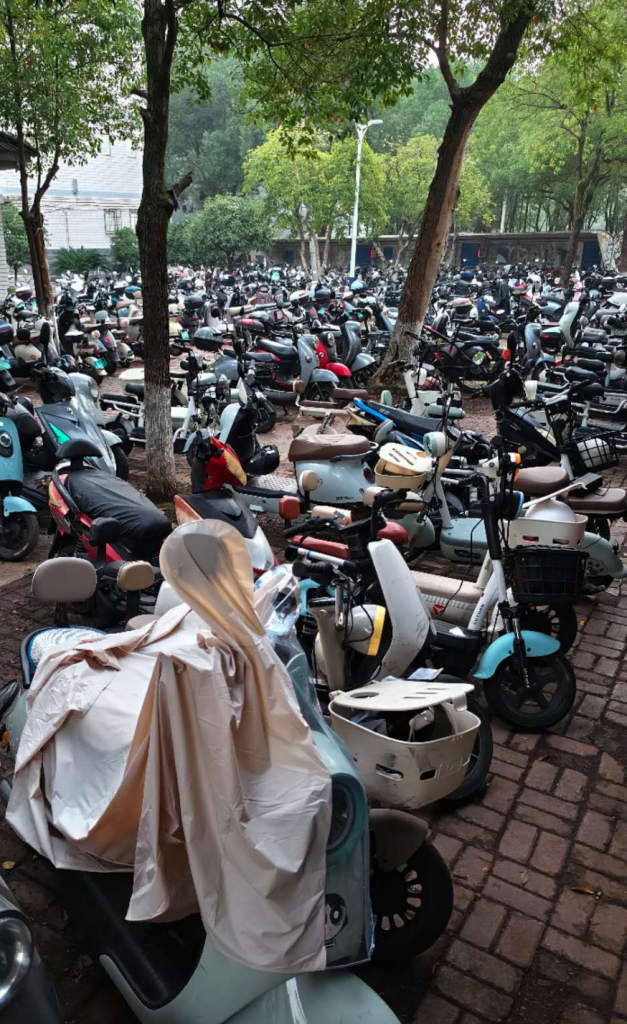
Here in Changsha, especially on Lushan Road near the university, life is bustling. It is hardly an exaggeration to speak of a long restaurant: various small ‘restaurants’ offering finger food, drinks, snacks and even ‘proper meals’ — interspersed with small boutiques and snack shops. At certain times, there is a lot of hustle and bustle: in the morning when the streets are cleaned, when deliveries are made, when the first people go to work, school or university (and the last ones quickly buy a snack before going to bed), at lunchtime and in the evening. Although these are the peak times, there is actually always something going on. Part of this street life, or more precisely, part of life on the pavement, are e-scooters: delivery services that stop briefly, pick up the order and set off again silently. Well, scooter riders are also citizens and seem to feel they have every right to ride on the pavement — only the old white man thinks this is a violation of the rules and that you can stubbornly go your own way. Different rules apply here, rules that prevent mass chaos and that also take precedence over the ‘written rules’. And there are masses of them — here on the pavement and elsewhere too. Anything with two wheels is being used.


And only the stranger is surprised that there seem to be so few accidents — after all, the photo was taken at a time when there is relatively little traffic and students are crossing from one campus of my university to the campus on the opposite side.

Self-regulation instead of rule-following: sure, there are cameras everywhere, but police officers are rarely seen. These are small cultural differences, we often don’t recognise if we are “in the middle of it”; many years ago, my Irish students pointed out to me — we were evaluating a study trip to Germany.

In Germany, all police officers are armed; in Ireland, they do not carry weapons.

It was only then that I realised what I had always known but tacitly accepted and, as it were, suppressed — the Irish students noticed this immediately as the situation in Ireland had been different — it’s true, travelling broadens the mind and often reveals the small differences. Those who are attentive then ask big questions: the question is not so much how much order is necessary, but how it is achieved. And in what way disorder also has something orderly and organising about it.

A United Europe … an ambition that has a long tradition, characterised by ups and downs

(scroll down for Dansk [machine translation], Deutsch, Français, Italiano)

One could also use a different wording as the ambition had not been solely and perhaps not even primarily led by the idea of global peace. Today we must remember the critique that had been frequently brought forward: a Fortress Europe, striving for competitiveness, directed against and profiting from the “others”.

For some time, we got used to a process of enlargement and – if taken optimistically – strengthened unity …. making us forget the conflicts linked to countries and regions as Republic of Ireland/United Kingdom of Great Britain and Northern Ireland; Spain/Catalonia/Basque Provinces, Italy/South Tyrol/Mezzogiorno and others.

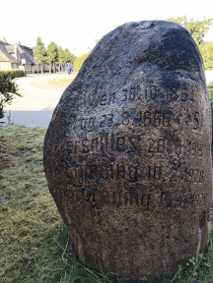
The Memorial Stone in front of the house Sønderbyvej 3, Møgeltønder

is part of this history – commemoration and remembrance. It had been put into place on the private initiative by Peter Eskildsen Jensen – this is stated in runic script to the roadside, saying

JENSEN PLACED THE STONE IN COMMEMORATION OF THE REUNION WITH THE MOTHERLAND AFTER HALF A CENTURY OF SEPARATION

On the backside of the stone different names with the relevant historical dates are listed – reminding us of the steps of occupation, liberation, dependency, foreign rule and liberation.

  • Vienna 30.10.1864[1]
  • Prague, 23.8.1866 (§ 5)[2]
  • Versailles 29.6.1919[3]
  • Plebiscite 10.2.1920
  • Reunification 15.6.1920

History does not repeat itself. And to make sure that this remains true we must not forget, aim on learning from what happened: sovereignty does not equal nationalism; we may even say that the denial of sovereignty is one of the sources of nationalism … – closing borders again is unlikely helping us today. And as incomplete, often even highly problematic the EU is, we must treat it with care and respect.

Visit also

https://edu-art.blog

https://www.hrug.legal

You may call 0045.30669969 to arrange a visit in the gallery: the collection reflects over 100 years of art history – from Chagall’s biblical visions to Peter Kurgan’s mineral landscapes.
It is also possible t arrange a visit in the small reference library with classical literature, contemporary novels and text books (philosophy, economics, law, political science and arts). Languages: English, French, German (few Italian, Chinese and Latin).

****

Dansk – maskinoversættelse

Et forenet Europa … en ambition med lange traditioner, præget af op- og nedture.

Man kunne også bruge en anden formulering, da ambitionen ikke udelukkende og måske ikke engang primært var drevet af tanken om global fred. I dag må vi huske den kritik, der ofte blev fremsat: et fæstnings-Europa, der stræber efter konkurrenceevne, rettet mod og til fordel for »de andre«.

I en periode vænnede vi os til en udvidelsesproces og – hvis man ser optimistisk på det – en styrket enhed …, der fik os til at glemme konflikterne mellem lande og regioner som Irland/Det Forenede Kongerige Storbritannien og Nordirland, Spanien/Catalonien/Baskerlandet, Italien/Sydtyrol/Mezzogiorno og andre.

Mindesten foran huset Sønderbyvej 3, Møgeltønder

er en del af denne historie – mindesmærke og erindring. Den blev rejst på privat initiativ af Peter Eskildsen Jensen – dette er angivet i runeskrift ved vejsiden, hvor der står

JENSEN REJSTE STENEN TIL MINDE OM GENFORENINGEN MED MODERLANDET EFTER ET HALVT ÅRHUNDREDES ADskillelse

På bagsiden af stenen er der forskellige navne med de relevante historiske datoer – som minder os om besættelsen, befrielsen, afhængigheden, fremmedstyret og frigørelsen.

  • Wien 30.10.1864[4]
  • Prag, 23.8.1866 (§ 5)[5]
  • Versailles 29.6.1919[6]
  • Afstemningen 10.2.1920
  • Genforeningen 15.6.1920

Historien gentager sig ikke. Og for at sikre, at dette forbliver sandt, må vi ikke glemme, men stræbe efter at lære af det, der skete: suverænitet er ikke det samme som nationalisme; man kan endda sige, at fornægtelse af suverænitet er en af kildene til nationalisme … – at lukke grænserne igen vil sandsynligvis ikke hjælpe os i dag. Og selvom EU er ufuldstændig og ofte endda meget problematisk, må vi behandle den med omhu og respekt.

Visit also

https://edu-art.blog

https://www.hrug.legal

****

(Uebersetzung aus dem Englischen)

Ein vereintes Europa … ein Ziel, das schon lange besteht und mit Höhen und Tiefen verbunden ist.

Man könnte dies auch anders sagen, weil die EUropäische Integration nicht nur und vielleicht nicht mal hauptsächlich von der Idee des Weltfriedens angetrieben wurde. Heute müssen wir uns an die Kritik erinnern, die oft geäußert wurde: eine Festung Europa, die nach Wettbewerbsfähigkeit strebt, sich gegen die „Anderen“ richtet und von ihnen profitiert.

Eine Zeit lang haben wir uns an einen Prozess der Erweiterung und – wenn man es optimistisch sieht – der Vertiefung der Einheit gewöhnt … und dabei die Konflikte vergessen, die in Ländern und Regionen wie der Republik Irland/dem Vereinigten Königreich Großbritannien und Nordirland, Spanien/Katalonien/den Baskenprovinzen, Italien/Südtirol/Mezzogiorno und anderen Geschichte und teils Gegenwart bestimmen.

Der Gedenkstein vor dem Haus Sønderbyvej 3 in Møgeltønder

ist Teil dieser Geschichte – Gedenken und Erinnerung. Er wurde auf private Initiative von Peter Eskildsen Jensen aufgestellt – dies ist in Runenschrift an der Straßenseite zu lesen

JENSEN STELLTE DEN STEIN ZUR ERINNERUNG AN DIE WIEDERVEREINIGUNG MIT DEM MUTTERLAND NACH EINEM HALBEN JAHRHUNDERT DER TRENNUNG

Auf der Rückseite des Steins sind verschiedene Namen mit den entsprechenden historischen Daten aufgeführt, die uns an die Etappen der Besetzung, Befreiung, Abhängigkeit, Fremdherrschaft und Wiedererlangung der Unabhängigkeit erinnern.

  • Wien 30.10.1864[4]
  • Prag, 23.8.1866 (§ 5)[5]
  • Versailles 29.6.1919[6]
  • Volksabstimmung 10.2.1920
  • Einigung 15.6.1920

Die Geschichte wiederholt sich nicht. Und damit das auch so bleibt, dürfen wir nicht vergessen, müssen aus dem Geschehenen lernen: Souveränität ist nicht gleich Nationalismus; man könnte sogar sagen, dass die Verweigerung der Souveränität eine der Ursachen des Nationalismus ist … – Grenzen wieder zu schließen, wird uns heute nicht weiterhelfen. Und so unvollkommen und oft sogar problematisch die EU auch sein mag, wir müssen sie mit Sorgfalt und Respekt behandeln.

****

traduction de l’anglais

Une Europe unie… une ambition qui a une longue histoire, avec des hauts et des bas.

On pourrait même dire ça autrement, car cette ambition n’était pas seulement, et peut-être même pas principalement, motivée par l’idée de la paix mondiale. Aujourd’hui, on doit se rappeler les critiques qui ont souvent été formulées : une Europe forteresse, qui cherche à être compétitive, qui s’oppose aux « autres » et profiter de la situation des autres.

Pendant un certain temps, on s’est habitués à un processus d’élargissement et, si on voit les choses de manière optimiste, à un renforcement de l’unité… qui nous a fait oublier les conflits liés à des pays et des régions comme la République d’Irlande/le Royaume-Uni de Grande-Bretagne et d’Irlande du Nord, l’Espagne/la Catalogne/les provinces basques, l’Italie/le Tyrol du Sud/le Mezzogiorno et d’autres.

La pierre commémorative devant la maison Sønderbyvej 3, Møgeltønder

fait partie de cette histoire, de cette commémoration et de ce souvenir. Elle a été mise en place à l’initiative privée de Peter Eskildsen Jensen, comme l’indique l’inscription en runique sur le bord de la route

JENSEN A PLACÉ CETTE PIERRE EN SOUVENIR DE LA RÉUNIFICATION AVEC LA MÈRE PATRIE APRÈS UN DEMI-SIÈCLE DE SÉPARATION

Au dos de la pierre, différents noms accompagnés des dates historiques importantes sont inscrits, nous rappelant les étapes de l’occupation, de la libération, de la dépendance, de la domination étrangère et de la libération.

  • Vienne, 30 octobre 1864[7]
  • Prague, 23 août 1866 (§ 5)[8]
  • Versailles, 29 juin 1919[9]
  • Plébiscite, 10 février 1920
  • Réunification, 15 juin 1920

L’histoire ne se répète pas. Et pour que ça reste vrai, on ne doit pas oublier, on doit chercher à tirer les leçons du passé : la souveraineté n’est pas synonyme de nationalisme ; on pourrait même dire que le déni de souveraineté est l’une des sources du nationalisme… Fermer à nouveau les frontières ne nous aidera pas aujourd’hui. Et même si l’UE est pas parfaite, voire souvent très problématique, on doit la traiter avec soin et respect.

Visit also

https://edu-art.blog

https://www.hrug.legal

****

traduzione dall’inglese

Un’Europa unita… un’ambizione che ha una lunga storia, con alti e bassi.

Si potrebbe anche dire che l’ambizione non era solo, e forse nemmeno principalmente, guidata dall’idea della pace globale. Oggi dobbiamo ricordare le critiche che sono state spesso sollevate: un’Europa fortezza, che cerca di essere competitiva, contro gli “altri” e a loro spese.

Per un po’ ci siamo abituati a un processo di allargamento e, se lo guardiamo con ottimismo, di rafforzamento dell’unità… che ci ha fatto dimenticare i conflitti tra paesi e regioni come la Repubblica d’Irlanda/Regno Unito di Gran Bretagna e Irlanda del Nord, Spagna/Catalogna/Paesi Baschi, Italia/Alto Adige/Mezzogiorno e altri.

La lapide commemorativa davanti alla casa Sønderbyvej 3, Møgeltønder

fa parte di questa storia, di commemorazione e di ricordo. È stata messa lì su iniziativa privata di Peter Eskildsen Jensen, come dice la scritta in runico sul bordo della strada

JENSEN HA POSTO QUESTA PIETRA IN MEMORIA DELLA RIUNIONE CON LA MADRE PATRIA DOPO MEZZO SECOLO DI SEPARAZIONE

Sul retro della pietra ci sono diversi nomi con le date storiche importanti, che ci ricordano le tappe dell’occupazione, della liberazione, della dipendenza, del dominio straniero e della liberazione.

  • Vienna 30.10.1864[10]
  • Praga, 23.8.1866 (§ 5)[11]
  • Versailles 29.6.1919[12]
  • Plebiscito 10.2.1920
  • Riunificazione 15.6.1920

La storia non si ripete. E per assicurarci che sia così, non dobbiamo dimenticare, ma imparare da quello che è successo: la sovranità non è nazionalismo; potremmo anche dire che negare la sovranità è una delle cause del nazionalismo… – chiudere di nuovo le frontiere non ci aiuterà molto oggi. E anche se l’UE è incompleta e spesso anche molto problematica, dobbiamo trattarla con cura e rispetto.

Visit also

https://edu-art.blog

https://www.hrug.legal


[1] The Treaty of Vienna, signed on October 30, 1864, concluded the Second Schleswig War between Denmark, Prussia, and Austria. As a result of the treaty, Denmark ceded the Duchies of Schleswig, Holstein, and Lauenburg to Prussia and Austria

[2] Peace Treaty of Prague; Article 5 of the Peace Treaty ends up playing a central role for the Danish-minded Schleswigers. It says that Schleswig and Holstein must in principle be managed by Prussia, but that the northern districts of Schleswig must be reunited with Denmark if the people in these areas demand it in a free vote. Negotiations on such a vote failed as early as 1868, however – and in 1878 Germany repealed the article – https://www.kb.dk/en/inspiration/reunification/timeline.

[3] Relevant for the later plebiscite 

[4] The Treaty of Vienna, signed on October 30, 1864, concluded the Second Schleswig War between Denmark, Prussia, and Austria. As a result of the treaty, Denmark ceded the Duchies of Schleswig, Holstein, and Lauenburg to Prussia and Austria

[5] Fredstraktaten i Prag; artikel 5 i fredstraktaten kommer til at spille en central rolle for de dansk-orienterede slesvigsher. Den fastslår, at Slesvig og Holsten i princippet skal administreres af Preussen, men at de nordlige distrikter i Slesvig skal genforenes med Danmark, hvis befolkningen i disse områder kræver det ved en fri afstemning. Forhandlingerne om en sådan afstemning strandede imidlertid allerede i 1868, og i 1878 ophævede Tyskland artiklen. – https://www.kb.dk/en/inspiration/reunification/timeline.

[6] Relevant for den senere folkeafstemning

[7] Le traité de Vienne, signé le 30 octobre 1864, a mis fin à la deuxième guerre du Schleswig entre le Danemark, la Prusse et l’Autriche. À la suite de ce traité, le Danemark a cédé les duchés de Schleswig, Holstein et Lauenburg à la Prusse et à l’Autriche.

[8] Traité de paix de Prague ; l’article 5 du traité de paix finit par jouer un rôle central pour les Schleswigers danois. Il stipule que le Schleswig et le Holstein doivent en principe être administrés par la Prusse, mais que les districts nord du Schleswig doivent être réunis au Danemark si la population de ces régions le demande par un vote libre. Cependant, les négociations sur un tel vote échouèrent dès 1868 et, en 1878, l’Allemagne abrogea cet article – https://www.kb.dk/en/inspiration/reunification/timeline.

[9] Pertinent pour le référendum ultérieur

[10] Il Trattato di Vienna, firmato il 30 ottobre 1864, pose fine alla seconda guerra dello Schleswig tra Danimarca, Prussia e Austria. In seguito al trattato, la Danimarca cedette i ducati di Schleswig, Holstein e Lauenburg alla Prussia e all’Austria.

[11] Trattato di pace di Praga; l’articolo 5 del trattato di pace finisce per avere un ruolo centrale per gli Schleswigesi di orientamento danese. Esso stabilisce che lo Schleswig e l’Holstein devono essere in linea di principio amministrati dalla Prussia, ma che i distretti settentrionali dello Schleswig devono essere riuniti alla Danimarca se la popolazione di queste zone lo richiede con un voto libero. I negoziati su tale voto fallirono però già nel 1868 e nel 1878 la Germania abrogò l’articolo – https://www.kb.dk/en/inspiration/reunification/timeline.

[12] Rilevante per il successivo plebiscito

memories revived — United Nations

Ah no, I never made it to the United Nations highest Assembly – and you surely will find it strange that I remember right now a little episode from the days before I left Ireland and UCC. A VIP (Very Important Person) came to the Departmental Meeting, talking about the new strategy of the University College Cork. A lengthy sermon (after he managed after an equally long time to get the slide-presentation working) – answered by a lengthy sermon from my side (without slides). Here only the end is of interest – I said, sarcastically thanking him, sth like: After this critique from my side, please let me conclude: in your previous, job you advised the Irish government – and Ireland is now (I do not remember when this “theatre” he’d been staged, probably the early 2010s) in a pretty bad shape. And now you come here, advising this University. – This was followed by a telling break and an even more telling look at the presenter and the colleagues from my side.

Why do I remember this after reading that Annalena Charlotte Alma Baerbock, Germany’s former minister of foreign affairs, had been elected as President of the United Nations General Assembly?

VIPs – Very Improbable Progress

small print

Often we find more important messages sidelined, seemingly of lesser importance than what may be expected when looking at headline and topic. The Handelsblatt, the German newspaper that provides essential news about economic developments, publishes a podcast, looking at economic challenges. The 09-05-2025 edition had been titled

Deutsche Wirtschaftspolitik: Neuer Optimismus trotz globaler Unsicherheiten

More or less at the beginning we hear that

die ersten

1:51 Schritte die die Regierung macht finde

1:53 ich richtig Wir müssen Paris und

1:55 Warschau adressieren Wir haben das hier

1:56 immer wieder Bert besprochen weil wir

1:58 gesagt haben das ist die Achse die

1:59 Europa stark macht

(I think the first steps taken by the government are right. We need to address Paris and Warsaw. We have discussed this repeatedly because we have said that this is the axis that makes Europe strong.)

Is it then the old axis – the axis that stood at the beginning (not only) of WW I and WW II? And the German prime minister aims on armament, wants that the Bundeswehr is the strongest army in Europe … Even if it is now only an economic war (and many signs are pointing into this direction) it is predominantly a war against the majority of the people.

not this way – changing transport

OPEN = PUBLIC STATEMENT (letter to the German Railway – Deutsche Bahn – maschine translation)
Hello, I am not contacting you on my behalf, but in the interest of a friend who visited me.
1) She received an offer of a BahnCard at a special price – this was probably chosen by lot. So far, so good. However, something went wrong with the booking – the code entered had expired; the REQUEST for a new code to be sent was rejected in a way that was friendly but showed that the customer was not aware of the email. It is forgivable that the railway booking system fails, but it is not forgivable that the employees fail and do not take note of texts. Or is it because the workers are underpaid and the CEOs are overpaid?
2) On the return journey, the regional train was late, so the connection could not be made. – The seat ticket in the quiet compartment expired, instead the journey from Hamburg to Berlin had to be spent in a noisy neighbourhood, the customer’s willingness/interest to engage in a closer relationship with DB for the future suffered greatly (to say the least). My willingness to retain the BC 50_1 on a large scale is also not strengthened. And I am not just expressing the unease of two people.
Even with all due respect for the efforts to make the railway more attractive, the old sentence from Goethe’s pen also applies here:
“Enough words have been exchanged, let me finally see action!”
Unsatisfied greetings from Peter Herrmann

so nicht – die Verkehrswende

OFFENE = OEFFENTLICHE STELLUNGNAHME
Hallo, ich melde mich nicht im Auftrag, aber im Interesse einer Freundin, die mich besucht hat.
1) Sie erhielt ein Angebot einer BahnCard zu einem Sonderpreis – dies wurde wohl per Los ausgewaehlt. Soweit, so gut. Allerdings schlug bei der Buchung etwas fehl – der eingegebene Code war damit verfallen; die BITTE um Zusendung eines neuen Codes wurde in einer Weise abgewiesen, die freundlich war, aber von Nicht-Kenntnisnahme des mails der Kundin zeugte. Dass das Buchungssystem der Bahn versagt, ist verzeihbar, dass die MitarbeiterInnen aber versagen und Texte nicht zur Kenntnis nehmen, ist nicht verzeihbar. Oder liegt es an der Unterbezahlung derjenigen, die arbeiten und der Ueberbezahlung der CEOs?
2) Auf der Rueckfahrt hatte der Regionalzug Verspätung, damit konnte der Anschluss nicht erreicht werden. – Die Platzkarte im Ruheabteil ist verfallen, stattdessen musste die Strecke von Hamburg nach Berlin in lärmender Nachbarschaft verbracht werden. Die Bereitschaft/das Interesse der Kundin, sich auf eine engere Bindung zur DB fuer die Zukunft einzulassen, hat darunter zumindest stark gelitten (um das Mindeste zu sagen). Meine Bereitschaft zu einer großzügen Beibehaltung der BC 50_1 wird ebenfalls nicht gestärkt. Und damit spreche ich nicht nur das Unbehagen zweier Personen aus.
Auch bei allem Respekt fuer die Bemuehungen, die Bahn attraktiver zu machen, gilt doch auch hier der alten Satz aus Goethe’s Feder:
„Der Worte sind genug gewechselt, lasst mich auch endlich Taten sehn!“
Unzufrieden gruesst Peter Herrmann

GTPT

Outright wrong !?

Tiny differences matter – you want to look at Chat GPT and a typo brings you to chat about GTP, of course no problem as you know everything about Guanosine-5′-triphosphate (GTP), this tiny building block which plays an important role in transcribing the synthesis of RNA.

Well, and this is the problem, where we should not really worry primarily about Chat GPT (or google’s bard or …) which may get things reasonably correct as long as we (a) apply the correct spelling, (b) do not expect really clear replies and are happy with answers that are as concise as the horoscope or the statements of any other oracle and (c) come up with simple issues . It is so advanced now that occasionally you may end up with an honest answer:

Sorry, I cannot answer this question. I am an AI-tool.

Yes, there are things where HI, i.e. human intelligence is needed: contradictory, emphatic, combative …

More worrying is the AI-imposed formulation of questions. Embedded in our word processor, or available as AI-writing support like Outright, QuillBot, Grammarly …

Such applications may be helpful at times …, and at first glance. But then the tiny differences may make a big difference:

This is really only the first draft of the initial script and we appreciate very much feedback by the readers. 

This is really only the first draft of the initial script and we appreciate very much feedback by the readers.

This is really only the first draft of the initial script and we appreciate very much feedback by the readers.

Or in Italian

Sono

Io sono

Sono anch’io

Io sono anche

AI comes up and autocorrects a sentence in different ways, sometimes possibly more elegant, and possibly “correcting” something that is actually wrong … because it is new: a new term, concept, … a searching for an “unknown unknown” — yes, borrowing from a militarist like Rumsfeld (MI?) may occasionally be more intelligent than relying on AI.

Intelligent or not … enjoy Christmas … or look forward to Spring Festival while others are celebrating … 

Only Arts? Or the art of living and leaving?

Continued from the riddle of time

Of course, we can easily say that this is the world of arts, not relevant for what is usually perceived as real life. So, coming back to real life then – or is the following the prolongation of arts in the form of an utmost absurdity, the unsane form of not leaving, a pattern that we can find in the catholic church: the Pope, not being able to fulfil the obligations, however staying in office, seeing himself obliged to do so, so to say following in the footsteps of his master. This “factual sedisvacancy” can be seen is expression of what had been said: the separation of life from living, the fact that existence is reduced on reproduction of from, well possible: ongoing existence while being quasi brain-dead. All this is also showing the kinship with artificial intelligence/singularity: let others think – I only repeat my thinking – let others repeat any thinking and merge what I thought with my presence which is reduced on its own past (if there is any past left).

The felt obligation to live eternally is the conviction of this being, the pure existence as only way to eternal life [yes, paradoxes are lurking around every corner]. A new version of eternal life is found suggested at least, now popping up as

artificial intelligence and singularity.

Too often reductionist…. – as already Marshall McLuhan said:

the purpose of communication surely is trying to illuminate most people do what goes on in human life people never communicate most people never communicate in their entire lives they think that what they say is communication what they the communication is the effect of what you say it’s not what you say it’s the effect of what you say

(1971: MARSHALL MCLUHAN on ADVERTISING | 24 Hours | Writers and Wordsmiths | BBC Archive; https://www.youtube.com/watch?v=LFjj3OyjzwA)

The crux is that the body is on the one hand defined as solely being outer shell, whereas it is in fact the only thing that remains real; AI is however, essential, defined as essence, while it is in fact not anything else than the reification of the past, and as such “dead life”, with this formulation leaning towards Marxist political economy where we find the term dead labour. At the end of the day it is about the synergy of externalisation and internalisation – cogito ergo sum. Reinterpreting this in materialist terms, means that AI easily results in extinction of being – thinking is reduced on personal reproduction, based on and resulting in ongoing partialisation. What appears is complete openness, the permanent reshuffling of parts, is in fact the overcoming of elements – where there is no entity, there is no need for any elementary form: arbitrariness is at work. However, god doesn’t throw dices. And while questioning god seems to be reasonable, it goes without question that nowhere the throwing of dice can be found. Whenever we witness and do something, we decide, we feel empathy, we revise … and we take responsibility for what we are doing and what we refrain from doing.

Reification of being is then becoming the supposed final goal of super-modernity [more appropriate than postmodernity I guess]: AI is then the final stage of ‘commodification of thinking’, of course including the reduction of thinking on the production and shifting of little particles – electro-magnetic waves without inner force moving towards creation and meaning.

What is, however, the difference between such particles: reproducible, combinable in different ways, forms, shapes on the one hand and particles that are accessible and appropriable and offering seemingly endless possibilities as reality that can be shaped by mind and will through the knowledge of quantum mechanics?

My suggestion is that telos is at least an important part, referring to the following layers:

  • it is inherently given in the second case, not simply defined by the economic powers
  • inherently given includes negotiation – and while negotiation is always also a matter of power, it is also a matter of simply finding a “violent setting”; instead, relationality is the foundation on which the different agencies move, “agencies” meaning (i) that every side is relevant, in some way and (ii) relationality is not least a matter of recognised, accepted and utilised mutual…, well, not dependency but interaction, inter-expressing something of exchange, mutuality.

Reification maybe a side effect but it is in any case an end in itself and/or a servant for the user, not a means to serve “something else”, i.e. a profiteur.

Sometimes it is a narrow line, sometimes overlapping, always in need to ask for looking at the following equation:

Individual benefit  +/- long/short term orientation+/-                                   +/-Societal benefit  +/-  going beyond the original goal, opening new spacetimes= in/stable developmentIn the case of societally profitable relationality non-linear 

Returning now to the disappointment of the old white man and woman … grumpy, elitist, the challenge is to re-establish teaching – and even communication in general – by way of increasing openness, a kind of renaissance as it will be necessary to overcome borders, moving first vehemently away from partialisation and return then, after the first big steps, to specialised analysis.

Isn’t that as well the general problem of life and living today? The often lamented short-temperedness, the lack of concentration in response to the continued demand for quick answers, often to be given without being asked a formulated question. The patterns that had been earlier described as prevalent in today’s art where they in actual fact only reflect the changes in the political economy of life/living – reflecting in a perverted way the Marxian conviction:

If we presuppose communal production, the time factor naturally remains essential. The less time society requires to produce corn, livestock, etc., the more time it wins for other production, material or spiritual. As with a single individual, the comprehensiveness of its development, its pleasures and its activities depends upon the saving of time. Ultimately, all economy is a matter of economy of time.

(Marx, Karl, 1857-61: Economic Manuscripts Of 1857-1858. [First Version of Capital]; in: Karl Marx Frederick Engels: Volume 28: Marx 1857-61; London: Lawrence & Wishart, 2010: 109)

It remains the competition, guided by the challenge to be part of, not to contribute to – not least as the being part of is simply about the form, and here it does not matter of what one is part; in the second case it is about the what, and after getting this clear, we can and have to think about what a suitable contribution is. In academia, applying too often the first way, we find again and again the learning of reproduceable formulas, so to say sine ira et studio, or even without interest and substance.

Again, it is a simple calculation that is needed to figure out what we – the old and young [being aware of the stereo typing] can contribute:

Experience as matter of confusion, permanently crossing lines and borders, in the way Dalì once – supposedly – said, something like:

confusion is the source of creativity;

and what Picasso experienced and expressed by pointing out that it took him a long time to find himself, his own style, after having learned during a relatively short period how academic painting is done [while being aware of the fact that he could not have found his own style without this knowledge].

Is there a solution? Mass education is reproduction, elite education is innovation? The danger is obvious: the loss of utopia.

And with this we face the challenge to look forward, considering even future as past – as Oscar Wilde said

A map of the world that does not include Utopia is not worth even glancing at, for it leaves out the one country at which Humanity is always landing.

Then, there will be no clipping wings of the innovation-oriented urge of youth; and there will be no acknowledgment of entrenched stubbornness of the old, no acceptance of such idiosyncrasy as wisdom ….

Back to secession and accession – mentioned earlier:   

The reference to reality is so well expressed by Ken Loach, contending

L’art se fait dans une forme de colère contre l’art, et pas quand il sert d’instrument de contentement de soi pour les classes dominantes.

Art arises out of a kind of rage against art, not when it serves as a self-gratification tool for the ruling class.

(Édouard Louis. Ken Loach. Dialogue sur l’art et la politique: 62)

Is not then the convulsive clinging to existence simply a perversion of the lack of individuality, which stands against true individuality as social being?

Édouard Louis notes in the same book:

(Je prends des exemples personnels non pas pour parler de ma famille en tant que telle, mais parce que c’est à travers cet angle-là que je me sens plus juste et plus proche du vrai). Les individus, étant donné leur pluralité, deviennent d’autres individus dans d’autres contextes politiques. C’est pour cela que les discours de la gauche sont importants, parce qu’il est presque impossible de changer un individu isolé, mais paradoxalement il est possible de transformer les des individus collectivement, en transformant le langage et sa circulation dans l’espace public, puisque cette transformation est toujours potentiellement possible grâce à la pluralité de manière d’être propre à chaque individu.

(I mention these personal examples not to talk about my family as such, but because I find this perspective more correct and closer to the truth). Thanks to their inherent plurality, individualsbecome other individuals in a different political context. This is why the discourse of the left is so important, because it is almost impossible to change an isolated individual; instead, paradoxically, it is possible to transform individuals collectively by transforming the language of public space, because this transformation is potentially always possible because of the plurality of each individual’s possibilities of existence.

(Édouard Louis. Ken Loach. Dialogue sur l’art et la politique: 50)

Leaving this dialectic out of consideration, accepting the loss of the social as existential focus, is sad on a personal level, and hugely problematic when we consider the grumpy old men and women, glued to their posts, and possible fatal for a political movement thinking that debating issues of woke capitalism is more important than addressing questions of class and political power. Berlusconi (founder of the right-wing Forza Italia), James (tea party republican), Largarde (European and World Banker), Prodi (considered the founder of the Italian centre-left, another expression for “gravedigger of the left”), Ratzinger (ex and em pope) knew well, where the real problem must be seen.

Reaching such point one should become cautious, ask oneself bravely if it is time to leave.

Delivery notification – your DHL parcel will be delivered to a branch office

(machine translation – deepl.com)

I have already complained about this case – it remains to be noted that the employee in charge is apparently so badly paid that he did not even stop at the house, but drove straight to the – remote – branch. The fact that I am expected to make the journey despite a disability is yet another sign of the decay of corporate management morals – only decent pay and decent working conditions enable decent performance.
What makes the whole thing even more unbearable: attached to the e-message is an ics date file – however, the delivery did not arrive at the post office specified at that time. A mistake on the part of the postman? Hardly. A mistake by the management, which is incapable of managing.
But these irresponsible people, who lack any humane character, can cash in and sell others for stupidity.

This is how societies are ruined! Disgusting!!!
This is even more true if you look at other figures – Die Zeit from 26.7.
Every fourth employed person receives less than 14 euros per hour

For CEOs with as little common sense as the aforementioned, there should be only one income: Incapacity-for-work-because-of-lack-of-common-sense-pension. Such beings would not be entitled to a citizen’s allowance or the like, since they refuse to engage in any meaningful activity.

As a recommendation: the film Sorry we missed you, by Ken Loach. In the DHL management this film could serve as a mirror and hopefully arouse disgust for themselves.

Once again angry and disgusted greetings from Peter Herrmann

Zustellbenachrichtigung – Ihr DHL Paket wird in eine Filiale gebracht

Offener Brief an DHL

Ich habe diesen Fall bereits reklamiert – es bleibt anzumerken, dass der zuständige Mitarbeiter scheinbar so schlecht bezahlt ist, dass er nicht einmal am Haus gehalten hat, sondern gleich in die – abgelegene – Filiale gefahren ist. Dass mir der Weg trotz einer Behinderung zugemutet wird, ist ein weiteres Zeichen fuer den Verfall der Sitten von Unternehmensfuehrungen – nur anständige Bezahlung und anständige Arbeitsbedingungen ermoeglichen anständige Leistungen.

Was das Ganze noch unerträglicher macht: der e-nachricht hängt eine ics-Termindatei an – allerdings ist die Lieferung zu jener dort angegebenen Zeit nicht bei dem angegebenen Postamt angekommen. Ein Fehler des Zustellers? Wohl kaum. Ein Fehler der Geschäftsleitung, die unfähig ist zu leiten.
Aber kassieren und die Menschheit fuer Dummheit verkaufen koennen diese Unverantwortlichen, denen selbst jede Menschlichkeit fehlt

– so richtet man Gesellschaften zugrunde!!! Abstossend!!

Noch mehr gilt dies, wenn man sich andere Zahlen anschaut – die Zeit vom 26.7. :

Jeder vierte Erwerbstätige erhält weniger als 14 Euro pro Stunde

Fuer CEOs, die sich durch so wenig gesunden Menschenverstand auszeichnen, wie der Genannte, sollte es nur ein Einkommen geben: Arbeitsunfaehigkeits-wegen-Mangel-an-Verstand-Rente. Auf Bürgergeld o.ae. haetten solche Wesen keinen Anspruch, da sie sich verweigern, einer sinnvollen Taetigkeit nachzugehen.

Als Empfehlung: der Film Sorry we missed you, von Ken Loach. Der DHL-Unternehmensleitung koennte dieser Film als Spiegel dienen und hoffentlich Abscheu vor sich selbst erregen.

Wieder einmal veraergerte und angewiderte Gruesse von Peter Herrmann