What do we do with the revolution – and what does the revolution do to us?

Peter Herrmann / Mehmet Okyayuz[1]/[2]

What to do with the revolution – and what does the revolution do to us?

The title of the following article is an allusion to the motto of attac’s coming Summer Academy

1918 – 1968 – 2018: In Favour of Change – That happened to the Revolution?

But the article presented here is about the orientation on the Battle for the Good Life, published on 23.12.’18, authored by Ulrich Brand. In our view, Brand takes up that SOAK motto by correctly pointing out that a revolution is already under way; however, in our view it is misleading to classify the change of life-style as any kind of revolution, being driven by such changes. Such arguments in favour of an anti-imperial way of life can be seen as new-Kantian categorical imperative:

Reasonable, conscious people of all countries, unite.


Instead of taking a sound economic analysis of global neoliberalism as point of departure, and deriving from there concrete plans to fight for a “good life”, Brand focuses on attitudes and behavioural patterns, suggesting that we reach from there a point leading almost inherently to the good life.

Admittedly, the path to a good life is naturally closely bound to patterns of everyday’s behaviour. The alternatives presented in the text by Brand – and also in the book which he elaborated with Markus Wissen – lead to a diffuse and individual, negative attitude, founded in and guided by “free will”. This can probably best be described as a denial of consumption: Consequently, we should not drive any SUV, not eat too much meat, preferably not fly, or at least limit this. The list can be continued, and all these quests are surely also commendable. But didn’t Adorno state already in his Minima Moralia that there is no real life in the wrong life. It may be that this statement comes – deliberately – eye-catching. Their basic content should, however, be changed in a constructive way so that structural preconditions, potentially leading to a good/better life, are developed from an analytical perspective – and this is especially true when addressing a readership such as the TAZ-constituency: the risk that dream images will be constructed which, at best, will settle the conscience. Just as the imperial way of life has been subjectively produced, reproduced and legitimised since the beginning of the 1990s at the latest, here the antithetical counter-conception is constructed in the same way.

Analogous to Lawrence Harrison’s “liberal” approach – he argues that underdevelopment is the result of a “mindset” (see Harrison, LE, 1985: Underdevelopment is a State of Mind, Lanham: Madison Books) – we find here a modified version: the breakout from the imperial way of life or from the global underdevelopment can also be the result of an attitude of refusal.

Indeed,

it is not just individual actions that maintain this life that is contrary to but solidarity and sustainability. There are also powerful structures of production that produce mobile phones, cars and food in capitalist competition, generating profits and growth. 

However, such statement is “fundamentally critical” only if it linked to outspoken demands for clear regulations and distribution structures, and asks even more for clear structures of production and its organisation. For example, the requirement that cooperatives can exist has to be secured not least by tax law; recognition of what we produce has to be accompanied by looking at the various damages, however, important is that such alternative perspectives soon lose the character of good, namely when results are forced into balance sheets and new accounting techniques … – An extreme mishap occurs when we look for “pricing of everything” (George Monbiot), which then suggests so-called green growth as way out. What is proposed here is, as well, quite concrete, though laborious. Last but not least, it is also about small steps and the ‘sweeping in front of your own door’ – for example, to work for the development of the Local Public Transport Network and cycle path networks instead of embarking on the dangerous “main road”; for example, it is about denouncing the overcrowding of shop corridors in supermarkets instead of accepting being exposed to the dangers of injury. Of course, these are also truisms and will hardly be considered as a critique of Brand’s critique of the imperial way of life. However, the difference is huge – now it is time for a bit of theory, otherwise it remains really a

we-know-it “Ökoelite”, telling society how to live so that climate change and other environmental problems are overcome.

In comparison – and acknowledging the dangers of such shortcut – the following points can easily be recognised as an important approach to concrete, that is, feasible, utopias.
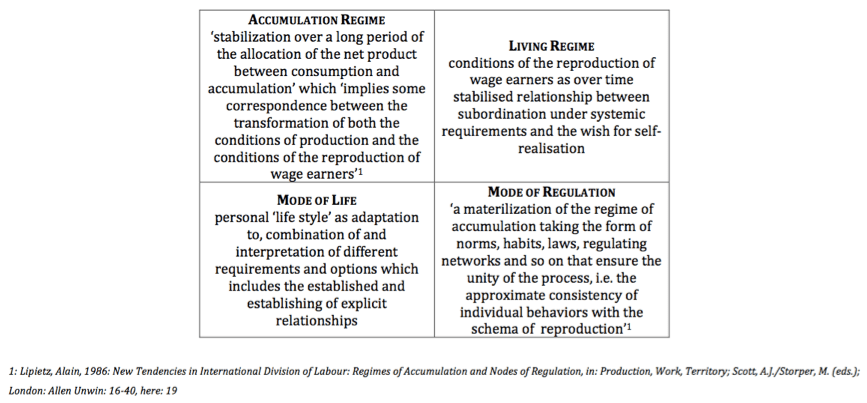
First, Brand starts from the criticism of lifestyle and then sees ,even powerful production structures’. In contrast, in our opinion – strongly influenced by the French Regulation School – a set of four dimensions needs to be considered: [a] the accumulation regime, in a broad way defined as definition of what has value and the appropriate structuration of value; [b] the life-regime as a framework or “set-box” within which individuals can plan their lives – very different ways but in general limited by cornerstones such as paid employment, increasingly private social security [note this oxymoron of the “privacy of the social”] and many more; [c] the mode of regulation, generally not least an ideological and formal system, which ensures the implementation of the two regimes mentioned before. And here, too, there is a counterpart, namely [d] the mode of life – this is looking at what each individual really makes of life – taking into account the small print or observing the principle that terms and conditions apply.

Given this framework, it is possible to determine more precisely where we stand – and against which we must develop systematically our strategy: it is methodological nationalism and methodological individualism – this goes further than simply nationalism and individualism, for it is about the roots of these phenomena, without which just a left critique quickly reaches the limits. With these four dimensions in mind, it is also possible to illuminate the developmental path more systematically and to look at perspectives of the “no movement further this way” – five core areas will be mentioned, also aiming of replacing the Keynes Beverdige orientation on the five major evils: greed, illness, ignorance, misery and laziness. Although many challenges still need to be addressed, the five tensions are outlined as major economic and political challenges:

  • The overproduction of goods – globally and locally – turns into a production of very concrete, tangible bads
  • Huge public and quasi-public wealth meets with extremely unequal access options for the majority
  • The wealth of knowledge is trimmed by an orientation on skills
  • The individualisation of problems itself causes social problems
  • The complexity of governmental processes leads to the inability to govern, which in Germany is partly criticized as “Merkelogy” – the attempt of doing everything right by avoiding clear decisions.[3]

Admittedly a bit snappy, a remark remains to be added: even the discussion about the anti-imperial way of life, as brought forward by Brand, has something of that oxymoron of the privacy of the social – and unfortunately that is different and perhaps even contrary to the slogan that the private is political.

Sure, communism “is the simple thing that is so difficult to do” – this is how Brecht formulated, writing the role for Palagea Vlasova, The Mother. And so it is with every kind of better life. Anyway, we think more appropriate than those Christmas- and New Year wishes put forward in the article we refer to, are the following ideas and demands:

  • Conscious life – as a recognition and evaluation of successes already achieved instead of continued recalculations of what we know at least in principle [19.7% poverty and exclusion in Germany[4] are too much – but already 15% and even 10% were already too much.
  • As part of this: emphasis of existing opportunities emerging from the public use of public goods – e.g. more data access and control for everybody, considering them as public goods, instead of excessive protection of artificially defined privacy.
  • Lived equality and openness instead of closing “communities” in order to maintain consensus of the various kind – something that concerns gated communities in urban settlements as well various “critical” groups that are sealing themselves of against critical debates
  • Which translates in the need for an open and honest disputes and conflict culture against forced “burden of consensus”, aiming on a pseudo-peace culture.

Sure, it is not be meant this way – yet the fight for the good life nearly pushes its advocates to see Bill Gates, Jeff Bezos, Mark Zuckerberg, and Cronies as allies. They already live in such a rational world of sharing and doing good, of course far from a rights-based approach and far from the idea of producing something different and producing in different ways. They fear redistribution probably less than establishing rights-based systems that would block the possibilities of initial exploitation – that mode of accumulation, which easily determines the last fibres our way of life. It is precisely this notion that makes also Brands wish-list not much more than well-meant, and certainly not worthless, individualistic efforts. The testimony of such “revolution” will then be that it had been tried hard to reach the goal – everybody who knows about the rules of phrasing such documents knows what is actually means: trying to achieve a goal does not mean actually doing so.

[1] Social philosopher; UEF, Finland ; Corvinus University of Hungary; EURISPES, Italy; currently Max Planck Institute for Social Law and Social Policy [Social Law], Munich

[2] Social scientist; Middle East Technical University, Ankara

[3] These five tensions are first addressed in Herrmann, Peter, 2016: From 5 giant evils to 5 giant tensions – the current crisis of capitalism as seedbed for its overturn – or: How many gigabytes has a horse ?; Seminar ‘Continuidad y Cambios en la relaciones Internacionales’ at ISRI (Instituto Superior de Relaciones Internacionales Raúl Roas García), Havana [ https://www.researchgate.net/publication/301815015_From_5_giant_evils_to_5_giant_tensions_-_the_current_crisis_of_capitalism_as_seedbed_for_its_overturn_-_or_How_Many_Gigabyte_has_a_Horse ] ; Growth and Development – Complement or Contradiction? Challenges for a Global Agenda; Shanghai Forum, China and Latin America. The Development Partnership of the Trans-Pacific Section [https://www.researchgate.net/publication/303549291_Growth_and_Development_-_Complement_or_Contradiction_Challenges_for_a_Global_Agenda]

[4] https://de.statista.com/themen/120/armut-in-deutschland/; 31/12/17

Was machen wir mit der Revolution – und was lassen wir die Revolution mit uns machen?

Peter Herrmann/Mehmet Okyayuz[1]/[2]

Was machen wir mit der Revolution – und was lassen wir die Revolution mit uns machen?

Der Titel des folgenden Beitrages ist eine Anspielung auf das Motto der diesjährigen Sommerakademie von attac – dort soll es um ‚1918 – 1968 – 2018: für Veränderung – Wo bleibt die Revolution’ gehen. Aber in dem hier vorlegten Beitrag geht es um eine Auseinandersetzung für den Kampf ums gute Lebenzu dem am 23.12.’18 in der TAZ von Ulrich Brand aufgefordert wurde. Unseres Erachtens knüpft Brand insofern an jenes SOAK-Motto an, als er richtig darauf hinweist, dass eine solche Revolution bereits im Ansatz stattfindet, irreführend ist aus unserer Sicht aber, diese als eine Revolution zu klassifizieren, die aus der Lebensweise kommt und von dort weiter getrieben werden soll. Es geht in diesem Bild um eine anti-imperiale Lebensweise gleichsam als neu-Kantianische Realität eines kategorischen Imperativ: Vernünftige aller Länder, vereinigt euch. Anstatt eine ökonomische Analyse des globalen Neoliberalismus als Bezugspunkt zu nehmen und daraus abgeleitet konkrete Überlegungen zum Kampf ums gute Leben vorzustellen, konzentriert sich Brandt auf Einstellungs- und Verhaltensmuster, die dann fast wie von selbst zum guten Leben führen sollen.


Der Weg zum guten Leben hat dabei zugegebenermaßen natürlich auch mit Mustern des täglichen Verhaltens zu tun; die aufgezeigten Alternativen münden in dem Text von Brand – und ebenso in dem Buch, welches er mit Markus Wissen vorgelegt hat, allerdings in eine diffuse und individuelle, vom ‚freien Willen‘ geleiteten, Negativhaltung. Dies kann man wohl am treffendsten mit Konsumverweigerung umschreiben: Folglich soll man sich keine SUVs mehr kaufen, nicht zuviel Fleisch essen, möglichst nicht fliegen, oder dies doch zumindest begrenzen. Die Liste kann fortgeführt werden, und all dies klingt ja auch lobenswert. Aber hat nicht schon Adorno in seiner Minima Moralia festgestellt, dass kein richtiges Leben im Falschen möglich sei. Es mag sein, dass diese Feststellung – bewusst – plakativ daherkommt; ihren Grundgehalt sollte man aber – so meinen wir – dahingehend konstruktiv verändern, dass man strukturelle Vorbedingungen, die zu einem guten/besseren Leben führen könnten, auf einer analytischen Betrachtungsweise erarbeitet – und das gilt gerade, wenn eine Leserschaft wie die der TAZ angesprochen wird. Anderenfalls läuft man Gefahr, dass Wunschbilder konstruiert werden, die bestenfalls das Gewissen zu beruhigen in der Lage sein werden. Genauso, wie die imperiale Lebensweise spätestens seit Beginn der 1990’er Jahre auf subjektivistische Weise produziert, reproduziert und legitimiert wird, so wird hier der antithetisch daherkommende Gegenentwurf auf die gleiche Weise konstruiert.

Diese Vorgehensweise, die – analog zu Lawrence Harrisons ‘liberalem’ Ansatz, dass Unterentwicklung quasi das Resultat einer ‘Geisteshaltung’ sei (siehe Harrison, L.E., 1985: Underdevelopment is a State of Mind. The Latin American Case; Lanham: Madison Books), wird hier in dem Sinn modifiziert, dass der Ausbruch aus der imperialen Lebensweise bzw. aus der globalen Unterentwicklung ebenfalls das Resultat einer Geisteshaltung der Verweigerung sein könne.

In der Tat, ‚es ist aber nicht nur das individuelle Handeln, das diese alles andere als solidarische oder nachhaltige Lebensweise am Laufen hält. Es sind auch machtvolle Produktionsstrukturen, die in der kapitalistischen Konkurrenz Handys, Autos und Nahrungsmittel produzieren, Profite und Wachstum generieren.’ Eine solche Feststellung ist aber nur dann in kritischem Sinne ‚komplett‘, wenn auch Forderungen nach klaren Regulierungen und Verteilungsstrukturen, aber mehr noch nach klaren Strukturen für die Produktion und deren Organisation damit einhergehen: So etwa die Forderung, dass die Existenz von Genossenschaften nach Unternehmens- und Steuerrecht abgesichert werden muss; Anerkennung dessen, was wir produzieren, neben den Gütern die diversen Schäden, aber ebenso das diverse Gute, dass allerdings schon bald den Charakter des Guten verliert, wenn es dann in Bilanzen und neue Buchführungstechniken gezwängt wird … – Im extremen Fehlgriff geht es dann beim pricing of everything’ (George Monbiot) um sogenanntes Grünes Wachstum. Auch das ist durchaus konkret, wenngleich mühselig. Nicht zuletzt geht es auch hier um kleine Schritte und das ‚Kehren vor der eigenen Tür’ – etwa sich für dem Ausbau des OePNV und der Radwegnetze einzusetzen, anstatt sich auf die gefährliche ‚Nutzerbahn’ zu begeben; etwa gilt es, die Überfüllung der Laden-Korridore anzuprangern anstatt sich mit Trolley und Kind den Gefahren der Verführung und Verletzung auszusetzen. Freilich sind auch dies Binsenwahrheiten und werden wohl kaum als Kritik an der Imperialen Lebensweise angesehen werden. Der Unterschied aber ist ein gewaltiger – und nun muss ein wenig Theorie her, denn sonst bleibt es doch leicht dabei, dass ‚eine besserwisserische „Ökoelite“ […] der Gesellschaft vorschreiben [wolle], wie sie zu leben habe, damit Klimawandel und andere Umweltprobleme eingedämmt werden.’

In der Gegenüberstellung – und im Eingeständnis der Gefahren durch Verkürzung – sind aber doch folgende Punkte leicht als Ansatz für die konkrete, also machbare Utopie zu erkennen.


Erstens, Brand geht von der Kritik der Lebensweise aus und sieht dann ‚auch machtvolle Produktionsstrukturen’. Dagegen steht unserer Auffassung – stark geprägt durch die französische Regulationsschule – als Viergespann: [a] entscheidend das Akkumulations-Regime in einem weiten Sinn als System der Definition dessen, was ‚Wert hat’ und die entsprechende Strukturierung der Wertschöpfung; [b] das Lebensregime als Rahmen oder ‚Setzkasten’, innerhalb derer Individuen Lebensentwürfe planen können – sehr verschieden, aber doch begrenzt durch Eckpfeiler wie etwa Erwerbsarbeitsverpflichtung, zunehmend private soziale Sicherung [man beachte dieses Oxymoron der Privatheit des Sozialen] u.v.m.; [c] die Regulierungsweise, allgemein als nicht zuletzt ideologisches und formales System, welches die Umsetzung der beiden genannten Regime sicherstellt. Und auch hier gibt es ein Pendant, namentlich [d] die Lebensweise – hier geht es darum, was denn jeder Einzelne wirklich aus dem Leben macht – unter Berücksichtigung des Kleingedruckten oder bei Beachtung des Grundsatzes ‚Es gelten die allgemeinen Geschäftsbedingungen’.

Mit diesem Rahmen lässt sich nun genauer bestimmen, wo wir stehen – und wogegen wir systematisch angehen müssen: es ist der methodologische Nationalismus und der methodologische Individualismus – dies geht weiter als einfach Nationalismus und Individualismus, denn es geht um die Wurzeln dieser Erscheinungen, ohne die eben auch eine linke Kritik schnell an die Grenzen stößt. Mit dem Viergespann lässt sich auch schnell ein wenig systematischer der Entwicklungspfad ausleuchten und auf die Perspektiven des ‚Nicht Weiter So’ eingehen – fünf Kernbereiche sollen genannt werden. Dabei geht es auch ganz bewusst um eine Ablösung der Keynes-Beverdige-Orientierung an den fünf großen Übeln: Gier, Krankheit, Unwissenheit, Elend und Faulheit.[3] Auch wenn sich viele Herausforderungen immer noch hierum drehen [müssen], so soll hier von fünf Spannungen gesprochen werden:

  • Die Überproduktion von Gütern schlägt – global und lokal – in eine Produktion von ganz konkreten, fassbaren Belastungen um
  • Enormer gesellschaftlicher Reichtum paart sich mit extrem-ungleichen Zugangschancen
  • Reichhaltigkeit des Wissens wird durch eine Orientierung auf Fähigkeiten zurechtgestutzt
  • gerade aus der Individualisierung von Problemlagen erwachsen gesellschaftliche Probleme
  • die Komplexität von Regierungsprozessen mündet in der Regierungsunfähigkeit von ‚governance’, die in Deutschland teils als Methode Merkel des Allen-Recht-Machen-Wollens kritisiert wird.[4]

– Nun bleibt – zugegebenermaßen ein wenig bissig – die Bemerkung anzufügen, dass auch die Diskussion um die anti-imperiale Lebensweise, die ja bei Brand mitgeführt wurde, etwas von jenem o.g, Oxymoron der Privatheit des Sozialen hat – und leider ist das ist etwas anderes und vielleicht gar Gegensätzliches zur Losung, dass das Private Politisch sei.

Klar, der Kommunismus ‚ist das einfache, was so schwer zu machen ist’ – so legte Brecht es der Palagea Wlassowa, Der Mutter, in den Mund. Und so ist es mit jeder Art des besseren Lebens. Allemal, angemessener als die hier kritisierten, seinerzeit als Weihnachts- und Neujahrswünsche vorgetragenen Gedanken seien dann hier einige Anregungen und ‚Wünsche’ genannt:

  • Bewusstes Leben – als Anerkennung und Beurteilung bereits erzielter Erfolge anstelle fortwährender Neuberechnungen von Bekanntem [19.7 % Armuts- und Ausgrenzungs-Betroffene in Deutschland[5] sind zuviel – aber auch 15 % waren schon zuviel.
  • Als Teil dessen Betonung bestehender Möglichkeiten, die sich bei öffentlicher Nutzung der ja auch öffentlichen Güter ergeben – etwa mehr Datenzugang für alle als Schutz einer künstlichen Privatsphäre.
  • Gelebte Gleichheit und Offenheit anstatt Schließung der verschiedenen, auch linker Gruppen, um Konsens zu sichern
  • offene und ehrliche Dispute und Streitkultur gegen die eigene konsens-belastende Schein-Friedenskultur

Sicher, so ist es nicht gemeint – gleichwohl der Kampf ums gute Leben, wie er von uns kritisiert wird, kann fast dazu verleiten, Bill Gates, Jeff Bezos, Mark Zuckerberg und Kumpane als Mitkämpfer anzusehen. Sie leben ja bereits in einer solchen Vernunftwelt des Teilens und Gut-Tuns, freilich fern von Recht und fern vom Gedanken, anders und anderes zu produzieren. Selbst Umverteilung fürchten sie wohl weniger als ein Recht, dass sie schon zur Ordnung ruft, wenn sie das Umzuverteilende unter knechtenden Bedingungen produzieren lassen – im Rahmen eben einer Akkumulationsweise, die uns bis in die letzten Fasern unserer Lebensweise zügelt. Gerade so macht sie solche zu nicht viel mehr als zu wohlmeinenden, und sicher nicht ganz wertlosen, Individual- und Klein-Schichten bezogenen Bemühungen. Im Führungszeugnis einer solche ‚Revolution’ wird dann stehen müssen, dass sie stets bemüht war das Ziel zu erreichen – jede[r], der Formulierungen von solchen Dokumenten kennt, weiß was tatsächlich gemeint ist: Bemühungen ein Ziel zu erreichen, bedeutet nicht, es tatsächlich zu tun.

***********

[1] Sozialphilosoph; UEF, Finnland; Corvinus Universität Ungarn; EURISPES, Italien; gegenwärtig Max-Planck-Institut für Sozialrecht und Sozialpolitik [Sozialrecht], München

[2] Sozialwissenschaftler; Middle East Technical University, Ankara

[3] Im Original want, disease, ignorance, squalor and idleness

[4] diese fünf Spannungen sind erstmals angesprochen in Herrmann, Peter, 2016: From 5 giant evils to 5 giant tensions – the current crisis of capitalism as seedbed for its overturn – or: How Many Gigabyte has a Horse?; Seminar ‘Continuidad y Cambios en las Relaciones Internacionales’ at ISRI (Instituto Superior de Relaciones Internacionales Raúl Roas García), Havana; Growth and Development – Complement or Contradiction? Challenges for a Global Agenda; Shanghai Forum, China and Latin America. The Development Partnership of Trans-Pacific-Section

[5] https://de.statista.com/themen/120/armut-in-deutschland/; 31/12/17

changing face

Patterns of revolution change …
– at some stage it had been the increase of the price of bread, causing the upheavals in France, or at least being a string contributor; now things changed
more changed: At some stage it had been about directing ager against the nobility, now it is against the fellow consumer … – apparently too small to mention details of history matter, indeed.

complements to bubble economies

Sure, some debate is needed on it; and on the conclusion and the needed conclusions have to be brought on the agenda. Not least the various strategies of exploitation that stand behind impoverishment.


But at least we see: more bubbles, a failing system of global policies complementing the bubble economies, and even more: making them possible.

inner beauty – and the lack of it

The times of Jean-Paul Sartre and Simone de Beauvoir and the somewhat frivolous times at The Existentialist Café – the times of being,enjoying freedom and striving for more of it and of philosophising over and about Apricot Cocktails are gone [may be they are here 😉] – and sometimes a paradoxical development requires now political correctness that would be countering the understanding that we[re] meant those years. So, even talking about beauty becomes quickly a somewhat tricky topic – easy to drop a brick, or even to cause a tower collapsing. Sure, a problem for many, and for me too.

Be it as it is, when talking to a friend in China, occasionally the term inner beauty came up. I suppose it mainly refers to harmony and ‘contentedness’, making beauty a matter of living ones own life – a bit of La Belle et la Bête perhaps? And as much as this is an individual matter, or a matter to be resolved between beauty and beast, it is also very much a social construct, depending in multiple ways on the space and time we live in. And part of it is the paradoxical attempt to compensate for the lack of inner, of one’s ‘natural’ beauty by a whole range of artificial means – Clothes Make the Man [Gottfried Keller] and in some way we may add: makeup make the woman [ah yes, I know …, as said …]. It is at least interesting to see that – according to Angus Trumble [2004: A Brief History  of the Smile; NY: Basic Books: page 57]

[t]oward the beginning of the current recession, in 2001, American women spent more then $836 million on lipstick, 6% more than the year before. According to Leonard Lauder, chairman of Esteée Lauder, ‘When things get tough, women buy lipstick.’ Perhaps.

Probably this is a matter of striving for some artificial beauty, underlining natural expressions, compensating for ‘unnaturally’ enforced lack of beauty: socio-economic crisis causing too many worry lines and wrinkles – some redistribution from the bottom to the top being implied: at least trying to makeup the way to higher echelons ….

More interesting, I find, is the other case, namely the in fact explicit redistribution from rich artificiality, aiming on making natural beauty possible –

first comes a full stomach, then ethics [Brecht],

and

first comes a full stomach, then inner beauty can unfold again
[Herrmann, nothing wrong with occasionally forgetting modesty I supose]

So, how to make sure that people can live up to their inner beauty? – again from the book mentioned, here page 61,

by the eighteenth century the French consumed approximately two million pots of rouge each year, of wich a certain proportion was applied to lips as well as cheeks. The reason we can be sure of the figure is that an attempt was made to impose a tax on each pot at a rate of 25 sols, in this case to finance pensions for the widow of poor army officers. Comparable amounts of rose and patchouli scent are consumed by women of rank.

[I did the highlighting; and in this case I do not give out, reading that the money was used to support  widows of army officers – the normal thing: social support first for military servants, then state officials and finally, if at all, for ‘ordinary people’ – looking at cutbacks, we find the reverse order … – and there I give out.

Yes, economy and economics is lurking around every corner, and sometimes it is easier to forget all about it, simply enjoying the inner beauties that are around…

«LOSERS, GOOD GUYS, COOL KIDS» THE EVERYDAY LIVES OF EARLY SCHOOL LEAVERS

eeeeeeA small study, titled

«LOSERS, GOOD GUYS, COOL KIDS» THE EVERYDAY LIVES OF EARLY SCHOOL LEAVERS

and authored by Judit Csoba and Peter Herrmann had been just published.


ABSTRACT

The article describes an empir- ical study concerned with the NEET gen- eration in Hungary. The NEET generation (Not in Education, Employment or Train- ing) is represented by those young per- sons who do not work or study anywhere due to a number of social, economic and political reasons. The authors pres- ent the results of qualitative interviews revealing some of the problems of sec- ondary school graduates. The findings point to deep public misunderstanding of the situation of the NEET generation and help the authors to draw up several proposals on the modernization of youth policies.

The complete reference is as follows:

Правильная ссылка на статью:

Csoba J., Herrmann P. “Losers, good guys, cool kids” the everyday lives of early school leavers // Мониторинг общественного мнения : Экономические и социальные перемены. 2017.

No 6. С. 276—293. DOI: 10.14515/monitoring.2017.6.15.

Csoba J., Herrmann P. “Losers, good guys, cool kids” the everyday lives of early school leavers. Monitoring of Public Opinion : Economic and Social Changes. 2017. No 6. P. 276—293. DOI: 10.14515/monitoring.2017.6.15.

ROC

as rip-off capitalism ….

Sure, in capitalism, there may be many final rip offs … and yet, there is none that is really final. Always new niches, new paths and new fields are found by ingenious entrepreneurs, more or less ingenuously making a fortune out of nothing and of everything.

Schumpeter, at least in this respect wisely, said:

The conquest of the air may well be more important than the conquest of India was—we must not confuse geographical frontiers with economic ones.

From my side some idea, to be exploited by others, feeling myself to ingenuous in the meaning of lacking the disputes rip off attitude [oh, I hope, nobody really takes it up !!]: in Amsterdam I saw this photo in the window of an auctioneer …

Shouldn’t all birdhouses and bird feeders be exploited: the rip-off state could surely elaborate without problems a system of taxation, the birdwatchers, together with the developers of algorithms should look for ways to identify birds who use these, may be charged in a different way … hum … can’t one convert the wing beat to energy, then asking the birds to pay for the food ..

Sure, there may be another option: the price for accommodation in Amsterdam may suggest that such little places are also sold on the market  …

The old question:

Little Man, What Now?

is always newly veiled, always requiring new answers …  – and too often, as the little man told us, it finds, very sad answers.

Magic small numbers

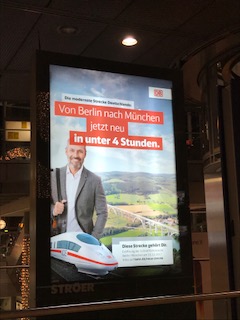
Friday I returned from Berlin to Munich – apparently I was going the new route [though still not the new speed] which is today opened with new trains and new time schedules this had been celebrated on the eighth in Berlin.

From the tenth of December it takes less than four hours to go that route. Going on the sixth to Berlin, the ‘back route’, was a bit more ‘the old style’: slower, especially through some mountainous areas, nice especially where there had been some snow veiling the trees …

From yesterday then: Berlin – Munich in less than four hours. New trains I assume, tightened rails I suppose, new schedules for sure, new staff may be …? Of course that shortening of the journey is a great disadvantage. On the other hand, there is no opportunity, no reason to look out of the window. The magic four: every four years elections; every four month amending laws; every four weeks a new diploma; every four days we may get a new job …, if we get one; every four hours we read entire libraries, summarised in some wiki.

– May be think about some new expression: to wiki a book = put it into a easily digestible format that does not need long intellectual chewing. Al this is about even on earth even? Trains with heavenly speed as their is no reason to fly? Thoughts flying into the brain like roasted pigeons flying into the mouth in the land behind the gingerbread-wall of paradise … – Mind, the synonym is to veil a book. As mutes the synonym for the paradisal pigeon may just be fast-food.

– No, I am afar from praising any good old times, times that never really existed anyway … I am leaning back, quite comfortably … – the …, well, once these people had been called rain conductor … walks along the corridor.

‘Coffee …? Anybody want a coffee ….?

I do not ask for one, thinking about one often quoted passage from Keynes, that surely will also be present in the wiki-libreria:

But this long run is a misleading guide to current affairs. In the long run we are all dead. Economists set themselves too easy, too useless a task, if in tempestuous seasons they can only tell us, that when the storm is long past, the ocean is flat again. [A Tract on Monetary Reform (1923)]

Looking at Keynes unwikied, didn’t he mean implicitly: of we only look at wikied policy measures – short and short-lived, we are not able to solve the underlying problems. And there are good reasons to look out of the window – or read entire books – before writing and boxing. Well, all this is surely also about skills and knowledge.

Well, there is a difference between expresso and espresso. And ever trust anybody who promises to make a nice expresso, very quick.

skills and – or versus – knowledge?

A short passage from Hannah Arendt’s Human Condition, right at the beginning, shows the Poodel’s core …

If it should turn out to be true that knowledge (in the modern sense of know-how) and thought have parted company for good, then we would indeed become the helpless slaves, not so much of our machines but of our know-how, thoughtless creatures at the mercy of every gadget which is technically possible, no matter how murderous it is.

Well,

This was the poodle’s real core

Usually we read about the gadgets, being easily ready to blame them for everything but in actual fact it is not about machines, algorithm’s and the mathematisation of science as such. Indeed we are dealing with the alteration of substance by subordinating matters under alien standards, those of technology or of administrations

The death of the theorist and the emergence of data and algorithms in digital social research

What Hannah Arendt presents as us having

been forced to adopt a “language” of mathematical symbols which, though it was originally meant only as an abbreviation for spoken statements, now contains statements that in no way can be translated back into speech.

is exactly the inability to express ourselves, even more: the inability to be selves.

Indeed, there is no reason for Luddism. It is not about blaming instruments for what they are instrumentalised.

All this has a bit of the body snatchers – if you did not watch the film yet, try to get hold of it and watch it in the presented perspective.

The poodle’s real core – the translation of the phrase in different languages is exciting, allowing to play a bit:

the crux of the matter – fin mot de l’histoire – nocciolo della questione – madre del cordero

The cross we are bearing after committing the sin, confronting us with the end of everything, just reducing things on a nucleus that barely has space for much, and still, brought to explosion it reduces even this little, showing itself as mother of the lamb – and we know too well that the lamb had to be sacrificed.

Though we should not feel tempted to sacrifice the gadgets, we surely should get the brush ready to sweep away the ‘new thinkers’: those new priests that torture us by putting people into boxes and those new priests that ruin institutions by reducing them on administrative machines. It is one of the challenges to see that machines – be it in forms of boxes or administrators desks, are simply not able to engage in what would be needed: intellectual confrontation.

We may move from Arendt to Goethe’s Faust:

‘Tis written: “In the Beginning was the Word.”
Here am I balked: who, now can help afford?
The Word?—impossible so high to rate it;
And otherwise must I translate it.
If by the Spirit I am truly taught.
Then thus: “In the Beginning was the Thought
This first line let me weigh completely,
Lest my impatient pen proceed too fleetly.
Is it the Thought which works, creates, indeed?
“In the Beginning was the Power,” I read.
Yet, as I write, a warning is suggested,
That I the sense may not have fairly tested.
The Spirit aids me: now I see the light!
“In the Beginning was the Act,” I write.

If I must share my chamber with thee,
Poodle, stop that howling, prithee!
Cease to bark and bellow!
Such a noisy, disturbing fellow
I’ll no longer suffer near me.
One of us, dost hear me!
Must leave, I fear me.
No longer guest-right I bestow;
The door is open, art free to go.
But what do I see in the creature?
Is that in the course of nature?
Is’t actual fact? or Fancy’s shows?
How long and broad my poodle grows!
He rises mightily:
A canine form that cannot be!
What a spectre I’ve harbored thus!


Academia Now and Then

I am wondering if and in which way we can and have to speak of changes in the academic world.

Putting it into a question one could ask:

Can living in the academic world be compatible with working academically?

It has something religious – similar to the questions, leading to and accompanying the Reformation, criticizing the institutionalised church in order to rescue faith.

It has something ancient philosophic-economical, where we find the contrast of Oikonomia, roughly  use-value oriented and resource-respecting management of the household  and Chrematistike, roughly the exchange-value oriented money-making, money becoming as fetish a use-value.

If we are generously accepting that different sides are justified, instead of insisting on a romanticised ideal, there still remains the

cui prodest, cui bono?

To be precise, it is not just the question who benefits. Centre-stage we have to ask

Where do we find systemically and what are the leading motives?

Looking at the distribution of income within the sector of Higher Education is revealing. And understanding that this is not the only sector where power is abused is frightening. And that power is often abused not just for private benefits, but where dependents are guided into wrong directions is a disgrace …

And there are still people speaking about freedom of thought and speech? Well, we see, it is not just a matter of a finger …, it can also be about having a different approach or uncovering injustice or speaking about it. And then people hear they should think outside of the box …?

Well, there is something biblical in all this as we know from Genesis 26 ff. – still encouraging some to ask Why can’t we do what we like to do?