A United Europe … an ambition that has a long tradition, characterised by ups and downs

(scroll down for Dansk [machine translation], Deutsch, Français, Italiano)

One could also use a different wording as the ambition had not been solely and perhaps not even primarily led by the idea of global peace. Today we must remember the critique that had been frequently brought forward: a Fortress Europe, striving for competitiveness, directed against and profiting from the “others”.

For some time, we got used to a process of enlargement and – if taken optimistically – strengthened unity …. making us forget the conflicts linked to countries and regions as Republic of Ireland/United Kingdom of Great Britain and Northern Ireland; Spain/Catalonia/Basque Provinces, Italy/South Tyrol/Mezzogiorno and others.

The Memorial Stone in front of the house Sønderbyvej 3, Møgeltønder

is part of this history – commemoration and remembrance. It had been put into place on the private initiative by Peter Eskildsen Jensen – this is stated in runic script to the roadside, saying

JENSEN PLACED THE STONE IN COMMEMORATION OF THE REUNION WITH THE MOTHERLAND AFTER HALF A CENTURY OF SEPARATION

On the backside of the stone different names with the relevant historical dates are listed – reminding us of the steps of occupation, liberation, dependency, foreign rule and liberation.

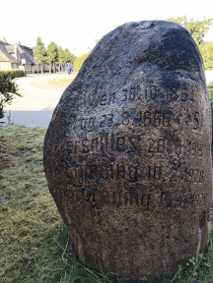
  • Vienna 30.10.1864[1]
  • Prague, 23.8.1866 (§ 5)[2]
  • Versailles 29.6.1919[3]
  • Plebiscite 10.2.1920
  • Reunification 15.6.1920

History does not repeat itself. And to make sure that this remains true we must not forget, aim on learning from what happened: sovereignty does not equal nationalism; we may even say that the denial of sovereignty is one of the sources of nationalism … – closing borders again is unlikely helping us today. And as incomplete, often even highly problematic the EU is, we must treat it with care and respect.

Visit also

https://edu-art.blog

https://www.hrug.legal

You may call 0045.30669969 to arrange a visit in the gallery: the collection reflects over 100 years of art history – from Chagall’s biblical visions to Peter Kurgan’s mineral landscapes.
It is also possible t arrange a visit in the small reference library with classical literature, contemporary novels and text books (philosophy, economics, law, political science and arts). Languages: English, French, German (few Italian, Chinese and Latin).

****

Dansk – maskinoversættelse

Et forenet Europa … en ambition med lange traditioner, præget af op- og nedture.

Man kunne også bruge en anden formulering, da ambitionen ikke udelukkende og måske ikke engang primært var drevet af tanken om global fred. I dag må vi huske den kritik, der ofte blev fremsat: et fæstnings-Europa, der stræber efter konkurrenceevne, rettet mod og til fordel for »de andre«.

I en periode vænnede vi os til en udvidelsesproces og – hvis man ser optimistisk på det – en styrket enhed …, der fik os til at glemme konflikterne mellem lande og regioner som Irland/Det Forenede Kongerige Storbritannien og Nordirland, Spanien/Catalonien/Baskerlandet, Italien/Sydtyrol/Mezzogiorno og andre.

Mindesten foran huset Sønderbyvej 3, Møgeltønder

er en del af denne historie – mindesmærke og erindring. Den blev rejst på privat initiativ af Peter Eskildsen Jensen – dette er angivet i runeskrift ved vejsiden, hvor der står

JENSEN REJSTE STENEN TIL MINDE OM GENFORENINGEN MED MODERLANDET EFTER ET HALVT ÅRHUNDREDES ADskillelse

På bagsiden af stenen er der forskellige navne med de relevante historiske datoer – som minder os om besættelsen, befrielsen, afhængigheden, fremmedstyret og frigørelsen.

  • Wien 30.10.1864[4]
  • Prag, 23.8.1866 (§ 5)[5]
  • Versailles 29.6.1919[6]
  • Afstemningen 10.2.1920
  • Genforeningen 15.6.1920

Historien gentager sig ikke. Og for at sikre, at dette forbliver sandt, må vi ikke glemme, men stræbe efter at lære af det, der skete: suverænitet er ikke det samme som nationalisme; man kan endda sige, at fornægtelse af suverænitet er en af kildene til nationalisme … – at lukke grænserne igen vil sandsynligvis ikke hjælpe os i dag. Og selvom EU er ufuldstændig og ofte endda meget problematisk, må vi behandle den med omhu og respekt.

Visit also

https://edu-art.blog

https://www.hrug.legal

****

(Uebersetzung aus dem Englischen)

Ein vereintes Europa … ein Ziel, das schon lange besteht und mit Höhen und Tiefen verbunden ist.

Man könnte dies auch anders sagen, weil die EUropäische Integration nicht nur und vielleicht nicht mal hauptsächlich von der Idee des Weltfriedens angetrieben wurde. Heute müssen wir uns an die Kritik erinnern, die oft geäußert wurde: eine Festung Europa, die nach Wettbewerbsfähigkeit strebt, sich gegen die „Anderen“ richtet und von ihnen profitiert.

Eine Zeit lang haben wir uns an einen Prozess der Erweiterung und – wenn man es optimistisch sieht – der Vertiefung der Einheit gewöhnt … und dabei die Konflikte vergessen, die in Ländern und Regionen wie der Republik Irland/dem Vereinigten Königreich Großbritannien und Nordirland, Spanien/Katalonien/den Baskenprovinzen, Italien/Südtirol/Mezzogiorno und anderen Geschichte und teils Gegenwart bestimmen.

Der Gedenkstein vor dem Haus Sønderbyvej 3 in Møgeltønder

ist Teil dieser Geschichte – Gedenken und Erinnerung. Er wurde auf private Initiative von Peter Eskildsen Jensen aufgestellt – dies ist in Runenschrift an der Straßenseite zu lesen

JENSEN STELLTE DEN STEIN ZUR ERINNERUNG AN DIE WIEDERVEREINIGUNG MIT DEM MUTTERLAND NACH EINEM HALBEN JAHRHUNDERT DER TRENNUNG

Auf der Rückseite des Steins sind verschiedene Namen mit den entsprechenden historischen Daten aufgeführt, die uns an die Etappen der Besetzung, Befreiung, Abhängigkeit, Fremdherrschaft und Wiedererlangung der Unabhängigkeit erinnern.

  • Wien 30.10.1864[4]
  • Prag, 23.8.1866 (§ 5)[5]
  • Versailles 29.6.1919[6]
  • Volksabstimmung 10.2.1920
  • Einigung 15.6.1920

Die Geschichte wiederholt sich nicht. Und damit das auch so bleibt, dürfen wir nicht vergessen, müssen aus dem Geschehenen lernen: Souveränität ist nicht gleich Nationalismus; man könnte sogar sagen, dass die Verweigerung der Souveränität eine der Ursachen des Nationalismus ist … – Grenzen wieder zu schließen, wird uns heute nicht weiterhelfen. Und so unvollkommen und oft sogar problematisch die EU auch sein mag, wir müssen sie mit Sorgfalt und Respekt behandeln.

****

traduction de l’anglais

Une Europe unie… une ambition qui a une longue histoire, avec des hauts et des bas.

On pourrait même dire ça autrement, car cette ambition n’était pas seulement, et peut-être même pas principalement, motivée par l’idée de la paix mondiale. Aujourd’hui, on doit se rappeler les critiques qui ont souvent été formulées : une Europe forteresse, qui cherche à être compétitive, qui s’oppose aux « autres » et profiter de la situation des autres.

Pendant un certain temps, on s’est habitués à un processus d’élargissement et, si on voit les choses de manière optimiste, à un renforcement de l’unité… qui nous a fait oublier les conflits liés à des pays et des régions comme la République d’Irlande/le Royaume-Uni de Grande-Bretagne et d’Irlande du Nord, l’Espagne/la Catalogne/les provinces basques, l’Italie/le Tyrol du Sud/le Mezzogiorno et d’autres.

La pierre commémorative devant la maison Sønderbyvej 3, Møgeltønder

fait partie de cette histoire, de cette commémoration et de ce souvenir. Elle a été mise en place à l’initiative privée de Peter Eskildsen Jensen, comme l’indique l’inscription en runique sur le bord de la route

JENSEN A PLACÉ CETTE PIERRE EN SOUVENIR DE LA RÉUNIFICATION AVEC LA MÈRE PATRIE APRÈS UN DEMI-SIÈCLE DE SÉPARATION

Au dos de la pierre, différents noms accompagnés des dates historiques importantes sont inscrits, nous rappelant les étapes de l’occupation, de la libération, de la dépendance, de la domination étrangère et de la libération.

  • Vienne, 30 octobre 1864[7]
  • Prague, 23 août 1866 (§ 5)[8]
  • Versailles, 29 juin 1919[9]
  • Plébiscite, 10 février 1920
  • Réunification, 15 juin 1920

L’histoire ne se répète pas. Et pour que ça reste vrai, on ne doit pas oublier, on doit chercher à tirer les leçons du passé : la souveraineté n’est pas synonyme de nationalisme ; on pourrait même dire que le déni de souveraineté est l’une des sources du nationalisme… Fermer à nouveau les frontières ne nous aidera pas aujourd’hui. Et même si l’UE est pas parfaite, voire souvent très problématique, on doit la traiter avec soin et respect.

Visit also

https://edu-art.blog

https://www.hrug.legal

****

traduzione dall’inglese

Un’Europa unita… un’ambizione che ha una lunga storia, con alti e bassi.

Si potrebbe anche dire che l’ambizione non era solo, e forse nemmeno principalmente, guidata dall’idea della pace globale. Oggi dobbiamo ricordare le critiche che sono state spesso sollevate: un’Europa fortezza, che cerca di essere competitiva, contro gli “altri” e a loro spese.

Per un po’ ci siamo abituati a un processo di allargamento e, se lo guardiamo con ottimismo, di rafforzamento dell’unità… che ci ha fatto dimenticare i conflitti tra paesi e regioni come la Repubblica d’Irlanda/Regno Unito di Gran Bretagna e Irlanda del Nord, Spagna/Catalogna/Paesi Baschi, Italia/Alto Adige/Mezzogiorno e altri.

La lapide commemorativa davanti alla casa Sønderbyvej 3, Møgeltønder

fa parte di questa storia, di commemorazione e di ricordo. È stata messa lì su iniziativa privata di Peter Eskildsen Jensen, come dice la scritta in runico sul bordo della strada

JENSEN HA POSTO QUESTA PIETRA IN MEMORIA DELLA RIUNIONE CON LA MADRE PATRIA DOPO MEZZO SECOLO DI SEPARAZIONE

Sul retro della pietra ci sono diversi nomi con le date storiche importanti, che ci ricordano le tappe dell’occupazione, della liberazione, della dipendenza, del dominio straniero e della liberazione.

  • Vienna 30.10.1864[10]
  • Praga, 23.8.1866 (§ 5)[11]
  • Versailles 29.6.1919[12]
  • Plebiscito 10.2.1920
  • Riunificazione 15.6.1920

La storia non si ripete. E per assicurarci che sia così, non dobbiamo dimenticare, ma imparare da quello che è successo: la sovranità non è nazionalismo; potremmo anche dire che negare la sovranità è una delle cause del nazionalismo… – chiudere di nuovo le frontiere non ci aiuterà molto oggi. E anche se l’UE è incompleta e spesso anche molto problematica, dobbiamo trattarla con cura e rispetto.

Visit also

https://edu-art.blog

https://www.hrug.legal


[1] The Treaty of Vienna, signed on October 30, 1864, concluded the Second Schleswig War between Denmark, Prussia, and Austria. As a result of the treaty, Denmark ceded the Duchies of Schleswig, Holstein, and Lauenburg to Prussia and Austria

[2] Peace Treaty of Prague; Article 5 of the Peace Treaty ends up playing a central role for the Danish-minded Schleswigers. It says that Schleswig and Holstein must in principle be managed by Prussia, but that the northern districts of Schleswig must be reunited with Denmark if the people in these areas demand it in a free vote. Negotiations on such a vote failed as early as 1868, however – and in 1878 Germany repealed the article – https://www.kb.dk/en/inspiration/reunification/timeline.

[3] Relevant for the later plebiscite 

[4] The Treaty of Vienna, signed on October 30, 1864, concluded the Second Schleswig War between Denmark, Prussia, and Austria. As a result of the treaty, Denmark ceded the Duchies of Schleswig, Holstein, and Lauenburg to Prussia and Austria

[5] Fredstraktaten i Prag; artikel 5 i fredstraktaten kommer til at spille en central rolle for de dansk-orienterede slesvigsher. Den fastslår, at Slesvig og Holsten i princippet skal administreres af Preussen, men at de nordlige distrikter i Slesvig skal genforenes med Danmark, hvis befolkningen i disse områder kræver det ved en fri afstemning. Forhandlingerne om en sådan afstemning strandede imidlertid allerede i 1868, og i 1878 ophævede Tyskland artiklen. – https://www.kb.dk/en/inspiration/reunification/timeline.

[6] Relevant for den senere folkeafstemning

[7] Le traité de Vienne, signé le 30 octobre 1864, a mis fin à la deuxième guerre du Schleswig entre le Danemark, la Prusse et l’Autriche. À la suite de ce traité, le Danemark a cédé les duchés de Schleswig, Holstein et Lauenburg à la Prusse et à l’Autriche.

[8] Traité de paix de Prague ; l’article 5 du traité de paix finit par jouer un rôle central pour les Schleswigers danois. Il stipule que le Schleswig et le Holstein doivent en principe être administrés par la Prusse, mais que les districts nord du Schleswig doivent être réunis au Danemark si la population de ces régions le demande par un vote libre. Cependant, les négociations sur un tel vote échouèrent dès 1868 et, en 1878, l’Allemagne abrogea cet article – https://www.kb.dk/en/inspiration/reunification/timeline.

[9] Pertinent pour le référendum ultérieur

[10] Il Trattato di Vienna, firmato il 30 ottobre 1864, pose fine alla seconda guerra dello Schleswig tra Danimarca, Prussia e Austria. In seguito al trattato, la Danimarca cedette i ducati di Schleswig, Holstein e Lauenburg alla Prussia e all’Austria.

[11] Trattato di pace di Praga; l’articolo 5 del trattato di pace finisce per avere un ruolo centrale per gli Schleswigesi di orientamento danese. Esso stabilisce che lo Schleswig e l’Holstein devono essere in linea di principio amministrati dalla Prussia, ma che i distretti settentrionali dello Schleswig devono essere riuniti alla Danimarca se la popolazione di queste zone lo richiede con un voto libero. I negoziati su tale voto fallirono però già nel 1868 e nel 1878 la Germania abrogò l’articolo – https://www.kb.dk/en/inspiration/reunification/timeline.

[12] Rilevante per il successivo plebiscito

Fearing for jobs?

There is so much talk about the loss of jobs — all the executives, not least the many “activists” in the field of artificial intelligence are presenting the dystopias … no jobs in the future. Why are THEY speaking of such supposedly bleak future. In fact, they show that we have a pool of new jobs that one can hardly think of an end:

  • chief executive officer (CEO)
  • chief strategy officer (CSO)
  • chief reputation officer (CRO)
  •  chief operating officer (COO)
  • chief financial officer (CFO)
  • chief strategy officer (CSO)
  • chief marketing officer (CMO)
  • chief business officer (CBO)

And more and more we come across the

chief economic opportunity officer (CEOO)

If the spirit of innovation among these people should wane, I could suggest a new position:

What about a

Chief Mischief Officer??

Doesn’t all this remind us of some forms of societal leadership we know from the past: the chiefs and chiefdoms … and many had a special position: the jester.

standards

Sure, money doesn’t make happy – nevertheless it helps; if it is not helping those who earn (not deserve) it, it helps people like you and me who must understand the world, or better: who should know things that cannot be understood.

Baerbock is now in this top position that brings her according to the daily Welt 13,000 Euro per month (https://www.welt.de/politik/ausland/article256206282/annalena-baerbock-deutschland-bezahlt-ihr-gehalt-bei-den-un-so-viel-erhaelt-die-ex-ministerin.html); at the same time, Mr Merz aims on entering history books as second DOGE, suggesting strict control of social spending and even a change of social law. (https://www.welt.de/politik/deutschland/article256203762/sozialbereich-steigerungsraten-nicht-laenger-akzeptabel-merz-will-foerderungen-ueberpruefen.html) – It is worthwhile to mention that the income of Bearbock is paid from the German budget.

Is it unbelievable , faked news or just madness? Global madness that lost reality out of sight?

Mr Gates recently stated that he wants to give away 99% of his fortune:

“People will say a lot of things about me when I die, but I am determined that ‘he died rich’ will not be one of them,”

– Oh, what generous motive. Sure, fair enough; however some doubts may be raised if one reads at the same time

Giving away 99% of his fortune could still leave the fifth-richest person in the world a billionaire, according to Bloomberg (https://www.bbc.com/news/articles/cn4qg5gzgzxo)

Difficult to understand this world without becoming mad. But it’s well known, madness is always with the others and looking at all that, I believe it is true.

memories revived — United Nations

Ah no, I never made it to the United Nations highest Assembly – and you surely will find it strange that I remember right now a little episode from the days before I left Ireland and UCC. A VIP (Very Important Person) came to the Departmental Meeting, talking about the new strategy of the University College Cork. A lengthy sermon (after he managed after an equally long time to get the slide-presentation working) – answered by a lengthy sermon from my side (without slides). Here only the end is of interest – I said, sarcastically thanking him, sth like: After this critique from my side, please let me conclude: in your previous, job you advised the Irish government – and Ireland is now (I do not remember when this “theatre” he’d been staged, probably the early 2010s) in a pretty bad shape. And now you come here, advising this University. – This was followed by a telling break and an even more telling look at the presenter and the colleagues from my side.

Why do I remember this after reading that Annalena Charlotte Alma Baerbock, Germany’s former minister of foreign affairs, had been elected as President of the United Nations General Assembly?

VIPs – Very Improbable Progress

small print

Often we find more important messages sidelined, seemingly of lesser importance than what may be expected when looking at headline and topic. The Handelsblatt, the German newspaper that provides essential news about economic developments, publishes a podcast, looking at economic challenges. The 09-05-2025 edition had been titled

Deutsche Wirtschaftspolitik: Neuer Optimismus trotz globaler Unsicherheiten

More or less at the beginning we hear that

die ersten

1:51 Schritte die die Regierung macht finde

1:53 ich richtig Wir müssen Paris und

1:55 Warschau adressieren Wir haben das hier

1:56 immer wieder Bert besprochen weil wir

1:58 gesagt haben das ist die Achse die

1:59 Europa stark macht

(I think the first steps taken by the government are right. We need to address Paris and Warsaw. We have discussed this repeatedly because we have said that this is the axis that makes Europe strong.)

Is it then the old axis – the axis that stood at the beginning (not only) of WW I and WW II? And the German prime minister aims on armament, wants that the Bundeswehr is the strongest army in Europe … Even if it is now only an economic war (and many signs are pointing into this direction) it is predominantly a war against the majority of the people.

Big Data – Big Worries

The current penetration of our society with new media is a profound cultural upheaval.

A statement that can hardly denied. Often experts in some field – as medicine, finance, engineering and of course data processing/information technology – welcome this, making out the great instrumentality, seeing that ‘machines’ are better able to perform some tasks than human beings (even if this is sometimes an illusion: typing a small equation into the calculator may be more tedious than just calculating … – though having only learned to calculate with the calculator may make it impossible to do any calculation that cannot be performed by using the fingers [don’t make divisions, please]). Often the person from the street, ordinary people appreciate it as these ‘cultural tools’ make things possible that had not been even thinkable before – or at least some things are becoming easier. And then there is a third group, also reflected by within the two groups mentioned: sceptics, who, in extreme cases, lament the decline of culture and Western values.

There are surely good arguments in favour of each attitude. However, isn’t there also a good argument for suggesting that we are looking at the wrong question?

The current penetration of our society with new media is a profound cultural upheaval.

This formulation suggests that the new media are the decisive point in question. While looking at the current penetration, it refers to ‘our society’ and this ‘our society’ seems not to be at stake – or to be more precise: our society changes as consequence of (a) the new media and (b) the penetration. Such perspective has major implications for nearly everything: the way we approach democracy, elections, consumption, education, learning, travelling … . – Spoiler: the following does not claim to know the correct answer; and the outline of the present answer is moving on slippery, i.e. contradictory ground.

***

The English businessman Thomas Cook (22 November 1808 – 18 July 1892) is not least known as forerunner of package holidays. However, it had not been until the 1950s that the concept came to a breakthrough: combined flight, transfers, and accommodation, and later the ‘leisure-time activities’ by animateurs characterised new ways of mass tourism. Without doubt a progressive concept, opening explorations to people who could not afford it before.

However, we also see a connotation that is often lost: the amateur had been replaced by the follower of an animateur; the immediate experience of touring by the explorer, entering unknown territories had been replaced by tourism, that offered a framework, an arena, a predefined track for tours. Of course, very few people even in the olden times could afford to travel like Marco Polo (c. 1254 – 8 January 1324), merchant, adventurer and author who travelled years along the Silk Road. One underlying fundamental change is that the multi-skilled, multi-interested and not very rich Marco Polo had been what we may call entrepreneur, undertaker – not in today’s Schumpeterian understanding – who had been replaced by today’s user. There is a paradox implied: whereas for Polo’s generation of undertakers the exchange value emerged from the use value, for today’s user (the entrepreneur as the consumer alike) the use value depends on the exchange value – so far its highest stage and ultimate expression is the financialisation of the economy, techno feudalism (Varoufakis) only being a variation.

Marco Polo, James Cook and the Horizon Holiday Group are only one of many developments that characterise the shallowing and draining of life – the seedbed for

[t]he current penetration of our society with new media

A simple answer can be given by unscrewing the wheel, returning to elitist concepts … – as said: Marco Polo had been one of the few privileged at a time where mass migration existed only as answer on some kind of exodus.

And

In the 2nd century AD, around the same time in the Western world that the Roman emperor Marcus Aurelius was recording his philosophical thoughts on papyrus scrolls and relying on scribes to reproduce them, the main works of classical Chinese literature were cut into stone slabs in China over a period of eight years from the year 175 AD. Thousands of copies were made in the form of copies: Moistened paper was pressed onto the inscription stones in such a way that when the paper was brushed with ink, the incised characters stood out white against the otherwise blackened paper. (Team “Mainz. Gutenberg 2000: Vor Gutenberg; https://www.gutenberg.de/erfindung/vor_gutenberg.php; 17/11/2024; own translation)

The various steps of massification from earlier developments until today seem to be inextricably linked to a flattening.

But, so far, the simple answer ignores one aspect: what appears to be massification, had been dominated by the idea of rationalisation and making control more effective – that the ability to read could also be used to read other info that those supported by the modern entrepreneurs had to be accepted as unintended side-effect. The liberating effects, however, had not been transposed into the real liberation of the user, or even more: the transformation of the user into the role of the owner. Instead, it had been the orientation on gain as sole guideline also for social processes (see Polanyi) – the alternative is becoming clear in the following lines, taken from the first volume of Willi Bredel’s Ein neues Kapital – A New Chapter: (Berlin: Aufbau, 1974: 412)

….Deshalb
wollen wir lernen, fleißig lernen,
nicht
um klüger zu werden als andere
und daraus Vorteile zu gewinnen,
sondern
um die noch nicht Kluggewordenen
klug zu machen.
Deshalb
wollen wir schaffen, rastlos schaffen,
nicht
um reicher zu werden als andere
und daraus Macht zu gewinnen,
sondern
um das Leben aller reich zu machen.
….Therefore
we want to learn, to study hard,
not
to become wiser than others
and to gain advantages from it,
but
to make those who are not yet wise
wise.
Therefore
we want to create, to work tirelessly,
not
to become richer than others
and to gain power from it,
but
to make life rich for everyone.

A simple example: The daughters of a famer had been ‘travelling the world’, the father ‘travels with them’, using the internet, National Geographic etc. and of course digital means of communication even if he rarely moved physically to the next lager city. Both could afford it, not least because they had been ‘time-rich’.

Keynes, writing in 1930 about the Economic Possibilities for Our Grandchildren, suggested

Three-hour shifts or a fifteen-hour week may put off the problem for a great while. For three hours a day is quite enough to satisfy the old Adam in most of us! (https://www.aspeninstitute.org/wp-content/uploads/files/content/upload/Intro_and_Section_I.pdf; 17/11/2024)

Wouldn’t that allow all of us to travel more substantial than instagramable, to exchange honestly instead of sending only short messages and sending pictures, to study deeply rather to depend on ‘deep AI’ .

And not least, would that not also open a door to informed political decisions, ‘deep democracy’, going beyond elections – in the US for instance, the campaign of the recent elections had been the most expensive ever (see e.g. https://www.opensecrets.org/news/2024/10/total-2024-election-spending-projected-to-exceed-previous-record/; https://www.zeit.de/politik/2024-11/usa-wahlkampf-teuerster-donald-trump-kamala-harris; 17/11/2024), resulting in a criminal being president (see e.g. https://www.lto.de/recht/hintergruende/h/usa-donald-trump-us-stormy-daniels-manhattan-new-york?utm_source=Eloqua&utm_content=WKDE_LEG_NSL_LTO_Daily_EM&utm_campaign=wkde_leg_mp_lto_daily_ab13.05.2019&utm_econtactid=CWOLT000034312644&utm_medium=email_newsletter&utm_crmid=).Interestingly enough, taking from an entry on the US elections on Robert’s blog, we learn:

The biggest caveat to Trump’s voting victory is that contrary to the usual hype of a ‘massive voter turnout’, fewer Americans eligible to vote bothered to do so compared to 2020. Then over 158m voted, this time the vote was down to 143m. The voter turnout of those eligible fell to 58.2% from the high of 65.9% in 2020.

Around 40% of Americans registered to vote did not do so. And the number of Americans who failed to register rose to 19m from 12m in 2020. So, although Trump got 51% of those who voted, he actually got only 28% support of Americans of voting age.

If it is said that

how we learn, work, discuss, position ourselves socially and politically and make decisions – all of this is changing so quickly that we can hardly keep up

we should go a step further, asking for what we are leaning, discussing and position ourselves, what kind of decisions are we making. If the polity changes along the line of gaining and maintaining power – individually and/or in the sense of MAGA (or any other country). If political decisions are replaced by financial investments and juridification ala “seek(.)[ing] jail and public office ban (https://www.theguardian.com/world/2024/nov/14/marine-le-pen-embezzlement-trial-national-rally-prosecutor-ban?CMP=Share_AndroidApp_Other; 17/11/2024) for disagreeable politicians we are confronted with the problem of depleting public spaces, leaving it to individuals to decide ‘what is right and what is wrong’. Such ban directed against Le Pen may be in the short run to be welcomed as it may be welcomed to ban a right-wing populist party like the German AFD. At the end, however such depletion of public spaces is a kind of re-feudalisation, reestablishing the absolute ruler. Of course it is a paradox: in the extreme case, and only then, the absolute ruler may be necessary to avoid the absolute dictator.

Indeed, it is interesting that

[t]he German legal system does not provide any legal protection against disinformation and fake news beyond defamation offences. In order to activate the protective effects of the law, a personal reference is always needed first. In the broad area of assertions without personal reference, in particular the right-wing camp has adopted the peculiar narrative that Google, X and Bytedance (the company behind TikTok) should decide on lies and truth rather than the state. (Chan-jo Jun, Flint, Jessica, 2024: Warum nicht Tiktok und Co über Demokratie entscheiden sollten. Regulierung nach dem DSA; in: Legal Tribune Online, 30.05.2024 , https://www.lto.de/persistent/a_id/54659; abgerufen am: 16.11.2024)

This fundamental problem must be highlighted: the trinity of privatisation, individualisation and the dismissal of the state from responsibility. The aforementioned juridification only appears as contradiction, insofar law is fundamentally concerned with rights of individuals. This basically opens the door to digitisation, and what’s more, digitisation becomes a logical consequence if not necessity as both are based on the principle of binarity.

With all of this, contexts are systematically destroyed – TV programmes, that people are talking about are victim of TV media libraries, commercial channels that offer whatever we like at whichever time we want [and of course, they tell us as well what we want] …. The “Monday morning question at work”: Did you watch …? The subsequent discussion cannot really happen anymore, is at least not encouraged; the debate of the latest news is difficult as the news are sooner old than they can be digested – and in addition they drown in ‘multimedia-news shows’: presenting a central message, accompanied by the stock exchange info on the bottom, the weather forecast on the right and/or some sport info on the left and not least the very latest news in a short superimposition … and of course, somewhere the next film is announced — already now available in the TV library, even if only broadcasted the next day … . This can be continued without end, applied for different areas – and perhaps the only exception is sports: bringing people together and although they get lost in the crowd, everyone feels an important part of it – not digitally, but in analogue. – And yes, sometimes the smell of horses on the field or in the arena of a circus is much better, a counterweight against Pokémon.

And it is in this sense always necessary to discuss the meaning of rights, not leaving justice as in the hands of algorithm-driven machines.

democratic miracle

The German Die Zeit suggested that the mass demonstrations the recent days must be seen as democratic miracle. Sure, it had been in some ways encouraging to see people demonstrating. Though a little drop of bitterness is going hand in hand with it:

• The protest had been in some way diffuse, directed against the AFD, often with reference to a meeting between AFD members, in which CDU members were also involved, as a point of reference and as …, well, equally diffuse request to the government, to the prime minister and to “the people” to counteract the further drift to the right;

• While these demonstrations are looked at as democratic miracle, two major movements are not mentioned in this context: the strike of railway workers and the protest of (not only) the farmers – doesn’t this suggest that these are not part of the democratic movement?

• And then a rather fundamental issue: The Aerzteblatt published already in 2019 a short side note (https://www.aerzteblatt.de/archiv/209491/Randnotiz-Frage-nach-der-Nuetzlichkeit): it concerns a parliamentary question. In short: 

die AfD will wissen, welche „volkswirtschaftlichen Verluste durch die nicht genutzten Erwerbspotenziale“ von Menschen mit psychischen Erkrankungen und Beziehern von Erwerbsminderungsrenten bestehen. 

The AfD wants to know what “economic losses exist due to the unutilised employment potential” of people with mental illnesses and recipients of reduced earning capacity pensions.

And the Diaconia warns that people should never be assessed on grounds of utility considerations

  • Hinter der Frage darf die Vorstellung vermutet werden, dass psychisch Kranke die Volkswirtschaft und die Sozialsysteme belasten. Die Nazis propagierten ihre Vernichtungsaktionen mit Plakaten von „unnützen Essern“, die nicht in den „gesunden Volkskörper“ passten. Kein Mensch darf Nützlichkeitserwägungen unterworfen werden – niemals mehr.
  • The idea that mentally ill people are a burden on the national economy and social systems may be assumed to be behind the question. The Nazis propagated their extermination campaigns with posters of “useless eaters” who did not fit into the “healthy national body”. No human being should be subjected to considerations of usefulness – ever again.

And why is this mentioned in the context of the mass demonstrations against the right, as drop of bitterness of the democratic miracle? Exactly this utilitarian thinking had been accepted for years: migrants being classified as those who are welcomed as adding to the national workforce and those who are seen as burden of the social security systems; the deserving and the non-deserving poor; the good, well integrated workers and those who are victims of mobbing and discrimination, notwithstanding the laws that are forbidding such maltreatment …

Sure, the recent developments broke the camel’s back; but wasn’t it a serious neglect not to talk about the fact that the problem begins with camels being used as working animals?

The president and prime minister and other state reps celebrated the democratic miracle. A mystery seems to be, then, that they represent a state that app 44 % of the AFD’s budgets comes from the state.

Pandemics … a publication and the afterthought …

Just signed a contract, a book titled

Pandemics as a Matter of a System Crisis – Precarity of Society

Springer Nature is the publisher, Prekarisierung und sociale Entkopplung the title of the series, edited by Rolf Hepp and others.

The following are some thoughts, arguing that the topic is still relevant, whatever the next news concerning the virus will be:

Afterthought

While finalising the script, already answering some questions after having submitted a first version, and thus with some time having passed since first taking up the work, it becomes clear to me that than pandemics helped to highlight part of the polity-virus but even without such an extreme and extremely manifest threat the Precarity of Society as System Crisis is sadly obvious.

Sure, Corona is still occasionally issued as threat, new variants striking – but by and large the pandemics are not a topic on the political agenda anymore. This does not mean that the socio-economic consequences are solved. Going together with other major economic crises and hazards small shops are under severe pressure; social provisions and services – be it health care, child care, education and also the capacities of municipal administrations – are overburdened and even standard obligatory acts are hugely delayed, offices closed for the public, allowing staff to catch up with the growing piles of files; the housing situation a matter of serious concern – and the government trying to cushion the problems by occasional grants to relieve the burden on certain groups.

The hopes for a fundamental change, however, burst like soap bubbles: While climate activists are blocking roads and motor highways, highlighting the dangers of global warming, asking for roundtables and negotiations, they are in many cases criminalised and/or met by aggressive measures. At the same time, private transport is fostered, now focusing on electromobility while negotiating the reform of public transport and the relevant pricing systems are suffering from the same weakness as they had been shown above in relation to Covid 19. In Berlin, after a successful referendum I support of the socialisation of the property of large housing corporations according article 15 Basic Law, there are again and again new hurdles erected: socialisation cannot become real, if it goes beyond ruinous payment of selective relief funds …

The emperor’s new dress showing that the ruler is still trapped in the structures of the small princedoms. He only reacts with fear, but without strategy, to the fact that the people have turned their backs on him. In the ‘positive’ case, it is addicted to individualism and withdraws more or less depressively into itself or the family as own little princedom; in the negative case, it follows the populist pied pipers (although such an allusion to the fairy tale of the Pied Piper of Hamlinneeds some qualification). – Still, a certain loyalty to the system is, of course, still maintained by the fact that the powers – be it in business, government and the mass media – still succeed in building up an external enemy. If, though, today’s challenges are global, not knowing any borders, it would be wiser to focus on real cooperation.

Delivery notification – your DHL parcel will be delivered to a branch office

(machine translation – deepl.com)

I have already complained about this case – it remains to be noted that the employee in charge is apparently so badly paid that he did not even stop at the house, but drove straight to the – remote – branch. The fact that I am expected to make the journey despite a disability is yet another sign of the decay of corporate management morals – only decent pay and decent working conditions enable decent performance.
What makes the whole thing even more unbearable: attached to the e-message is an ics date file – however, the delivery did not arrive at the post office specified at that time. A mistake on the part of the postman? Hardly. A mistake by the management, which is incapable of managing.
But these irresponsible people, who lack any humane character, can cash in and sell others for stupidity.

This is how societies are ruined! Disgusting!!!
This is even more true if you look at other figures – Die Zeit from 26.7.
Every fourth employed person receives less than 14 euros per hour

For CEOs with as little common sense as the aforementioned, there should be only one income: Incapacity-for-work-because-of-lack-of-common-sense-pension. Such beings would not be entitled to a citizen’s allowance or the like, since they refuse to engage in any meaningful activity.

As a recommendation: the film Sorry we missed you, by Ken Loach. In the DHL management this film could serve as a mirror and hopefully arouse disgust for themselves.

Once again angry and disgusted greetings from Peter Herrmann

Why not?

Nowadays, it is so often that we receive emails or messages on the answer phone, informing that at the moment an increasing number of mails and phone calls has to be looked after – so they ask for understanding that things take a little bit longer. In particular since the outbreak of corona pandemic’s outbreak such announcements are common, though we should not overlook that this is the continuation of a trend that lasts already for decades, only accelerating now. But why is so little said about the true character of it: the fact that additional work is put on the shoulders of the employees, additional staff is often underpaid (and/or/due to lacking qualification) and employers aim on avoiding new permanent jobs … and due to this kind of “overheating exploitation” actually more things go wrong, giving cause for more complains.