Not only paradise lost …

That paradise is lost is well known and widely accepted. And we probably have to accept that finally politics is lost too.
Some speak at least still changing the imperial mode of lifepleading for vegetarianism and opposing the use of SUVs – of course especially the latter easily accepted by the unemployed …. [see in this context Peter Herrmann / Mehmet Okyayuz: What to do with the revolution – and what does the revolution do to us?]
Others rejecting political responsibility completely … – well, passing it on to incompetent night watch [wo]men.
[Von Julian Herzog, CC-BY 4.0, https://commons.wikimedia.org/w/index.php?curid=43002116]
Some time ago, March 15th, 2018, the then designated Minister-president of Bavaria, stated in an interview
I will understand myself on the one hand as manager of Bavaria, but also as maker./Ich werde mich einerseits als Manager Bayerns verstehen, aber auch als Kümmerer.
His principle philosophy is Bavaria plus:
If the federal government decides something, ‘let’s put a scoop on it’./Wenn der Bund etwas beschließe, ‘legen wir noch eine Schippe drauf’. 

Schumpeter stated in his book on ‘Capitalism, Socialism and Democracy’

The conquest of the air may well be more important than the conquest of India was—we must not confuse geographical frontiers with economic ones.

At the moment it seems that exactly this applies to supposed
as for instance the GAFAs are selling us – HOT AIR, nothing more than extremely well paid gobbledygook, of course well displayed [BTW, habe a closer look at the logo on the mugs]
All this is even more remarkable when we consider that the top-CEOs are increasingly taking over politics as I elaborated in one of the recently submitted and accepted book-contributions, namely the one titled

The Comedy of Big Data – Or: Corporate Social Responsibility Today, while Corporations wither away?: in: Corporate Social Responsibility and Corporate Governance – a 21st Century Challenge; Mulej, Matjaž/O’Sullivan, Grażyna/Štrukelj, Tjaša (eds.): forthcoming

Some adjunct issues are also looked at in recent presentations of which the recordings can be found here.


some reading …

… or actually writing:

New publications by Peter Herrmann, currently guest researcher at the Max Planck Institute for Social Law and Social Policy/Max-Planck-Institut für Sozialrecht und Sozialpolitik [section social law], Munich, Germany, are now on the way or already at the printer, waiting for final publication:

  • The Comedy of Big Data – Or: Corporate Social Responsibility Today, while Corporations wither away?: in: Corporate Social Responsibility and Corporate Governance – a 21st Century Challenge; Mulej, Matjaž/O’Sullivan, Grażyna/Štrukelj, Tjaša (eds.): forthcoming
  • Potentials for Taking a Strategic Role for Sustainable Sociability; in: Globalistics and Globalization Studies 2017; Volgograd: Uchitel Publishing: 311–328
  • For him art, research, creation and politics were the same thing  – In memory of Paul Boccara: in: World Review of Political Economy (WRPE) The World Association for Political Economy, Hong Kong; Shanghai University of Finance and Economics, and Center of Economic and Social Development, Chinese Academy of Social Sciences; forthcoming [longish article]
  • « Art, recherche, création et politique ». à la mémoire de Paul Boccara; in: économie et politique; Paris: 30 f.


CFP – 10 years into the crisis – What prospects for a popular political economy in Europe?


European Economists for an Alternative Economic Policy in Europe

Call for Papers and Participation

24th Annual Conference on Alternative Economic Policy in Europe

10 years into the crisis – What prospects for a popular political economy in Europe?

extended SUBMISSION-Date: 31.5.2018

Dear colleagues

This year’s EuroMemo Group conference will be jointly hosted with the University of Helsinki and will take place on 27-29 September 2018 (Thursday-Saturday) at the University of Helsinki.

Against the background of an increasingly alarming influence of right-wing nationalist and populist forces, the conference wants to facilitate discussion on progressive ideas, concepts and policies, on how to reconstruct a political integration project in Europe that is responsive to the economic and social needs of all groups and people affected by the severe economic crisis of the last ten years, and in particular of workers, the unemployed, the precariat, migrants and other vulnerable groups, also in a gender perspective.

The programme will be as follows:

Thursday, September 27th 201

15.00 – 19.00    Opening plenary on the state of the Union

20.00                Conference Dinner

Friday, September 28th 2018

10.00 – 13.30    Workshops on key themes of EU policy

14.30 – 16.00    Plenary on policy proposals from workshops

16.15 – 18.00    Special plenary on the conference topic ’10 years into the crisis – What prospects for a popular political economy in Europe?’

Saturday, September 29th 2018

09.00 – 12.00    Planning meeting: EuroMemorandum 2019 and other activities 

There will be a public event prior to the conference on September 27th 2018:

13.00 – 14.30    ‘The future of the EMU’ (organised by the University of Helsinki)

We would like to invite you to attend the conference and to submit proposals for contributions to the workshops.

All papers that present an original perspective on the conference theme ’10 years into the crisis – What prospects for a popular political economy in Europe?’ are welcome. In particular, we encourage submissions that relate to recent European developments and are specific to one of the following topics

–        Macroeconomic and financial policies

–        Politics of structural reforms: critique and alternatives

–        Economic and political divergences in the EU

–        Social policies in Europe

–        Migration policies and demographic change

–        Nordic welfare model: crisis, erosion, prospects

–        Crisis of the global political economy & world politics: the role of the EU (protectionism, trade wars)

–        Conceptual frameworks and aspects of popular political economy as well as policy proposals for instance with respect to productive transformation, industrial policy, the solidarity economy etc.

–        Socio-ecological transformation and a good life for all

–        New democratic challenges to the status quo: what can we learn from the left-alliance government in Portugal, the labour party under Jeremy Corbyn, the Podemos project in Spain and other similar cases?

Proposals for papers together with a short abstract (maximum 250 words) should be submitted by 15 May 2018to info@euromemo.eu. If possible, please indicate the topic which the proposal is intended for. If accepted, completed papers should be submitted by 06 September 2018

We strongly encourage participants to submit short papers (10-12 pages) and to explicitly address policy implications.

If you would like to submit an abstract and/ or participate in the conference, please copy the registration form below into an email and reply to info@euromemo.eu. Please note that there is no deadline for registering for participation only.

All submitted abstracts will be reviewed by the Steering Committee of the EuroMemo Group. Accepted papers will be published on the conference website and there is also the possibility to publish papers presented at the conference within the EuroMemo Group Discussion Paper Series.

Please note that there will be a conference fee collected at the venue to cover the cost of the conference (30 Euro regular fee / 10 Euro for students / 80 Euro for participants with institutional support).

An information sheet with practical information including details about hotel bookings and transport is attached. Early booking is strongly recommended.

We look forward to seeing you in Helsinki!

Best wishes,
from the EuroMemo Group

Marija Bartl, Joachim Becker, Marcella Corsi, Wlodzimierz Dymarski, Trevor Evans, Marica Frangakis, John Grahl, Peter Herrmann, Aimilia Koukouma, Jeremy Leaman, Jacques Mazier, Agustín Menéndez, Mahmood Messkoub, Ronen O’Brien, Werner Raza, Catherine Sifakis, Achim Truger, Frieder Otto Wolf

European Economists for an Alternative Economic Policy in Europe
EuroMemo Group 
E-Mail    >>  info@euromemo.eu
Internet  >>  http://www.euromemo.eu
Registration form for the 24th Workshop on Alternative Economic Policy in Europe

(please reply to info@euromemo.eu)


Yes, I intend to participate in the 24th Workshop on Alternative Economic Policy in Europe

(27-29 September 2018 in Helsinki)

First Name:

Last Name:

Institution:

City:

e-mail:

Yes, I wish to contribute a paper

Title of the Paper:

Abstract (max. 250 words):

Tragicomedy of Capitalism Today

The recordings of three recent presentations are now online. They had been given in Maynooth, Ireland. The first two had been part of the teaching at the Maynooth University Department of Chinese, the third addressed the conference The (re)Birth of Marx(ism): haunting the future:
The presentations are part of a series of lectures titled

Tragicomedy of Capitalism Today

which will be continued.
The wider topic is to highlight some essential issues that emerge not least with digitisation, marking processes  that show the forces of socialisation that are immanent in what presents itself under the name of neoliberalism as apparent secular process of individualisation.

What is the Value of things

Peter Herrmann, currently guest researcher at the Max Planck Institute for Social Law and Social Policy/Max-Planck-Institut für Sozialrecht und Sozialpolitik [section social law], Munich, Germany, will present later today his thoughts on
Value Theory –, asking if there is still any value in it?/Is it still worthwhile to talk about it?
to the conference

Abstract

The theory of value is probably the most contested feature of Marx’ political economy. The reasons for this are the following two

* It stands at the centre of making out the political of political economy
* It is cross cutting with respect to the micro- and macro-level and especially the ‘personal/individual’ and the ‘societal/institutional’ aspects of economic thinking.
Today the questionable character comes even more to the fore as we witness an apparently fundamental change of the mode of production.
Notwithstanding the critique then and now, there are good reasons to emphasise the usefulness of the theory of value. These will be taken up by exploring explicitly the tensions mentioned, and discussing them against the background of the contemporary shift within the capitalist mode of production.
Marxism, in this light, is especially instrumental for the analysis of globalisation as it allows a clearer understanding not least of the emergence of poverty chains and the role of the capitalist state as institution that maintains centre-periphery patterns of inequality within the productive sphere. Furthermore, we can find from here at least clues for answers Marxism has when it comes to fighting for societal change.

One Belt – One Road – One World – Digitisation of Life as Chinese Lifestyle?

It is never an easy thing: dedication of some work – doesn’t it propose also agreement?
I do not know if and in which way Elmar would have agreed with what I presented – yesterday he passed away and we, critical thinkers with a genuine interest in progressive scientific work – progressive by way of contributing to progress of societal development so we will never know exactly. One thing we do know – the obituary of the scientific committee of attac [German] clearly states it:

ELMAR ALTVATER DIED

It talks about him as an

Inspiring critique of the capitalist economy

This he truly was – as such he encourages me to dedicate the presentation to him: as quest to me and to the students to take up this challenge of critical thinking.

The abstract of the presentation which is recorded here
may give some insight into what you can expect from the lecture — and hopefully you still will be surprised and inspired.
Living in China means as well getting used to a highly advanced level of internet-penetration in large parts of daily life. Often this is perceived as contradicting prevailing traditional ‘life styles’ and attitudes. At first glance this has not much to do with the future of social policy, or does it? – Social policy faces the difficult task of bringing an institutional system and ‘life worlds’ together. With globalisation and digitisation there is an additional challenge: the reference to the nation state and standard forms of labour are increasingly loosing or changing their role, or at least changing it. Is there any common ground for small island nations like Ireland and unimaginable countries like China?

Wisdom versus educating for “bubble-existence”

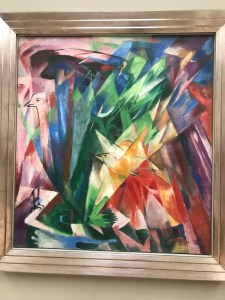
Again it is the one painting in the Lehnbachhaus that catches some special attention, fascination and wondering …

It simply says Children on the Balcony (by Albert Burkart) though our question is if these are children or – if it is about maturing, being able to look over the fence, preparing for the stage where the fence does not exist anymore … –

Man only plays when in the full meaning of the word he is a man, and he is only completely a man when he plays.

I nod

Yes, you are right

– and I ask

Do we need the birds-eye, the ease of the flight to reach such independence – an independence that only exists through the complete sintesi – a state of conflation and consolidation?

Marc was not able to see that this flight would bring him only to death – he may have thought of a peaceful merger, the merge towards peace, the two pieces fighting with each other for a while …

Colours as deceiving interims, though appropriating after some time the essence, ignorant when it comes to the need to communicate, to apply different, i.e. substantial criteria.

From where can we take them? Now I am the one to quote Schiller – again from the Letters On the Aesthetic Education of Man

The greater part of men are much too exhausted and enervated by their struggle with want to be able to engage in a new and severe contest with error. Satisfied if they themselves can escape from the hard labour of thought, they willingly abandon to others the guardianship of their thoughts.

And I add: the greater part is not able any more to dance, at least to dance the dance of the sintesi.


On the way back, passing the King’s Square, the former headquarter of the Fascist murderers that accommodates today a school for music and theatre (“Hochschule für Musik und Theater München”) we arrive at the back of the Old Pinakothek – today the place for free play, the place for free play today … – The freedom, registered as association according German law, once per year, between 14:00 and 18:00 hrs – the lawn is nicely cut, fresh .., one can still smell what The Grim, the man with the scythe revealed, a sweet odour of decay …

Additional opportunities can be booked as special service package – later such packages turn to boxes, but that is for students already …

… indeed, there’s nothing like starting young …

The way to reach free play, the state of free of play, constraint by bubbles

And true too:

… indeed, there’s nothing like starting young to reach wisdom ….

Age .. here it has to accept the responsibility – accepting what we may call Schiller’s paradox

It would be necessary that they should be already sages to love wisdom: a truth that was felt at once by him to whom philosophy owes its name.

Shall we … – the sun is too tempting … – we sit down … with the ease of true playfulness.

hope — even for those …?

Crosses ordered onto walls of all Bavarian government buildings

It requires a lot of …, well, hard to say: naivety (or is it Bavarian nativity?), stupidity, short-sightedness, self-overestimation … or lack of confidence that makes it necessary for politicians to hide behind ‘public acts’ that may have only one purpose: personal profiling in the sense of putting oneself on stage, perform as hero without becoming aware that they change the stage to a place for dangerous tragicomedies, to a place where clowns and comedians make policy in the name of five stars, one cross and an abyss that is guiding their thinking …

Their problem — but also that of each of us, requiring to condemn … also our own faults ….

The scribes and the Pharisees brought a woman who had been caught in adultery, and placing her in the midst they said to him, “Teacher, this woman has been caught in the act of adultery. Now in the Law, Moses commanded us to stone such women. So what do you say?” This they said to test him, that they might have some charge to bring against him. Jesus bent down and wrote with his finger on the ground. And as they continued to ask him, he stood up and said to them, “Let him who is without sin among you be the first to throw a stone at her.” And once more he bent down and wrote on the ground. But when they heard it, they went away one by one, beginning with the older ones, and Jesus was left alone with the woman standing before him. Jesus stood up and said to her, “Woman, where are they? Has no one condemned you?” She said, “No one, Lord.” And Jesus said, “Neither do I condemn you; go, and from now on sin no more.”

Of course, that, in the case in question, i.e. Mr. Soeder,  cannot mean to withdraw from critique – it is about dialectics I guess: accepting the message quoted from John 8.3-11, without following what is stated in Luca 23,34:

“Father, forgive them, for they know not what they do.” And they cast lots to divide his garments.

Where is the border between forgiving and civil courage? Surely not in retreating into the individuals’ realms …

Principiis obsta – Finem respice
‘Resist the beginnings’ – ‘consider the end

How many roads must a man have walked down

A visit of Peter Herrmann, currently guest researcher at the Max Planck Institute for Social Law and Social Policy/Max-Planck-Institut für Sozialrecht und Sozialpolitik [section social law], Munich, Germany, will be giving the coming first week of Mai two lectures in Maynooth, Ireland, at the Maynooth University’s Department of Chinese, directed by Dr. Lu Zhouxiang.
The first lecture deals with
One Belt – One Road [OBOR] – One World – From Economy of Comparative Advantage to Socio-Politics of Cooperative Progressing.
The second is looking at
One Belt – One Road – One World – Digitisation of Life as Chinese Lifestyle
[https://doc-research.org/en/new-match-dialogue-civilisations-one-belt-one-road/]
These lecturers, made possible in particular by the engagement of Dr. Lu Zhouxiang. Herrmann, who is himself visiting scholar at the Department in Maynooth, will contribute from his experience of having lectured and researched for some time  in China – Bangor College of Central South University of Forestry & Technology, ChangSha, and Zhejiang University, School of Public Affairs, Dept. of Social Security and Risk Management, HangZhou, PRC. This will establish links to theoretical debates and establish as well reflections from the global experience Herrmann gained over the years.