Poverty of the Welfare State or: Poverty: construction – de-construction – and losing the battle

The following notes had been made in preparation of the contrubution to the Spring Symposium “Conceptualising and Measuring Poverty: methods for the 21st century” at University College Cork – it took place on the 17th of May 2013.

At a later stage an elaborated annd extended version of these catchwords will be published in the framework of the book under the title

Poverty of the Welfare State.

*****************

*****************

Surely it is necessary, painting a bleak picture, showing the harsh measures and consequences of austerity policies under the aegis of neo-liberalism.

Sure, I would love to deconstruct now for the next two hours the ideology of neo-liberalism – I think there is much more and something different in it than we usually think about. Anyway, as I am supposed to talk about the EU, I may end right now with reference to just one letter from an official from the European Commission outlining in a very firm and concise form the EU’s privatisation strategy.

*****************

being originally from Germany I may start here pointing out what this potentially means in such a rich and democratic country – of which the constitution has still some obligation to

democratic, social and federal principles (Article 23)[1]

In my view it is hardly possible to justify under such heading a strategy of evicting homeless people.

*****************

It is equally clear that we have to highlight the immorality of such policies.

Having lived for some time in Ireland, I want to refer to Michael Higgins, addressing the European Parliament – see on this also already an earlier post)

There he stated

– Schuman, who was aware of it, reached back to recall the early monastic perigrinatio and declared Columbanus to be “the patron saint of all those who now seek to build a united Europe”.

– The Schuman meeting, and the others which followed it, assisted by such as Jean Monnet, was responding to near and terrible events. But we should never forget, and I emphasize it today, that in their response they recognized its immense value, and drew on, the rich scholarship, philosophy, moral instincts and generous impulses of European thought as they sought, not only to replace war with peace, but more importantly, to construct a vision of Europe’s people working together in an inclusive way. It was not any abstract construction. It was a practical proposal drawn from the head, propelled by the heart, and uniting economy and ethics in its aspiration.

(Higgins, Michael D., 2013: ‘Towards a European Union of the Citizens’. Adress to the European Parliament, Strasbourg, Wednesday, 17th April, 2013http://www.president.ie/speeches/address-by-president-michael-d-higgins-towards-a-european-union-of-the-citizens-european-parliament-strasbourg-wednesday-17th-april-2013-2/ – 10/05/2013)

*****************

Furthermore we should not hesitate to critically discuss the various “approaches” of dismantling the “welfare state”

Coming currently from Hungary Victor Orbán has to be mentioned, of course. He shocked some people by the orientation on a munka alapú társadalmat , i.e. work-based society – mind, there are some issues around translation – the official translation speaks of workfare society though the actual translation is likely “work based”. –

More captivating is in Hungary the shift of social policy issues to the minister of inner affairs – defining relevant issues a matter of control.

And more shocking is the fact that going through Budapest and seeing the amount of people sleeping rough. And it may actually be the contrast I faced actually last Sunday: passing one of the beautiful old buildings, still carrying the marks of the recent renovation and the archway offering shelter, no: a living space for a group of homeless people.

*****************

Criticising such positions: the harsh measures, the rejection on moral and ethical grounds and the conceptual dismantling means not least to defend the welfare state and actually to engage for its formation.

Living now in Italy we still face the challenge of replacing the traditional social protectionism as it had been established by Mafia with a modern welfare state.

But of course, it is then a question if our constitution gets the priorities right.

L’Italia è una Repubblica democratica, fondata sul lavoro.

Actually some may remember the times when the inclusion of the employment chapter into the EU-treaties had been celebrated as major success of social policy on the European level.

*****************

And of course I could go on with this EUropean game. And finally I would return to Brussels.

Well, two weeks ago I had been there again. After about four years I re-entered that stage. A bit strange, having been there for several years, being allowed to walk in and out …; this time it had  been more like entering an alien world of a fortress – with external and not least internal borders – discussing clear lines of programs, policy packages … – and knowing: the transparency suggested by the massive glass fronts showing as much reality as the screen saver of our computers.

*****************

Sure, there are reasons to celebrate – the EU as Nobel laureate.

But it had been on the personal level – carrying specific experiences from my Brussels years with me – again frightening to see how the less celebratory parts are forgotten – the memorial by ATD-Fourth World in front of the European Parliament is worn out.

*****************

OK, enough of this little EUropean game

We face some kind of paradox:

Poverty is seemingly a “general condition of socio-human existence – or even a condito humana, rooted in eternal greed and the immortality of immorality? Occasionally reaching unbearable scope, and reminding us of the need of a good life?

Or poverty is a very specific pattern of a very specific formation of society?

*****************

Part of this problem is the difficulty we face when it comes to defining poverty

I.

We see terms that are questionably used to be near to synonyms:

  • deprivation
  • social exclusion
  • disadvantage
  • exclusion

II.

We find complex approaches towards a definitional framework:

  • relative income or equality as matter of well-being
  • subjective and objective criteria
  • capability approach
  • human development and human security

And we find with this the different analytical perspectives behind it, e.g.

  • Human Development Index (HDI)
  • Human Wellbeing Index (HWI)
  • Weighted Index of Social Progress (WISP)
  • Social Quality (SQ)

*****************

Two issues are – in today’s debates – somewhat permanent companions.

I.

While we are talking about poverty, we are actually concerned with wealth

  • for Adam Smith it had been the Wealth of the Nation
  • implicitly linked to the wealth of individuals, inherently understood as matter of increased availability of goods – SI, QoL
  • and frequently questioned by the wealth of society –in the pre-capitalist society for instance by an important economist like John Stuart Mill with his notion of the stationary state

I cannot, therefore, regard the stationary state of capital and wealth with the unaffected aversion so generally manifested towards it by political economists of the old school. I am inclined to believe that it would be, on the whole, a very considerable improvement on our present condition. I confess I am not charmed with the ideal of life held out by those who think that the normal state of human beings is that of struggling to get on; that the trampling, crushing, elbowing, and treading on each other’s heels, which form the existing type of social life, are the most desirable lot of human kind, or anything but the disagreeable symptoms of one of the phases of industrial progress. It may be a necessary stage in the progress of civilization, and those European nations which have hitherto been so fortunate as to be preserved from it, may have it yet to undergo. It is an incident of growth, not a mark of decline, for it is not necessarily destructive of the higher aspirations and the heroic virtues; as America, in her great civil war, has proved to the world, both by her conduct as a people and by numerous splendid individual examples, and as England, it is to be hoped, would also prove, on an equally trying and exciting occasion. But it is not a kind of social perfection which philanthropists to come will feel any very eager desire to assist in realizing. Most fitting, indeed, is it, that while riches are power, and to grow as rich as possible the universal object of ambition, the path to its attainment should be open to all, without favour or partiality. But the best state for human nature is that in which, while no one is poor, no one desires to be richer, nor has any reason to fear being thrust back by the efforts of others to push themselves forward.

(Mill, John Stuart, 1848: Principles of Political Economy with some of their Apllications to Social Philosophy; London et altera: Longmans, Green, and Co., 1920 [based on the 6th edition from 1865]: 748 f.)

Sure, talking about wealth is somewhat breath-taking then 150 billion USD that computer giant apple stores hording is the proper term, as we know it from Marx.

*****************

II.

It had been also a somewhat unquestioned reference established to capitalism.

Occasionally it meant to criticise capitalism as fundamentally problematic.

More often it had been about a fundamentally affirmative approach, possibly slightly brushed up by looking at the varieties of capitalism (Hall, Peter A./Soskice, David (eds.): Varieties of Capitalism. The Institutional Foundations of Comparative Advantage. Oxford: Oxford University Press, 2001), the claim of a “good capitalism” (Baumoll, William J./Litan, Robert E./Schramm, Carl J. Schramm (2007): Good Capitalism, Bad Capitalism, and the Economics of Growth and Prosperity; Yale University Press).

*****************

Sure, as we accepted taking responsibility over from god, we have to look now at The Spirit Level (Wilkinson, Richard G./Pickett, Kate, 2009: The Spirit Level: Why More Equal Societies Almost Always Do Better. London, Allen Lane) – mind the multiple meaning, linking to bubbles, levelling and spirituality itself. And with this we find of course easily also a link to the mushrooming moral economy.

*****************

What do these two links

  • wealth
  • capitalism

actually mean? We have to explore this against the background of a by and large undefined understanding of welfare.

We may translate it into the concern for the nation state as new framework for (re-)production of social and individual existence, defined by the means of production.

*****************

It has to be left to a side remark: this shift to the nation state as framework had been not least a fundamental shift of what (re-)production is about. Coming back to John Stuart Mill we see at the beginning of the chapter from which the quote is taken the actually interesting concern.

The preceding chapters comprise the general theory of the economical progress of society, in the sense in which those terms are commonly understood; the progress of capital, of population, and of the productive arts. But in contemplating any progressive movement, not in its nature unlimited, the mind is not satisfied with merely tracing the laws of the movement; it cannot but ask the further question, to what goal? Towards what ultimate point is society tending by its industrial progress? When the progress ceases, in what condition are we to expect that it will leave mankind?

It must always have been seen, more or less distinctly, by political economists, that the increase of wealth is not boundless that at the end of what they term the progressive state lies the stationary state, that all progress in wealth is but a postponement of this, and that each step in advance is an approach to it. We have now been led to recognise that this ultimate goal is at all times near enough to be fully in view ; that we are always on the verge of it, and that if we have not reached it long ago, it is because the goal itself flies before us. The richest and most prosperous countries would very soon attain the stationary state, if no further improvements were made in the productive arts, and if there were a suspension of the overflow of capital from those countries into the uncultivated or ill-cultivated regions of the earth.

(Mill, John Stuart, 1848: Principles of Political Economy with some of their Apllications to Social Philosophy; London et altera: Longmans, Green, and Co., 1920 [based on the 6th edition from 1865]: 746)

Of course, this opens an interesting debate not least on utilitarianism – a theory of ethics which surely needs to be seen beyond its translation into utilitarian-based conceptualisations of exchange.

*****************

The main points are then the following.

(1) The development of the “welfare state” had been a differentiated process – giving answers to distinct socio-economic patterns. – This actually explains very much the different analytical approaches and criticisms around problem solving, control, socialisation, productive function of the welfare system (see Pierson, Christopher/Francis G. Castles (eds.): 2006: The Welfare State Reader; Cambridge: Polity Press)

(2) We are focusing now a comparable situation as it characterised the emergence of the different welfare states: the “EU” establishing itself as new national welfare system, but not (sufficiently) recognising the changed objective conditions.

(3) In order to understand these processes we have to investigate the foundation which is given by the link between means of production – mode of production – social system – social policy.

(4) Following classical economic thinking, EU social policies (and also the national social policies) are tied up by the limited understanding of the economic process as production function. The clearest formulation of this is the Cobb-Douglas production function:

Y = ALßKα

Production equals factor productivity multiplied by Labour input defined by output elasticity multiplied by capital defined by output elasticity

At least some of the problems with this have to be mentioned: it does not clearly spell out what the different factors are, and actually attributes productivity to capital, i.e. it supposes that capital would produce anything. It does not! Furthermore, it suggests implicitly that productivity is solely about commodity production – a factor that is not only in the light of more recent debates questionable. Most importantly, it refers to labour where we actually have to talk about labour power.

The latter point is of special importance as it allows us to focus our attention on the cost of the production and reproduction of labour power.

*****************

A brief overview of the analytical – and actually methodological – perspective has to do suffice. The elements will be presented in four matrixes which will lead to a further matrix which presents an analytical tool for welfare systems – they had been introduced already earlier.

focus of the productive process

consumerism[2]

rationalisation/ technicisation

Demand-supply-side economics

matrix 1: Value Generation

*****************

high-value production founded in informational labour

high-volume production based in low-cost labour

redundant producers, reduced on devalued labour

production of raw material founded in natural resources

matrix 2: Resource Reference

*****************

autocentric development

extraverted development

relative economic sustainability

competitiveness

matrix 3: Patterns of Growth

*****************

monetary policy i.w.s. as means of social integration

monetary policy i.w.s. as means of securing international sovereignty

competitiveness

traditionality

matrix 4: Socio-Political System and Sovereignty

*****************

This taken together provides an analytical tool for looking at development and the welfare system

resource reference

value generation

patterns of growth

socio-political system and sovereignty

matrix 5: welfare system – analytical tool

*****************

To some extent this surely reflects the traditional mainstream perspective with the common reference to T.H. Marshall:

I shall be running true to type as a sociologist if I begin by saying that I propose to divide citizenship into three parts. But the analysis is, in this case, dictated by history even more clearly than by logic. I shall call these three parts, or elements, civil, political and social.

(Marshall, Tom H., 1950: Citizenship and Social Class; in: Citizenship and Social Class; Tom H. Marshall/Tom Bottomore; London et altera: Pluto Press, 1992: 8)

*****************

The difficulty of understanding consists of the necessary differentiation between

  • secular trends
  • secular capitalist trends
  • specific developments as they are reflecting the connection between them

*****************

In any case: Capitalism surely had been up to hitherto the main driver of the development of the means of production, thus allowing also a major development of the productive forces (as matter of the production in Department I) and production of consumables (as matter of the production in Department II), thus being also a matter of the Wealth of Nations.

*****************

The fundamental challenge however is the following: This system defines its various borders in a way that contradicts its own conditions

  • e.g. the costs of labour power vs the need to ensure mass purchasing power
  • time
  • space
  • environment and externalities.

*****************

Then Social Policy and Welfare States have to be understood in a much broader way, including in particular

  • governance
  • productivity in economic terms
  • productivity in terms of social integration and cohesion
  • global inclusiveness.

*****************

It is surely a complex field we are looking and the actually important point is to accept this complexity. We may briefly come back to the Cobb-Doulas function mentioned above. There the approach had been criticised by the following:

“it suggests implicitly that productivity is solely about commodity production – a factor that is not only in the light of more recent debates questionable. Most importantly, it refers to labour where we actually have to talk about labour power.

The latter point is of special importance as it allows us to focus our attention on the cost of the production and reproduction of labour power.”

And we see marked shift in terms of the latter when we look at the current development not of income but on the source and securitisation. A few examples may do suffice – each of them standing for a specific fundamental problem.

  • Karstadt, a major trade chain at least of German origin and today surely in various ways internationally and globally braided, plans to withdraw for two-years from collective agreements which can be discussed in the perspective of income and rights
  • The eviction of people from their homes in Spain which is answered by a law against the banks, limiting their space for action inclusion and rights
  • The mushrooming of  soup kitchens – surely doing good for people concerned but undermining any rest of cohesion and rights
  • And globally an absurd call for more slums, clearly showing the need to reflect on empowerment and rights

*****************

Seen in such perspective, we should actually not be afraid if social policy is seen as productive factor. The question is – as always:

  • what do we actually produce?
  • how do we produce?

This is also important as this perspective allows us to go beyond a perspective that sees social policy as instrument of poor relief and charitable add-on to normal capitalism.

But it faces us with a major challenge, namely linking rights and law – some of you may know from my writing the inherent problem, due to the inherent individualist and individualising character of law.

*****************

In any case we may add another useful tool for the analysis, namely the assessment of control – centrally understood as multiple cumulation of power and property.

*****************

Of special relevance are here

  • control of means of production
  • control of processes of production
  • control of products
  • control of the distribution of products

*****************

The Social/Welfare Welfare Systems (see in this context also already the blog entry on China and Asia – A New Capitalist Centre or A New Capitalism?)

  • the social state – von Itzenplitz
  • the welfare society – Wigforss-Hansson
  • the welfare state – Beveridge
  • the familiarist-public welfare state – Leo XIII
  • the co-operative social economy – Raiffeisen
  • the harmonious familiarist paternalism – Confucius, Mencius

(see in this context in particular Herrmann, Peter, 2012: Social State, Welfare State and Then? Where to Move from the Welfare state? A Cooperative State of Sustainable Sociability as Perspective for Innovation; in: Heiskanen, Johanna/Henry, Hagen/Hytinkoski, Pekka/Köppä, Tapani (eds.): New Opportunities for Co-operatives: New Opportunities for People. Proceedings of the 2011 ICA Research Conference, 24-27 August, 2011, Mikkeli, Finland; Helsinki: University of Helsinki. Ruralia Institute, 2012: 295- 313).

*****************

EUrope – here we see roughly the development of the following major stages

  • from basic social security for workers (gender, ESF, social charter)
  • over marginal poverty relief and experimental good-doing
  • to employment policies
  • arriving at social innovation and social investment of the Lisbon competitiveness strategy.

*****************

The overall pattern

  • from civil liberties – single market
  • to political rights – crisis of legitimacy and EP-elections
  • to social rights – as matter of employment policies

*****************

But also – and not least:

All this is systematically caught in the contradiction of

  • productivist nation state building and
  • consumerist dependencies

*****************

Seen in this light, the EU is now facing a new competition between systems.

The wealth of nations is not an option for the EU,

  • being caught in internal and international/global competition
  • not having sufficient power and resources for inner and external colonialisation

*****************

In consequence we are confronted with a disastrous mine field

  • several countries “externally bankrupt” as for instance Cyprus and Greece
  • several countries “internally bankrupt” as for instance Germany
  • having a “model” and values for social policy that actually evolved from conditions that do not exist anymore
  • and not having the strength to establish – on its own – a valid socio-economic alternative

*****************

The two main problems and challenges I see:

  • the lack of suitable social fabrique
  • the need to reintegrate political economy

I am afraid that technical approaches like those proposed by Gabriele Giudice, Head of Unit, ECFIN.G3: Greece at European Commission and proposals for Social Investment will only provide a mere perspective – this is a nice way to speak of privatised services that are not accessible, and rocketing unemployment rates.

*****************

Moving on seems a bit like a Don Quijoterie ….

But at least it would be wrong to say that we have to worry about money – at least here in Ireland there is still so much money around that it can be literally be put into the waste bin. – on ebay a Quinnsworth-plastic bag  had been offered  earlier this year for 997 Euro.


[1]           Basic Law for the Federal Republic of Germany; version October 2010; https://www.btg-bestellservice.de/pdf/80201000.pdf – 10/05/2013

Interestingly he previous version had been different

Article 20 (Basic principles of state order, right to resist).

(1) The Federal Republic of Germany is a democratic and social Federal state.

Basic Law for the Federal Republic of Germany (Promulgated by the Parliamentary Council on 23 May 1949) (as Amended by the Unification Treaty of 31 August 1990 and Federal Statute of 23 September 1990); http://www.constitution.org/cons/germany.txt – 10/05/2013

[2]            Degree to which the economic process is focussed on extended reproduction

REINVENTING THE WHEEL OR SQUARING THE CIRCLE – SUSTAINABLE SOCIAL QUALITY VS SOCIAL POLICY

Notes in Connection with a Presentation on Occasion of Retiring from University College Cork, School of Applied Social Studies

Introduction

Social policy arrives frequently at junctures, being a non-discipline, bordering and combining elements from various other disciplines. The presentation will look at two major challenges:

(1) Academic work frequently overlooks that division of labour, i.e. the establishment of subjects in research and teaching is also about disciplining. But is the notion of Spinoza’s time, suggesting that Omne ens habet aliquod esse proprium – every entity has a singular essence is true? Who and what is setting the references?

(2) Part of the process of (self-)disciplining is about defining points of references. The ongoing challenge is not least about balancing politics and policies. Sustainable Social Quality is an attempt to integrate these dimensions.

(3) To arrive at the trinity, that we have to look for a definite point of reference in societal practice not (only) as matter of analysis but also by way of taking the role of “organic intellectuals” (Gramsci)

It is another attempt – after many predecessors, and competing with other paradigms. So are we then just reinventing the wheel or squaring the circle?

The presentation will, of course, not provide the answers – but it may be able to put forward some questions that need attention and demand us as collective to thoroughly think about.

Language matters – and it is also important to look at from where language actually comes – easily seen by Norbert, being asked for a power point presentation. Well, yes, here it is

In general and for the purpose of this presentation we should not establish too high expectations: take things as they are said – and be aware of the fact that they are stated in a very specific socio-historical context. In order to understand this, the presentation will occasionally make some inspiring detours – hopefully allowing also enjoying some beauties of life that carry historical messages about structure and change – be aware: exploring the beauty of history and the meaning of society takes time, requires patience …

Although we may say that it goes without saying, we are frequently forgetting the deep meaning of exactly this fact: In any scientific work we are dealing with both, structure and process.

*****

We may usefully start from Aristotle’s zoon politicon, the human being seen as social being. This does not simply look at the interaction between human beings – surely an important factor. There are already difficulties as it is not clear in which way the politicon has to be interpreted. There is both, the reference to the state, to politics and to a very general understanding of togetherness, interaction.

Importantly it is clear that with all this we are not least acting beings – only our own action, i.e. societal practice actually defines our very existence. Thus includes the ability not to act. Now, we may think of Friedrich Schiller who sees the highest form of existence, as

man only plays when in the full meaning of the word he is a man, and he is only completely a man when he plays.

(Schiller, letters, XV/9)

Here we surely find a complex understanding dealing with regaining power over the will not only by way of control, i.e. oppression, but by way of developed forms of free play.

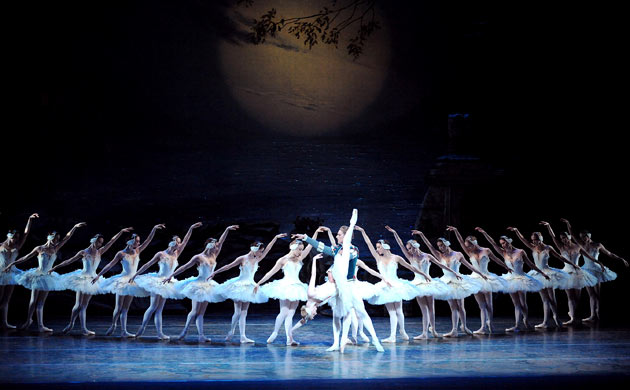
– What do we commonly think when it comes to these terms: play, freedom …? Children, unhindered in their naïveté is in may cases likely the first connotation. And the second connotation may be the artful play of … – for instance the reasonably uncontested beauty of a harmonious dance.

It is the beauty of clarity, order and balance. It seems to be a self-explanatory approach, allowing us to accept without asking, looking at something that has its own order, being independent. Probably this is part of our tendency to perversely celebrate power: the monuments of past and present oppression – yes, I had been in the German Reichstag not only due to business, and part of the study trips I did with the students here from Cork had always been the admiration of some of these ‘monuments’, the last one the most impressive town hall in Paris.

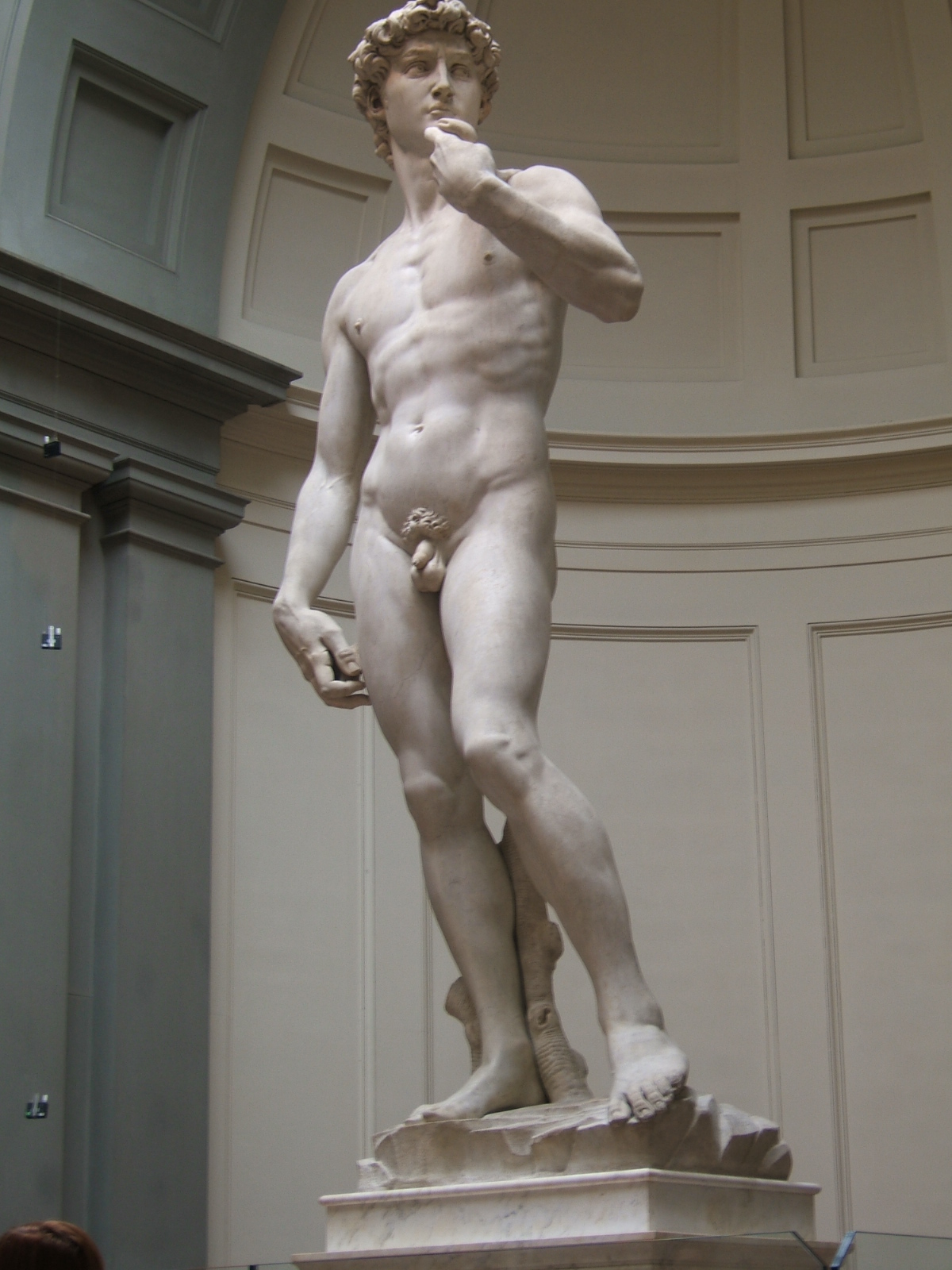
It is the admiration of something able to stand without support. Supposedly in sculpturing Michelangelo’s statue David is a very early example for such order: the first free-standing statue, the young man standing on his own. As such, standing upright, the statue had been sending a strong – and actually hugely contested – message.

As the Florentine chronicler Luca Landucci noted in his diary, stones were thrown at the collossal sculpture even if it was being transported from the Office of Works, so that a guard had to be mounted to protect it.

Importantly

The stone-throwing youth’s came from pro-Medici families for whom the prospect of a figure with republican connotations being installed in front of the seat of the Florentine government must have been thorougly unpalatable.

(Zoellner, Frank/Thoenes, Christoph, 2007: Michelangelo. 1475-1564. Life and Work; Koeln:Taschen, 2007/2010: 46)

Giorgio Vasari chronicled in this context a little story that has some metaphorical meaning.

It happened at this time that Piero Soderini, having seen it (the statue, P.H.) in place, was well pleased with it, but said to Michelangelo, at a moment when he was retouching it in certain parts, that it seemed to him that the nose of the figure was too thick. Michelangelo noticed that the Gonfalonier was beneath the Giant, and that his point of view prevented him from seeing it properly; but in order to satisfy him he climbed upon the staging, which was against the shoulders, and quickly took up a chisel in his left hand, with a little of the marble-dust that lay upon the planks of the staging, and then, beginning to strike lightly with the chisel, let fall the dust little by little, nor changed the nose a whit from the what it was before. Then, looking down at the Gonfalonier, who stood watching him, he said, ‘Look at it now.’ ‘I like it better,’ said the Gonfalonier, ‘you have given it life.’ And so Michelangelo came down, laughing to himself at having satisfied that lord, for he had compassion on those, who, in order to appear full of knowledge, talk about things of which they know nothing.

(Vasari, Giorgio, 1568: Lives of Painters, sculptors and architects. Vol 2: translated by Gaston du C. de Vere. With an Introduction and Notes by David Ekserdjian; New York et altera: Alfred Knopf, 1996: 654 f.)

From here it takes some steps to the question of the disciplining effects of which I promised to talk. But with a little bit of common sense, putting away the cultural bias it will actually be soon clear.

  • One of the fundamental demands put forward in science is concerned with the discovery of structures that are characterising any given reality. Methodologically this is a complex process – and speaking of methods it seems to be a rather simple matter of the famous bean counting. And with the latter we usually overlook that even the counting of beans isn’t as simple and without presumptions as we like to see it. On the contrary – and I quote Joe Finnerty

one of the most effective applications of indicators is not merely to describe but also to analyse, thereby sometimes changing the definition of a problem.

(Finnerty, Joseph, 2005: Social Indicators: Pitfalls ad Promise; in: Herrmann, Peter (ed.): Utopia between Corrupted Public Responsibility and Contested Modernisation. Globalisation and Social Responsibility; New York: Nova Science Publ.; 61-76; here: 69)

  • With this we arrive at the fact that paradoxically a second and simultaneous fundamental rule of science is construction – though analysing reality, this reality isd also constructed by the process if selection and combination. If we focus on elementarity as core moment of the research process, i.e. if we look for what is elementary, we are always applying a histrocial and social (class) dimension.
  • The story of David and Michelangelo’s presentation captures both, the determination of structure based on some form of de-construction and the construction according to the interest that is standing behind research:
  • * David stands in front of his colossal enemy, finding the small point of his vulnerability: the gap through which he could throw the fatal stone
  • * Michelangelo interpreted this: emphasising David’s beauty, virginity and power: a firm independence. However, this translates into some inability to move. It is correct to speak of structure; and it is equally correct to say that this structure follows in some way a rule that is inherent in the person of the David – later in history this is fully spelled out, the early modernity suggesting

Omne ens habet aliquod esse proprium (every entity has a singular essence)

(Johannes Duns Scotus, Opera Omina [1266 à Duns 1308] quoted in: Suarez-Nani, Tiziana: Pietro Pomponazzi et Jenas Duns Scot critiques de Thomas d’Aquin; in: Biard, Joel/Gontier, Thierry (dir.): Pietro Pomponazzi entre traditions et innovations; Amsterdam/Philadelphia: B.R. Gruener Publishing, 2009: 29-67; here:  33)

  • * And finally, the supposedly neutral viewer – the Gonfalonier – is getting lost in all of this: being deceived by falling dust and taking it for change. It is the lack of ability to understand the rigidity caused by looking at isolated ‘facts’. We may take it as metaphor, seeing it as confirmation of Michael Hardt’s and Antonio Negri’s stance:

The triple imperative of the Empire is incorporate, differentiate, manage.

(Hardt, Michael/Negri, Antonio, 2000: Empire; Cambridge, Mass./London,Engl.: Harvadd University Presee: 201)

Now it is not a major step anymore – David can be seen as anticipated manifestation of modern understanding of Anglo-American social policy as academic discipline: it is a discipline that defines itself by de-contextualising the subject matter; it is a discipline that looks at social administration of the good and the evil, the deserving and the non-deserving … .

  • Of course, it is a long and winded road …, at the end of which structuralism evolves. We may speak of Davidian social science and can easily see the fatal development: ‘methodological individualism’. Social processes are dissolved, deconstructed. And from here this social science – always being applied social science – supports in real history the emergence of something new, namely the modern individual, reflecting only him or herself. As we know from Descartes, it is the individual that comes only with this reflection to its existence. It is this reification of Narcissus that leads then Adam Smith to look for an invisible hand – power and security standing outside, being seen as independent from the dynamic processes.
  • However, as much as we are dealing with ideal figures: imagined independent structures, we should not forget that these constructions are not based on free will. They are reflecting societal and eco-technical circumstances as they are given in the social structures: the productive forces and the mode of production – the pedestal on which Davidian thinking stands.

So much on David and the meaning for social science: established had been a figure that expressed

compassion on those, who, in order to appear full of knowledge, talk about things of which they know nothing.

The Gonfalonier, Michelangelo is facing is manifest in today’s office worker: senior officials and the administrator depending on their instructions, immersed in seemingly neutral rules; rules themselves presenting themselves as technical whereas their essence is substantially about socio-political power: law and administration as presented by Max Weber, speaking of

[s]pecialists without spirit, sensualists without heart; this nullity imagines that it has attained a level of civilization never before achieved.

Max Weber, The Protestant Ethic and the Spirit of Capitalism. 1905,Chapter V, Asceticism and the Spirit of Capitalism

Karl Marx refers to this in the famous statement from the 18th Brumaire.

Men make their own history, but they do not make it just as they please; they do not make it under circumstances chosen by themselves, but under circumstances directly encountered, given and transmitted from the past.

(Marx, Karl, 1852: The 18th Brumaire of Louis Bonaparte; in: Karl Marx/Frederick Engels: Collected Works; Colume 11: Marx and Engels: 1851-53; London: Lawrence&Wishart, 1979: 99-197; here: 103)

The dream of freedom emerges turns into its opposite

The tradition of all dead generations weighs like a nightmare on the brain of the living.

(Marx, Karl, 1852: The 18th Brumaire of Louis Bonaparte; in: Karl Marx/Frederick Engels: Collected Works; Colume 11: Marx and Engels: 1851-53; London: Lawrence&Wishart, 1979: 99-197; here: 103)

And exactly this is Michelangelo’s paradox as much as it is the frequently re-emerging paradox of history: the dwarf, the powerless gaining power and establishing him/herself as giant. I am not talking about the tyrants, emerging for usually brief periods in history. I am talking about the tyrannical systems for which they are only mere backers.

Coming back then to Marx contending that

[m]en make their own history

we have to recognise that this claim stands fundamentally in opposition to structuralism – be it as closed and disciplining scientific methodology or be it as ‘way of life’. It stands against the rigidity of oppression, against the abduction and rape of the freedom of thought.

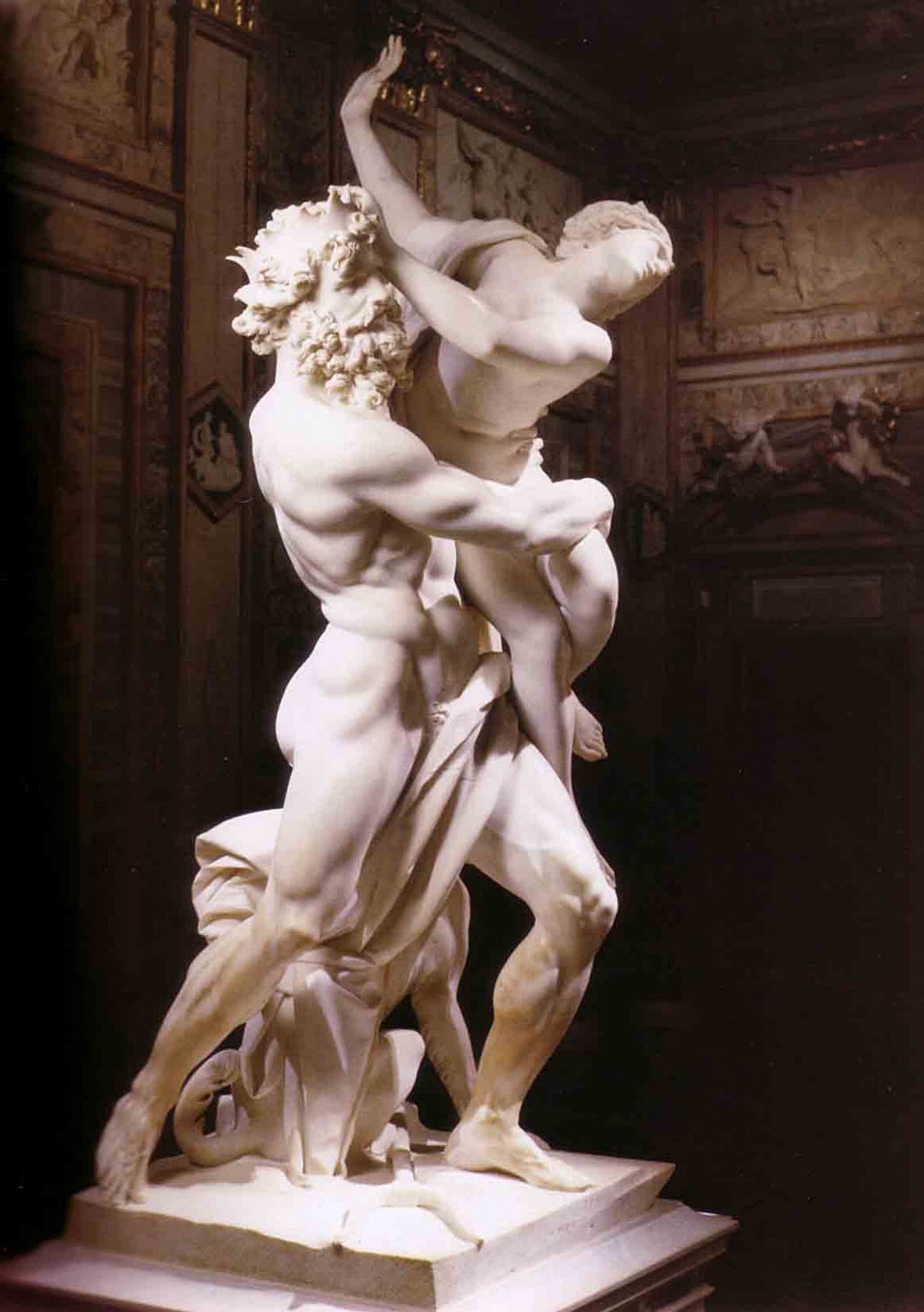
The most impressive statue I ever came across is Bernini’s Rato di Proserpina.

For me it is an amazing, most powerful expression in sculpturing or even in art expressing the victory of process over structure. Sure, the title still focuses on the old hegemony: abduction and rape. Nevertheless, it also suggests a different focus. At the centre we find Prosperpina: fighting, resisting. Her rejection and aversion is expressing a new beauty: the beauty of action, the beauty of a revolutionary process.

According to Simon Schama in a BBC-feature, this statue, Bernini’s great work, is the first piece in the history of art that dynamises sculpturing in a serious way (Schama: passim). Behind this we find in very broad terms two inventions:

  • the invention of the now ‘civilised individual’, distanced from nature and distanced from the social
  • and the invention of the economic sphere as distinct area – a ‘de-socialised sphere of social action’, organised by stratified-functional segmentation.[4]

Of course, this meant not least that the process had been a matter of dialectical development: clearly positioning structures as independent of each other, the escape of the individual from the oppression of the political power had been simultaneously the establishment of new structures. In methodological terms it is what Karl Marx develops, contending that

proletarian revolutions, like those of the nineteenth century, constantly criticise themselves constantly, interrupt themselves continually in their own course, come back to the apparently accomplished in order to begin afresh, deride with unmerciful thoroughness the inadequacies, weaknesses and paltrinesses of their first attempts …

(Marx, Karl, 1852: The 18th Brumaire of Louis Bonaparte; in: Karl Marx/Frederick Engels: Collected Works; Colume 11: Marx and Engels: 1851-53; London: Lawrence&Wishart, 1979: 99-197; here: 106)

But importantly we find this as a process of a permanent restructuration and reconstruction – this is only possible by way of fundamentally accepting the ‘blurring of boarders’. With this we arrive at a point not only of questioning given border lines, but also as matter of establishing new points of reference. Processes of change are of course again linked to real processes – at stake is not an intellectual exercise of ‘reordering the world’. Instead we are dealing again with the fact that processes and structures alike are reflecting societal and social structures: the productive forces and the mode of production. Proserpina is, in this interpretation, not just expressing her rejection but she is also expressing part of another world, now being possible. And now also being necessary as matter of developing independence.

The actual challenge for (social) science is to find a way that allows the construction of an ongoing structured processualistion – in actual fact a rather harsh process of open battles, reminding me of Pablo Picasso’s masterpiece Guernica.

Such quest may replace at least to some extent the dominant discussion of social science that juxtaposes function and structure. Critical realism – for instance being brought forward by Roy Baskar and Margaret Archer – can be an important inspiration for this process. The social quality approach makes importantly reference to this work. At the same time it emerges from the analysis of concrete policy processes, in particular in the area of EUrope – and looking back to art we come at this stage really back to dance – earlier reference had been made already earlier to its beauty.

At the core this new approach in discussing social policy is about a more radical version of dance, not limited top the disciplined form of an academic subject. Even as somebody who had been not only teaching social policy but who had been working for a quite a while in the lobbying industry for changes of social policy I dare to say that the social quality approach is about rejecting the concept of social policy at least in its mainstream understanding. This is not primarily about a rejection by way of criticising certain measures or policy programs. Nor is it about a rejection due to social policy being annexed to other areas of policy making, in particular economics, captured as social investment, the productive role of social policy, the increasing subordination under managerial, legal and financial requirements and regulations. At the core of the critique stands something else: the conceptual framework that is based in two fundamental flaws – with this I come back to matters that had been mentioned already on more general terms.

  • It is about the definition of social policy as something that is rooted in processes and structures that are seemingly standing outside of society. Although social policy is surely seen as something that deals with issued that ‘emerge from society’, social policy itself is considered to have somewhat different roots: it is about intervention, activities ‘on behalf’ or ‘in the interest’ of certain groups, pursuing certain moral ideas and … – and predominantly at the end society comes into play and social policy strives for a better society.  – In short, the social is by and large something imagined, not something real. It is a ‘distinct state’ in some ways similar to Benedict Anderson’s Imagined Communities.
  • * To put it on its feet, we would need a clear and explicit understanding of what the social actually is – the proposal by the social quality approach is to understand it as

outcome of the interaction between people (constituted as actors) and their constructed and natural environment. Its subject matter refers to people’s interrelated productive and reproductive relationships. In other words, the constitutive interdependency between processes of self-realisation and processes governing the formation of collective identities is a condition for the social and its progress or decline.

(van der Maesen, Laurent J.G./Walker, Alan, 2012: Social Quality and Sustainability; in: van der Maesen, Laurent J.G./Walker, Alan (Eds.): Social quality: From Theory to indicators; Basingstoke: Macmillan: 250-274: 260)

  • * Furthermore, the real ground has to be seen in the production and reproduction of daily lives. David Harvey asserts that

[a]t Marx’s conception of the world lies the notion of an appropriation of nature by human beings in order to satisfy their wants and needs.

(Harvey, David, 2006: Limits to Capital; London/Brooklyn, Verso 5)

This brings us immediately to the point Marx himself emphasises. Point of departure is a simple relationality:

[i]ndividuals producing in a society

(Marx, Karl: Introduction (to the Economic Manuscripts of 1857-1858 [First Version of Capital]); in: Karl Marx. Frederick Engels. Collected Works; volume 28: Karl Marx: 1857-61; London: Lawrence & Wishart, 1986: 17-48; here: 17)

And he ascertains:

The further back we go in history, the more does the individual, and accordingly also the producing individual, appear to be dependent and belonging to a larger whole. At first, he is still in a quite natural manner part of the family, and of the family expanded into the tribe; later he is part of a community, of one of the different forms of community which arise from the conflict and the merging of tribes.

(ibid.: 18)

Now it is important to emphasise that

[a]ll production is appropriation of nature by the individual within and by means of a definite form of society. In this sense it is a tautology to say that property (appropriation) is a condition of production.

(ibid.: 25)

However, social policy in its mainstream thinking – including approaches claiming radical changes – are lacking a proper reference in this respect. Instead, arguments are brought forward from idealist perspectives. A confirmation is that social policy, at least in its mainstream and especially in its Anglo-American perspective, does look at the exclusion and oppression of the working class – but it hardly recognises that it had been the working class and the relevant movements that led to what we see as social policy today.

  • The other reason for rejecting mainstream views on social policy is a variation of the first: although the dominance of economic interests is frequently highlighted and criticised – and although it is even recognised as matter of power relationships – the concept of economy is de-socialised. This could be further elaborated; and it could also be elaborated by way of extending the analytical alienation by showing a similar process of de-socialisation in political thinking. In the same way in which Alfred Marshall deprived political economy from the political dimension it can be said that Hobbes (to name just one) the state from the political. The Leviathan is an anonymous institution, bar of a political dimension, reduced on its instrumental and thus technical character of controlling individuals. – And paradoxically we find in both cases the emergence of superpowers that exist as a kind of cloud-castle.

Society is dissolved into three spheres: market, state and communities – and politicians as well as academics fit easily into the role of secular priests, celebrating the economy as father, confirming the state in the role of the obedient son, and hoping for the community and family as emerging holy spirit.

Of course, law plays a role too – presenting itself as a kind of Holy Scripture: a skeleton, keeping things together by way of a seemingly neutral, formal framework – claiming universalism, pertaining particularistic class interests. On the one hand

[a]n understanding of law’s nature is hard to attain because, on the face of things, law seems to possess characteristics that cannot be combined within a single entity: law is an established social institution, but also a guiding ideal for such institutions; an apparatus of organized force, but also the antithesis of force; a product of authority, but also the source of any such authority. It is in this quality that has some theorists to conclude that traditional ideas of law embody a belief in the ‘incarnation’ of the ideal within the realm of the actual, or a belief that law is ‘brooding omnipresence in the sky’.

(Simmonds, Nigel, 2007: Law as a Moral Idea; Oxford: Oxford University Press: 21)

    On the other hand

[m]en and women create their moral identities and values as by-product of interaction and mutual acknowledgement, just as they create culture, language and the structures of thought. The relationships in which we associate together can embody values that structure our choices and decisions.

(ibid.: 7)

And in a society in which power is not distributed equally, the meaning is clear: it is about the moral identities and values of the ruling classes.

  • And to produce then myself such trinity, I come to the next point of rejecting the stance of mainstream social policy: the externalisation of nature – actually we are still dealing with more or less a variation or even the accumulation of the first point, namely the dissociation and idealisation of individual action. From here anthropocentrism is nearly unavoidable

Leaving detailed discussion aside, we find human beings loosing the ability to act – or more precise: they are able to act but there is no space left for developing practice.

For social policy it means that it is fundamentally characterised by especially two flaws:

α) It is highly individualistic, even to such an extent that so-called social rights are only conceptualised as rights of individuals;

β) furthermore social policy is systematically limited by being detached from the socio-ecological causal and contextual foundation, i.e. the (re-)productive existence.

Consequently – and wrongly – social policy as theory and practice – avoids economy (and economics) like the plague. The celebration of noble ambitions, the striving for values that are proclaimed as universal is not simply a quirk of academic thinking – it is in actual fact a dangerous des-empowerment.

– It may be worth a nota bene that it is also undermining academic work: values are stated, remain unquestionable and opposing them is similar to opposing god. A new Alighieri may tell us if Benedict has to go through similar pain, as we know from Pope St. Celestine V, left to ‘gran rifiuto’ – the great refusal (see Alighieri, Dante, 1308-21: La Divina Commedia. Inferno; illustrata da Gustavo Doré, con commenti di Eugenio Camerini; Roma: Fratelli Spada Editori, without date: 36). And furthermore somebody else may show us how this kind of academic dislocation will be end in vein – if we won’t see it already with our own eyes.

I do not want to delve into details of social quality as alternative approach. Shortly, however, one point. I had been asked last week during a debate in Rome as seemingly question: Why don’t you call it socialism?

  • The initial answer had been straightforward: Personally I call it a socialist strategy.
  • Nevertheless, there is a more complex answer: we have to look for ways to adapt socialism and the search for socialist policies to the changed conditions. I.e. we have to find sound answers to the questions of the development of the productive forces, the meaning of such development also in a global, not only a national or regional perspective. Only from here we can understand the meaning of these changes for needs and also for governance. Though this surely means claiming socialist orientation it goes also further. It is a matter of analysing contemporary conditions, it is a matter of social practice in a conscious way. Taking the Marxist tradition, it means to use a permanently critical approach.

Critique is the practice of exposing the social basis underlying an argument. Marxist critique is generally immanent critique, that is, critique springing from inside. …

… critique implicitly recognises that the argument it opposes is right, but right in the context of a specific form of social practice which may not be declared.

(Marxists Internet Archive: Encyclopedia. Critique;)

– Another nota bene: It is exactly this approach that is applied in some work by the Centro de Investigaciones de Política Internatioal (CIPI) in Cuba in which I am involved. It is also something that has important repercussions in countries like Bolivia, Venezuela etc. I make this remark as it highlights that we can expect in particular from peripheral countries and regions inspiring theoretical challenges in this context.

Furthermore, the approach of Social Quality Policies instead of social policy is also not simply socialist as it is an approach that still ask for small measures, traditional policies and reforms that may be departure for further and more radical developments.

  • But having said this, at the end of the day it is a socialist approach to the extent to which it focuses on the social as complex structure of power-based interactions. Here we can briefly look at Antonio Gramsci’s discussion of hegemony and the role of the organic intellectual. Important is to recognise first of all that the core of Gramsci’s work is concerned with the structural conflict in society and the need for addressing it as question of clashing class interests – for those who don’t like the term: just refer to fundamental and antagonist conflicts between different interests. Second, Antonio Gramsci speaks of different forms of power – much later Michel Foucault comes up with this as well, transposing it from the Gramscian view on class struggles into a more generic context of different forms of power imbalances on the one side, power struggles on the other side – culminating in the view on the indivisible relationship between power and knowledge. The important point is that for Gramsci power is only real when it is intermingled with knowledge – deep knowledge leading to organic power reflected in and by the organic intellectuals. Briefly quoting the Quaderni

The criterion on which we should base our analysis is this: that the supremacy of a social group manifests itself in two ways, as ‘domination’  and as ‘intellectual and moral leadership’. A societal group is dominant over opposing groups which it tends to ‘liquidate’ or which it even aims to subdue by armed force and it is leading the allied groups and immediate allies.[7]

With this I am coming to the end by highlighting four points that are in my opinion central for the development for taking responsibility in teaching sustainable social quality.

First, I said in the beginning language matters. It does so in a twofold way: it is about clarity of language and at the very same time about use of language to substantially engage with what is going on around us. Engagement may be about going with the stream of beauty; and it may also require taking up fundamental challenges of disputes.

Second, it is also about the clarity of analysis: only posing an exact question will allow us to find exactly the causalities – and of course the casualities of wrong politics and policies. This is conditio sine qua non for finding therapies: answers to the burning questions.

Third, it requires looking at the realities – not as they appear but as they are. If we then say social policy – to use this term, though not the concept – is predominantly about Social Justice (Equity), Solidarity, Equal Valuation, Human Dignity (the four normative factors elaborated by the Social Quality Theory) and if we see that these values are decomposing, it is because the reality that had been behind them is decomposing. And without falling into relativism, we should not forget that our understanding of Social Justice (Equity), Solidarity, Equal Valuation, Human Dignity is always a historical one. Without this recognition – and without taking firm responsibility for a clear analysis and open dispute, we arrive indeed at reinventing the wheel or squaring the circle.

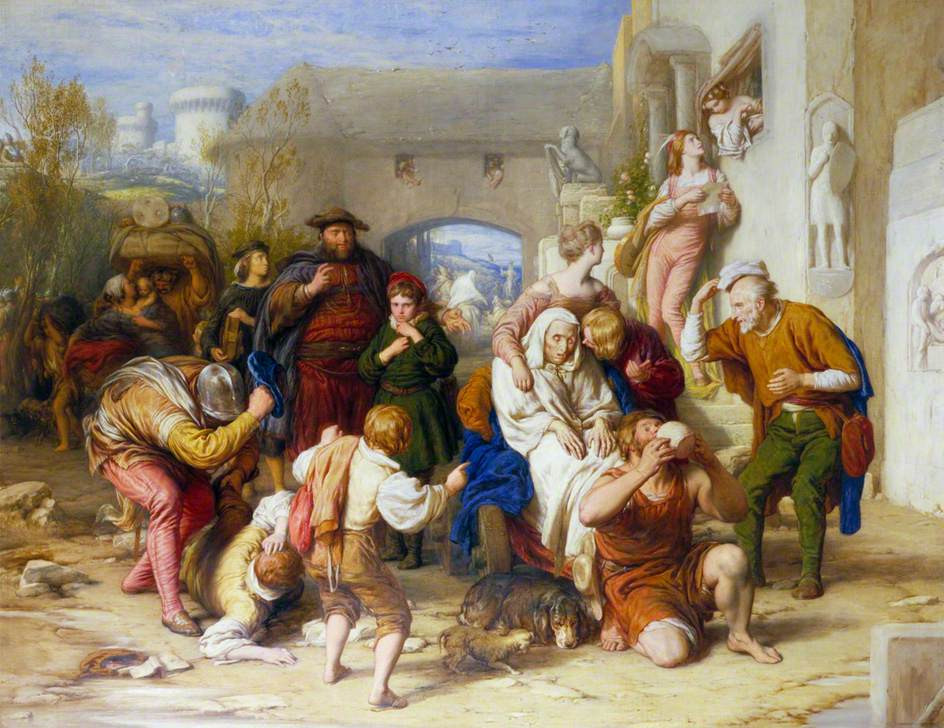
– Of course fourth: Have  look, the little boy, stepping out.

If you ant, this kind of enlightenment is then leading to paradise – referring to another time to Dante, now the third volume, tha Paradiso

Like sudden lightning scattering the spirits
of sight so that the eye is then too weak
to act on other things it would perceive,


such was the living light encircling me,
leaving me so enveloped by its veil
of radiance that I could see no thing.


The Love that calms this heaven always welcomes
into Itself with such a salutation,
to make the candle ready for its flame.[9]


[4]            We can leave the further consideration aside, including the fact that actually globalisation is to a large extent a kind of replication of stratificatory differentiation; see in this context already Herrmann,Peter, 1994: Die Organisation. Eine Analyse der modernen Gesellschaft; Rheinfelden/Berlin: Schäuble

[6]            http://www.birdnest.org/edensk2/dance4.jpg – 27/02/2013

[7]            Il criterio su cui occorre fondare il proprio esame è questo: che la supremazia di un gruppo sociale si manifesta in due modi, come ‘domino’ e come ‘direzione intellettuale e morale’. Un gruppo sociale è dominante dei gruppi avversari che tende a ‘liquidare’ o a sottomettere anche con la forza armata ed è dirigente dei gruppi affini e alleati.

Gramsci, Antonio, 1934-35: Quaderni del Carcere. Vol 3: Quaderni 12-29; Edizione Critica dell’Istituto Gramsci. A Cura di Valentino Gerratana; Torino: Giulio Einaudi editore, 1977: 2010

[8]            “Seven Ages of Man” William Mulready, 1838 – http://upload.wikimedia.org/wikipedia/commons/9/9e/Seven_ages_of_man.jpg. 27/02/2013

[9]            Dante Alighieri: Paradiso, Canto XXX, lines 46–54, Mandelbaum translation. http://www.worldofdante.org/comedy/dante/paradise.xml/3.30 – 27/02/2013