
Order is half of life — so say the lyrics in one of the songs on Peter Maffay’s album Tabaluga. So is the other half disorder? Or are disorder and order one and the same? At first glance, this is certainly a rather strange thought; but when you look at the traffic here, you can imagine that it is entirely justified — an experience I also had many years ago in Turkey: when I was picked up from the airport in Ankara, the journey was no problem — despite the heavy traffic and the lack of road markings. Despite the lack of road markings? I asked myself this question a few years later when I noticed that there were now road markings, but the traffic was no longer running as smoothly.
Here in Changsha, especially on Lushan Road near the university, life is bustling. It is hardly an exaggeration to speak of a long restaurant: various small ‘restaurants’ offering finger food, drinks, snacks and even ‘proper meals’ — interspersed with small boutiques and snack shops. At certain times, there is a lot of hustle and bustle: in the morning when the streets are cleaned, when deliveries are made, when the first people go to work, school or university (and the last ones quickly buy a snack before going to bed), at lunchtime and in the evening. Although these are the peak times, there is actually always something going on. Part of this street life, or more precisely, part of life on the pavement, are e-scooters: delivery services that stop briefly, pick up the order and set off again silently. Well, scooter riders are also citizens and seem to feel they have every right to ride on the pavement — only the old white man thinks this is a violation of the rules and that you can stubbornly go your own way. Different rules apply here, rules that prevent mass chaos and that also take precedence over the ‘written rules’. And there are masses of them — here on the pavement and elsewhere too. Anything with two wheels is being used.
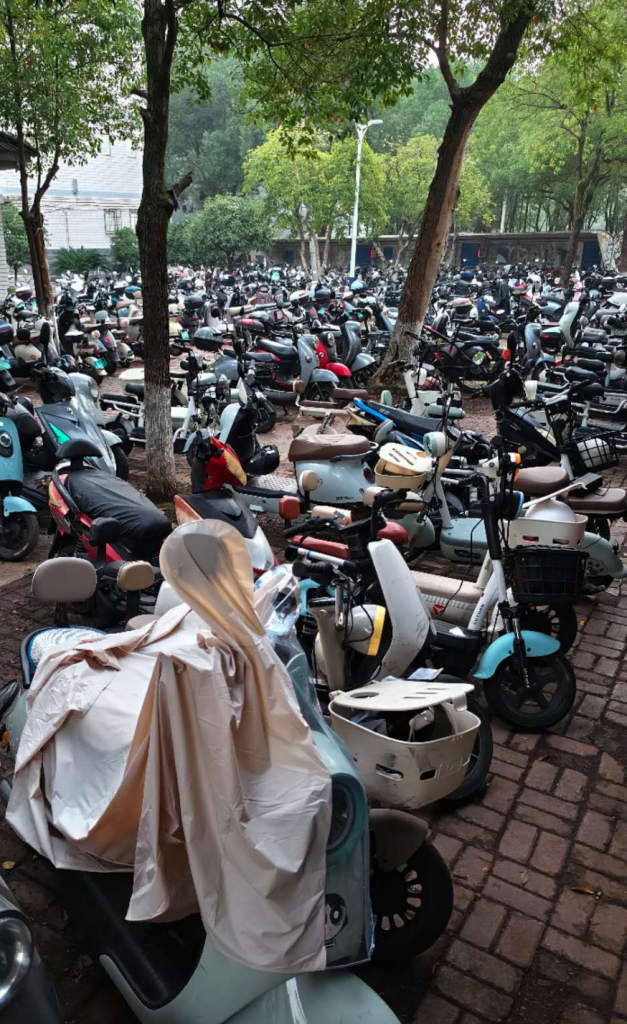
And only the stranger is surprised that there seem to be so few accidents — after all, the photo was taken at a time when there is relatively little traffic and students are crossing from one campus of my university to the campus on the opposite side.

Self-regulation instead of rule-following: sure, there are cameras everywhere, but police officers are rarely seen. These are small cultural differences, we often don’t recognise if we are “in the middle of it”; many years ago, my Irish students pointed out to me — we were evaluating a study trip to Germany.
In Germany, all police officers are armed; in Ireland, they do not carry weapons.
It was only then that I realised what I had always known but tacitly accepted and, as it were, suppressed — the Irish students noticed this immediately as the situation in Ireland had been different — it’s true, travelling broadens the mind and often reveals the small differences. Those who are attentive then ask big questions: the question is not so much how much order is necessary, but how it is achieved. And in what way disorder also has something orderly and organising about it.


























 COMMEDIA DELLA VITA OR PÁNTA RÊI'S FIRM GROUND