Order is half of life — so say the lyrics in one of the songs on Peter Maffay’s album Tabaluga. So is the other half disorder? Or are disorder and order one and the same? At first glance, this is certainly a rather strange thought; but when you look at the traffic here, you can imagine that it is entirely justified — an experience I also had many years ago in Turkey: when I was picked up from the airport in Ankara, the journey was no problem — despite the heavy traffic and the lack of road markings. Despite the lack of road markings? I asked myself this question a few years later when I noticed that there were now road markings, but the traffic was no longer running as smoothly.
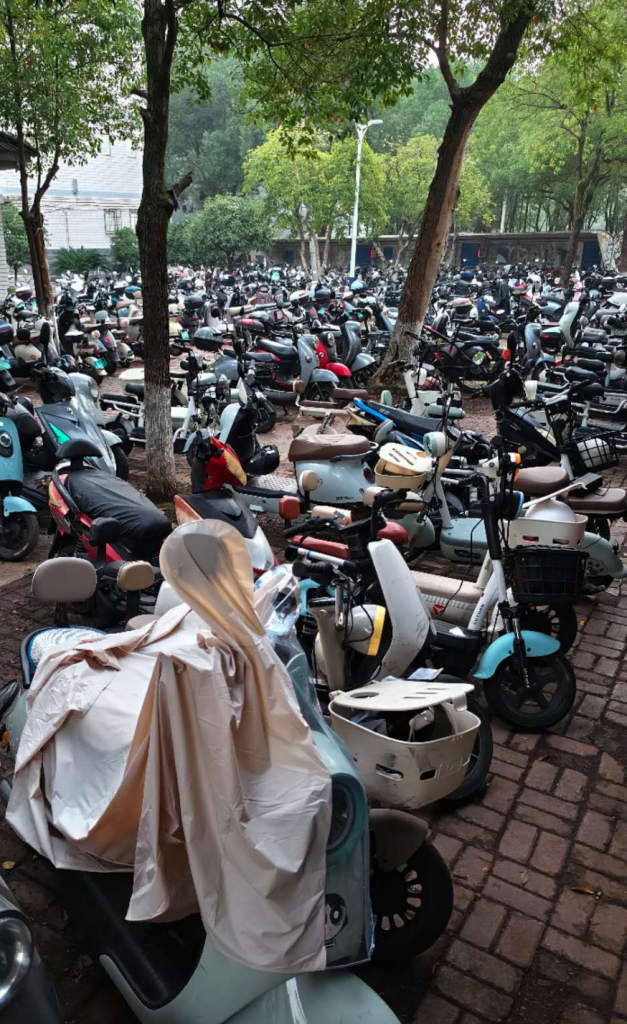
Here in Changsha, especially on Lushan Road near the university, life is bustling. It is hardly an exaggeration to speak of a long restaurant: various small ‘restaurants’ offering finger food, drinks, snacks and even ‘proper meals’ — interspersed with small boutiques and snack shops. At certain times, there is a lot of hustle and bustle: in the morning when the streets are cleaned, when deliveries are made, when the first people go to work, school or university (and the last ones quickly buy a snack before going to bed), at lunchtime and in the evening. Although these are the peak times, there is actually always something going on. Part of this street life, or more precisely, part of life on the pavement, are e-scooters: delivery services that stop briefly, pick up the order and set off again silently. Well, scooter riders are also citizens and seem to feel they have every right to ride on the pavement — only the old white man thinks this is a violation of the rules and that you can stubbornly go your own way. Different rules apply here, rules that prevent mass chaos and that also take precedence over the ‘written rules’. And there are masses of them — here on the pavement and elsewhere too. Anything with two wheels is being used.
And only the stranger is surprised that there seem to be so few accidents — after all, the photo was taken at a time when there is relatively little traffic and students are crossing from one campus of my university to the campus on the opposite side.
Self-regulation instead of rule-following: sure, there are cameras everywhere, but police officers are rarely seen. These are small cultural differences, we often don’t recognise if we are “in the middle of it”; many years ago, my Irish students pointed out to me — we were evaluating a study trip to Germany.
In Germany, all police officers are armed; in Ireland, they do not carry weapons.
It was only then that I realised what I had always known but tacitly accepted and, as it were, suppressed — the Irish students noticed this immediately as the situation in Ireland had been different — it’s true, travelling broadens the mind and often reveals the small differences. Those who are attentive then ask big questions: the question is not so much how much order is necessary, but how it is achieved. And in what way disorder also has something orderly and organising about it.
The village, my village, det smukke by Møgeltønder: about 1,000 inhabitants, and somehow amazing how quiet it is: walking along the main street, you rarely meet anyone, although somehow everyone seems to know everyone else, direct contact is limited to the five neighbouring houses.
The train station — I have to go to Suzhou in order to give a lecture:
The walk through the waiting area is probably as long as the main street in my village. At 6 o’clock in the morning, it’s quiet here too… relatively speaking. Size does matter, even if it is often overestimated, because after all, some cities ‘over there’ also have several million inhabitants.
A man in the station concourse is practising Tai Chi: calm, balance, harmony… not only in the dance, but also in the clean station concourse.
****
Size matters: the evening before, I had to deal with the supercomputer. These are dimensions that are difficult to grasp. This is no longer a comparison between a mobile phone and the old Siemens computer; this is about something else:
• two buildings with a total floor space of 27,000 square meters
• a storage capacity of 20 petabytes, and a peak power consumption of 8 megawatts; a peak performance of 1.342 petaflops
• the world’s fastest supercomputer from November 2010 to November 2011 The Tianhe-1A system used a heterogeneous architecture combining CPUs and GPUs, with 7,168 NVIDIA Tesla M2050 GPUs and 14,336 CPUs
• The National Supercomputing Center in Changsha is part of a national network of six centers, including those in Tianjin, Jinan, Guangzhou, Shenzhen, and Wuxi, each focusing on different research domains and leveraging unique networking and resource advantages
• The center’s development aligns with China’s long-term strategy to advance high-performance computing, as outlined in the National Medium- and Long-Term Science and Technology Development Plan (2006–2020) and the “863 major projects” during the Eleventh Five-Year Plan period
• a wide range of high-performance computing (HPC) applications, including *weather forecasting, climate prediction, ocean environment simulation, aerospace engineering, and remote sensing data processing. It also serves critical roles in **biomedical research, genetic technology, materials science, energy, and computational chemistry*.
Then I walk along the little path, wanting to use the time to gather my thoughts: a narrow trail… The path turns slightly to the right; halfway there is a wooden gate, a little rickety, but the big dog looks rather inviting, and a sign invites to take a break… Yes, a coffee would be nice. The place has something enchanted, hyggelig as we say at home.
****
• Size matters… Shortly before the train departs, I go to the toilet – unisex and accessible for disabled people; but also for tall and short people, because even the little ones need to go sometimes.
Automatic ticket inspection
1.HERRMANN PETER, train No.G1778, departure at 07:24 on 11 November 2025 from 长沙南站(Changshanan) to 苏州北站(Suzhoubei), Seat No.012D in Coach 13. The ticket price is RMB470.00
• 7:21 — a soft beep, the doors close
• 7:22 the train starts moving
• 7:26 — cruising speed is reached, 305 km/h, until shortly before MiLuoDong, the first stop.
There is so much talk about the loss of jobs — all the executives, not least the many “activists” in the field of artificial intelligence are presenting the dystopias … no jobs in the future. Why are THEY speaking of such supposedly bleak future. In fact, they show that we have a pool of new jobs that one can hardly think of an end:
chief executive officer (CEO)
chief strategy officer (CSO)
chief reputation officer (CRO)
chief operating officer (COO)
chief financial officer (CFO)
chief strategy officer (CSO)
chief marketing officer (CMO)
chief business officer (CBO)
And more and more we come across the
chief economic opportunity officer (CEOO)
If the spirit of innovation among these people should wane, I could suggest a new position:
What about a
Chief Mischief Officer??
Doesn’t all this remind us of some forms of societal leadership we know from the past: the chiefs and chiefdoms … and many had a special position: the jester.
Sure, money doesn’t make happy – nevertheless it helps; if it is not helping those who earn (not deserve) it, it helps people like you and me who must understand the world, or better: who should know things that cannot be understood.
Difficult to understand this world without becoming mad. But it’s well known, madness is always with the others and looking at all that, I believe it is true.
Ah no, I never made it to the United Nations highest Assembly – and you surely will find it strange that I remember right now a little episode from the days before I left Ireland and UCC. A VIP (Very Important Person) came to the Departmental Meeting, talking about the new strategy of the University College Cork. A lengthy sermon (after he managed after an equally long time to get the slide-presentation working) – answered by a lengthy sermon from my side (without slides). Here only the end is of interest – I said, sarcastically thanking him, sth like: After this critique from my side, please let me conclude: in your previous, job you advised the Irish government – and Ireland is now (I do not remember when this “theatre” he’d been staged, probably the early 2010s) in a pretty bad shape. And now you come here, advising this University. – This was followed by a telling break and an even more telling look at the presenter and the colleagues from my side.
Why do I remember this after reading that Annalena Charlotte Alma Baerbock, Germany’s former minister of foreign affairs, had been elected as President of the United Nations General Assembly?
Having lived in Rome for several years and even taught at the Pontificia Università degli Studi San Tommaso d’Aquino, I have developed a specific interest in the Catholic Church, or more precisely, in the Vatican. It is a contradictory structure: consider that access to certain ‘inner parts’ is only possible by saying a password, which is checked by members of the Swiss Guard, but on the other hand, modern public relations work is carried out through the Church’s own radio station, the use of mobile phones is a matter of course, and Pope Francis had been active on twitter. All this, and my very personal involvement in the election process of Pope Francis, are the reasons why I have been following the reporting of the last few weeks rather closely. There is at least one ‘secret message’ – perhaps not so much secret as ‘mostly overlooked’. The following quote is telling – the same holy spirit can be found in other messages from some other participants of the conclave:
Cardinal Nichols, the Archbishop of Westminster, said that his mobile phone was taken off him, adding that he found he had “more time on my hands just to be prayerful, just to reflect, just to be still, rather than being constantly agitated… or prompted by what might be coming in” on his phone.
“For me, one of the experiences of these last few days was to learn a bit of patience, to just take this step by step,” he said.
“There was a calmness, a bit of solemnity,” he continued, adding that everyone he spoke to when in it was “peaceful and just wanting to do this well”.
Often we find more important messages sidelined, seemingly of lesser importance than what may be expected when looking at headline and topic. The Handelsblatt, the German newspaper that provides essential news about economic developments, publishes a podcast, looking at economic challenges. The 09-05-2025 edition had been titled
Deutsche Wirtschaftspolitik: Neuer Optimismus trotz globaler Unsicherheiten
More or less at the beginning we hear that
die ersten
1:51 Schritte die die Regierung macht finde
1:53 ich richtig Wir müssen Paris und
1:55 Warschau adressieren Wir haben das hier
1:56 immer wieder Bert besprochen weil wir
1:58 gesagt haben das ist die Achse die
1:59 Europa stark macht
(I think the first steps taken by the government are right. We need to address Paris and Warsaw. We have discussed this repeatedly because we have said that this is the axis that makes Europe strong.)
Is it then the old axis – the axis that stood at the beginning (not only) of WW I and WW II? And the German prime minister aims on armament, wants that the Bundeswehr is the strongest army in Europe … Even if it is now only an economic war (and many signs are pointing into this direction) it is predominantly a war against the majority of the people.
Now let everyone speak, if they are able, more profoundly and better than I have done, if it only benefits humanity. Should he succeed without resistance, then he will achieve what no one has ever achieved before. Because nobody can speak and live to the satisfaction of all people, however much one wants to criticise me for it.
***
Nun rede jeder, wenn er es vermag, tiefgründiger und besser, als ich es getan habe, wenn es nur der Menschheit nützt. Sollte es ihm wohl ohne Widerstand gelingen, so verbringt er, was noch keinem Menschen gelungen ist. Denn keiner kann zur Zufriedenheit aller Leute reden und leben, wie sehr man auch mich dafür schelten will.
The current penetration of our society with new media is a profound cultural upheaval.
A statement that can hardly denied. Often experts in some field – as medicine, finance, engineering and of course data processing/information technology – welcome this, making out the great instrumentality, seeing that ‘machines’ are better able to perform some tasks than human beings (even if this is sometimes an illusion: typing a small equation into the calculator may be more tedious than just calculating … – though having only learned to calculate with the calculator may make it impossible to do any calculation that cannot be performed by using the fingers [don’t make divisions, please]). Often the person from the street, ordinary people appreciate it as these ‘cultural tools’ make things possible that had not been even thinkable before – or at least some things are becoming easier. And then there is a third group, also reflected by within the two groups mentioned: sceptics, who, in extreme cases, lament the decline of culture and Western values.
There are surely good arguments in favour of each attitude. However, isn’t there also a good argument for suggesting that we are looking at the wrong question?
The current penetration of our society with new media is a profound cultural upheaval.
This formulation suggests that the new media are the decisive point in question. While looking at the current penetration, it refers to ‘our society’ and this ‘our society’ seems not to be at stake – or to be more precise: our society changes as consequence of (a) the new media and (b) the penetration. Such perspective has major implications for nearly everything: the way we approach democracy, elections, consumption, education, learning, travelling … . – Spoiler: the following does not claim to know the correct answer; and the outline of the present answer is moving on slippery, i.e. contradictory ground.
***
The English businessman Thomas Cook (22 November 1808 – 18 July 1892) is not least known as forerunner of package holidays. However, it had not been until the 1950s that the concept came to a breakthrough: combined flight, transfers, and accommodation, and later the ‘leisure-time activities’ by animateurs characterised new ways of mass tourism. Without doubt a progressive concept, opening explorations to people who could not afford it before.
However, we also see a connotation that is often lost: the amateur had been replaced by the follower of an animateur; the immediate experience of touring by the explorer, entering unknown territories had been replaced by tourism, that offered a framework, an arena, a predefined track for tours. Of course, very few people even in the olden times could afford to travel like Marco Polo (c. 1254 – 8 January 1324), merchant, adventurer and author who travelled years along the Silk Road. One underlying fundamental change is that the multi-skilled, multi-interested and not very rich Marco Polo had been what we may call entrepreneur, undertaker – not in today’s Schumpeterian understanding – who had been replaced by today’s user. There is a paradox implied: whereas for Polo’s generation of undertakers the exchange value emerged from the use value, for today’s user (the entrepreneur as the consumer alike) the use value depends on the exchange value – so far its highest stage and ultimate expression is the financialisation of the economy, techno feudalism (Varoufakis) only being a variation.
Marco Polo, James Cook and the Horizon Holiday Group are only one of many developments that characterise the shallowing and draining of life – the seedbed for
[t]he current penetration of our society with new media
A simple answer can be given by unscrewing the wheel, returning to elitist concepts … – as said: Marco Polo had been one of the few privileged at a time where mass migration existed only as answer on some kind of exodus.
And
In the 2nd century AD, around the same time in the Western world that the Roman emperor Marcus Aurelius was recording his philosophical thoughts on papyrus scrolls and relying on scribes to reproduce them, the main works of classical Chinese literature were cut into stone slabs in China over a period of eight years from the year 175 AD. Thousands of copies were made in the form of copies: Moistened paper was pressed onto the inscription stones in such a way that when the paper was brushed with ink, the incised characters stood out white against the otherwise blackened paper. (Team “Mainz. Gutenberg 2000: Vor Gutenberg; https://www.gutenberg.de/erfindung/vor_gutenberg.php; 17/11/2024; own translation)
The various steps of massification from earlier developments until today seem to be inextricably linked to a flattening.
But, so far, the simple answer ignores one aspect: what appears to be massification, had been dominated by the idea of rationalisation and making control more effective – that the ability to read could also be used to read other info that those supported by the modern entrepreneurs had to be accepted as unintended side-effect. The liberating effects, however, had not been transposed into the real liberation of the user, or even more: the transformation of the user into the role of the owner. Instead, it had been the orientation on gain as sole guideline also for social processes (see Polanyi) – the alternative is becoming clear in the following lines, taken from the first volume of Willi Bredel’s Ein neues Kapital – A New Chapter: (Berlin: Aufbau, 1974: 412)
….Deshalb wollen wir lernen, fleißig lernen, nicht um klüger zu werden als andere und daraus Vorteile zu gewinnen, sondern um die noch nicht Kluggewordenen klug zu machen. Deshalb wollen wir schaffen, rastlos schaffen, nicht um reicher zu werden als andere und daraus Macht zu gewinnen, sondern um das Leben aller reich zu machen.
….Therefore we want to learn, to study hard, not to become wiser than others and to gain advantages from it, but to make those who are not yet wise wise. Therefore we want to create, to work tirelessly, not to become richer than others and to gain power from it, but to make life rich for everyone.
A simple example: The daughters of a famer had been ‘travelling the world’, the father ‘travels with them’, using the internet, National Geographic etc. and of course digital means of communication even if he rarely moved physically to the next lager city. Both could afford it, not least because they had been ‘time-rich’.
Keynes, writing in 1930 about the Economic Possibilities for Our Grandchildren, suggested
Wouldn’t that allow all of us to travel more substantial than instagramable, to exchange honestly instead of sending only short messages and sending pictures, to study deeply rather to depend on ‘deep AI’ .
The biggest caveat to Trump’s voting victory is that contrary to the usual hype of a ‘massive voter turnout’, fewer Americans eligible to vote bothered to do so compared to 2020. Then over 158m voted, this time the vote was down to 143m. The voter turnout of those eligible fell to 58.2% from the high of 65.9% in 2020.
Around 40% of Americans registered to vote did not do so. And the number of Americans who failed to register rose to 19m from 12m in 2020. So, although Trump got 51% of those who voted, he actually got only 28% support of Americans of voting age.
If it is said that
how we learn, work, discuss, position ourselves socially and politically and make decisions – all of this is changing so quickly that we can hardly keep up
we should go a step further, asking for what we are leaning, discussing and position ourselves, what kind of decisions are we making. If the polity changes along the line of gaining and maintaining power – individually and/or in the sense of MAGA (or any other country). If political decisions are replaced by financial investments and juridification ala “seek(.)[ing] jail and public office ban (https://www.theguardian.com/world/2024/nov/14/marine-le-pen-embezzlement-trial-national-rally-prosecutor-ban?CMP=Share_AndroidApp_Other; 17/11/2024) for disagreeable politicians we are confronted with the problem of depleting public spaces, leaving it to individuals to decide ‘what is right and what is wrong’. Such ban directed against Le Pen may be in the short run to be welcomed as it may be welcomed to ban a right-wing populist party like the German AFD. At the end, however such depletion of public spaces is a kind of re-feudalisation, reestablishing the absolute ruler. Of course it is a paradox: in the extreme case, and only then, the absolute ruler may be necessary to avoid the absolute dictator.
Indeed, it is interesting that
[t]he German legal system does not provide any legal protection against disinformation and fake news beyond defamation offences. In order to activate the protective effects of the law, a personal reference is always needed first. In the broad area of assertions without personal reference, in particular the right-wing camp has adopted the peculiar narrative that Google, X and Bytedance (the company behind TikTok) should decide on lies and truth rather than the state. (Chan-jo Jun, Flint, Jessica, 2024: Warum nicht Tiktok und Co über Demokratie entscheiden sollten. Regulierung nach dem DSA; in: Legal Tribune Online, 30.05.2024 , https://www.lto.de/persistent/a_id/54659; abgerufen am: 16.11.2024)
This fundamental problem must be highlighted: the trinity of privatisation, individualisation and the dismissal of the state from responsibility. The aforementioned juridification only appears as contradiction, insofar law is fundamentally concerned with rights of individuals. This basically opens the door to digitisation, and what’s more, digitisation becomes a logical consequence if not necessity as both are based on the principle of binarity.
With all of this, contexts are systematically destroyed – TV programmes, that people are talking about are victim of TV media libraries, commercial channels that offer whatever we like at whichever time we want [and of course, they tell us as well what we want] …. The “Monday morning question at work”: Did you watch …? The subsequent discussion cannot really happen anymore, is at least not encouraged; the debate of the latest news is difficult as the news are sooner old than they can be digested – and in addition they drown in ‘multimedia-news shows’: presenting a central message, accompanied by the stock exchange info on the bottom, the weather forecast on the right and/or some sport info on the left and not least the very latest news in a short superimposition … and of course, somewhere the next film is announced — already now available in the TV library, even if only broadcasted the next day … . This can be continued without end, applied for different areas – and perhaps the only exception is sports: bringing people together and although they get lost in the crowd, everyone feels an important part of it – not digitally, but in analogue. – And yes, sometimes the smell of horses on the field or in the arena of a circus is much better, a counterweight against Pokémon.
And it is in this sense always necessary to discuss the meaning of rights, not leaving justice as in the hands of algorithm-driven machines.
Tiny differences matter – you want to look at Chat GPT and a typo brings you to chat about GTP, of course no problem as you know everything about Guanosine-5′-triphosphate (GTP), this tiny building block which plays an important role in transcribing the synthesis of RNA.
Well, and this is the problem, where we should not really worry primarily about Chat GPT (or google’s bard or …) which may get things reasonably correct as long as we (a) apply the correct spelling, (b) do not expect really clear replies and are happy with answers that are as concise as the horoscope or the statements of any other oracle and (c) come up with simple issues . It is so advanced now that occasionally you may end up with an honest answer:
Sorry, I cannot answer this question. I am an AI-tool.
Yes, there are things where HI, i.e. human intelligence is needed: contradictory, emphatic, combative …
More worrying is the AI-imposed formulation of questions. Embedded in our word processor, or available as AI-writing support like Outright, QuillBot, Grammarly …
Such applications may be helpful at times …, and at first glance. But then the tiny differences may make a big difference:
This is really only the first draft of the initial script and we appreciate very much feedback by the readers.
This is really only the first draft of the initial script and we appreciate very much feedback by the readers.
This is really only the first draft of the initial script and we appreciate very much feedback by the readers.
Or in Italian
Sono
Io sono
Sono anch’io
Io sono anche
AI comes up and autocorrects a sentence in different ways, sometimes possibly more elegant, and possibly “correcting” something that is actually wrong … because it is new: a new term, concept, … a searching for an “unknown unknown” — yes, borrowing from a militarist like Rumsfeld (MI?) may occasionally be more intelligent than relying on AI.
Intelligent or not … enjoy Christmas … or look forward to Spring Festival while others are celebrating …




 COMMEDIA DELLA VITA OR PÁNTA RÊI'S FIRM GROUND