All the Same – All Being New. Basic Rules of Capitalism in a World of Change

All the Same – All Being New. Basic Rules of Capitalism in a World of Change

Finally I am really working on this book⏎ , meaning: I am working on finalising the work. It is only editing a book, writing just one contribution myself. The work with the contributors: commenting and you know what is involved is done. And there is some time to come I concentrate on it: after the recent workshops and conferences and … and the visit to Vilnius to where I had to go for two PhD-students, well, since then: two doctors (they are now. Right though – never really get over the confusion with doctors, medical doctors, PhDs …).

Anyway, though an extremely short trip, leaving Munich around Lunch time on Tuesday, returning around lunchtime on Thursday, had been sufficient time to visit also the Opera House, staging Otello. Seems I entered a contemporary piece:

Esultate! L’orgoglio musulmano sepolto è in mar *

And leaving the love story aside, the “Shakespeare/Verdi collaboration” is very much also about the definition of a very specific hegemony – in a nutshell we my say that Shakespeare’s piece is about a crusade without talking much about religion. There is a tiny point that is, in some respect, too small to be even recognised: real hegemony exists only where its reason does not need to destroy the other – be it that it is already completely diminished or for the simple reason of being consistently … , well …., tamed is probably the appropriate, at least the commonly used term. Is it by chance that this is probably in some way Verdi’s most innovative opera, not working with highlights of the grand arias, not aiming on the da capo but following throughout the entire piece, nearly disrespecting even the of the (surely existing four) distinct acts.

– It is worth to mention in a side remark that going to Lietuvos Nacionalinis Pperos ir Baleto Teatras was again the special pleasure of that place: surely a stage that can well keep up with some of the most famous places, offering especially exciting arrangements. And indeed it had been a performance that surely did justice to Verdi’s strive to maintain a permanence of the tension, going through the entire performance – the accomplished hegemony as the domestication is with this something that is and that is not: a feature of daily life of which we are not aware due to its lack of highlight. We complain, protest, justify, defend positions only when it comes to the headscarf, the cross in classrooms, the war again terror … – and accept exactly these tensions because they are deeply engraved. However, there is a BUT …. as

We cannot all be masters, nor all masters
Cannot be truly follow’d.

So, looking at the origin, namely Shakespeare he presented another reality – another facet of the reality. (Likely) a year after publishing Othello, he published in 1623 The Taming of the Shrew

A harshly misogynistic piece? Or a piece that works with a kind of alienation, ridiculing a reality … ?- Leaving aide if it is misogynistic or not, the topic is surely going much beyond, and at the same time is closely linked with others – gender, …, and surely the modern crusades follow all the same principle, suggesting a war against evil, Goethe’s words unwillingly capturing in his Erlkoenig.

“Ich liebe dich, mich reizt deine schöne Gestalt;
Und bist du nicht willig, so brauch ich Gewalt.” —
“Mein Vater, mein Vater, jetzt faßt er mich an!
Erlkönig hat mir ein Leids getan!**

One year between Shakespeare’s two pieces …, Goethe writing these words in 1782, roughly 150 years later and perhaps they can both seen culminating in Verdi’s opera. Why this: 1871 had been the year of national upheavals in Italy and elsewhere, the era of nation building – and this is surely nothing else than striving for hegemony, for (redefining it).

And this is currently the ‘grand narrative’, against defiance of postmodernist ‘openness’ and vacillation. The attempts and failures of establishing a new hegemonic order – looking for its structures by looking at the clash of civilisations, by looking at the structurations by accumulation regimes and the role of financialisation – and by confronting ourselves with the topic:

All the Same – All Being New. Basic Rules of Capitalism in a World of Change

All this is surely not least a question of openly dealing with nearness and distance – Petruchio telling his friend Hortensio of his strive for seeking the future

farther than at home/Where small experience grows”

The words are taken from The Taming of the Shrew but would surely be most appropriate also somewhere in Othello.

Indeed (from Otello again): 

Questa è una ragna dove il tuo cuor casca***

And being caught in such spiderweb it arises as phenomenon of a very peculiar kind that we may not even know about it, moving with it and along its single single fathom, perceiving the glutinous support as savour … – as one of the PhD-candidates lauded: ‘We are experience only 20 years of independence …’, not even thinking about the following:

By totalling up pages in the many volumes of the EU’s Official Journal of legislation we found that the EU has passed a staggering 666,879 pages of law since its inception in 1957.

The figures as such …, who knows if this is really the total – and do numbers really matter? Doesn’t another fact matter much more? The fact of seeing this as independence – a “this” which is a true hegemon standing against the people, the demos as the supposed sovereign?

Sure, it may sound strange, but after enjoying Verdi on Wednesday in Vilnius and just having left a most enjoyable performance of  The Taming of the Shrew on Sunday in Munich, strange people may leave the Bavarian State Ballet, return to the office, thinking that it may be time to return to Kant’s works, looking at his Reflections on Anthropology rather than Habermasian good-will-voluntarism. In volume 15, containing the Handschriftlicher Nachlass: Anthropologie he contends:

We are inclined to wish that vice faces more obstacles. But authoritarian and other extrinsic force would be noxious in this case before the way of thinking is generally improved. Philosophers are already by their undertakings most independent of statutes. They have to make true conventions general. Their pupils, the clergy have to mould their religion accordingly. And the education of the rulers. Rulers will attempt to institute world peace. After that the inner establishment of freedom, law and power. Subsequently educations will follow under the auspices of the common character.

Sciences do not belong to the determination of the individual but to that of humankind. The individual being has his primary determination by animalism. However, the species finds it in completion of reason, braking with the first. ****

Idealism, sure – but allowing to enter the search for realism … – enabling it to stand on its feet by looking what actually is the same and what did really change. Surely we should be careful: Muley Hassan‘s bitterness, saying

Der Mohr hat seine Arbeit getan, der Mohr kann gehen *****

is only the answer on the arrogance of one who claims to be the one rather than  being just one of many others. And such bitterness needs … education – something to be looked at one of the next days.

The only thing that remains for a while – for me – is the memory of two most beautiful events and the privilege  to be one of the cobblers, working with others for the shoes of such peace which at some stage may allow people to live a life, being educated to live it like an untamed dance ….

******************************

⏎ TOC so far

Peter Herrmann: Deciphering Globalisation – An Introduction

Paul Boccara: “We must incriminate the basic rules of capitalism

John Bellamy Foster/Robert W. McChesney: Monopoly-Finance Capital and the Paradox of Accumulation

Arno Tausch: Paul Boccara’s Analysis of Global Capitalism

Paul Boccara: The Global Crisis and Africa : Struggles for Alternatives – Alternative Financial System for North and South and Struggles to Master the Market, and for Common and Public Services or Goods, from Local to Global Levels

Judit Csoba: Goals and tools of Public Employment Programs in Hungary

Paul Boccara: Labour market, employment and unemployment policies in the European Union

Paul Boccara: What needs from Marxism?

******************************

* “Rejoice! The Mussulman’s pride is buried in the sea

** “I love you, your beautiful form entices me;
 And if you’re not willing, then I need force.”
 “My father, my father, he’s grabbing me now!
 Erl king has done me some harm!”

*** This is a spiderweb in which your heart is caught”

**** Denn wir sind schon so dazu geneigt zu wünschen, daß dem Laster mehr in den Weg gelegt würde. Aber der obrigkeitliche und andere außere Zwang würde schädlich hiebey seyn, bevor die Denkungsart allgemein verbessert würde. Die philosophen sind durch ihre Geschafte schon am meisten unabhangig von statuten. Sie müssen die wahre Grundsatze allgemein machen. Die Geistliche, ihre Schüler, müssen die Religion darnach modeln. Und die Erziehung der regenten. Regenten werden den Weltfrieden zu stiften suchen. Hernach die innere Einrichtung der Freyheit, des Rechts und der Macht. Und denn werden die Erziehungen auch unter den Augen des gemeinen Wesens geschehen.

Die Wissenschaften gehören gewiß nicht zur Bestimmung des einzelnen Menschen, aber zur Bestimmung des menschlichen Geschlechts. Der einzelne Mensch hat seine vornehmste Bestimung auf die Thierheit, aber das Ganze Geschlecht auf die Verstandesvollkommenheit, doch mit Abbruch der ersteren.

***** The moor has fulfilled his duty; the moor can leave.
Breaks – Still on the Way to Modernity

Pioneer of Modern Art – the English translation doesn’t catch the ambiguity of the German title of the exhibition of the work of Max Liebermann to which I went during the lunch break: Wegbereiter der Moderne. It could also be translated just as Pioneer, trailblazer of modernity, emphasising that he had been a pioneer not just as somebody who did something before others did the same, but underlining his proactive role, the ‘fight for something’. And it doesn’t limit the something to arts but leaves it open for a much wider scope.

I do not want and cannot engage in Max Liebermann’s complex and contradictory personality: citoyen and demotic; orderly, like the lanes in the part of his villa and allowing, provoking and even planning the impressionistic as seen in the flowerbeds on the roadside of the little palace ….

Surely as such – as other representatives especially of the citoyenitée of the time (see Thomas and Heinrich Mann, read the Buddenbrooks, The Small Town Tyrant, The Forsyte Saga ….) – reflecting very much the contradiction of the time.

One thing is sure: in life and in general there is surely not one pioneer – it is people as groups, peoples and personalities …

…. and it is about movements, ‘inventions of acceptance’. Entering the exhibition had been already exciting by looking at the plain pictures of life – ‘socialist realism’ came to my mind. Looking at his depiction of the twelve year old Jesus in the Temple – emerging as another simple life: simplicity of deification without simplifying the apotheosis; and then looking at her, looking into her face: Eva. It is a painting from 1882. And the way she looks says it all: No need, Adam. Not for you. And though I my not look like it. I have the apple, I eat the apple and I enjoy eating it.

Giving the impression of weakness and happiness, of inferiority and forcefulness … – modernity.

The Game is Over or: Strawberry Cake

I remember Niklas Luhmann once writing or telling this little anecdote: a couple, married since many years … – and the housewife (well, yes, it had been last century, and not at its very end), so: the housewife made every year a “birthday surprise cake” for her husband: strawberry cake. He enjoyed every year, showed his pleasure by indulging into it … Well, and then it happened once up a time … – Listen to her: “darling, I am so very sorry but you know, I have had these problems, couldn’t …, well, to cut a long story short: I had not been able to have your favourite cake for today’s birthday.” She was near to crying, but he approached her tenderly, saying: “Listen, love. To be honest, I don’t really like strawberry cake. But seeing you every year, looking at you how much you enjoyed seeing me eating the cake …, well I didn’t want to take this joy from you.”

The game was over, of course.

And so is my game here – a different one, but still similar to the life of the couple and also with that of my highly esteemed colleague Immanuel, occasionally seen as  “regular verb” not least on grounds of his legendary daily walk.

More or less the last day – and despite some irregularities: wrapping up stuff, final discussions, posting some stuff to Ireland before carrying it with be over the next months the regularities. And in this light, I had been over the last days getting increasingly aware of the play-fullness of many things: breakfast: Gülistan bringing me the most beautiful Turkish coffee, Yusuf getting later the simit for me, and a tea, the daily swim, after the first four hour shift between 6: 30 and 10: 30; going afterwards grabbing something to eat, walking back to the office, eating, drinking the lovely Ayran, getting another tea from Mehmed, before heading to the library …

Later back – “in the public”, there it is where at least for me the routines are getting so clear – clear to me and to the others and in the interaction with the others . The routines getting clear by the questions that do not need to be asked …, and that nevertheless are asked. Tea? Coffee? These questions are asked and they evoke a smile when the reply is the one that bad been expected. …

The end of the game … – no coffee, no tea anymore …. – only breakfast in the morning before a irregular day: going to Ankara, meeting friends.

No, in the simit restaurant here on the campus people didn’t know it –from where should they, we could speak just by gestures, smiles, signs … “This is Yusuf” – the first day I am told his name. “And I am Suleyman. What is your name?” “I am Peter”. Yusuf stretches the had out to me. Gülistan smiles at me.

No, they do not know – Mehmet knows .. . We meet later, this day I had to return to the office, clear up in the office. Mehmet knows. We embrace, kiss the cheeks, like “real men” … güle güle ….  The game is over … . And we both new: not a game – it never had been a game and it never will be a game. And only when we pretend things being one, we can get aware of how serious it actually is.

… like being stuck in strawberry cake.

But I am first stuck in further work for a while …

PS – Garbage

Should have mentioned it: Having been recently in Istanbul I went ….

…, well let me start the other way round. It is now a couple of years ago that I went with a group of students – MA in Youth and Community Work, which then existed at UCC [now it is all about individualist Social Work courses  and Asian studies, planned now as well as something like joined MA Iruish-Asian social work;-) – tertium non datur: no youth and now community anymore] to West Cork. One of the students, Julie, pointed somewhere at a wreck of a car, just left somewhere: masterless, meaningless, lacking real past, present and future.

Will we one day pay attention to these things, wondering around and admiring these things as we are now searching for monuments of ancient times –

she asked.

Perhaps looking at them in the way as I recently mentioned – a matter of

concretised, condensed, monumentalised history not in the position we take towards and the interpretation of – past, present and future – reality. It is the monumentalisation of peoples’ engagement and practice.

Apparently we will – and we do already:

Chinese artist Yao Lu, has photographed mounds of garbage covered in green protective nets and reworked them by computer to re-create Chinese painting aesthetics. By digitally adding pagodas, houses, boats, interesting trees onto the photos he took at these sites he produces meticulously created landscapes.

This is what the website of Istanbul Modern states on a truly fascinating work.

Prejudice?

Just this morning I heard a sentence in the audio book I am listening to while jogging – Thubron’s Shadow of the Silk Road. Not the best, but a blind hen occasionally picking a corn – and a pre-occuoied writer occasionally writing something true. It went like: Stories are not told as reflection of what truly happened but by the reality that we project on the history through our past and present perception.

It may be accidental sitting this evening then in the Bolshoi: Евге́ний Оне́гин (Eugene Onegin) – the Opera with the music of Пётр Ильич Чайковский (Pyotr Ilyich Tchaikovsky), based on the novel by Алекса́ндр Серге́евич Пу́шкин (Alexander Sergeyevich Pushkin). Fiction and Life, the definition of life, its perception by our projections and interpretations.

Sure,

It is not the consciousness of men that determines their existence, but their social existence that determines their consciousness.

But equally sure is that societal reality acts from practice which emerges not least of being consciously, aware of reality around us. in some way a tightrope walk, captured in this masterful piece of arts.

eoim
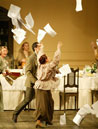
scene from the opera

past and presence

While travelling and occasionally writing about it, Rozenberg launched yesterday the publication of TRAVELNOTES under the title Diary from Another World. They are illustrated by Kerstin Walsh, a Cork artist. Later, the Notes will be published as ‘real book’ – still something nice in our day and age.

According to a reader of the work before its publication

I’ve been enjoying reading your collection- they are interesting stories and perspectives and its hilarious in places!

May be you visit the site – and if so I hope you enjoy reading …

and perhaps you say afterwards as well

it did kinda give me itchy feet :-/

Living (with) wrong expectations

The announcement of the performance begins with the words

Lucrezia Borgia, brewer of poisons, adulteress and murderer, does her best to live up to an image of womankind created by men, and just as passionately she does whatever she can to find a new identity.

Having read this some time ago, knowing Donizetti and Hugo likewise had been reason enough to make sure that I sit right now in the Nationaltheater while passing Munich on a longer trip across the continent, joining for Lucrecia Borgia.

Of course, there is at least an indirect statement going hand in hand with this: this attempt, this striving to adapt to expectations has a perverse effect – we may see B, the letter, as matter of base, in the understanding of a foundation. But Lucrecia Borgia, with her attempt of living up to expectations of others, having lost her genuine own orientation and identity, apparently lost exactly this: the B. Look at the name – see what remains without it ….

Freedom …

As said, I had been lucky, getting hold of one ticket. And thus the four of us, never leaving each other, went to the concert on Monday evening.

The one of us simply enjoying some festive mood, the pleasure of the concert hall, the opportunity of delving into the music – floating with the waves of sound, getting engaged and excited by the different compositions, each reflecting different spaces and times … – also the enjoyment of gaining new meaning by forgetting to analyse and the opportunity to allow being carried away.

Of course, it had been something special not only because the special appreciation of the ticket availed of against the odds – the other fellow of the small group, the economist, said something. At least he wanted to say something, talk a little bit about the determination of value: Scarcity …. – is this and if so, in which way is it a matter of determining value, as well economic value. Is economic value about that or about the costs of production … – Come on, don’t spoil the evening …, just enjoy rather than coming up with the macro- and possibly microeconomic debate on the value determination. We may even end up with discussing the role of speculation and the current economic crisis. That is something which finds a more appropriate place in the interview that I want to do on Wednesday.

I agree, said the historian of the gang of four – all four already occupying the one seat. There is actually something else that I think is  more interesting anyway. Look at the conductor: Hungarian. And the orchestra: Viennese, i.e. Austrian. Does it ring a bell? Do you remember, few years back you met the young Habsburg and complained about his arrogance, the way he still features the imperial tradition …, walking on heavy carpets in his noble office, representing nobility, at least pretending to represent the ancient regime in a legitimate way. As if such emporium would and could ever be legitimate. – Gosh, yes; but why does one have to remember this now? Because one can have the illusion that a Hungarian conductor in front of an Austrian orchestra things changed, the balance of the new world order is fundamentally different. A short look to the right is sufficient: the broad American accent is a reminder that such broad claims persist. An American president does not have to go to war to underscore the American claim of being a superpower. Nor does a Hungarian conductor mean that the power of traditional spirit could be overcome. – This historical discourse, surely interesting at one point, was either not suitable to make the evening just an enjoyable event. Not least as it brought up thoughts not only about history past but also about history present: the government, dancing with dark spectres of extreme conservatism for the sceptres as means of control and oppression. A clandestine joy would hardly be sufficient to make for that … – The first of us returned, leaned finally back with the other three: the economist and the historian who already commented, and the sociologist who had been silent, looking around at the people, thinking that there would surely be many who would not look like the typical visitor going for classical concerts. Most enjoyable – as said: the opportunity of delving into the music – floating with the waves of sound, getting engaged and excited by the different compositions, each reflecting different spaces and times … – also the enjoyment of gaining new meaning by forgetting to analyse and the opportunity to allow being carried away.

However, though the sociologist amongst us still did not speak it out, he was getting somewhat excited towards the end – towards the two ends. The second piece of the concert had been performed by the orchestra and as soloist a young pianist: Alice Sara Ott. Surely with some brilliance, having her own style already. But what the sociologist thought did not concern “multiculturalism in one person” (the artist being German-Japanese). Nor did it concern any demographic issues (finally being just over 20 is surely not the normal age for a superstar in this genre). The issue at stake had been …, well: Toennies, the sociologist, wrote in his main work about two kinds of will, linking the second to the higher development of the will to freestyle, to voluntarism, the the freedom of decision. And this was so obvious in the expression when the play moved on ‘from the program to the encore’. Actually it had not been an encore in the sense of repeating part of what had been played before, It had been a real add-on, now allowing the artist to enjoy gaining new meaning by forgetting to analyse and the opportunity to allow being carried away – and giving thus new meaning also to the pieces she played earlier and allowing the listener the same, gaining new and even more excitement than the already brilliant performance during the part which would in Toennies’ terms be guided by the ‘Wesenswille’: the more or less bare necessity. And the same was getting obvious at the end of the second part, the encore carrying conductor and orchestra away, allowing them to enter the sphere of freedom.

While the sociologist amongst us leaned back, somewhat satisfied with this insight, the historian chaffed about it: Sure, the Kuerwille carried the conductor away, but there had been something peculiar. The encore, the actually two added pieces had been …, yes, pieces from the Austrian tradition – engaging the Hungarian, carrying him away. The expressions being so different here if compared with the performance in particular of the first piece: Kodály’s Dances of Galanta. There, driven by the Wesenswille, being an ‘exercise of duty’, the Hungarian’s engagement had not been less, perhaps even stronger. Amazing to see his expressions at the end of the performance of the Dances. Proud, acknowledging the outstanding effort of the musicians, expressing it with unspoken words and an even stronger spoken body-language; and bending humbly, proudly, strongly … towards the audience, not saying anything, but still expressing something: Yes, we can!

We, the Hungarians, not children of the Habsburgs anymore – having a leading role now? We, the workers, people who are proud of what they can do, driven by duty and free will? We, the artists, neither being Hungarians nor Austrians but world citizens, creators and inhabitants of the universe?

All this shows also a development about which Hegel wrote. But this time it seems to move into the opposite direction. Hegel emphasised:

‘By love’s extension over a whole community  its character changes; it ceases to be a living union of individualities and instead its enjoyment is restricted to the consciousness of their mutual love.’

And the move of the concert showed how true this is, however it showed it by going the other direction: The real love as personal engagement, as direct relationship, bar of any abstraction, therefore being a matter of immediate engagement with the matter: participation as taking part and being part; appropriation as matter of ownership in terms of a mutual belonging. Hegel saw it in the idealist way, of course, claiming that ‘only that which is an object of freedom may be called an idea.’ And of course, this had been countered by Marx, claiming that freedom is the insight into what is necessary. With this, Marx allowed the subject to transcend the restrictions of certain objectivities, thus allowing the subject gaining space for practice, allowing the subject to emerge as sovereign over any idea that claims to be absolute.

Yes, barely that one really can go to a concert, leaving the others: the economist, the historian, the sociologist and all the others home, or at least at the doorstep of the concert hall – but finally: why should they remain outside: don’t they also have the right just to enjoy music, a most beautiful, engaged and engaging performance? 😉

so appropriate for launching something new

(Sorry, surely most will be in English – as ‘lingua franca’ – as we say all around, using these very English terms 😉

“Lange habe ich mich gesträubt,

Endlich gab ich nach;

Wenn das alte Ich zerstäubt,

Wird das neue wach.

Und solang Du das nicht hast,

Dieses: Stirb und werde!

Bist Du nur ein trüber Gast

Auf der dunklen Erde!”

Goethe “West-Östlicher Divan”