
derweil es immer offensichtlicher ist, dass wir ueberall und immer wieder und von recht vielen menschen auf den arm genommen werden, ist es schoen, einmal in den arm genommen zu werden … auch wenn es sich dann herausstellt, dass man doch wieder nur auf den arm genommen wurde.
Autore: Peter Herrmann's Blog
Dr. Peter Herrmann is a sociologist of German origin -- well, he was, before moving forward, being now ..., well, some say: social philosopher, permanently crossing borders between arts, economics, jurisprudence, philosophy, political science and .., yes, still sociology ... and having lost many links to the origins as fasr as nationality is concerned, trying to imagine that there is no border ...
Culture Tour — Order Must Be
Order is half of life — so say the lyrics in one of the songs on Peter Maffay’s album Tabaluga. So is the other half disorder? Or are disorder and order one and the same? At first glance, this is certainly a rather strange thought; but when you look at the traffic here, you can imagine that it is entirely justified — an experience I also had many years ago in Turkey: when I was picked up from the airport in Ankara, the journey was no problem — despite the heavy traffic and the lack of road markings. Despite the lack of road markings? I asked myself this question a few years later when I noticed that there were now road markings, but the traffic was no longer running as smoothly.
Here in Changsha, especially on Lushan Road near the university, life is bustling. It is hardly an exaggeration to speak of a long restaurant: various small ‘restaurants’ offering finger food, drinks, snacks and even ‘proper meals’ — interspersed with small boutiques and snack shops. At certain times, there is a lot of hustle and bustle: in the morning when the streets are cleaned, when deliveries are made, when the first people go to work, school or university (and the last ones quickly buy a snack before going to bed), at lunchtime and in the evening. Although these are the peak times, there is actually always something going on. Part of this street life, or more precisely, part of life on the pavement, are e-scooters: delivery services that stop briefly, pick up the order and set off again silently. Well, scooter riders are also citizens and seem to feel they have every right to ride on the pavement — only the old white man thinks this is a violation of the rules and that you can stubbornly go your own way. Different rules apply here, rules that prevent mass chaos and that also take precedence over the ‘written rules’. And there are masses of them — here on the pavement and elsewhere too. Anything with two wheels is being used.
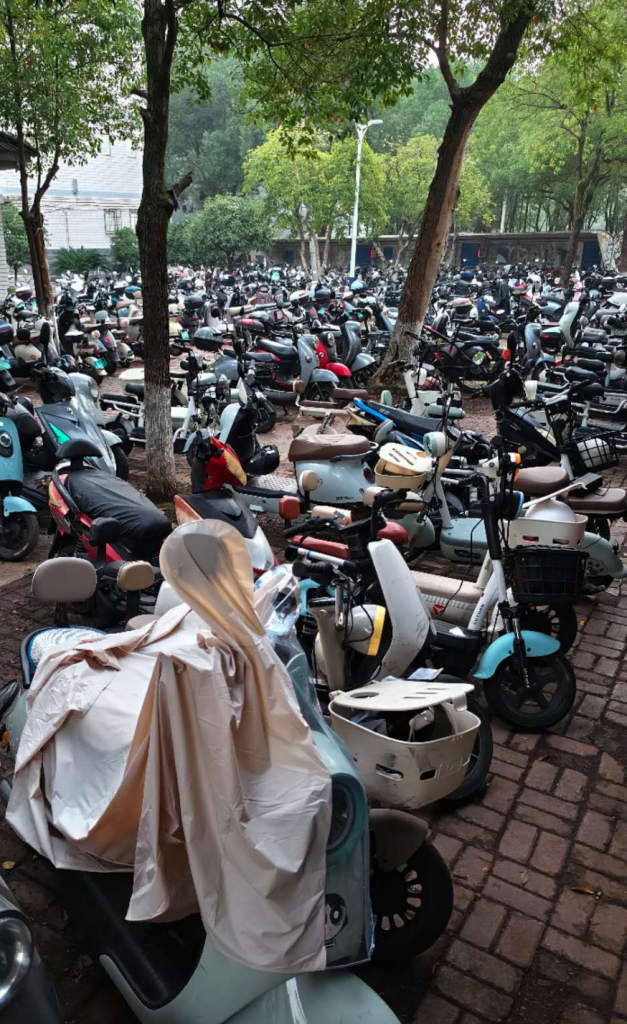
And only the stranger is surprised that there seem to be so few accidents — after all, the photo was taken at a time when there is relatively little traffic and students are crossing from one campus of my university to the campus on the opposite side.

Self-regulation instead of rule-following: sure, there are cameras everywhere, but police officers are rarely seen. These are small cultural differences, we often don’t recognise if we are “in the middle of it”; many years ago, my Irish students pointed out to me — we were evaluating a study trip to Germany.
In Germany, all police officers are armed; in Ireland, they do not carry weapons.
It was only then that I realised what I had always known but tacitly accepted and, as it were, suppressed — the Irish students noticed this immediately as the situation in Ireland had been different — it’s true, travelling broadens the mind and often reveals the small differences. Those who are attentive then ask big questions: the question is not so much how much order is necessary, but how it is achieved. And in what way disorder also has something orderly and organising about it.
Culture Tour — Lost in Time and Space
The village, my village, det smukke by Møgeltønder: about 1,000 inhabitants, and somehow amazing how quiet it is: walking along the main street, you rarely meet anyone, although somehow everyone seems to know everyone else, direct contact is limited to the five neighbouring houses.
The train station — I have to go to Suzhou in order to give a lecture:
Law — Loosing the Role of Being the Great Equaliser
The walk through the waiting area is probably as long as the main street in my village. At 6 o’clock in the morning, it’s quiet here too… relatively speaking. Size does matter, even if it is often overestimated, because after all, some cities ‘over there’ also have several million inhabitants.
A man in the station concourse is practising Tai Chi: calm, balance, harmony… not only in the dance, but also in the clean station concourse.
****
Size matters: the evening before, I had to deal with the supercomputer. These are dimensions that are difficult to grasp. This is no longer a comparison between a mobile phone and the old Siemens computer; this is about something else:
• two buildings with a total floor space of 27,000 square meters
• a storage capacity of 20 petabytes, and a peak power consumption of 8 megawatts; a peak performance of 1.342 petaflops
• the world’s fastest supercomputer from November 2010 to November 2011 The Tianhe-1A system used a heterogeneous architecture combining CPUs and GPUs, with 7,168 NVIDIA Tesla M2050 GPUs and 14,336 CPUs
• The National Supercomputing Center in Changsha is part of a national network of six centers, including those in Tianjin, Jinan, Guangzhou, Shenzhen, and Wuxi, each focusing on different research domains and leveraging unique networking and resource advantages
• The center’s development aligns with China’s long-term strategy to advance high-performance computing, as outlined in the National Medium- and Long-Term Science and Technology Development Plan (2006–2020) and the “863 major projects” during the Eleventh Five-Year Plan period
• a wide range of high-performance computing (HPC) applications, including *weather forecasting, climate prediction, ocean environment simulation, aerospace engineering, and remote sensing data processing. It also serves critical roles in **biomedical research, genetic technology, materials science, energy, and computational chemistry*.
Then I walk along the little path, wanting to use the time to gather my thoughts: a narrow trail… The path turns slightly to the right; halfway there is a wooden gate, a little rickety, but the big dog looks rather inviting, and a sign invites to take a break… Yes, a coffee would be nice. The place has something enchanted, hyggelig as we say at home.
****
• Size matters… Shortly before the train departs, I go to the toilet – unisex and accessible for disabled people; but also for tall and short people, because even the little ones need to go sometimes.
Automatic ticket inspection
1.HERRMANN PETER, train No.G1778, departure at 07:24 on 11 November 2025 from 长沙南站(Changshanan) to 苏州北站(Suzhoubei), Seat No.012D in Coach 13. The ticket price is RMB470.00
• 7:21 — a soft beep, the doors close
• 7:22 the train starts moving
• 7:26 — cruising speed is reached, 305 km/h, until shortly before MiLuoDong, the first stop.
Culture tour — To The Provinces In Europe
Province — using this term is often perceived as an affront. But perhaps that will change and people will look longingly back to the real world, where life was simply more comfortable?
Consumo ergo sum — I consume, therefore I am. It is probably a global trend, even though consumption still varies greatly in terms of quantity and significance.
Perhaps something else is more significant for the local culture in Europe, not least in view of the discussions there — must we talk about a new world order? But first, let’s go to the shopping mall: more or less new, modern, spacious — and a mixture of “clearly structured” and “an invitation to get lost”.
It is a kind of adventure park with shopping facilities — already a long way from what can be seen in Europe. What is on offer in such shopping mall? Various car companies offering their ‘space labs for the road’, IKEA with a new concept, not as an outlet on a greenfield site; the purchase of an accessory for a recently purchased mobile phone fails:
We don’t have it.
I point to the boxes, take one, but find that it is empty.
It can only be ordered on the internet.
Is it the bonus of being somewhat exotic, the effect of the stranger or general friendliness — the young sales assistant helps me. Later, I quickly buy a pair of trousers and a jumper: the goods are to be placed on a special ‘box’ — I want to take them out and scan them.
No, leave them there.
Everything is listed on a display, I just have to confirm that there are two items, then I am asked if I have a membership card, select the payment method, hold my phone up to the scanner —…
… pling …
I take the underground back to the university, three stops away.
No sooner have I arrived at the office than I receive a message that the parcel has been prepared, followed by another message the next morning:
[长沙市]快件离开 【长沙长安转运中心】,已在发往 【长沙岳麓左家垅店】 的路上
[Changsha City] Parcel dispatched from [Changsha Chang’an Transfer Centre], en route to [Changsha Yuelu Zuojialong Branch].
About an hour later, there’s a knock at the door… —
…and a little later again: Long, a student who helps me with a few things. It’s about some orders I want to place on the internet. I had already looked at the items online. Long takes photos of them, various offers appear on the sales website (similar to Amazon), and the orders are placed…
Later I want to get some fresh air and buy some fruit. Another shopping centre — quite normal, like Kvikly at home, just a little bigger; the way there takes me past countless small businesses: ‘repairing everything that can be repaired if you have imagination and skill as tools’; countless small ‘finger food restaurants’. In the grocery shop: unimaginably low prices — only my beloved cheese… — Milkana processed cheese slices individually wrapped in multiple layers of plastic film, at least named cheese, available at an exorbitant price.
The pedestrian way to and fro is a kind of slalom course: a multitude of e-scooters delivering food — it seems that all the small shops are connected to the delivery system, and the mentality seems to be: ‘delivered is better than cooked’. Though this is one side only as the valuation of good food, enjoyed with friends, classmates or colleagues is still highly valued.
And what remains for me — apart from a certain fascination with technology? The economist’s question of how to understand the reorganisation of the economic world. Technical progress and digitalisation have at least a different everyday meaning here — something that takes some time to get used to when coming from a cosy village in the south of Denmark but also very different from today’s European cities; perhaps it is a ‘new cosiness’ and perhaps also a new way of working that needs to be examined more closely. — The more or less less posh car I ordered in the evening via WeChat to visit a friend (a kind of Uber service) doesn’t make me think about a precarious job, at least for now.
Culture tour – Greetings from afar.
A break, leaving the office for a short walk across the campus, around the small pond in front of my office building, my thoughts lost in life between worlds – a privilege not to be here on holiday. Music is coming from one of the nearby buildings, I look through the door: dance performances. A notice that I struggle to decipher:
2025 Celebration of the diamond and golden anniversary of Central South University and inauguration of the branch of the National Open University for the Elderly, as well as cultural performances for the Double Ninth Festival
The dances help me understand what I recently learned in theory while studying Confucius: harmony is very important here, and it is not least about being in tune with nature

— easier to understand in dance than in a textbook. The performances are a combination of dances and a film projection in the background: scenes of nature, matchine the movement of the dance and the dance matching the movement of nature. This is surely very different to what some Europeans think when they hear harmony.
On the way back to the office, I chat with Tian, a student — chat = sending messages back and forth; I still haven’t quite got used to this excessive use of these stupid smartphones. The topic is the Double Ninth Festival — off the cuff, references are made to texts from Chinese classics, such as Han Yu.
This classic text is part of the standard curriculum in Chinese secondary schools, and virtually all students have to learn it and memorise it.
Studying music was part of the curriculum of my students when I taught economics here. — No glorification, I know the pressure to perform here … but I also repeatedly experience the ‘calm’ side of this often noisy country.
A United Europe … an ambition that has a long tradition, characterised by ups and downs
(scroll down for Dansk [machine translation], Deutsch, Français, Italiano)
One could also use a different wording as the ambition had not been solely and perhaps not even primarily led by the idea of global peace. Today we must remember the critique that had been frequently brought forward: a Fortress Europe, striving for competitiveness, directed against and profiting from the “others”.
For some time, we got used to a process of enlargement and – if taken optimistically – strengthened unity …. making us forget the conflicts linked to countries and regions as Republic of Ireland/United Kingdom of Great Britain and Northern Ireland; Spain/Catalonia/Basque Provinces, Italy/South Tyrol/Mezzogiorno and others.
The Memorial Stone in front of the house Sønderbyvej 3, Møgeltønder

is part of this history – commemoration and remembrance. It had been put into place on the private initiative by Peter Eskildsen Jensen – this is stated in runic script to the roadside, saying
JENSEN PLACED THE STONE IN COMMEMORATION OF THE REUNION WITH THE MOTHERLAND AFTER HALF A CENTURY OF SEPARATION
On the backside of the stone different names with the relevant historical dates are listed – reminding us of the steps of occupation, liberation, dependency, foreign rule and liberation.

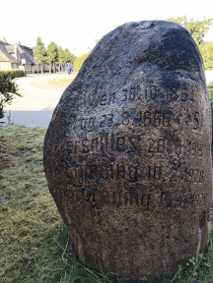
- Vienna 30.10.1864[1]
- Prague, 23.8.1866 (§ 5)[2]
- Versailles 29.6.1919[3]
- Plebiscite 10.2.1920
- Reunification 15.6.1920
History does not repeat itself. And to make sure that this remains true we must not forget, aim on learning from what happened: sovereignty does not equal nationalism; we may even say that the denial of sovereignty is one of the sources of nationalism … – closing borders again is unlikely helping us today. And as incomplete, often even highly problematic the EU is, we must treat it with care and respect.
Visit also
You may call 0045.30669969 to arrange a visit in the gallery: the collection reflects over 100 years of art history – from Chagall’s biblical visions to Peter Kurgan’s mineral landscapes.
It is also possible t arrange a visit in the small reference library with classical literature, contemporary novels and text books (philosophy, economics, law, political science and arts). Languages: English, French, German (few Italian, Chinese and Latin).
****
Dansk – maskinoversættelse
Et forenet Europa … en ambition med lange traditioner, præget af op- og nedture.
Man kunne også bruge en anden formulering, da ambitionen ikke udelukkende og måske ikke engang primært var drevet af tanken om global fred. I dag må vi huske den kritik, der ofte blev fremsat: et fæstnings-Europa, der stræber efter konkurrenceevne, rettet mod og til fordel for »de andre«.
I en periode vænnede vi os til en udvidelsesproces og – hvis man ser optimistisk på det – en styrket enhed …, der fik os til at glemme konflikterne mellem lande og regioner som Irland/Det Forenede Kongerige Storbritannien og Nordirland, Spanien/Catalonien/Baskerlandet, Italien/Sydtyrol/Mezzogiorno og andre.
Mindesten foran huset Sønderbyvej 3, Møgeltønder
er en del af denne historie – mindesmærke og erindring. Den blev rejst på privat initiativ af Peter Eskildsen Jensen – dette er angivet i runeskrift ved vejsiden, hvor der står
JENSEN REJSTE STENEN TIL MINDE OM GENFORENINGEN MED MODERLANDET EFTER ET HALVT ÅRHUNDREDES ADskillelse
På bagsiden af stenen er der forskellige navne med de relevante historiske datoer – som minder os om besættelsen, befrielsen, afhængigheden, fremmedstyret og frigørelsen.
- Wien 30.10.1864[4]
- Prag, 23.8.1866 (§ 5)[5]
- Versailles 29.6.1919[6]
- Afstemningen 10.2.1920
- Genforeningen 15.6.1920
Historien gentager sig ikke. Og for at sikre, at dette forbliver sandt, må vi ikke glemme, men stræbe efter at lære af det, der skete: suverænitet er ikke det samme som nationalisme; man kan endda sige, at fornægtelse af suverænitet er en af kildene til nationalisme … – at lukke grænserne igen vil sandsynligvis ikke hjælpe os i dag. Og selvom EU er ufuldstændig og ofte endda meget problematisk, må vi behandle den med omhu og respekt.
Visit also
****
(Uebersetzung aus dem Englischen)
Ein vereintes Europa … ein Ziel, das schon lange besteht und mit Höhen und Tiefen verbunden ist.
Man könnte dies auch anders sagen, weil die EUropäische Integration nicht nur und vielleicht nicht mal hauptsächlich von der Idee des Weltfriedens angetrieben wurde. Heute müssen wir uns an die Kritik erinnern, die oft geäußert wurde: eine Festung Europa, die nach Wettbewerbsfähigkeit strebt, sich gegen die „Anderen“ richtet und von ihnen profitiert.
Eine Zeit lang haben wir uns an einen Prozess der Erweiterung und – wenn man es optimistisch sieht – der Vertiefung der Einheit gewöhnt … und dabei die Konflikte vergessen, die in Ländern und Regionen wie der Republik Irland/dem Vereinigten Königreich Großbritannien und Nordirland, Spanien/Katalonien/den Baskenprovinzen, Italien/Südtirol/Mezzogiorno und anderen Geschichte und teils Gegenwart bestimmen.
Der Gedenkstein vor dem Haus Sønderbyvej 3 in Møgeltønder
ist Teil dieser Geschichte – Gedenken und Erinnerung. Er wurde auf private Initiative von Peter Eskildsen Jensen aufgestellt – dies ist in Runenschrift an der Straßenseite zu lesen
JENSEN STELLTE DEN STEIN ZUR ERINNERUNG AN DIE WIEDERVEREINIGUNG MIT DEM MUTTERLAND NACH EINEM HALBEN JAHRHUNDERT DER TRENNUNG
Auf der Rückseite des Steins sind verschiedene Namen mit den entsprechenden historischen Daten aufgeführt, die uns an die Etappen der Besetzung, Befreiung, Abhängigkeit, Fremdherrschaft und Wiedererlangung der Unabhängigkeit erinnern.
- Wien 30.10.1864[4]
- Prag, 23.8.1866 (§ 5)[5]
- Versailles 29.6.1919[6]
- Volksabstimmung 10.2.1920
- Einigung 15.6.1920
Die Geschichte wiederholt sich nicht. Und damit das auch so bleibt, dürfen wir nicht vergessen, müssen aus dem Geschehenen lernen: Souveränität ist nicht gleich Nationalismus; man könnte sogar sagen, dass die Verweigerung der Souveränität eine der Ursachen des Nationalismus ist … – Grenzen wieder zu schließen, wird uns heute nicht weiterhelfen. Und so unvollkommen und oft sogar problematisch die EU auch sein mag, wir müssen sie mit Sorgfalt und Respekt behandeln.
****
traduction de l’anglais
Une Europe unie… une ambition qui a une longue histoire, avec des hauts et des bas.
On pourrait même dire ça autrement, car cette ambition n’était pas seulement, et peut-être même pas principalement, motivée par l’idée de la paix mondiale. Aujourd’hui, on doit se rappeler les critiques qui ont souvent été formulées : une Europe forteresse, qui cherche à être compétitive, qui s’oppose aux « autres » et profiter de la situation des autres.
Pendant un certain temps, on s’est habitués à un processus d’élargissement et, si on voit les choses de manière optimiste, à un renforcement de l’unité… qui nous a fait oublier les conflits liés à des pays et des régions comme la République d’Irlande/le Royaume-Uni de Grande-Bretagne et d’Irlande du Nord, l’Espagne/la Catalogne/les provinces basques, l’Italie/le Tyrol du Sud/le Mezzogiorno et d’autres.
La pierre commémorative devant la maison Sønderbyvej 3, Møgeltønder
fait partie de cette histoire, de cette commémoration et de ce souvenir. Elle a été mise en place à l’initiative privée de Peter Eskildsen Jensen, comme l’indique l’inscription en runique sur le bord de la route
JENSEN A PLACÉ CETTE PIERRE EN SOUVENIR DE LA RÉUNIFICATION AVEC LA MÈRE PATRIE APRÈS UN DEMI-SIÈCLE DE SÉPARATION
Au dos de la pierre, différents noms accompagnés des dates historiques importantes sont inscrits, nous rappelant les étapes de l’occupation, de la libération, de la dépendance, de la domination étrangère et de la libération.
- Vienne, 30 octobre 1864[7]
- Prague, 23 août 1866 (§ 5)[8]
- Versailles, 29 juin 1919[9]
- Plébiscite, 10 février 1920
- Réunification, 15 juin 1920
L’histoire ne se répète pas. Et pour que ça reste vrai, on ne doit pas oublier, on doit chercher à tirer les leçons du passé : la souveraineté n’est pas synonyme de nationalisme ; on pourrait même dire que le déni de souveraineté est l’une des sources du nationalisme… Fermer à nouveau les frontières ne nous aidera pas aujourd’hui. Et même si l’UE est pas parfaite, voire souvent très problématique, on doit la traiter avec soin et respect.
Visit also
****
traduzione dall’inglese
Un’Europa unita… un’ambizione che ha una lunga storia, con alti e bassi.
Si potrebbe anche dire che l’ambizione non era solo, e forse nemmeno principalmente, guidata dall’idea della pace globale. Oggi dobbiamo ricordare le critiche che sono state spesso sollevate: un’Europa fortezza, che cerca di essere competitiva, contro gli “altri” e a loro spese.
Per un po’ ci siamo abituati a un processo di allargamento e, se lo guardiamo con ottimismo, di rafforzamento dell’unità… che ci ha fatto dimenticare i conflitti tra paesi e regioni come la Repubblica d’Irlanda/Regno Unito di Gran Bretagna e Irlanda del Nord, Spagna/Catalogna/Paesi Baschi, Italia/Alto Adige/Mezzogiorno e altri.
La lapide commemorativa davanti alla casa Sønderbyvej 3, Møgeltønder
fa parte di questa storia, di commemorazione e di ricordo. È stata messa lì su iniziativa privata di Peter Eskildsen Jensen, come dice la scritta in runico sul bordo della strada
JENSEN HA POSTO QUESTA PIETRA IN MEMORIA DELLA RIUNIONE CON LA MADRE PATRIA DOPO MEZZO SECOLO DI SEPARAZIONE
Sul retro della pietra ci sono diversi nomi con le date storiche importanti, che ci ricordano le tappe dell’occupazione, della liberazione, della dipendenza, del dominio straniero e della liberazione.
- Vienna 30.10.1864[10]
- Praga, 23.8.1866 (§ 5)[11]
- Versailles 29.6.1919[12]
- Plebiscito 10.2.1920
- Riunificazione 15.6.1920
La storia non si ripete. E per assicurarci che sia così, non dobbiamo dimenticare, ma imparare da quello che è successo: la sovranità non è nazionalismo; potremmo anche dire che negare la sovranità è una delle cause del nazionalismo… – chiudere di nuovo le frontiere non ci aiuterà molto oggi. E anche se l’UE è incompleta e spesso anche molto problematica, dobbiamo trattarla con cura e rispetto.
Visit also
[1] The Treaty of Vienna, signed on October 30, 1864, concluded the Second Schleswig War between Denmark, Prussia, and Austria. As a result of the treaty, Denmark ceded the Duchies of Schleswig, Holstein, and Lauenburg to Prussia and Austria
[2] Peace Treaty of Prague; Article 5 of the Peace Treaty ends up playing a central role for the Danish-minded Schleswigers. It says that Schleswig and Holstein must in principle be managed by Prussia, but that the northern districts of Schleswig must be reunited with Denmark if the people in these areas demand it in a free vote. Negotiations on such a vote failed as early as 1868, however – and in 1878 Germany repealed the article – https://www.kb.dk/en/inspiration/reunification/timeline.
[3] Relevant for the later plebiscite
[4] The Treaty of Vienna, signed on October 30, 1864, concluded the Second Schleswig War between Denmark, Prussia, and Austria. As a result of the treaty, Denmark ceded the Duchies of Schleswig, Holstein, and Lauenburg to Prussia and Austria
[5] Fredstraktaten i Prag; artikel 5 i fredstraktaten kommer til at spille en central rolle for de dansk-orienterede slesvigsher. Den fastslår, at Slesvig og Holsten i princippet skal administreres af Preussen, men at de nordlige distrikter i Slesvig skal genforenes med Danmark, hvis befolkningen i disse områder kræver det ved en fri afstemning. Forhandlingerne om en sådan afstemning strandede imidlertid allerede i 1868, og i 1878 ophævede Tyskland artiklen. – https://www.kb.dk/en/inspiration/reunification/timeline.
[6] Relevant for den senere folkeafstemning
[7] Le traité de Vienne, signé le 30 octobre 1864, a mis fin à la deuxième guerre du Schleswig entre le Danemark, la Prusse et l’Autriche. À la suite de ce traité, le Danemark a cédé les duchés de Schleswig, Holstein et Lauenburg à la Prusse et à l’Autriche.
[8] Traité de paix de Prague ; l’article 5 du traité de paix finit par jouer un rôle central pour les Schleswigers danois. Il stipule que le Schleswig et le Holstein doivent en principe être administrés par la Prusse, mais que les districts nord du Schleswig doivent être réunis au Danemark si la population de ces régions le demande par un vote libre. Cependant, les négociations sur un tel vote échouèrent dès 1868 et, en 1878, l’Allemagne abrogea cet article – https://www.kb.dk/en/inspiration/reunification/timeline.
[9] Pertinent pour le référendum ultérieur
[10] Il Trattato di Vienna, firmato il 30 ottobre 1864, pose fine alla seconda guerra dello Schleswig tra Danimarca, Prussia e Austria. In seguito al trattato, la Danimarca cedette i ducati di Schleswig, Holstein e Lauenburg alla Prussia e all’Austria.
[11] Trattato di pace di Praga; l’articolo 5 del trattato di pace finisce per avere un ruolo centrale per gli Schleswigesi di orientamento danese. Esso stabilisce che lo Schleswig e l’Holstein devono essere in linea di principio amministrati dalla Prussia, ma che i distretti settentrionali dello Schleswig devono essere riuniti alla Danimarca se la popolazione di queste zone lo richiede con un voto libero. I negoziati su tale voto fallirono però già nel 1868 e nel 1878 la Germania abrogò l’articolo – https://www.kb.dk/en/inspiration/reunification/timeline.
[12] Rilevante per il successivo plebiscito
Fearing for jobs?
There is so much talk about the loss of jobs — all the executives, not least the many “activists” in the field of artificial intelligence are presenting the dystopias … no jobs in the future. Why are THEY speaking of such supposedly bleak future. In fact, they show that we have a pool of new jobs that one can hardly think of an end:
- chief executive officer (CEO)
- chief strategy officer (CSO)
- chief reputation officer (CRO)
- chief operating officer (COO)
- chief financial officer (CFO)
- chief strategy officer (CSO)
- chief marketing officer (CMO)
- chief business officer (CBO)
And more and more we come across the
chief economic opportunity officer (CEOO)
If the spirit of innovation among these people should wane, I could suggest a new position:
What about a
Chief Mischief Officer??
Doesn’t all this remind us of some forms of societal leadership we know from the past: the chiefs and chiefdoms … and many had a special position: the jester.
standards
Sure, money doesn’t make happy – nevertheless it helps; if it is not helping those who earn (not deserve) it, it helps people like you and me who must understand the world, or better: who should know things that cannot be understood.
Baerbock is now in this top position that brings her according to the daily Welt 13,000 Euro per month (https://www.welt.de/politik/ausland/article256206282/annalena-baerbock-deutschland-bezahlt-ihr-gehalt-bei-den-un-so-viel-erhaelt-die-ex-ministerin.html); at the same time, Mr Merz aims on entering history books as second DOGE, suggesting strict control of social spending and even a change of social law. (https://www.welt.de/politik/deutschland/article256203762/sozialbereich-steigerungsraten-nicht-laenger-akzeptabel-merz-will-foerderungen-ueberpruefen.html) – It is worthwhile to mention that the income of Bearbock is paid from the German budget.
Is it unbelievable , faked news or just madness? Global madness that lost reality out of sight?
Mr Gates recently stated that he wants to give away 99% of his fortune:
“People will say a lot of things about me when I die, but I am determined that ‘he died rich’ will not be one of them,”
– Oh, what generous motive. Sure, fair enough; however some doubts may be raised if one reads at the same time
Giving away 99% of his fortune could still leave the fifth-richest person in the world a billionaire, according to Bloomberg (https://www.bbc.com/news/articles/cn4qg5gzgzxo)
Difficult to understand this world without becoming mad. But it’s well known, madness is always with the others and looking at all that, I believe it is true.
memories revived — United Nations
Ah no, I never made it to the United Nations highest Assembly – and you surely will find it strange that I remember right now a little episode from the days before I left Ireland and UCC. A VIP (Very Important Person) came to the Departmental Meeting, talking about the new strategy of the University College Cork. A lengthy sermon (after he managed after an equally long time to get the slide-presentation working) – answered by a lengthy sermon from my side (without slides). Here only the end is of interest – I said, sarcastically thanking him, sth like: After this critique from my side, please let me conclude: in your previous, job you advised the Irish government – and Ireland is now (I do not remember when this “theatre” he’d been staged, probably the early 2010s) in a pretty bad shape. And now you come here, advising this University. – This was followed by a telling break and an even more telling look at the presenter and the colleagues from my side.
Why do I remember this after reading that Annalena Charlotte Alma Baerbock, Germany’s former minister of foreign affairs, had been elected as President of the United Nations General Assembly?
VIPs – Very Improbable Progress
The election of Leo XIV and a forgotten message
Having lived in Rome for several years and even taught at the Pontificia Università degli Studi San Tommaso d’Aquino, I have developed a specific interest in the Catholic Church, or more precisely, in the Vatican. It is a contradictory structure: consider that access to certain ‘inner parts’ is only possible by saying a password, which is checked by members of the Swiss Guard, but on the other hand, modern public relations work is carried out through the Church’s own radio station, the use of mobile phones is a matter of course, and Pope Francis had been active on twitter. All this, and my very personal involvement in the election process of Pope Francis, are the reasons why I have been following the reporting of the last few weeks rather closely. There is at least one ‘secret message’ – perhaps not so much secret as ‘mostly overlooked’. The following quote is telling – the same holy spirit can be found in other messages from some other participants of the conclave:
Cardinal Nichols, the Archbishop of Westminster, said that his mobile phone was taken off him, adding that he found he had “more time on my hands just to be prayerful, just to reflect, just to be still, rather than being constantly agitated… or prompted by what might be coming in” on his phone.
“For me, one of the experiences of these last few days was to learn a bit of patience, to just take this step by step,” he said.
“There was a calmness, a bit of solemnity,” he continued, adding that everyone he spoke to when in it was “peaceful and just wanting to do this well”.
(https://www.bbc.com/news/articles/cz63wgxe1vlo; 11/05/2025)
How about a mobile-phone free day per week, or week per month for everybody?


 COMMEDIA DELLA VITA OR PÁNTA RÊI'S FIRM GROUND